

If you recently fell on someone else’s property, you might be asking, “Do you need to report a slip and fall accident in Florida?” The short answer is an absolute yes. Reporting the incident immediately is a critical step to protect your physical health and your legal rights.
Slip and fall accidents are surprisingly common and can lead to severe injuries, mounting medical bills, and lost wages. According to the Florida Department of Health, falls are the leading cause of injury-related hospital admissions in the state. Whether you slipped on a wet floor in a grocery store, tripped over uneven pavement, or fell due to poor lighting, taking immediate action is essential.
This comprehensive guide will walk you through the reporting requirements, the legal nuances of premises liability, and the steps you must take to build a strong personal injury claim in Florida.
Why Reporting a Slip and Fall Accident in Florida is Crucial
When you experience a slip and fall, the shock and embarrassment often make you want to leave the scene as quickly as possible. However, failing to report the incident can severely jeopardize your chances of receiving fair compensation later. Here is why reporting the accident immediately is so important.
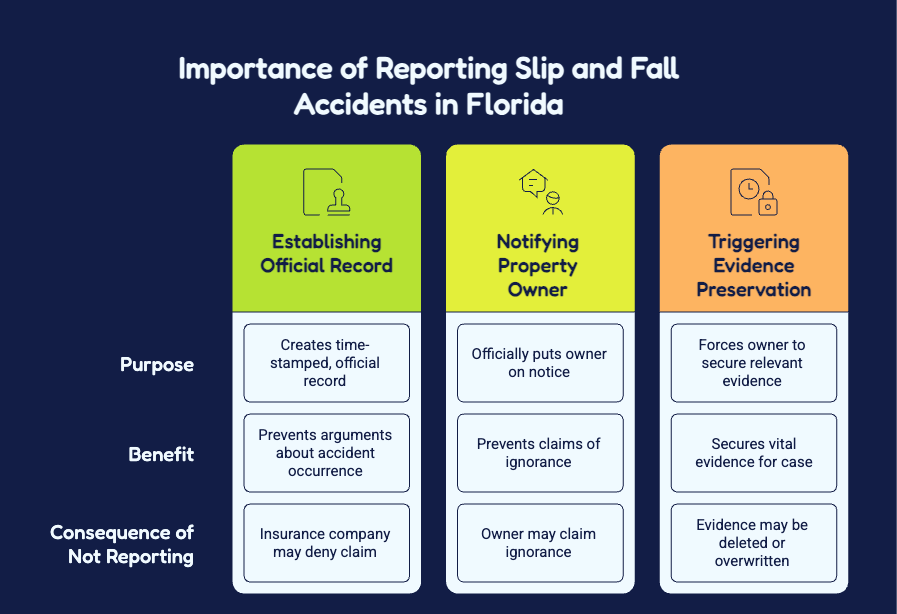
Establishing an Official Record
An official incident report serves as the foundational piece of evidence for your claim. When you report the accident to a store manager, landlord, or property owner, they are usually required to document the event.
This report creates a time-stamped, official record that the accident occurred exactly when and where you claim it did. Without this report, the property owner’s insurance company may argue that the fall never happened on their premises or that your injuries were caused by an unrelated event.
Notifying the Property Owner
In Florida, premises liability cases heavily rely on the concept of notice. To hold a property owner liable for your injuries, you must prove that they knew or should have reasonably known about the dangerous condition that caused your fall.
By reporting the accident immediately, you are officially putting them on notice. This prevents them from later claiming ignorance of the hazard or the incident itself.
Triggering the Preservation of Evidence
Once a property owner is notified of an accident, they have a legal obligation to preserve relevant evidence, such as surveillance camera footage. If you walk away without reporting the fall, the business might routinely delete or overwrite their security footage within a few days.
An official report forces them to secure this vital evidence, which could be the key to proving your case.
How to Properly Report a Slip and Fall Accident
Knowing that you need to report the accident is only half the battle; knowing how to report it correctly is equally important. Following these steps can help protect your rights and strengthen your potential claim.
Notify Management Immediately
Before you leave the scene, ask to speak with the highest-ranking employee available, such as a store manager, property supervisor, or security officer. Calmly explain that you have fallen and been injured.
Stick to the basic facts: what happened, where it happened, and what caused the fall. Avoid making detailed statements, apologizing, or admitting any fault, as these comments can be used against you later.
Request an Incident Report
Ask the manager to fill out a formal incident report. Most commercial businesses have standard procedures for this. Ensure that the report accurately reflects your account of the event.
Request a copy of the completed report before you leave. If they refuse to provide a copy, politely ask for the name and contact information of the person who took the report, as well as the report number if applicable.
Call Law Enforcement if Necessary
In most slip and fall cases on private commercial property, calling the police is not required. However, if the accident occurred on public property, involved a criminal act, or resulted in severe, life-threatening injuries where emergency medical services are dispatched, law enforcement may arrive and create an official police report.
This police report can serve as powerful, objective evidence in your favor.
Essential Steps to Take After Reporting the Accident
Reporting the incident is just the first step. To ensure you have a viable personal injury claim, you must take several other critical actions immediately following your slip and fall in Florida.
Seek Immediate Medical Attention
Your health should always be your top priority. Even if you feel fine or believe your injuries are minor, seek medical evaluation immediately. Adrenaline can mask the symptoms of severe injuries, such as traumatic brain injuries or internal bleeding.
A prompt medical examination not only ensures your well-being but also creates a vital medical record linking your injuries directly to the slip and fall accident. Delaying treatment can give insurance adjusters a reason to argue that your injuries are not serious or were caused by something else.
Document the Scene and Gather Evidence
If you are physically able, gather as much evidence from the scene as possible. Use your smartphone to take clear, wide-angle and close-up photographs of the exact location where you fell.
Photograph the hazard that caused the fall (such as a puddle, torn carpet, or broken step), and any lack of warning signs. Also, photograph your visible injuries and the clothing and shoes you were wearing.
Collect Witness Information
If anyone saw you fall, ask for their names, phone numbers, and email addresses. Independent eyewitness testimony can be incredibly persuasive in corroborating your version of events.
Witnesses can help prove that the hazardous condition existed before your accident and that the property owner failed to address it in a timely manner.
Understanding Florida Premises Liability Law
To successfully recover compensation for a slip and fall accident, you must navigate Florida’s complex premises liability laws. These laws dictate the responsibilities of property owners and the burden of proof placed on the injured party.
The Duty of Care
In Florida, property owners owe a “duty of care” to individuals legally on their premises. The extent of this duty depends on your status as a visitor. “Business invitees,” such as shoppers in a grocery store, are owed the highest duty of care.
Property owners must maintain the premises in a reasonably safe condition, regularly inspect for hazards, and promptly fix or warn visitors of any dangers.
Proving Negligence and Notice
To win a slip and fall claim, you must prove that the property owner was negligent. Specifically, under Florida Statutes Section 768.0755, if you slip and fall on a “transitory foreign substance” in a business establishment, you must prove that the business had actual or constructive knowledge of the dangerous condition.
Constructive knowledge can be proven by showing that the hazard existed for such a length of time that the owner should have discovered it through ordinary care. Alternatively, you can show that the condition occurred with regularity and was therefore foreseeable.
Florida’s Modified Comparative Fault Rule
It is crucial to understand that Florida operates under a modified comparative negligence system. This means that if you are found partially at fault for your accident, your compensation will be reduced by your percentage of fault.
Furthermore, under recent legislative changes in House Bill 837, if you are found to be more than 50% responsible for the accident, you are barred from recovering any compensation at all. This makes gathering strong evidence and hiring skilled legal representation more important than ever.
The Florida Statute of Limitations for Slip and Fall Claims
Time is of the essence when it comes to filing a personal injury lawsuit in Florida. Recent changes to the law have significantly impacted the timeframe you have to take legal action.
The Two-Year Deadline
Historically, Florida allowed four years to file a negligence claim. However, following the passage of House Bill 837 in 2023, the statute of limitations for most personal injury cases, including slip and fall accidents, has been reduced to just two years from the date of the incident.
If you fail to file your lawsuit within this strict two-year window, the court will almost certainly dismiss your case, and you will lose your right to seek compensation forever. Because investigating a claim takes time, it is vital to contact an attorney well before this deadline approaches.
For more details on how these deadlines work, you can review our guide on How to Start a Personal Injury Claim in Florida: A Step-by-Step Guide.
Common Challenges in Florida Slip and Fall Cases
Slip and fall claims are notoriously difficult to win. Insurance companies and defense attorneys will use various tactics to minimize your payout or deny your claim entirely.
Disputing the Hazard’s Existence
The defense may argue that the hazard did not exist or that it was an “open and obvious” danger that you should have easily avoided. This is why taking immediate photographs of the scene before the hazard is cleaned up or repaired is absolutely essential.
Blaming the Victim
As mentioned earlier, under Florida’s modified comparative fault rules, the defense will try to shift the blame onto you. They might claim you were wearing inappropriate footwear, running, or simply not paying attention to your surroundings.
A skilled attorney will anticipate these arguments and build a robust case to minimize your assigned fault.
Minimizing Your Injuries
Insurance adjusters often scrutinize medical records to argue that your injuries are pre-existing, exaggerated, or not related to the fall. Following your doctor’s treatment plan precisely and avoiding gaps in your medical care will help counter these tactics.
FAQ
H3: Do I have to report a slip and fall to the police in Florida?
Generally, no. Unless the accident occurred on public property or involved a severe emergency requiring immediate medical transport, a police report is not legally required for a slip and fall on private commercial property. However, you must report it to the property management.
H3: How long do I have to report a slip and fall to the property owner?
You should report the incident to the property owner or manager immediately, before leaving the scene. Delaying the report can make it much harder to prove that the accident actually occurred on their property.
H3: What if I didn’t report the slip and fall immediately?
If you left the scene without reporting the fall, you should notify the property owner in writing as soon as possible. While a delayed report can complicate your case, it does not automatically bar you from seeking compensation, especially if you have other evidence like witness statements.
H3: Can I still file a claim if there was a “Wet Floor” sign?
Yes, but it may be more difficult. A warning sign does not automatically absolve a property owner of liability, especially if the sign was poorly placed, hidden, or if the hazard was left unattended for an unreasonable amount of time. However, the defense will likely use the sign to argue comparative negligence on your part.
H3: How much is a typical slip and fall settlement in Florida?
There is no “typical” settlement amount, as compensation depends entirely on the specific facts of your case, including the severity of your injuries, your medical expenses, lost wages, and the degree of fault assigned to each party. Settlements can range widely based on the specific circumstances.
Conclusion
So, do you need to report a slip and fall accident in Florida? Absolutely. Reporting the incident immediately to the property owner or manager is a fundamental step in protecting your health and preserving your right to seek fair compensation.
From establishing an official record to triggering the preservation of crucial evidence, a prompt report lays the groundwork for a successful premises liability claim. Navigating the complexities of Florida’s premises liability laws, strict statutes of limitations, and comparative fault rules can be overwhelming, especially while you are trying to recover from serious injuries.
You do not have to face the insurance companies alone. If you or a loved one has been injured in a slip and fall accident, the experienced legal team at Pencheff and Fraley is here to help. We have a proven track record of holding negligent property owners accountable and securing maximum compensation for our clients.
Contact Pencheff and Fraley LPA Today
Contact us today for a free, no-obligation consultation. We will review your case, answer your questions, and explain your legal options. Learn how we can help you on the road to recovery. Pay nothing unless we win your case.
Call us at 904-770-4953 or visit our website at www.pencheffandfraley.com to schedule your free case consultation.
We’re Here for You 24/7
We are available 24/7 to take your call. If you are unable to travel, we will come to you. The sooner you call, the stronger your case can be. Your path to maximum compensation and justice starts with a single phone call to Pencheff & Fraley.
Author: Pencheff and Fraley Legal Team
Disclaimer: This article is for informational purposes only and does not constitute legal advice. Every case is unique, and you should consult with a qualified attorney about your specific situation.
Contact Pencheff and Fraley today for a free, no-obligation consultation to discuss your case and explore your legal options. You can also learn more about the legal process by reading our guide on How to Switch Personal Injury Lawyers in Florida?.