

Uninsured Driver Accident Lawyer Jacksonville FL
If you need an uninsured driver accident lawyer in Jacksonville, FL, you may still have options after a crash. Florida’s no-fault system may provide initial benefits through Personal Injury Protection (PIP). Your own uninsured/underinsured motorist coverage may also respond. Other insurance policies or a claim against responsible parties may matter too. The firm’s personal injury practice includes accident-related representation.
The first steps are important. Report the collision, seek medical care, preserve evidence, and notify the right insurers. Do not sign a release before you understand your coverage and damages. A Jacksonville personal injury lawyer can review the crash, your policy, and the available recovery sources.
Important: This article provides general information, not legal advice. Insurance policies and deadlines vary. Talk with a Florida attorney about your specific facts.
What to do after an uninsured-driver crash in Jacksonville
A collision with an uninsured driver creates two separate problems. You must prove how the crash happened. You must also identify a source of payment for your injuries and losses.
Use this checklist if you are physically able:
- Call 911 when required. Florida requires law-enforcement notification for crashes involving an injury, death, hit-and-run, suspected DUI, a commercial vehicle, a vehicle that needs towing, or apparent damage of at least $500. The Florida Highway Safety and Motor Vehicles crash-report guidance lists these reporting situations.
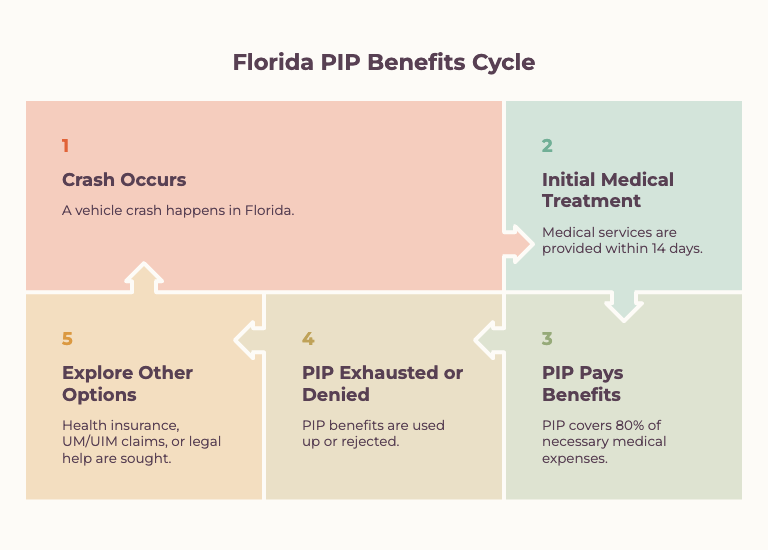
- Get medical attention. Florida PIP benefits generally depend on receiving initial services within 14 days. Emergency symptoms require emergency care, not a wait for an insurance decision.
- Photograph the scene. Capture the vehicles, license plates, roadway, traffic controls, debris, skid marks, weather, and visible injuries.
- Collect contact information. Get names, phone numbers, driver-license details, vehicle information, and witness contacts when safe.
- Avoid admissions. Give factual information to responding officers. Do not guess about speed, fault, or the extent of an injury.
- Notify your insurers promptly. Report the crash under the policy’s notice requirements. Ask how to preserve PIP, collision, medical-payments, and UM/UIM benefits.
- Save every record. Keep the crash report, medical bills, employment records, photographs, repair estimates, claim letters, and policy documents.
- Get legal advice before releasing claims. A signed release can affect your insurer’s subrogation rights and your remaining claims.
For a longer Florida checklist, see the firm’s guide on what to do after a car accident in Florida.
Why an uninsured driver changes a Jacksonville injury claim
In a typical insured-driver claim, an injured person may pursue the at-fault driver’s bodily-injury liability insurer. An uninsured driver may have no liability policy to pay that claim. The driver may also have few assets.
That does not automatically end the case. The claim may involve your PIP benefits, UM/UIM coverage, health insurance, medical-payments coverage, collision coverage, or other policies. The exact answer depends on who was insured, which vehicle was involved, and what each policy says.
A lawyer should investigate more than the other driver’s insurance card. The driver may have given incorrect information. A policy may have lapsed. The vehicle owner may differ from the driver. Another household policy may provide coverage. A hit-and-run may qualify as an uninsured-motorist event if the policy and evidence satisfy Florida requirements.
Uninsured versus underinsured driver
An uninsured driver has no available bodily-injury liability coverage, or the insurer cannot pay within its limits. An underinsured driver has coverage, but the limits are not enough to cover the injured person’s damages.
Florida Statutes § 627.727 treats some underinsured situations as uninsured-motorist situations. It also addresses claims involving an insolvent insurer and certain coverage exclusions. Read the current Florida uninsured-motorist statute with counsel because policy language and claim facts matter.
Hit-and-run crashes can raise the same coverage questions
A driver who leaves the scene may be unidentified. That makes evidence especially important. Report the crash immediately and ask whether nearby businesses, homes, traffic systems, or vehicles may have captured video.
Do not assume an unidentified driver is covered under every UM policy. Policies may require proof of physical contact or other facts. Your attorney can review the policy, crash report, witness evidence, and available video.
Florida PIP: the first layer of medical protection
Florida requires registered vehicles to carry at least $10,000 in PIP and $10,000 in property-damage liability coverage. The FLHSMV insurance requirements page explains that PIP pays 80% of necessary and reasonable medical expenses up to the applicable limit, regardless of who caused the crash.
PIP is not a substitute for a full injury claim. It does not automatically pay all medical bills. It also does not fully compensate pain, disability, lost earning capacity, or other damages. The policy, medical findings, and statutory requirements control.
The Florida 14-day treatment rule
Florida Statutes § 627.736 generally requires initial medical services within 14 days after the crash for PIP medical benefits. The statute also distinguishes emergency medical conditions from non-emergency conditions. The available benefit can depend on the provider’s findings and the type of treatment.
Read the current text of Florida Statutes § 627.736. If you have symptoms, do not delay care while trying to determine who was at fault.
PIP does not decide fault
PIP is designed to provide first-party benefits. The insurer may pay eligible benefits even when another driver caused the collision. A later UM/UIM claim can involve different questions, such as negligence, injury severity, policy limits, exclusions, and damages.
Keep copies of every explanation of benefits and payment record. A PIP payment can affect the accounting of your claim, but it does not necessarily answer what your total case is worth.
What if PIP is exhausted or denied?
Ask the insurer for a written explanation. Review the denial, medical records, treatment dates, and policy language. Health insurance, medical-payments coverage, provider arrangements, and a UM/UIM claim may become relevant.
Do not ignore unpaid bills. Tell providers about the crash and preserve itemized statements. A lawyer can help identify liens, subrogation claims, and payment sources before settlement discussions.
How uninsured-motorist coverage may help
Uninsured-motorist coverage, often called UM coverage, protects insured people who are legally entitled to recover damages from an uninsured motorist because of bodily injury, sickness, disease, or death. Florida law generally requires UM coverage to be offered with bodily-injury liability coverage. A named insured may reject it or select lower limits in writing.
This distinction matters. A policy may show that UM coverage was rejected, reduced, or limited. The rejection form, declarations page, renewal documents, and policy endorsements should be reviewed together.
Check the declarations page and endorsements
Ask for the complete policy, not only a summary page. Look for:
- UM or UIM limits, shown per person and per accident.
- Whether coverage is stacked or non-stacked.
- Vehicles listed on the policy.
- Named insureds and resident relatives.
- Exclusions for owned, borrowed, rented, or employer-provided vehicles.
- Notice requirements after a crash.
- Consent-to-settle provisions.
- Arbitration provisions.
- Medical-payment or collision coverage.
The declarations page is a starting point. It is not always the entire contract.
Stacked and non-stacked UM coverage
Florida law allows insurers to offer policies with limits that are not added together across vehicles. The statute also describes how those limitations can affect coverage when a person occupies a vehicle or is a pedestrian.
A simple example shows why the wording matters. A household may have two vehicles with $50,000 of UM limits. A stacked policy and a non-stacked policy may not provide the same available limit. The result can also change based on the vehicle occupied and the insured person’s status.
Do not rely on a general online explanation. Ask an attorney to interpret the policy that existed on the date of the crash.
UM coverage is not automatically “free money”
The injured person usually must prove the other driver’s fault and the value of the injury claim. The insurer may dispute liability, causation, treatment, permanency, or damages. Your own insurer can become an adverse party in the claim even though you pay premiums to that company.
A claim may require medical records, expert opinions, witness testimony, crash reconstruction, or litigation. The insurer’s duty is defined by the contract and Florida law, not by a promise to pay every bill.
How to prove fault when the other driver has no insurance
Insurance coverage does not replace proof. A strong claim connects the driver’s conduct to the crash, the crash to the injury, and the injury to documented losses.
Evidence from the crash scene
Preserve photos and video in their original form. Keep metadata when possible. Photograph lane markings, signs, signals, lighting, road defects, debris, and vehicle positions.
Ask witnesses for permission to contact them later. Write down what you remember before details change. Do not edit or enhance the only copy of a photograph.
Official reports and records
The Florida Crash Portal is the state system for obtaining crash reports. FLHSMV says reports can take up to 10 days to become available. Online reports cost $10 per report, plus a transaction convenience fee.
The Jacksonville Sheriff’s Office crash-report page explains that certain minor crashes may be self-reported. It also states that a driver must self-report within 10 days when the crash meets the applicable criteria.
If you need the other driver’s insurance information, FLHSMV explains that a person involved in the crash, the person’s attorney, or an insurer representative may request it. The agency lists an insurance-request form and requires a complete crash report or self-report.
Digital and physical evidence
Potential evidence can include:
- Dashcam and doorbell-camera footage.
- Nearby business or traffic-camera video.
- Vehicle event-data information.
- Cellphone or telematics records when legally obtainable.
- Photographs of damage and roadway conditions.
- Witness statements.
- Dispatch records and 911 calls.
- Medical records and diagnostic imaging.
- Employer records and disability documentation.
- Vehicle repair and total-loss records.
Video may be overwritten quickly. A lawyer can send preservation requests when appropriate.
Medical evidence and delayed symptoms
Some injuries become more obvious after the initial shock fades. A medical evaluation creates a record of symptoms, diagnoses, restrictions, and treatment recommendations.
Follow the treatment plan. Tell providers about prior injuries accurately. Do not hide a preexisting condition. Florida law can still permit recovery when a crash aggravates an earlier condition, but medical proof is essential.
What compensation may be available
A Jacksonville uninsured-driver claim can involve several categories of loss. The available recovery depends on the policy, the evidence, the injury, and Florida law.
Economic damages
Economic damages are financial losses supported by records. They may include:
- Medical treatment already received.
- Reasonably expected future medical care.
- Prescription medication and medical equipment.
- Physical rehabilitation and therapy.
- Lost wages and reduced work capacity.
- Property damage and transportation costs.
- Household services made necessary by the injury.
Save bills, receipts, pay records, tax documents, and mileage logs. Self-employed and gig workers may need contracts, invoices, tax returns, and bank records.
Non-economic damages
Non-economic damages may include physical pain, emotional distress, disfigurement, disability, loss of enjoyment, and loss of consortium. These damages are personal and fact-specific.
Medical records help explain the injury. A daily symptom journal can also document functional limits. Keep entries factual and consistent. Do not exaggerate symptoms.
Wrongful-death damages
When a crash causes death, the personal representative and surviving family members may have claims under Florida’s wrongful-death statutes. The available damages and deadlines differ from an injury claim.
If a family member died in a Jacksonville crash, get legal advice quickly. Preserve funeral records, medical records, employment information, insurance policies, and evidence from the scene.
Property damage is separate from bodily injury
A UM claim usually focuses on bodily injury. Vehicle repair, total-loss, rental, and diminished-value issues may involve collision coverage, PDL, or another claim.
Do not sign a broad release covering property damage before understanding whether it also affects injury claims. Read every release carefully.
Florida deadlines after an uninsured-driver accident
Florida Statutes § 95.11 generally provides a two-year limitations period for an action founded on negligence. The same statute lists a two-year period for wrongful-death actions. The exact rule can depend on the claim, the date, exceptions, and the defendant.
The current Florida limitations statute should be reviewed with a lawyer. Do not treat a blog summary as a case-specific deadline.
Your insurance policy may impose separate notice, proof-of-loss, arbitration, or cooperation requirements. An underinsured-motorist settlement can also require written notice to the UM insurer before settling with the at-fault driver’s insurer. Florida Statutes § 627.727 describes a 30-day process for certain proposed settlements.
Why early notice matters
Early notice helps preserve evidence and avoids preventable coverage disputes. It also gives counsel time to identify all policies and responsible parties.
Do not wait until the limitations period is close. A lawyer needs time to investigate, obtain records, analyze coverage, negotiate, and file suit if necessary.
What an uninsured-driver accident lawyer does
A lawyer’s work should be specific to the facts, not limited to sending a demand letter. A car accident lawyer can investigate the collision, review available coverage, and prepare the claim. The investigation may include the following steps:
- Review the crash. Analyze reports, photographs, witnesses, citations, video, and physical evidence.
- Identify coverage. Review your declarations pages, endorsements, household policies, vehicle ownership, and possible employer or rideshare coverage.
- Protect benefits. Coordinate PIP, medical-payment, health-insurance, collision, and UM/UIM claims.
- Document injuries. Gather medical records, bills, restrictions, lost-wage proof, and future-care opinions.
- Calculate damages. Separate past losses, future losses, non-economic harm, and liens or subrogation claims.
- Handle insurers. Respond to requests, challenge improper denials, and avoid premature releases.
- Prepare for litigation. Preserve evidence, file within applicable deadlines, and build a trial-ready case when needed.
For a related overview of legal representation after a collision, read the firm’s guide to what to do after a car accident that was not your fault.
How to choose a personal injury lawyer in Jacksonville
Choosing a lawyer is not only about a large settlement number. You need a firm that understands Florida insurance law, explains risk clearly, and can handle a disputed UM/UIM claim.
How to choose a personal injury lawyer: a practical checklist
Look for:
- Experience with Florida car-accident and UM/UIM claims.
- A clear explanation of PIP, policy limits, and settlement risks.
- A record of preparing cases for litigation.
- Direct attorney access and a defined communication process.
- Transparent contingency-fee and case-cost terms.
- A local presence or practical access for Jacksonville clients.
- A willingness to investigate coverage beyond the other driver’s policy.
- Written answers about conflicts, releases, liens, and insurer communications.
Review independent information. Ask the lawyer to explain what the firm can verify, what remains uncertain, and what evidence would change the analysis.
Best accident lawyer questions to ask
Bring these questions to your consultation:
- Have you handled uninsured or underinsured motorist claims in Florida?
- What policies should we investigate besides the other driver’s policy?
- Does my policy appear stacked or non-stacked?
- What deadlines apply to my injury claim and insurance claim?
- What should I say to my insurer, and what should I avoid saying?
- How will you prove fault and connect the crash to my injuries?
- How are medical bills, liens, and subrogation handled?
- What fees and case costs apply if the case settles or goes to trial?
- Who will handle day-to-day communication?
- What evidence should I preserve today?
The right lawyer should welcome specific questions. You should leave with a clear next-step list.
Common mistakes that can weaken a UM claim
Uninsured-driver claims often fail because evidence or coverage rights are lost early. Avoid these mistakes:
Waiting to report the crash
A delay can make it harder to locate the driver, request video, or preserve witness memories. Report the collision and keep confirmation of every notice.
Assuming the other driver has no insurance
Verify coverage through the crash report, insurer correspondence, and official requests. A driver’s statement is not conclusive.
Failing to read your own policy
Many people search only for the other driver’s policy. Your own declarations page may be the most important document in the case.
Giving an unprepared recorded statement
Answer required questions truthfully. Do not guess or speculate. Ask whether a recorded statement is required by your policy. Consider legal advice before providing one to an insurer that may dispute your claim.
Accepting a quick settlement
A release may close the claim before the full injury and future-care picture is known. Do not sign before reviewing the amount, scope, liens, and policy rights.
Posting claim details online
Social-media posts can be taken out of context. Avoid posting about the crash, your injuries, treatment, or activities while the claim is active.
For a broader checklist, see 12 common mistakes that can ruin a car accident claim.
Jacksonville-specific evidence and local considerations
Jacksonville spans a large geographic area. A crash on I-95 may produce different evidence from one near a neighborhood intersection, a commercial corridor, or a construction zone.
Record the precise location. Note the nearest cross street, direction of travel, lane, traffic control, weather, lighting, and nearby businesses. Local details can help an investigator identify video sources and witnesses.
The Jacksonville Sheriff’s Office provides resources for crash reporting and public-records requests. FLHSMV maintains the state crash-report portal. Use official sources rather than relying on an unverified social-media post or a third-party crash summary.
A local lawyer may also evaluate issues involving rideshare vehicles, commercial vehicles, road maintenance, employer liability, or a defective vehicle part. Those issues can create different insurance and notice rules.
When another vehicle is a rideshare or commercial vehicle
Ask whether the driver was working, transporting a passenger, making deliveries, or operating a company vehicle. Rideshare and commercial policies may apply differently from personal auto coverage.
Preserve screenshots, trip receipts, employer information, vehicle markings, and witness details. Tell your lawyer if a commercial vehicle or rideshare app was involved.
When a road condition may have contributed
A missing sign, malfunctioning signal, construction hazard, or roadway defect may require a different investigation. Claims against government entities may have special notice rules and limitations.
Do not assume the driver is the only possible responsible party. Preserve photos of the roadway before conditions change.
Frequently Asked Questions
Can I recover money if the driver who hit me had no insurance?
Possibly. Recovery may involve your PIP, UM/UIM, medical-payments, collision, health-insurance, or another available policy. You may also have a claim against the driver or another responsible party. The answer depends on coverage, fault, injury evidence, and Florida law.
Should I notify my insurance company after an uninsured-driver crash?
Usually, yes. Your policy may require prompt notice even when you did not cause the crash. Notify the insurer with basic facts and preserve the claim number. Ask for a copy of the declarations page and policy. Consider legal advice before giving a recorded statement or signing a release.
Does Florida require uninsured-motorist coverage?
Florida generally requires an insurer to offer UM coverage with a bodily-injury liability policy. A named insured may reject the coverage or choose lower limits in writing. The written rejection or selection form and policy documents matter. Read Florida Statutes § 627.727 for the current statutory framework.
What is the difference between uninsured and underinsured motorist coverage?
Uninsured coverage applies when the responsible driver has no available liability coverage, subject to the policy. Underinsured coverage may apply when the driver has insurance, but the available limits do not cover the full damages. Florida law contains special settlement-notice rules for certain underinsured claims.
Can I use PIP if the other driver was uninsured?
PIP generally applies regardless of who caused the crash, subject to the policy and statutory requirements. Florida law generally requires initial medical services within 14 days for PIP medical benefits. See § 627.736 and seek medical care promptly.
What if the uninsured driver fled the scene?
Call 911 and report the hit-and-run. Seek medical care and document the scene. Look for witnesses, video, debris, vehicle fragments, and any description of the vehicle. Whether your UM coverage applies can depend on policy language and proof of contact or identification.
How do I get a Jacksonville crash report?
FLHSMV says crash reports can be purchased through the Florida Crash Portal after they become available. Reports may take up to 10 days. The Jacksonville Sheriff’s Office directs drivers to the state reporting system for eligible self-reports. Keep the report, receipt, and claim correspondence together.
How long do I have to file a Jacksonville car-accident lawsuit?
Florida Statutes § 95.11 generally lists two years for negligence actions and wrongful-death actions. Exceptions and different claims may have different rules. Insurance policies may also contain notice or arbitration deadlines. Get case-specific advice before relying on a deadline summary.
How much is an uninsured-driver accident claim worth?
There is no reliable average for an individual claim. Value depends on fault, injury severity, treatment, permanency, lost income, policy limits, available coverage, comparative fault, liens, and proof. A lawyer should review the evidence and policy before estimating a range.
Should I accept a settlement from my insurer?
Do not accept a settlement before you understand the release, remaining treatment, future losses, policy limits, liens, and any consent-to-settle requirement. A quick payment may not reflect the full value of a serious injury claim.
How much does an uninsured-motorist lawyer cost in Jacksonville?
Many personal injury firms use contingency fees, but the percentage, costs, and case expenses vary. Ask for the fee agreement in writing. Pencheff & Fraley’s Jacksonville pages describe free consultations and no-fee-unless-recovery representation. Confirm the current terms during your consultation.
What should I bring to a free consultation?
Bring the crash report, photographs, medical records, bills, insurance cards, declarations pages, claim letters, wage records, witness information, repair estimates, and a timeline of events. If you do not have everything, schedule the consultation anyway. The firm can explain what to obtain next.
Contact a Jacksonville uninsured-driver accident lawyer
An uninsured-driver crash can leave you fighting both an injury and an insurance problem. The right evidence and policy review can make a major difference. Do not wait to report the crash, seek treatment, or preserve your coverage rights.
Pencheff & Fraley represents injury clients in Jacksonville and offers a free consultation through its Jacksonville personal injury office page. You can also review the firm’s guide to choosing a personal injury attorney in Jacksonville and its Jacksonville personal injury attorney resource before your consultation.
If you are ready to discuss your case, contact Pencheff & Fraley and provide the basic facts. Do not include sensitive medical or financial information in a public comment.
References
- Florida Highway Safety and Motor Vehicles: Florida Insurance Requirements
- Florida Highway Safety and Motor Vehicles: Involved in a Crash?
- Florida Highway Safety and Motor Vehicles: Traffic Crash Reports
- Florida Department of Financial Services: Personal Automobile Insurance Overview
- Florida Statutes § 627.727: Uninsured and underinsured vehicle coverage
- Florida Statutes § 627.736: Required personal injury protection benefits
- Florida Statutes § 95.11: Limitations other than recovery of real property
- Jacksonville Sheriff’s Office: Driver Self Report of a Traffic Crash
- Pencheff & Fraley: What to Do After a Car Accident in Florida
- Pencheff & Fraley: What to Do After a Car Accident That’s Not Your Fault
- Pencheff & Fraley: Car Accident Settlement Factors
- Pencheff & Fraley: Common Mistakes That Can Ruin Your Car Accident Claim
*Attorney advertising. This page is for general information and does not create an attorney-client relationship. Prior results do not guarantee a similar outcome. *
Website disclaimer: This website contains attorney advertising and is intended for informational purposes. It is not formal legal advice and does not create an attorney-client relationship. Prior results do not guarantee a similar outcome. Every claim is different.This article is intended for general informational purposes only and does not constitute legal advice. Laws change, and the information above may not reflect the most recent legal developments.
Please contact a qualified Florida personal injury attorney to discuss the specific facts of your case.
Author: Pencheff & Fraley Legal Team