

Who Is Liable in a Slip and Fall Accident?
When you slip, fall, and sustain an injury on someone else’s property, determining who is liable in a slip and fall accident becomes your most pressing concern. A sudden fall can result in severe injuries, mounting medical bills, and lost wages. Understanding your legal rights and the concept of premises liability is crucial for securing the compensation you deserve. In this comprehensive guide, we will explore the key elements of slip and fall liability, identify potentially responsible parties, and explain how to prove negligence under Ohio and Florida law.
Understanding Premises Liability Law
Premises liability is the legal framework that holds property owners and occupiers accountable for accidents that occur on their property. This area of personal injury law dictates that individuals or entities in control of a property have a duty to maintain a safe environment for visitors. When they fail to meet this obligation, and a visitor is injured due to a hazardous condition, the property owner may be held liable for damages.
In a premises liability case, the core issue is negligence. Property owners must take reasonable steps to discover and fix dangerous conditions or provide adequate warnings. However, the level of care owed to a visitor depends significantly on the visitor’s legal status at the time of the accident.
Visitor Status: Invitee, Licensee, or Trespasser
The legal duty owed by a property owner varies based on why the injured person was on the property. Courts generally categorize visitors into three main groups:
- Invitees: These are individuals invited onto the property for a business purpose, such as customers in a retail store or clients in an office. Property owners owe the highest duty of care to invitees, requiring regular inspections to identify and resolve hazards.
- Licensees: These individuals enter the property for their own purposes or as social guests, with the owner’s permission. The owner has a duty to warn licensees of known dangerous conditions but typically is not required to inspect the property for hidden hazards.
- Trespassers: People who enter the property without permission or legal right are trespassers. Generally, property owners owe no duty of care to trespassers, except to refrain from intentionally causing them harm.
Key Elements to Prove in a Slip and Fall Case
To successfully pursue a personal injury claim and prove who is liable in a slip and fall accident, you must establish four critical elements of negligence. Without these, your claim may not succeed in court or during settlement negotiations.
1. Duty of Care
First, you must demonstrate that the defendant owed you a legal duty of care. As discussed above, this usually depends on your status as an invitee or licensee. If you were a customer at a grocery store, the store owner clearly owed you a duty to keep the aisles safe and free of slipping hazards.
2. Breach of Duty
Next, you must prove that the property owner breached their duty of care. This means showing that the owner knew or should have known about the dangerous condition but failed to take reasonable action to fix it or warn visitors. For example, if a spill was left on a supermarket floor for hours without a warning sign, the store breached its duty.
3. Causation
The third element is causation. You must establish a direct link between the property owner’s breach of duty and your accident. It is not enough that a hazard existed; you must prove that the specific hazard caused your slip and fall. Medical records and accident reports are vital for proving causation.
4. Damages
Finally, you must show that you suffered actual damages as a result of the fall. Damages can include medical expenses, lost income, pain and suffering, and rehabilitation costs. If you fell but were not injured, you do not have a valid personal injury claim.
Common Causes of Slip and Fall Accidents
Slip and fall accidents can happen anywhere, from commercial properties to private residences. Identifying the cause of your fall is the first step in determining liability. Some of the most common hazards that lead to slip and fall injuries include:
- Wet or slippery floors: Spills, recently mopped floors without warning signs, or tracked-in rain and snow are frequent culprits.
- Uneven surfaces: Cracked sidewalks, torn carpeting, loose floorboards, or unexpected steps can easily cause a trip and fall.
- Poor lighting: Inadequate illumination in stairwells, hallways, or parking lots makes it difficult for visitors to see potential hazards.
- Weather-related hazards: Unshoveled snow or untreated ice on walkways and parking areas pose significant risks during winter months.
- Cluttered walkways: Debris, merchandise, or equipment left in aisles or pathways can create dangerous tripping hazards.
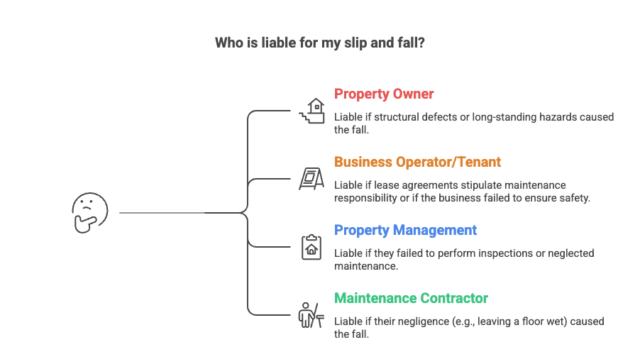
Who Can Be Held Liable for a Slip and Fall?
Determining who is liable in a slip and fall accident is not always straightforward. Depending on the specific circumstances of your case, multiple parties may share responsibility for your injuries.
Property Owners
The most obvious party to hold liable is the property owner. Whether it is a private homeowner, a commercial real estate company, or a government entity, the owner has a fundamental duty to maintain safe premises. If a structural defect or long-standing hazard caused your fall, the owner is likely responsible. Proving this often requires demonstrating property owner negligence in court.
Business Operators and Tenants
If you slip and fall in a leased commercial space, such as a restaurant or retail store, the business operator or tenant may be liable. Lease agreements often stipulate who is responsible for daily maintenance and hazard removal. Business owners must ensure their establishments are safe for customers.
Property Management Companies
Many property owners hire management companies to oversee daily operations, maintenance, and repairs. If a property management company fails to perform adequate inspections or neglects reported maintenance issues, they can be held liable for resulting accidents.
Maintenance Contractors
Sometimes, third-party contractors are responsible for specific maintenance tasks, such as snow removal, landscaping, or janitorial services. If a cleaning company leaves a floor wet without a warning sign, or a snow removal service does a poor job, they may bear liability for a subsequent fall.
Proving Notice in Slip and Fall Cases
One of the most challenging aspects of a slip and fall case is proving that the liable party had “notice” of the hazardous condition. To hold a property owner accountable, you generally must show one of the following:
Actual Notice
Actual notice means the property owner or their employees explicitly knew about the hazard. For example, if another customer reported a spill to a store manager, and the manager did nothing about it, the store had actual notice of the danger.
Constructive Notice
Constructive notice is more common and implies that the property owner should have known about the hazard. This is often proven by showing that the dangerous condition existed for a sufficient length of time that a reasonable person conducting regular inspections would have discovered it. For instance, a rotting staircase that has been deteriorating for months provides constructive notice.
State-Specific Laws: Ohio vs. Florida
Because Pencheff and Fraley LPA serves clients in both Ohio and Florida, it is essential to understand how slip and fall laws differ between these two states.
Slip and Fall Liability in Ohio
In Ohio, premises liability heavily relies on the visitor’s status (invitee, licensee, or trespasser) as defined in the Ohio Revised Code. Furthermore, Ohio applies the “open and obvious” doctrine. If a hazard is deemed open and obvious—meaning a reasonable person would have noticed and avoided it—the property owner may be shielded from liability. Ohio also follows a modified comparative negligence rule, meaning you can still recover damages as long as you are 50% or less at fault for the accident.
Slip and Fall Liability in Florida
Florida law regarding slip and falls, particularly in business establishments, places a specific burden on the plaintiff. Under Florida Statute 768.0755, if you slip on a “transitory foreign substance” (like a spill) in a business, you must explicitly prove that the business had actual or constructive knowledge of the condition. Florida recently shifted to a modified comparative negligence system as well, barring recovery if the plaintiff is more than 50% at fault.
What to Do After a Slip and Fall Accident
Taking immediate action after a slip and fall can significantly strengthen your personal injury claim. If you are injured, follow these crucial steps:
- Seek Medical Attention: Your health is the top priority. See a doctor immediately, even if your injuries seem minor. Medical records will serve as vital evidence linking your injuries to the fall.
- Report the Accident: Notify the property owner, store manager, or landlord immediately. Ask them to file an official incident report and request a copy for your records.
- Document the Scene: Take clear photographs or videos of the exact location where you fell, focusing on the hazard that caused the accident. Capture lighting conditions and any lack of warning signs.
- Gather Witness Information: If anyone saw you fall, collect their names and contact information. Eyewitness testimony can be invaluable in proving negligence.
- Contact a Personal Injury Attorney: Before speaking to insurance adjusters, consult with an experienced slip and fall lawyer to protect your rights and ensure you pursue the maximum compensation available.
Frequently Asked Questions (FAQ)
How much is the average slip and fall settlement?
Slip and fall settlements vary widely based on the severity of injuries, medical expenses, and the clarity of liability. Minor injuries might settle for $10,000 to $25,000, while severe cases involving surgery or permanent disability can exceed $100,000.
Can I sue if I slipped on ice in a parking lot?
Yes, you can potentially sue if you slipped on ice. However, liability depends on whether the property owner had a reasonable opportunity to clear the ice or if they created an unnatural accumulation of ice through improper drainage or negligent snow removal.
What if I was partially at fault for my fall?
In both Ohio and Florida, you can still recover compensation if you were partially at fault, thanks to modified comparative negligence laws. However, your total compensation will be reduced by your percentage of fault, and you cannot recover damages if you are found to be more than 50% responsible.
How long do I have to file a slip and fall lawsuit?
The statute of limitations varies by state. In Ohio, you generally have two years from the date of the accident to file a personal injury lawsuit. In Florida, recent legal changes have also reduced the statute of limitations for general negligence claims to two years.
Do I really need a lawyer for a slip and fall claim?
While not legally required, hiring a lawyer is highly recommended. Property owners and their insurance companies will aggressively fight liability claims. An experienced attorney can investigate the accident, gather evidence, handle negotiations, and take your case to court if necessary.
Conclusion: Get Help from Experienced Slip and Fall Attorneys
Determining who is liable in a slip and fall accident involves complex legal analysis, thorough investigation, and a deep understanding of premises liability law. Whether your accident occurred at a grocery store, an apartment complex, or a public sidewalk, you should not have to bear the financial burden of someone else’s negligence.
If you or a loved one has suffered an injury due to a hazardous property condition, the dedicated legal team at Pencheff and Fraley LPA is here to help. We have extensive experience handling personal injury claims across Ohio and Florida.
Contact us today for a free, no-obligation consultation. We will review your case, answer your questions, and explain your legal options. Learn how we can help you on the road to recovery. Pay nothing unless we win your case.
Call us at 904-770-4953 or visit our website at www.pencheffandfraley.com to schedule your free case consultation.
We’re Here for You 24/7
We are available 24/7 to take your call. If you are unable to travel, we will come to you. The sooner you call, the stronger your case can be. Your path to maximum compensation and justice starts with a single phone call to Pencheff & Fraley.
Author: Pencheff and Fraley Legal Team
Disclaimer: This article is for informational purposes only and does not constitute legal advice. Every case is unique, and you should consult with a qualified attorney about your specific situation.