

A simple trip to the grocery store or shopping mall can change your life in an instant. One moment you are walking down an aisle, and the next, you are on the ground in pain due to a wet floor or a misplaced box. If you find yourself in this unfortunate situation, you might be wondering: can you sue a store for a slip and fall in Florida? The short answer is yes, but successfully pursuing a claim requires navigating specific legal hurdles unique to the Sunshine State.
Florida law holds business owners responsible for maintaining safe premises for their customers. However, simply falling in a store does not automatically mean the business is liable for your injuries. To secure compensation, you must prove that the store’s negligence directly caused your accident. This comprehensive guide will explain your legal rights, the critical evidence needed to build a strong case, and the steps you must take to protect your future after a slip and fall incident in a Florida store.
Understanding Premises Liability and Invitee Status in Florida
When you enter a store during business hours to shop, browse, or conduct business, Florida law classifies you as a “business invitee.” This legal status grants you the highest level of protection under premises liability law. Because the store invites you onto its property for its own financial benefit, the business owes you a heightened duty of care compared to social guests or trespassers.
This duty of care means that store owners and managers must take reasonable steps to keep the property safe. They are legally obligated to regularly inspect the premises for potential hazards, promptly repair any dangerous conditions they discover, and provide adequate warnings about known dangers until they can be fixed. If a store fails to meet these obligations and you suffer an injury as a result, you may have grounds for a premises liability lawsuit.
However, the store is not an absolute guarantor of your safety. They are only liable if their actions—or lack of action—were negligent. For example, if another customer drops a glass jar of juice right in front of you and you slip on it two seconds later, the store may not be liable because they did not have a reasonable opportunity to discover and clean up the spill.
The Crucial Role of Florida Statute 768.0755
Slip and fall cases in Florida businesses are heavily governed by Florida Statute 768.0755. This specific law addresses premises liability for “transitory foreign substances” in business establishments. A transitory foreign substance is any liquid or solid item that does not belong on the floor, such as spilled water, a dropped grape, leaking refrigeration fluid, or a fallen piece of merchandise.
Under this statute, if you slip and fall on a transitory foreign substance in a business establishment, the burden of proof is entirely on you, the injured party. You must prove that the business had either actual knowledge or constructive knowledge of the dangerous condition and failed to take appropriate action to remedy it. This legal standard makes slip and fall cases more challenging than other types of personal injury claims, emphasizing the need for robust evidence.
Actual Knowledge vs. Constructive Knowledge
To win your case, you must establish that the store knew or should have known about the hazard.
Actual knowledge means the store’s employees or management were directly aware of the specific hazard before your fall. For instance, if an employee created the spill while stocking shelves, or if another customer reported the spill to a manager five minutes before you slipped, the store had actual knowledge. Proving actual knowledge is often difficult unless an employee admits to knowing about the spill or there is clear video evidence of an employee walking past the hazard without addressing it.
Constructive knowledge is more common in slip and fall cases. It means that even if the store didn’t explicitly know about the spill, they should have known about it if they were exercising reasonable care. Under Florida law, constructive knowledge can be proven by circumstantial evidence showing that:
- The dangerous condition existed for such a length of time that, in the exercise of ordinary care, the business establishment should have known of the condition.
- The condition occurred with regularity and was therefore foreseeable.
For example, if you slip on a puddle of water that has shopping cart tracks through it and is surrounded by dried, sticky residue, this circumstantial evidence suggests the puddle had been there for a significant amount of time. Similarly, if a store’s roof chronically leaks every time it rains and you slip on a puddle under the known leak during a storm, the store may have constructive knowledge because the hazard was foreseeable.
Common Causes of Slip and Fall Accidents in Florida Stores
Slip and fall accidents can occur in any retail environment, from large big-box stores and supermarkets to small boutique shops and restaurants. Some of the most frequent hazards that lead to these injuries include:
| Hazard Type | Common Locations | Store’s Responsibility |
| Spilled Liquids | Beverage aisles, produce sections, near refrigeration units | Promptly clean up spills and place highly visible “Wet Floor” signs. |
| Rainwater | Entryways and exits | Place absorbent mats at entrances and frequently mop tracked-in water during storms. |
| Uneven Flooring | Torn carpeting, cracked tiles, uneven transitions between surfaces | Repair damaged flooring and highlight uneven areas with warning tape. |
| Cluttered Aisles | Stocking areas, endcaps | Keep walkways clear of boxes, pallets, and fallen merchandise. |
| Poor Lighting | Parking lots, stairwells, restrooms | Maintain adequate illumination so customers can see potential tripping hazards. |
| Improperly Placed Mats | Entrances, produce sections | Ensure floor mats lie flat and do not have curled edges that create tripping hazards. |
If your injury was caused by one of these common hazards, documenting the exact nature of the condition is vital for your claim.
What to Do Immediately After a Slip and Fall in a Store
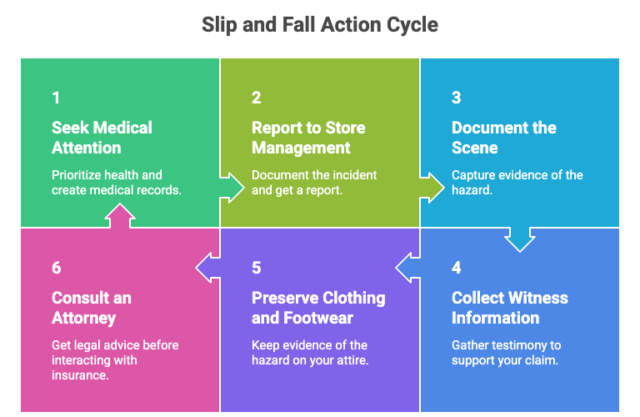
The actions you take in the moments and days following a slip and fall accident can significantly impact the success of your personal injury claim. To protect your physical health and your legal rights, follow these crucial steps:
1. Seek Immediate Medical Attention
Your health is the top priority. Even if you feel fine initially, adrenaline can mask the symptoms of severe injuries like concussions, internal bleeding, or soft tissue damage. See a doctor or visit an emergency room as soon as possible. Prompt medical evaluation not only ensures you get the necessary treatment but also creates an official medical record linking your injuries directly to the fall. Delaying treatment can give the insurance company grounds to argue that your injuries are not serious or were caused by a separate event.
2. Report the Incident to Store Management
Do not leave the store without reporting the fall to a manager or supervisor. Request that they create an official incident report documenting the details of the accident. Ask for a copy of this report before you leave. When speaking with management, stick to the facts of what happened. Do not apologize, minimize your injuries, or admit any fault, as these statements can be used against you later.
3. Document the Scene and Gather Evidence
If you are physically able, use your smartphone to take extensive photographs and videos of the accident scene. Capture the exact hazard that caused your fall, whether it was a spill, a torn carpet, or a lack of warning signs. Take wide-angle shots to show the surrounding area and close-ups of the hazard itself. Note if there are any surveillance cameras pointing toward the area where you fell.
4. Collect Witness Information
If anyone saw you fall or noticed the hazard before your accident, ask for their names and contact information. Independent witness testimony is incredibly valuable in slip and fall cases, as it can corroborate your version of events and help establish how long the hazard was present.
5. Preserve Your Clothing and Footwear
Keep the shoes and clothing you were wearing at the time of the fall in a safe place. Do not wash them. If there was a specific substance on the floor, the residue on your clothing or shoes can serve as physical evidence of the hazard.
6. Do Not Give a Recorded Statement to the Insurance Company
The store’s insurance adjuster may contact you shortly after the accident, asking for a recorded statement or offering a quick settlement. Do not provide a statement or sign any documents without first consulting an attorney. Insurance adjusters are trained to minimize payouts and may use your words out of context to shift blame onto you.
Understanding Florida’s Modified Comparative Negligence Law
In 2023, Florida made a significant change to its personal injury laws, shifting from a pure comparative negligence system to a modified comparative negligence system. This change has a profound impact on slip and fall cases.
Under the new law, your compensation will be reduced by your percentage of fault for the accident. For example, if a jury determines you are 20% at fault because you were looking at your phone when you slipped on a wet floor, and your total damages are $100,000, you will only receive $80,000.
More importantly, the modified comparative negligence rule states that if you are found to be more than 50% at fault for your injuries, you are barred from recovering any compensation whatsoever. Store owners and their insurance companies will aggressively try to shift the blame onto you, arguing that the hazard was “open and obvious,” that you were wearing inappropriate footwear, or that you were distracted. Having a skilled attorney is crucial to counter these tactics and protect your right to compensation.
The Statute of Limitations for Florida Slip and Fall Cases
Another critical change implemented in 2023 affects the deadline for filing a lawsuit. The statute of limitations for most personal injury cases in Florida, including slip and fall accidents based on negligence, was reduced from four years to two years from the date of the accident.
If you fail to file a lawsuit within this strict two-year window, you will almost certainly lose your right to seek compensation forever. While two years may seem like a long time, investigating a claim, gathering medical records, and negotiating with insurance companies takes significant time. It is vital to contact an attorney as soon as possible after your accident to ensure all deadlines are met and critical evidence, such as surveillance footage, is preserved before it is deleted.
What Compensation Can You Recover?
If you successfully prove that the store’s negligence caused your slip and fall, you may be entitled to recover various types of damages. These are generally categorized into economic and non-economic damages.
Economic Damages are tangible financial losses with a specific dollar amount. They include:
- Past and future medical expenses (hospital bills, surgeries, physical therapy, medication)
- Lost wages for the time you missed from work while recovering
- Loss of future earning capacity if your injuries prevent you from returning to your previous job
- Out-of-pocket expenses related to your injury, such as transportation to medical appointments or mobility aids
Non-Economic Damages are subjective losses that impact your quality of life. They include:
- Physical pain and suffering
- Emotional distress and mental anguish
- Loss of enjoyment of life
- Disfigurement or permanent scarring
The total value of your claim will depend on the severity of your injuries, the clarity of the store’s liability, and the impact the accident has had on your daily life.
How a Florida Premises Liability Attorney Can Help
Slip and fall cases against large retail corporations and their aggressive insurance companies are notoriously difficult to win on your own. They have teams of lawyers dedicated to minimizing or denying claims. To level the playing field, you need an experienced advocate on your side.
At Pencheff and Fraley, our dedicated legal team understands the complexities of proving property owner negligence in court. We will thoroughly investigate your accident, secure crucial evidence like surveillance footage and maintenance logs, interview witnesses, and handle all communications with the insurance company. If a fair settlement cannot be reached, we are fully prepared to take your case to trial.
If you or a loved one has been injured in a slip and fall accident in a Florida store, do not wait to seek legal guidance. Understanding how to start a personal injury claim in Florida is the first step toward securing the compensation you deserve. Contact Pencheff and Fraley today to schedule a free, no-obligation consultation with an experienced personal injury attorney. We are here to fight for your rights and help you rebuild your life.
Frequently Asked Questions (FAQ)
How long do I have to sue a store for a slip and fall in Florida? Due to a law change in 2023, you now have exactly two years from the date of the slip and fall accident to file a personal injury lawsuit in Florida. Missing this deadline will likely bar you from recovering any compensation.
What if there was a “Wet Floor” sign, but I still fell? A warning sign does not automatically absolve a store of liability. The sign must be highly visible and placed in a location that gives customers adequate time to avoid the hazard. If the sign was hidden, placed too close to the spill, or left out long after the floor was dry (creating a “cry wolf” scenario), the store may still be held responsible.
Do I need a lawyer for a minor slip and fall injury? If your injuries are truly minor and require no medical treatment, a lawsuit may not be necessary. However, many injuries, such as soft tissue damage or concussions, do not show severe symptoms immediately. It is always best to seek a medical evaluation and consult with an attorney to ensure you are not forfeiting your rights to compensation for latent injuries.
Can I still get compensation if I was partially at fault for the fall? Yes, but your compensation will be reduced by your percentage of fault under Florida’s modified comparative negligence law. However, if you are found to be more than 50% responsible for the accident, you cannot recover any damages from the store.
What is the average settlement for a slip and fall case in Florida? There is no “average” settlement, as every case is unique. The value of your claim depends heavily on the severity of your injuries, the amount of your medical bills, your lost wages, and the strength of the evidence proving the store’s negligence. Settlements can range from a few thousand dollars for minor injuries to hundreds of thousands or more for catastrophic injuries.
Contact us today for a free, no-obligation consultation. We will review your case, answer your questions, and explain your legal options. Learn how we can help you on the road to recovery. Pay nothing unless we win your case.
Call us at 904-770-4953 or visit our website at www.pencheffandfraley.com to schedule your free case consultation.
We’re Here for You 24/7
We are available 24/7 to take your call. If you are unable to travel, we will come to you. The sooner you call, the stronger your case can be. Your path to maximum compensation and justice starts with a single phone call to Pencheff & Fraley.
Author: Pencheff and Fraley Legal Team
Disclaimer: This article is for informational purposes only and does not constitute legal advice. Every case is unique, and you should consult with a qualified attorney about your specific situation.