

A slip and fall accident can leave you with severe injuries, mounting medical bills, and a significant amount of physical and emotional pain. As you struggle to recover and potentially miss time from work, the financial pressure can become overwhelming. It is completely natural to wonder: how long does a slip and fall settlement take in Florida?
The short answer is that there is no universal timeline. While some straightforward claims might settle in a few months, complex cases can take over a year or more to resolve, especially if they proceed to litigation. The duration of your settlement depends heavily on the specific facts of your case, the severity of your injuries, and the willingness of the property owner’s insurance company to negotiate fairly.
At Pencheff and Fraley LPA, we understand the financial strain and frustration that follow a severe injury. This comprehensive guide will break down the timeline of a typical slip and fall claim in Florida, explain the factors that can speed up or delay your settlement, and highlight why patience and skilled legal representation are critical to securing the maximum compensation you deserve.
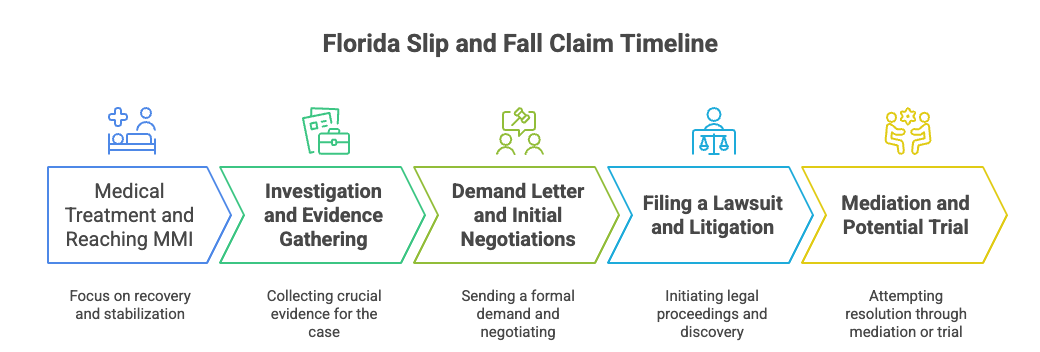
The Typical Timeline of a Florida Slip and Fall Claim
While every case is unique, a standard slip and fall claim in Florida generally progresses through several distinct phases. Understanding these stages can help you set realistic expectations for your settlement timeline.
Phase 1: Medical Treatment and Reaching MMI (Months 1 to 6+)
The most critical factor influencing your settlement timeline is your medical recovery. Before any settlement negotiations can begin, you must reach Maximum Medical Improvement (MMI). MMI is the point at which your doctors determine that your condition has stabilized and is unlikely to improve significantly with further treatment.
Why is reaching MMI so important? If you settle your claim before fully understanding the long-term impact of your injuries, you risk accepting an amount that fails to cover future medical expenses or ongoing care. Whether you suffered a minor sprain or a severe spinal cord injury, waiting until you reach MMI ensures that your attorney can accurately calculate your total damages. For minor injuries, MMI might be reached in a few months; for catastrophic injuries, it could take a year or more.
Phase 2: Investigation and Evidence Gathering (Months 1 to 3)
While you focus on your physical recovery, your legal team will begin building your case. Proving negligence in a slip and fall case requires robust evidence demonstrating that the property owner knew or should have known about the dangerous condition and failed to address it.
During this phase, your attorney will gather crucial evidence, which may include:
- Incident reports filed with the property owner or manager.
- Photographs or video footage of the hazard that caused your fall.
- Surveillance camera footage from the premises.
- Statements from eyewitnesses who saw the accident or the hazardous condition.
- Your complete medical records and billing statements.
The speed of this phase often depends on how quickly property owners and medical providers respond to requests for documentation.
Phase 3: The Demand Letter and Initial Negotiations (Months 3 to 6)
Once you have reached MMI and all evidence has been collected, your attorney will draft and send a formal demand letter to the at-fault party’s insurance company. This letter outlines the facts of the accident, details your injuries and medical treatment, explains why the property owner is legally liable, and demands a specific financial settlement.
After receiving the demand letter, the insurance adjuster will take time to review your claim. They typically respond within 30 to 45 days. The initial response is almost always a counteroffer that is significantly lower than your demand. This begins the negotiation process, which can involve several rounds of back-and-forth communication between your attorney and the insurer. If the insurance company is reasonable, a settlement can often be reached during this phase.
Phase 4: Filing a Lawsuit and Litigation (Months 6 to 18+)
If the insurance company refuses to offer a fair settlement or completely denies liability, your attorney may recommend filing a formal personal injury lawsuit. It is important to note that filing a lawsuit does not mean your case will inevitably go to trial. In fact, the majority of personal injury cases are settled out of court during the litigation process.
Once a lawsuit is filed, the case enters the discovery phase, where both sides exchange evidence, request documents, and conduct depositions (sworn testimonies) of witnesses, experts, and the parties involved. Discovery is often the longest part of the legal process and can take several months to complete.
Phase 5: Mediation and Potential Trial (Months 12 to 24+)
Before a case goes to trial, Florida courts typically require the parties to attend mediation. During mediation, a neutral third-party mediator helps facilitate negotiations between you, your attorney, and the insurance company’s legal team. Mediation is highly effective, and many complex slip and fall cases are successfully resolved at this stage.
If mediation fails, your case will proceed to trial. Trials require significant preparation and are subject to the court’s scheduling availability, which can add many months to your timeline. While trials are relatively rare, having an attorney who is prepared to litigate aggressively is essential for maximizing your leverage during negotiations.
Key Factors That Can Delay Your Slip and Fall Settlement
Several variables can significantly impact how long it takes to finalize your slip and fall settlement in Florida.
1. The Severity of Your Injuries
As mentioned earlier, the extent of your injuries dictates how long it takes to reach MMI. Cases involving traumatic brain injuries, complex fractures, or injuries requiring multiple surgeries naturally take longer to resolve because the full scope of medical expenses and long-term damages takes time to assess accurately.
2. Disputes Over Liability
Insurance companies are profit-driven entities, and their primary goal is to minimize payouts. In slip and fall cases, they frequently dispute liability. They may argue that the property owner had no reasonable way of knowing about the hazard or that the hazard was “open and obvious,” meaning you should have avoided it. When liability is heavily contested, your attorney must spend more time gathering evidence, consulting safety experts, and potentially litigating the case, which extends the timeline.
3. Florida’s Comparative Negligence Standard
Florida operates under a modified comparative negligence system. This means that if you are found partially at fault for your accident, your total compensation will be reduced by your percentage of fault. For example, if you were texting on your phone while walking and slipped on a wet floor, the insurance company might argue you were 30% at fault.
Insurers frequently use comparative negligence as a tactic to reduce settlement values. Resolving disputes over your level of fault requires strong evidence and skilled negotiation, adding time to the settlement process.
4. Uncooperative Insurance Companies
Some insurance carriers employ delay tactics, hoping that the financial pressure of mounting medical bills and lost wages will force you to accept a lowball settlement offer out of desperation. A seasoned personal injury attorney knows how to counter these tactics and keep the pressure on the insurer to negotiate in good faith.
Why Accepting a Fast Settlement is Often a Mistake
When you are facing financial hardship after an accident, the promise of a quick payout from an insurance adjuster can be tempting. However, accepting an immediate settlement is rarely in your best interest.
Insurance adjusters often reach out to injury victims shortly after an accident, before the victim has hired legal representation. The initial offer they present is typically a fraction of what the claim is actually worth. If you accept this early offer and sign a release of liability, you permanently forfeit your right to seek additional compensation, even if your injuries require unexpected surgery or ongoing physical therapy months down the road.
Patience is a crucial component of maximizing your recovery. Allowing your attorney the time necessary to thoroughly investigate your claim, calculate your total damages, and negotiate from a position of strength is the best way to ensure you receive fair compensation for your pain, suffering, and financial losses.
Important Deadlines: Florida’s Statute of Limitations
While patience during negotiations is important, you must also be aware of strict legal deadlines. The statute of limitations dictates how long you have to file a formal lawsuit.
In Florida, a significant change in the law occurred recently. For most personal injury cases, including slip and fall accidents based on negligence, you now have two years from the date of the injury to file a lawsuit. This was reduced from the previous four-year deadline.
If you fail to file a lawsuit within this two-year window, the court will likely dismiss your case, and you will lose your right to seek compensation entirely. Because building a strong case takes time, it is imperative to consult with an attorney as soon as possible after your accident to ensure you do not run afoul of these critical deadlines. You can learn more about how deadlines affect your case in our guide on Time Limits That Could Cost You: Injury Claim Deadlines Explained.
How Pencheff and Fraley Can Expedite Your Claim
Navigating a slip and fall claim on your own can be a frustrating and protracted experience. The experienced legal team at Pencheff and Fraley LPA is dedicated to handling every aspect of your case efficiently while fiercely advocating for your best interests.
Here is how we help streamline the process:
- Thorough Investigation: We immediately dispatch investigators to secure critical evidence before it disappears or is destroyed.
- Medical Coordination: We help ensure you receive the proper medical care and meticulously document your treatment to build a compelling damages profile.
- Aggressive Negotiation: We handle all communications with the insurance adjusters, protecting you from tactics designed to devalue your claim.
- Trial Readiness: We prepare every case as if it will go to trial. This level of preparation often compels insurance companies to offer fair settlements sooner to avoid the courtroom.
Contact a Florida Slip and Fall Attorney Today
If you or a loved one has been injured in a slip and fall accident in Florida, you do not have to face the legal process alone. Understanding how to start a personal injury claim in Florida is the first step, but having experienced legal counsel by your side makes all the difference.
Contact Pencheff and Fraley LPA Today
Contact us today for a free, no-obligation consultation. We will review your case, answer your questions, and explain your legal options. Learn how we can help you on the road to recovery. Pay nothing unless we win your case.
Call us at 904-770-4953 or visit our website at www.pencheffandfraley.com to schedule your free case consultation.
We’re Here for You 24/7
We are available 24/7 to take your call. If you are unable to travel, we will come to you. The sooner you call, the stronger your case can be. Your path to maximum compensation and justice starts with a single phone call to Pencheff & Fraley.
Author: Pencheff and Fraley Legal Team
Disclaimer: This article is for informational purposes only and does not constitute legal advice. Every case is unique, and you should consult with a qualified attorney about your specific situation.