

Workers’ Compensation for Tampa Employees: Benefits, Deadlines & Your Rights
If you have suffered a work-related injury, finding the right workers comp lawyer Tampa FL is one of the most important steps you can take to protect your future. A sudden accident on the job can turn your life upside down, leaving you with mounting medical bills, lost wages, and severe physical pain. Understanding your rights under Florida’s workers’ compensation laws can be incredibly confusing, especially when insurance companies push back or deny your legitimate claim.
When an unexpected injury disrupts your livelihood, you need strong legal advocates in your corner. At Pencheff and Fraley LPA, our experienced attorneys are committed to guiding injured workers through the complexities of the legal process with clarity and care. We fight relentlessly to ensure that employees receive the full medical care and financial support they deserve.
What Is Workers’ Compensation in Florida?
Workers’ compensation is a form of insurance designed to provide wage replacement and medical benefits to employees who are injured in the course of employment. In exchange for receiving these guaranteed benefits, injured workers generally surrender their right to sue their employer for negligence. This “no-fault” system was designed to protect both employers and employees.
Under the Florida Workers’ Compensation Act (Chapter 440, Florida Statutes), most employers are required to carry this insurance. Construction companies with at least one employee, non-construction businesses with four or more employees, and agricultural employers with six or more employees must all provide coverage. If you are injured on the job, it is vital to consult a knowledgeable workers compensation attorney in Tampa to ensure your claim is filed correctly and promptly.
Who Is Covered Under Florida Workers’ Compensation?
Most employees in Florida are covered, including full-time, part-time, and seasonal workers. However, certain categories of workers are not automatically covered. Independent contractors, volunteers, and workers at very small businesses may fall outside the system’s protections. In the construction industry, special rules apply: even subcontractors and independent contractors are generally treated as employees for workers’ compensation purposes unless they hold a valid exemption.
If you are unsure whether you qualify for benefits, speaking with a dedicated workers comp lawyer Tampa FL is the fastest way to get a clear answer. Our team at Pencheff and Fraley LPA offers free consultations to help you understand your options.
Common Workplace Injuries in Tampa, FL
Tampa’s diverse economy means that workplace accidents can happen in any industry. From busy construction sites along the waterfront to bustling healthcare facilities and office buildings in the Westshore Business District, employees face a wide variety of risks every day.
Construction and Industrial Accidents
The construction industry consistently records the highest rates of workplace fatalities and serious injuries nationwide. According to the Occupational Safety and Health Administration (OSHA), falls, being struck by objects, electrocution, and caught-in/between hazards account for the majority of construction fatalities. Workers frequently suffer spinal cord damage, traumatic brain injuries, and amputations in these incidents.
Repetitive Strain and Overexertion Injuries
Office workers, healthcare professionals, and assembly line employees frequently develop conditions like carpal tunnel syndrome, tendonitis, and chronic back pain due to repetitive motions over time. These injuries can be just as debilitating as acute trauma, yet they are often harder to prove because they develop gradually. A skilled workers comp lawyer Tampa FL can help you document the connection between your job duties and your medical condition.
Slips, Trips, and Falls
Wet floors, uneven surfaces, and cluttered walkways cause serious fractures and back injuries in retail stores, restaurants, and warehouses across Tampa every year. According to the National Safety Council, falls are one of the leading causes of workplace injuries and fatalities in the United States.
Occupational Diseases
Some workplace injuries develop over time due to prolonged exposure to hazardous substances or conditions. Occupational diseases such as mesothelioma from asbestos exposure, hearing loss from excessive noise, and respiratory conditions from chemical inhalation are all compensable under Florida law, provided you can demonstrate that your work environment was the major contributing cause.
No matter how your injury occurred, visit our workers’ compensation page to learn more about how Pencheff and Fraley LPA handles these complex cases.
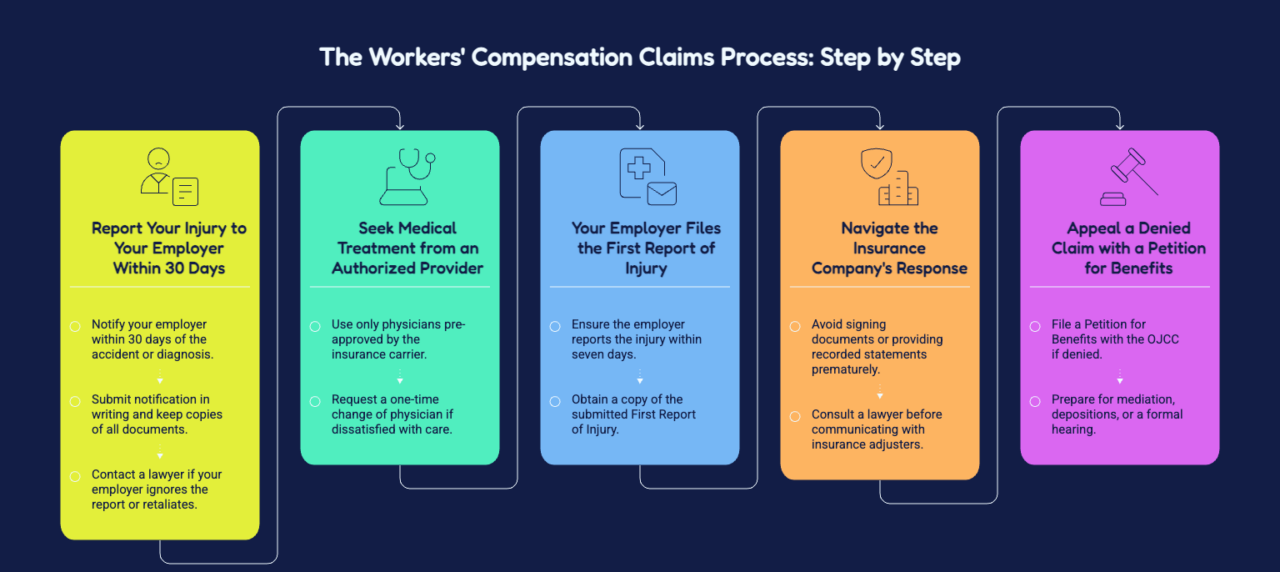
The Workers’ Compensation Claims Process: Step by Step
Filing a workers’ compensation claim in Florida involves strict deadlines and specific procedural requirements. Missing even one deadline can result in the complete denial of your benefits, leaving you financially responsible for your own recovery.
Step 1: Report Your Injury to Your Employer Within 30 Days
The first and most crucial step is reporting your injury. In Florida, you have exactly 30 days from the date of the accident — or the date a doctor first tells you that your condition is work-related — to notify your employer. This notification should be made in writing whenever possible. Keep a copy of every document you submit.
If your employer ignores your report, retaliates against you, or refuses to file a claim with their insurance carrier, contact a Tampa personal injury lawyer immediately. Retaliation for filing a workers’ compensation claim is illegal in Florida.
Step 2: Seek Medical Treatment from an Authorized Provider
Once you report your injury, your employer’s insurance company must authorize a medical provider. In the Florida workers’ compensation system, you generally cannot choose your own doctor. You must seek treatment from a physician pre-approved by the insurance carrier. Seeking care from an unauthorized provider could result in your medical bills being denied.
If you are dissatisfied with the care you are receiving, Florida law allows you a one-time change of physician. However, the insurance company still selects the new doctor. A dedicated workers comp lawyer Tampa FL can advocate for you if you believe you are receiving inadequate or biased medical care.
Step 3: Your Employer Files the First Report of Injury
After you notify your employer, they are legally required to report your injury to their insurance carrier within seven days. The carrier then has 14 days to either begin paying benefits or deny the claim. Ask your employer for a copy of the First Report of Injury (FROI) that they submit.
Step 4: Navigate the Insurance Company’s Response
Insurance adjusters are trained to minimize payouts. They may contact you quickly after your injury, asking for recorded statements or pushing you to accept a quick settlement. Do not sign any documents or provide recorded statements without first speaking to a workers comp lawyer Tampa FL. Anything you say can be used to undervalue or deny your claim.
Step 5: Appeal a Denied Claim with a Petition for Benefits
If your claim is denied or benefits are unreasonably delayed, you have the right to file a Petition for Benefits with the Office of the Judges of Compensation Claims (OJCC). For Tampa-area injuries in Hillsborough County, this is filed with the Tampa District Office. Once a petition is on file, the insurance carrier must formally respond. This process may involve mediation, depositions, and ultimately a formal hearing before a Judge of Compensation Claims. Learn more about your rights on our Workers’ Comp FAQs page.
Critical Deadlines: Do Not Miss These Dates
Understanding the time limits in Florida workers’ compensation law is essential. The following table summarizes the most important deadlines:
| Deadline | Timeframe | Consequence of Missing |
| Report injury to employer | 30 days from injury or diagnosis | Claim may be denied entirely |
| Employer reports to insurer | 7 days after employee notification | Carrier may face penalties |
| Carrier accepts or denies claim | 14 days after receiving notice | Carrier may face penalties |
| File Petition for Benefits | 2 years from injury date | Permanent loss of right to benefits |
The two-year statute of limitations is the most critical deadline for injured workers. Under Florida Statute § 440.19, you generally have two years from the date of your injury to file a formal Petition for Benefits. Failing to act within this window will permanently bar you from recovering compensation for that injury.
Types of Workers’ Compensation Benefits Available in Tampa
If your claim is approved, you may be entitled to several different types of benefits. An experienced workers comp lawyer Tampa FL will fight to ensure you receive the maximum compensation available in every applicable category.
Medical Benefits
Workers’ compensation covers 100% of your reasonable and necessary medical expenses related to the workplace injury. This includes emergency room visits, surgeries, hospital stays, prescription medications, physical therapy, and mileage reimbursement for travel to and from medical appointments. Medical benefits continue as long as the treatment is deemed medically necessary by your authorized treating physician.
Temporary Total Disability (TTD)
If your injury temporarily prevents you from performing any work, you may qualify for Temporary Total Disability benefits. TTD pays two-thirds (66.67%) of your pre-injury average weekly wage, subject to a state-mandated maximum. According to the Florida Department of Financial Services, the maximum weekly compensation rate is updated annually. TTD benefits are payable for up to 104 weeks or until you reach Maximum Medical Improvement (MMI), whichever comes first.
Temporary Partial Disability (TPD)
If you can return to work with restrictions but are earning less than 80% of your pre-injury wages, you may qualify for Temporary Partial Disability benefits. TPD pays 80% of the difference between your pre-injury and post-injury average weekly wages. This benefit helps bridge the income gap while you continue to recover.
Permanent Impairment Benefits
Once you reach Maximum Medical Improvement (MMI), your authorized treating physician will assign a Permanent Impairment Rating (PIR) using the Florida Uniform Permanent Impairment Rating Schedule. If your rating is greater than zero, you are entitled to permanent impairment benefits. The number of weeks of benefits you receive depends directly on your impairment rating percentage.
Permanent Total Disability (PTD)
For catastrophic injuries that permanently prevent you from engaging in any meaningful employment, PTD benefits may provide wage replacement until age 75. Florida law presumes permanent total disability for injuries such as spinal cord injuries causing paralysis, traumatic brain injuries with severe communication or motor disturbances, amputations of an arm or leg, and second- or third-degree burns covering more than 25% of the body.
Death Benefits
When a worker is killed in a work-related accident, surviving family members may be entitled to death benefits. Under Florida Statute § 440.16, these benefits include funeral and burial expenses up to $7,500 and wage-loss benefits up to $150,000 for eligible dependents.
Why Workers’ Compensation Claims Get Denied in Florida
Insurance companies are for-profit businesses, and their adjusters are trained to minimize payouts. It is not uncommon for legitimate workers’ compensation claims to be delayed, devalued, or denied entirely. Understanding the most common reasons for denial can help you avoid pitfalls.
Common Reasons for Claim Denial
Insurers frequently deny claims by alleging that the injury did not occur in the course of employment, that a pre-existing condition was the true cause of the worker’s pain, or that the employee failed to report the injury within the 30-day window. They may also dispute the severity of the injury or argue that the employee was intoxicated at the time of the accident.
The Role of Independent Medical Examinations (IMEs)
Insurance carriers often require injured workers to attend an Independent Medical Examination (IME) conducted by a physician the carrier selects and pays. These doctors frequently produce reports that minimize the severity of injuries or suggest the worker has already reached MMI. A workers comp lawyer Tampa FL can prepare you for an IME and challenge a biased report if necessary.
Employer Retaliation After Filing a Claim
Some employers retaliate against injured workers by reducing their hours, changing their job duties, or terminating their employment after a claim is filed. This is illegal under Florida law. If you believe you have been retaliated against, contact our team at Pencheff and Fraley LPA immediately, as there are strict time limits for pursuing a retaliation claim.
When Can You File a Personal Injury Lawsuit Instead?
Workers’ compensation is generally the exclusive remedy for workplace injuries, meaning you cannot sue your employer directly. However, there are important exceptions where a separate personal injury lawsuit may be available.
Third-Party Liability Claims
If a party other than your employer caused or contributed to your injury, you may be able to pursue a third-party personal injury claim. Common examples include:
- A negligent driver who caused a vehicle accident while you were driving for work
- A manufacturer of defective equipment or machinery that malfunctioned on the job
- A property owner whose negligence created a hazardous condition at a worksite
A third-party lawsuit allows you to recover damages not available through workers’ compensation, including pain and suffering, full lost wages, and punitive damages in egregious cases.
Intentional Torts by Employers
If your employer intentionally caused your injury, the workers’ compensation exclusivity rule may not apply, and you may be able to sue your employer directly in civil court.
How a Workers Comp Lawyer Tampa FL Can Help You
Navigating the Florida workers’ compensation system without legal representation puts you at a significant disadvantage. Insurance carriers employ experienced defense attorneys whose sole job is to protect the company’s bottom line. Here is how Pencheff and Fraley LPA levels the playing field.
Ensuring Accurate Average Weekly Wage Calculations
Your wage replacement benefits are based on your Average Weekly Wage (AWW), and insurance adjusters routinely calculate this figure on the low side. They may exclude overtime pay, tips, bonuses, and income from a second job. Our attorneys rebuild your AWW from the ground up using pay stubs, W-2s, and tax records to ensure you receive every dollar you are owed.
Gathering and Preserving Evidence
Building a strong workers’ compensation case requires prompt collection of evidence. This includes incident reports, surveillance footage, witness statements, medical records, and expert testimony. Delays in gathering this evidence can allow critical proof to disappear. Our team acts quickly to preserve the evidence that supports your claim.
Negotiating a Fair Settlement
Many workers’ compensation cases are resolved through a lump-sum settlement. While a settlement can provide immediate financial relief, accepting a low offer can leave you without resources to cover future medical expenses. Our attorneys carefully evaluate every settlement offer to ensure it reflects the true value of your claim, including anticipated future medical costs and lost earning capacity.
Representing You at Hearings and Appeals
If your claim proceeds to a formal hearing before a Judge of Compensation Claims, having an experienced litigator by your side is essential. Our attorneys know the procedural rules, the evidentiary standards, and the arguments that are most effective before the OJCC. We also handle appeals to the First District Court of Appeal if necessary.
Frequently Asked Questions
What should I do immediately after a workplace injury in Tampa?
If it is an emergency, seek medical attention immediately. Otherwise, report the injury to your supervisor right away, fill out an incident report, and ask for a copy. Do not give a recorded statement to the insurance company without first speaking to a workers comp lawyer Tampa FL. Contact our team at Pencheff and Fraley LPA for a free consultation.
Can I sue my employer for a workplace injury in Florida?
In most cases, no. Workers’ compensation is an “exclusive remedy,” meaning you cannot sue your employer for negligence. However, if a third party caused your injury, you may be able to file a separate personal injury lawsuit in addition to your workers’ compensation claim. Our attorneys can evaluate whether a third-party claim is available in your situation.
Do I really need a workers comp lawyer Tampa FL for my case?
While you are not legally required to have an attorney, navigating the complex workers’ compensation system alone puts you at a significant disadvantage. A lawyer ensures your deadlines are met, your AWW is calculated correctly, your medical treatment is appropriate, and your rights are fully protected throughout the process.
How much does it cost to hire a workers’ compensation attorney?
At Pencheff and Fraley LPA, we work on a contingency fee basis. This means there are no upfront costs, and we only collect a fee if we successfully secure compensation or a settlement for you. You can review our fee structure on our Workers’ Comp Fees page.
What if my employer does not have workers’ compensation insurance?
If your employer is required to carry workers’ compensation insurance but fails to do so, you may be able to file a claim with the Florida Division of Workers’ Compensation’s Special Disability Trust Fund, or you may be able to sue your employer directly in civil court. Contact our team immediately if you discover your employer is uninsured.
How long do workers’ compensation benefits last in Florida?
The duration of benefits depends on the type and severity of your injury. Temporary disability benefits are generally capped at 104 weeks. Permanent impairment benefits are paid for a set number of weeks based on your impairment rating. Permanent total disability benefits may continue until age 75.
Secure Your Future with Pencheff and Fraley LPA
A workplace injury should not lead to financial ruin. If you are struggling with a denied claim, inadequate medical care, or delayed wage replacement checks, you do not have to fight the insurance company alone. Our Tampa, FL office is conveniently located at 100 N Ashley Dr, Suite 600, Tampa, FL 33602, and we serve injured workers throughout Hillsborough County and the greater Tampa Bay area.
At Pencheff and Fraley LPA, our dedicated team has decades of experience advocating for injured workers across Ohio and Florida. We understand the tactics used by insurance carriers and know how to counter them effectively. Our case results speak for themselves, with millions in settlements won for our clients.
Do not wait until it is too late to protect your rights. Contact us today for a free, no-obligation consultation with a top workers comp lawyer Tampa FL. Let us handle the legal complexities so you can focus entirely on your recovery.
Disclaimer: This article is for informational purposes only and does not constitute legal advice. Every case is unique, and you should consult with a qualified attorney about your specific situation.