

Slip and Fall at a Jacksonville Beach or Resort: Who Pays Your Medical Bills?
A relaxing vacation at a Jacksonville beach or resort can turn into a nightmare in an instant. One moment you are enjoying the Florida sunshine by the pool, and the next, you are on the ground in pain with serious injuries and a pile of medical bills. If a property owner’s negligence caused your fall, you need an experienced slip and fall lawyer Jacksonville FL to fight for the compensation you deserve.
Florida’s premises liability laws are complex, and determining who pays your medical bills after a resort accident is not always straightforward. Understanding your legal rights is the first step toward holding a negligent property owner accountable. This guide covers everything you need to know about slip and fall accidents at Jacksonville beaches and resorts — from the legal framework to the steps you must take to protect your claim.
What Is Premises Liability in Florida?
Premises liability is the area of personal injury law that holds property owners responsible for injuries caused by dangerous conditions on their property. In Florida, this legal framework applies to hotels, resorts, beach properties, restaurants, and any other business open to the public.
When you check into a Jacksonville resort or walk onto a hotel’s beach access, you are classified under Florida law as a business invitee — the category of visitor owed the highest duty of care. Because you are on the property for the financial benefit of the business, the hotel or resort must actively maintain safe conditions, conduct regular inspections, and either repair hazards or warn guests about them.
This duty extends throughout the entire property. Lobbies, pool decks, stairwells, fitness centers, parking garages, boardwalks, and beach access paths all fall under the property owner’s obligation to keep guests safe. When a resort fails to meet this obligation and you are injured as a result, you may have a valid premises liability claim.
Why Slip and Fall Accidents Are Common at Jacksonville Resorts
Jacksonville’s coastal climate and the nature of resort properties create a unique combination of hazards that lead to frequent slip and fall accidents. More than 75,000 Floridians are hospitalized for unintentional falls each year, according to the Florida Department of Health. Understanding the most common causes of these accidents can help you identify negligence if you are injured.
Wet and Slippery Pool Decks
Pool decks are among the most dangerous areas at any Florida resort. Water constantly splashes onto surrounding surfaces throughout the day, and guests move between wet and dry areas continuously. A resort that fails to use slip-resistant materials, ensure proper drainage, or post adequate warnings in wet areas creates a foreseeable risk of serious injury. Falls on pool decks frequently result in broken wrists, hip fractures, and traumatic brain injuries from impact with hard concrete or tile.
Spills and Wet Floors in Common Areas
Florida’s frequent afternoon rainstorms mean that water is constantly tracked into hotel lobbies, entryways, and corridors. When a resort fails to place absorbent mats at entrances, mop wet floors promptly, or display wet floor warning signs, guests face a significant fall risk. Spilled food and drinks in resort restaurants and bars must also be cleaned up immediately. A dirty or scuffed liquid spill — one that shows signs of foot traffic through it — is evidence that the hazard existed long enough for the property to have discovered and corrected it.
Uneven Walkways and Deferred Maintenance
Large resort properties feature a mix of flooring types: tile, marble, carpet, outdoor pavement, and wooden boardwalks. Uneven transitions between surfaces, cracked tiles, loose carpeting, broken pavement, and potholes in parking lots are all fall hazards that a reasonable inspection program should identify and correct. These structural defects are often the result of deferred maintenance — the property owner knew the surface was deteriorating and simply failed to fix it.
Inadequate Lighting
Poor lighting in stairwells, hallways, parking garages, and beach access paths can obscure hazards and dramatically increase the risk of a fall. Hotels have a responsibility to ensure all areas used by guests are adequately lit. A burned-out light fixture that has not been replaced for weeks is a clear example of the kind of negligence that can support a premises liability claim.
Beach Access and Boardwalk Hazards
Jacksonville’s beachfront resorts often provide guests with direct access to the beach via boardwalks, dune crossovers, and outdoor pathways. Loose planks, missing handrails, uneven surfaces, and inadequate lighting along these routes are hazards that the property owner must address. Wet sand and sea spray can also make outdoor surfaces treacherous, particularly for older guests.
Florida’s Notice Requirement: The Critical Legal Hurdle
One of the most important — and challenging — aspects of a Florida slip and fall case is the notice requirement established by Florida Statute § 768.0755. This statute governs cases involving “transitory foreign substances,” which are spills, liquids, or other substances on a floor that are not a permanent part of the property.
Under this law, if you slip on a transitory foreign substance, you must prove that the business establishment had actual or constructive knowledge of the dangerous condition and failed to act. This is the single biggest hurdle in most resort slip and fall cases, and it is the primary defense that hotels and their insurance companies use to deny claims.
Actual vs. Constructive Knowledge
Actual knowledge means the property owner or an employee was directly aware of the hazard. For example, an employee who saw a spill and walked away without cleaning it up or placing a warning sign had actual knowledge of the danger.
Constructive knowledge is more nuanced. It means the condition existed for a sufficient length of time that the property owner should have discovered it through the exercise of ordinary care, or that the condition occurred with such regularity that it was foreseeable. A resort with a pool that constantly splashes water onto a walkway, for instance, should anticipate that the surface will be wet and take preventive measures.
Evidence relevant to the notice issue includes surveillance footage from before the fall, records of prior complaints or incident reports involving the same location, testimony from hotel employees about their inspection schedules, and the physical condition of the substance itself. This is why immediate evidence preservation is critical — surveillance footage is routinely overwritten within days, and witnesses scatter quickly.
Falls Caused by Structural Defects
It is important to note that the notice requirement under § 768.0755 applies specifically to transitory foreign substances. If your fall was caused by a structural defect — such as a broken stair, a loose handrail, a cracked pool deck tile, or a damaged boardwalk plank — the legal analysis is different. In those cases, the property owner’s duty to inspect and repair is evaluated more broadly, and these cases are often easier to prove than transitory substance cases. An experienced attorney can evaluate your specific situation and identify the strongest legal theory for your claim.
Who Pays Your Medical Bills After a Resort Slip and Fall?
After a slip and fall at a Jacksonville resort, your most immediate concern is likely how to cover your medical expenses. The answer depends on the circumstances of your accident and the insurance coverage available.
The Resort’s Commercial Liability Insurance
If the hotel or resort’s negligence caused your fall, their commercial general liability insurance is the primary source of compensation. This coverage should pay for your past and future medical bills, lost wages, pain and suffering, and other damages. However, insurance companies are not on your side. They will investigate the claim from the perspective of minimizing their payout, and they may argue that their insured had no notice of the hazard, that you were partially at fault, or that your injuries are not as severe as you claim.
Your Personal Health Insurance
While your premises liability claim is being investigated and negotiated, you will likely need to use your own health insurance to pay for medical treatment. If you ultimately receive a settlement or verdict against the resort, your health insurance provider may assert a subrogation lien — meaning they have the right to be reimbursed from your recovery for the bills they paid. A skilled personal injury attorney can negotiate these liens to reduce the amount you owe and maximize the net compensation you receive.
Out-of-State Visitors and Travel Insurance
Many people injured at Jacksonville resorts are tourists from other states. For out-of-state visitors, navigating medical bills and insurance claims can be especially complicated. Travel insurance may cover some emergency medical expenses, but it often excludes ongoing rehabilitation or long-term care. Florida law still applies to your claim regardless of where you live, and a local personal injury lawyer in Jacksonville can help you understand your rights and coordinate the various insurance coverages involved.
Damages You Can Recover in a Jacksonville Resort Slip and Fall Case
If you can prove that the resort’s negligence caused your injuries, you may be entitled to recover a wide range of damages. Florida law allows injured victims to pursue both economic and non-economic compensation.
| Type of Damage | What It Covers |
| Medical Expenses | Emergency care, surgery, hospitalization, physical therapy, future treatment |
| Lost Wages | Income lost while recovering from your injuries |
| Loss of Earning Capacity | Reduced ability to work if injuries cause permanent limitations |
| Pain and Suffering | Physical pain and emotional distress caused by the accident |
| Loss of Enjoyment of Life | Inability to participate in activities you previously enjoyed |
| Vacation Interruption | Prepaid travel costs, excursions, and activities rendered unusable |
| Out-of-Pocket Expenses | Transportation to medical appointments and other related costs |
In rare cases involving particularly egregious conduct — such as a resort that knowingly concealed a dangerous condition — punitive damages may also be available to punish the wrongdoer and deter similar behavior.
Modified Comparative Negligence: How Shared Fault Affects Your Case
Florida follows a modified comparative negligence system under Florida Statute § 768.81. This means that if you are found to be partially at fault for your own accident, your compensation is reduced by your percentage of fault. If you are found to be more than 50% at fault, you are completely barred from recovering any compensation.
Resort insurance companies routinely argue that injured guests were not paying attention, were wearing inappropriate footwear, or should have noticed and avoided the hazard. These arguments are designed to shift blame onto the victim and reduce the resort’s financial exposure. An experienced attorney understands these tactics and will work to counter them with evidence that demonstrates the property owner’s negligence was the primary cause of your fall.
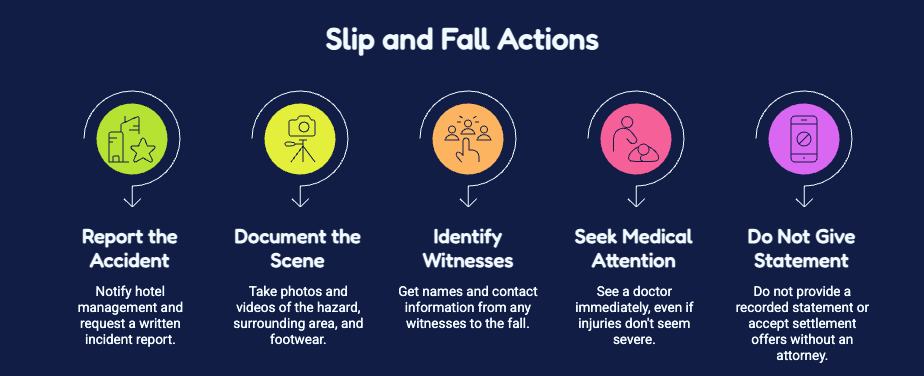
What to Do Immediately After a Slip and Fall at a Jacksonville Resort
The actions you take in the minutes and hours following a slip and fall accident have a direct impact on the strength of your legal claim. Follow these steps to protect your health and your rights.
Report the Accident to Hotel Management
Before you leave the area where you fell, notify a hotel manager or supervisor. Ask them to create a written incident report and request a copy for your records. Note the name of the person you spoke with and the time you made the report. This creates an official record of the accident and prevents the hotel from later claiming it never occurred.
Document the Scene Thoroughly
Use your phone to take photos and videos of the exact location where you fell. Capture the hazard that caused the fall, the surrounding area, any wet floor signs that were or were not present, and the footwear you were wearing. Conditions at hotel properties change quickly as staff respond to accidents, so documenting the scene before anything is cleaned or corrected is critical. If there are security cameras in the area, note their locations.
Identify and Preserve Witness Information
If any other guests or hotel employees witnessed your fall, get their names and contact information before they leave the area. Vacationers often scatter quickly, making it difficult to locate them later. Witness accounts can corroborate your description of the hazard and contradict claims by the hotel that the area was properly maintained.
Seek Medical Attention Immediately
See a doctor as soon as possible, even if your injuries do not feel severe right away. Adrenaline can mask pain, and injuries like soft tissue damage, fractures, and concussions may not present fully until hours after the accident. Medical records that connect your injuries to the date and circumstances of the fall are essential to your claim. Delaying treatment gives the insurance company grounds to argue that your injuries are not serious or were not caused by the fall.
Do Not Give a Recorded Statement to the Insurance Company
The resort’s liability insurer may contact you quickly after the accident. They are not calling to help you. Their goal is to gather information that minimizes or defeats your claim. Do not provide a recorded statement, accept any settlement offer, or sign any documents until you have spoken with an attorney.
Understanding Florida’s Two-Year Statute of Limitations
Under Florida Statute § 95.11(3)(a), as amended by House Bill 837 in 2023, you have two years from the date of your fall to file a personal injury lawsuit. If you miss this deadline, your case is permanently barred, regardless of how strong the evidence is. For a full breakdown of how this deadline works and the limited exceptions that may apply, read our detailed guide on understanding the statute of limitations for your injury claim.
Two years may seem like a long time, but building a strong premises liability case takes time. Your attorney needs to investigate the accident scene, obtain surveillance footage before it is overwritten, identify and interview witnesses, gather maintenance and inspection records, and work with medical experts to document the full extent of your injuries. The sooner you contact an attorney after your accident, the better your chances of preserving the evidence needed to win your case.
Can You Sue a Resort If You Signed a Liability Waiver?
Some resort activities — particularly pools, water sports, and recreational programs — include waiver language in check-in documents or activity registration forms. Many guests assume that signing anything at check-in eliminates their ability to make a claim if they are injured.
This is not necessarily true. Liability waivers in Florida are interpreted narrowly by courts, and they do not automatically bar all claims. A waiver that is buried in fine print, that is not conspicuous, or that attempts to waive liability for gross negligence or willful misconduct may be unenforceable. Even when a waiver is partially enforceable, it may not apply to the type of accident that occurred.
If you were asked to sign anything before or during your stay and you were later injured, do not assume your claim is gone. An experienced attorney can review the specific language of any waiver and advise you on whether it affects your rights.
How Pencheff and Fraley Can Help You After a Jacksonville Resort Slip and Fall
Pursuing a premises liability claim against a large resort or hotel chain requires legal expertise, investigative resources, and a thorough understanding of Florida law. At Pencheff and Fraley, our team of dedicated personal injury lawyers in Jacksonville has the knowledge and experience to take on even the largest property owners and their insurance companies.
We handle every aspect of your case from start to finish. Our attorneys will conduct a thorough investigation of the accident, gather and preserve critical evidence, work with medical and liability experts, and aggressively negotiate with the insurance company on your behalf. If the resort refuses to offer fair compensation, we are fully prepared to take your case to trial.
We understand the financial pressure that comes with a serious injury. That is why we work on a contingency fee basis — you pay no attorney’s fees unless we win your case. There are no upfront costs, and your initial consultation is completely free and confidential.
If you have been injured in a slip and fall at a Jacksonville beach or resort, do not wait. Evidence disappears quickly, and the clock on your legal deadline has already started. Contact Pencheff and Fraley today to speak with a qualified slip and fall lawyer Jacksonville FL who will fight for the full compensation you deserve.
Frequently Asked Questions
Who pays my medical bills after a slip and fall at a Jacksonville resort?
If the resort’s negligence caused your fall, their commercial liability insurance is the primary source of compensation for your medical bills. While your claim is being resolved, you may need to use your own health insurance to cover immediate treatment. Your attorney can help coordinate these coverages and negotiate any health insurance liens to maximize your net recovery. To learn more about the claims process, visit our personal injury page.
What do I have to prove to win a slip and fall case in Florida?
Under Florida Statute § 768.0755, if you slipped on a transitory foreign substance, you must prove that the business had actual or constructive knowledge of the hazard and failed to clean it up or warn you. For falls caused by structural defects, the analysis is different and often more favorable to the injured party. For a deeper look at what you need to prove, read our guide on what you need to prove in a slip and fall case.
How long do I have to file a slip and fall lawsuit in Florida?
Florida’s statute of limitations for personal injury lawsuits, including slip and fall cases, is two years from the date of the accident. This deadline was shortened from four years by House Bill 837 in 2023. Missing this deadline will permanently bar your claim. For more information on deadlines, see our article on understanding the statute of limitations for your injury claim.
Can I sue a hotel if I signed a liability waiver at check-in?
Yes, you may still have a valid claim even if you signed a waiver. Florida courts interpret liability waivers narrowly, and they do not protect hotels from gross negligence or failure to maintain safe premises. An attorney can review the specific language of any waiver and advise you on whether it affects your rights.
How much is my slip and fall case worth?
The value of your case depends on the severity of your injuries, the extent of your medical bills, your lost wages, and the impact the accident has had on your quality of life. There is no one-size-fits-all answer, but our attorneys can evaluate the specific facts of your case and provide an honest assessment of its value. Read our detailed guide on how much a slip and fall case is worth in Florida for more information.
What should I do right after a slip and fall at a Jacksonville resort?
Report the accident to hotel management immediately and request a written incident report. Document the scene with photos and videos, gather witness contact information, seek medical attention right away, and do not give a recorded statement to the insurance company. Then, contact an experienced personal injury lawyer in Jacksonville as soon as possible. For a complete step-by-step guide, read our article on what to do after a slip and fall accident.
Does Florida’s comparative negligence law affect my resort slip and fall claim?
Yes. Under Florida’s modified comparative negligence rule, if you are found to be more than 50% at fault for your accident, you cannot recover any compensation. Insurance companies routinely argue that injured guests were not paying attention or were wearing improper footwear. A skilled attorney will counter these arguments and protect your right to full compensation. Learn more about Florida slip and fall laws in 2026.
Conclusion
A slip and fall accident at a Jacksonville beach or resort can cause serious, life-altering injuries and leave you facing overwhelming medical bills. Florida premises liability law gives you the right to hold negligent property owners accountable, but proving your case requires prompt action, careful evidence preservation, and a thorough understanding of complex legal requirements.
The most important thing you can do after a resort slip and fall is to contact an experienced slip and fall lawyer Jacksonville FL as soon as possible. At Pencheff and Fraley, we are committed to fighting for injured victims and their families. We offer free, confidential consultations and handle all personal injury cases on a contingency fee basis — meaning you pay nothing unless we win.
Do not let a negligent resort escape accountability. Contact our Jacksonville office today at 904-770-4953 or visit our contact page to schedule your free consultation. Let our team of dedicated personal injury lawyers in Jacksonville put their experience to work for you.
Author: Pencheff and Fraley Legal Team
Disclaimer: This article is for informational purposes only and does not constitute legal advice. Every case is unique, and you should consult with a qualified attorney about your specific situation.