

If you have been hurt in a crash, one of the first questions you will ask is: how long does car accident lawsuit take Florida? The honest answer is that it depends. Some Florida car accident claims resolve in a few months. Others — especially those involving serious injuries, disputed liability, or uncooperative insurers — can take one to three years or more.
Understanding the Florida car accident settlement timeline puts you in control. It helps you set realistic expectations, avoid costly mistakes like accepting a premature settlement offer, and make informed decisions about your case. This guide walks you through every stage of the process, the key factors that affect your timeline, and the critical legal deadlines that apply under current Florida law.
What Is the Typical Florida Car Accident Settlement Timeline?
Before diving into the details, the table below gives a quick overview of how long a car accident case takes in Florida based on injury severity and case complexity.
| Case Type | Estimated Timeline |
| Minor injuries, clear liability | 3 to 6 months |
| Moderate injuries or shared fault | 6 to 12 months |
| Severe injuries, surgery required | 12 to 24 months |
| Complex litigation or trial | 2 to 4+ years |
These ranges are estimates. Every case is unique, and a single complicating factor — such as a disputed liability question or an uncooperative insurance company — can push any case into a longer category.
Stage-by-Stage: The Florida Car Accident Lawsuit Process
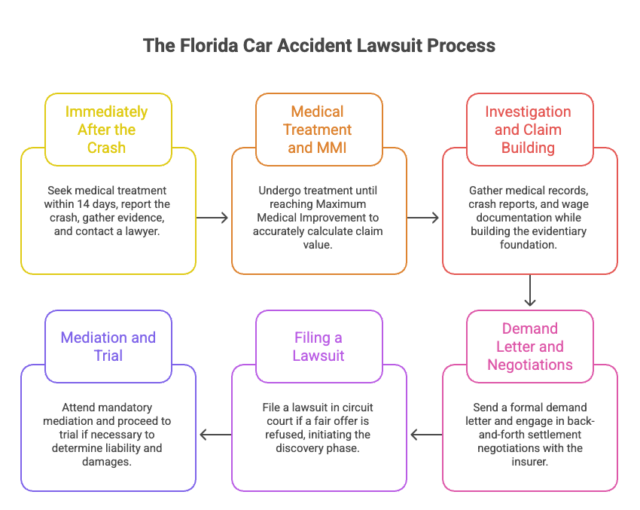
Stage 1: Immediately After the Crash (Days 1 to 14)
The Florida car accident lawsuit process begins the moment the crash occurs. Your first priority is your health. Florida’s no-fault insurance system requires you to seek initial medical treatment within 14 days of the accident to preserve your Personal Injury Protection (PIP) benefits under Florida Statute § 627.736. Missing this window can cost you up to $10,000 in PIP coverage.
At the same time, you should report the crash to law enforcement if it involves injury, death, or property damage exceeding $500, as required by Florida Statute § 316.065. Gather evidence at the scene — photographs, witness contact information, and the other driver’s insurance details.
Contacting a Florida car accident lawyer at this stage is strongly advisable. An attorney can begin preserving evidence, such as traffic camera footage and vehicle black box data, before it is lost or overwritten.
Stage 2: Medical Treatment and Maximum Medical Improvement (Weeks to Months)
This is almost always the longest phase of the car accident lawsuit timeline Florida. Before your attorney can calculate the true value of your claim, you must reach Maximum Medical Improvement (MMI). MMI is the point at which your treating physicians determine that your condition has stabilized and is unlikely to improve further with continued treatment.
Reaching MMI is essential for two reasons. First, it allows your attorney to accurately calculate the full cost of your past and future medical care. Second, it prevents you from accepting a settlement that is far too low to cover your ongoing needs. Settling before MMI is one of the most common and costly mistakes accident victims make.
The time it takes to reach MMI varies widely. Minor soft-tissue injuries may resolve in six to twelve weeks. Fractures, herniated discs, and traumatic brain injuries can require six months to two years of treatment before a doctor can issue an MMI determination.
Stage 3: Case Investigation and Building Your Claim (Runs Parallel to Treatment)
While you focus on recovery, your legal team is building the evidentiary foundation of your case. This phase involves gathering all medical records and billing statements, obtaining the official crash report from the Florida Department of Highway Safety and Motor Vehicles (FLHSMV), documenting lost wages with employer verification, and identifying all available insurance coverage.
If liability is disputed, this phase may also involve retaining an accident reconstruction expert, reviewing surveillance footage, and interviewing witnesses. Cases involving multiple liable parties — such as a commercial truck driver and their employer — require additional investigation to identify every responsible party and their respective insurance policies.
Stage 4: The Demand Letter and Settlement Negotiations (30 to 90 Days)
Once you have reached MMI and all documentation is in order, your attorney will send a formal demand letter to the at-fault party’s insurance company. This letter presents the facts of the accident, details your injuries and treatment, quantifies your economic and non-economic damages, and states the amount you are seeking.
Under Florida law, insurance companies have a general obligation to respond to claims in a timely manner. In practice, the insurer will review the demand and respond — usually with a lower counteroffer. A period of back-and-forth negotiation follows. Many Florida car accident cases settle during this phase, avoiding the need for a lawsuit entirely.
If the insurer uses delay tactics — such as repeatedly requesting documents that have already been provided or switching adjusters to reset the process — your attorney can apply legal pressure to keep the case moving.
Stage 5: Filing a Personal Injury Lawsuit (If Necessary)
If the insurance company refuses to make a fair offer, your attorney will file a personal injury lawsuit in the appropriate Florida circuit court. Filing suit does not mean your case will go to trial. In fact, the act of filing often prompts the insurer to take the claim more seriously and return to the negotiating table.
Once the lawsuit is filed, the case enters the discovery phase. Both sides exchange evidence through interrogatories (written questions), requests for production of documents, and depositions (sworn testimony taken before trial). Discovery can take six months to a year or more, depending on the complexity of the case.
Stage 6: Mediation and Trial
Florida courts require parties in civil litigation to attend mediation before proceeding to trial. A neutral mediator facilitates a structured negotiation session, and the vast majority of car accident lawsuits settle at or before mediation. This is good news for most clients, as it avoids the expense and uncertainty of a trial.
If mediation fails, the case proceeds to trial. A jury will hear the evidence and determine both liability and the amount of damages. Trials can last several days to several weeks. After a verdict, either party may appeal, which can add additional months or years to the process.
Key Factors That Affect How Long a Car Accident Case Takes in Florida
Severity of Injuries and Length of Treatment
The more serious your injuries, the longer your case will take. Catastrophic injuries — such as spinal cord damage, traumatic brain injuries, or injuries requiring multiple surgeries — demand extended medical treatment before MMI can be reached. Your attorney must wait for a complete medical picture before making a demand, because settling early means permanently waiving your right to additional compensation.
Disputed Liability and Florida’s Comparative Negligence Law
When fault is clear — for example, in a rear-end collision with a police report confirming the other driver ran a red light — the case tends to move faster. When liability is disputed, the insurance company will conduct its own investigation, which adds weeks or months to the timeline.
Florida’s 2023 tort reform changed the state from a pure comparative negligence system to a modified comparative negligence system. Under this change, if you are found to be more than 50% at fault for the accident, you are completely barred from recovering any compensation. Because of this rule, insurers now have a stronger incentive to argue that you share blame, making liability disputes more common and more contentious.
Insurance Company Tactics
Insurance companies are businesses, and their financial interest lies in minimizing payouts. Common delay tactics include offering a lowball settlement immediately after the accident (before you know the full extent of your injuries), requesting duplicate documentation, and assigning a new adjuster to restart negotiations from scratch. An experienced personal injury attorney will recognize these tactics and respond effectively.
Multiple Liable Parties
Accidents involving commercial trucks, rideshare vehicles like Uber or Lyft, or government-owned vehicles introduce additional layers of complexity. Each liable party has its own insurer and legal team, and reaching a global settlement requires all parties to agree on their respective shares of fault. If you were injured in a rideshare crash, you can learn more about how these claims work in our article on Uber and Lyft injury claims.
Court Docket Congestion
Even if your attorney is ready to go to trial, the case cannot proceed until the court has an available date. In busy Florida jurisdictions — including Hillsborough County (Tampa), Duval County (Jacksonville), and Orange County (Orlando) — court dockets can be congested, sometimes adding six months or more to the litigation timeline.
Florida Car Accident Statute of Limitations: Critical 2026 Deadlines
One of the most important aspects of the Florida car accident lawsuit process is understanding the statute of limitations. Missing this deadline means losing your right to compensation entirely, regardless of how strong your case is.
For accidents occurring on or after March 24, 2023, Florida law sets a two-year statute of limitations for personal injury claims arising from negligence, including car accidents. This is codified under Florida Statute § 95.11(4)(a), as amended by the 2023 tort reform legislation.
For accidents that occurred before March 24, 2023, the prior four-year statute of limitations may still apply, depending on the specific circumstances of your case.
If the accident resulted in a wrongful death, the surviving family members generally have two years from the date of death to file a wrongful death lawsuit. Because these deadlines are strict and the applicable rule depends on when the accident occurred, you should consult with a qualified attorney as soon as possible to confirm your specific filing deadline.
How Long Does It Take to Get a Settlement Check After a Car Accident in Florida?
Once a settlement agreement is reached, most clients want to know when they will actually receive their money. From the date the settlement documents are signed, you can typically expect to receive your check within four to six weeks.
Here is what happens during that window. First, the insurance company processes the signed release form and issues a settlement check to your attorney’s trust account. Your attorney is then legally required to resolve all outstanding medical liens — amounts owed to healthcare providers, hospitals, Medicare, Medicaid, or private health insurers that paid for your treatment. Once all liens and attorney fees are deducted, the remaining funds are disbursed to you.
The lien resolution process can sometimes take longer than expected, particularly if Medicare or Medicaid is involved, as federal agencies have their own review procedures.
How a Florida Car Accident Lawyer Affects Your Timeline
Hiring an experienced attorney does not slow your case down — it almost always speeds it up. Here is why. Insurance companies know which law firms are prepared to file suit and take cases to trial. When they receive a demand from a firm with a strong litigation track record, they are more likely to make a fair offer during the negotiation phase, avoiding the cost and uncertainty of a trial.
An attorney also handles all the procedural work that causes delays for unrepresented claimants: gathering medical records, responding to insurer requests, meeting court deadlines, and managing the lien resolution process. Clients who handle their own claims often miss critical steps that allow the insurance company to delay or deny their claim.
At Pencheff & Fraley, our Florida personal injury attorneys work on a contingency fee basis, which means you pay nothing unless we win or settle your case. You can review our personal injury fees and links page for more information on how our fee structure works.
Our firm serves clients throughout Florida from multiple locations, including Jacksonville, Tampa, Orlando, Kissimmee, and Winter Haven. You can also review our case results to see the outcomes we have achieved for clients in situations similar to yours.
What to Do Right Now to Protect Your Claim
Taking the right steps immediately after a crash can significantly shorten your car accident lawsuit timeline Florida and strengthen your case.
Seek medical attention immediately. Do not wait. Even if you feel fine, some injuries — including traumatic brain injuries and internal bleeding — do not produce obvious symptoms right away. Prompt medical care also creates a documented record linking your injuries to the accident.
Do not give a recorded statement to the other driver’s insurance company. Adjusters are trained to ask questions in ways that can be used to minimize your claim. Politely decline and refer them to your attorney.
Document everything. Keep a journal of your symptoms, medical appointments, and how your injuries affect your daily life. Save all medical bills, prescription receipts, and communications with insurance companies.
Contact a Florida car accident attorney promptly. Evidence fades quickly. Surveillance footage is often overwritten within days. Witnesses’ memories fade. The sooner an attorney begins working on your case, the stronger your claim will be.
Frequently Asked Questions About Florida Car Accident Lawsuits
#1. How long does Florida car accident lawsuit take to go to trial?
If your case cannot be resolved through negotiation or mediation, it may take 12 to 24 months — or longer — to reach a trial date after a lawsuit is filed. The exact timeline depends on the specific court’s docket and the complexity of the discovery process. Most cases, however, settle before trial.
#2. How long does insurance have to settle a car accident claim in Florida?
Under Florida law, insurance companies have 30 days to acknowledge receipt of a claim and begin investigation. For PIP claims, the insurer has 30 days to pay or deny a claim after receiving all required documentation. For third-party bodily injury claims, there is no rigid statutory deadline to settle, which is why legal representation is so important.
#3. What happens if I miss the Florida car accident statute of limitations?
If you file a lawsuit after the two-year deadline (for accidents after March 24, 2023), the court will almost certainly dismiss your case. The defendant’s attorney will file a motion to dismiss based on the expired statute of limitations, and you will lose your right to compensation permanently. There are very limited exceptions, such as cases involving minors or fraud.
#4. Do I need to reach Maximum Medical Improvement before settling?
Yes, in virtually all cases. Settling before MMI is risky because you cannot predict your future medical needs. Once you sign a settlement release, the case is closed forever. If your condition worsens or you require additional surgery, you will have no legal recourse to recover those costs.
#5. Can I switch attorneys if my case is taking too long?
Absolutely. You have the right to change your legal representation at any time during your case. If you feel your attorney is not communicating effectively or is not moving your case forward, you can seek new counsel. Our article on switching personal injury lawyers in Florida explains the process in detail.
#6. How does Florida’s no-fault insurance system affect my car accident case?
Florida is a no-fault state, meaning your own PIP coverage pays for the first $10,000 of your medical bills and 60% of lost wages, regardless of who caused the accident. To step outside the no-fault system and file a claim against the at-fault driver, your injuries must meet Florida’s serious injury threshold — which includes significant or permanent loss of a bodily function, permanent injury, significant scarring or disfigurement, or death.
#7. Is there a difference between a car accident settlement and a car accident lawsuit?
Yes. A settlement is a negotiated agreement reached between the parties — usually with the insurance company — without going to court. A lawsuit is a formal legal action filed in court when a settlement cannot be reached. Most Florida car accident cases resolve through settlement. Only a small percentage proceed to trial.
Conclusion: Start Your Florida Car Accident Claim Today
Understanding how long does car accident lawsuit take Florida is the first step toward protecting your rights. The timeline depends on the severity of your injuries, the complexity of liability, and the willingness of the insurance company to negotiate fairly. What is certain is that time is not on your side. Evidence disappears, witnesses move on, and the statute of limitations clock is always ticking.
The experienced Florida car accident lawyers at Pencheff & Fraley have helped injured clients across the state secure the compensation they deserve — from Jacksonville to Tampa to Orlando. We handle every aspect of your claim so you can focus on healing.
Contact us today for a free, no-obligation case evaluation. There are no upfront fees — you pay nothing unless we win. Read our client testimonials to learn what our clients say about working with our team, and visit our personal injury FAQs page for answers to more common questions.
This article is intended for general informational purposes only and does not constitute legal advice. Laws change, and the information above may not reflect the most recent legal developments. Please contact a qualified Florida personal injury attorney to discuss the specific facts of your case.