

When you are hurt in an Ohio car accident, the physical and emotional toll can be overwhelming. One of the most complex issues you might face is a traumatic brain injury (TBI). The unique challenges of proving a traumatic brain injury (TBI) in court begin the moment you leave the emergency room. Unlike broken bones or deep lacerations, brain injuries are often invisible. This invisible nature makes it incredibly difficult to demonstrate the full extent of your suffering to an insurance company or a jury.
Proving a traumatic brain injury in court requires more than just a statement of your symptoms. It demands a strategic approach, comprehensive medical evidence, and a deep understanding of personal injury law. This guide walks you through the complexities of TBI litigation, the crucial role of medical experts, and the specific hurdles victims face when seeking fair compensation in Ohio and Florida.
What Is a Traumatic Brain Injury?
A traumatic brain injury occurs when an external physical force disrupts normal brain function. According to the Centers for Disease Control and Prevention (CDC), a concussion is a type of TBI caused by a bump, blow, or jolt to the head. TBIs range from mild concussions to severe, life-altering injuries that cause permanent disability.
There are two main categories of TBIs: penetrating TBIs, where an object pierces the skull, and blunt TBIs, where a violent jolt causes the brain to strike the inside of the skull. Blunt TBIs are far more common in car accidents and are also the most difficult to prove in court because they leave no visible external wound.
Common TBI Symptoms to Document
Symptoms vary widely depending on the severity of the injury. Documenting them early and consistently is critical for your claim.
| Symptom Category | Mild TBI (Concussion) | Moderate to Severe TBI |
| Physical | Headaches, dizziness, nausea, light sensitivity | Seizures, loss of consciousness, severe headaches |
| Cognitive | Memory lapses, difficulty concentrating | Significant memory loss, confusion, disorientation |
| Emotional | Irritability, anxiety, mood swings | Depression, impulsivity, personality changes |
| Sleep | Insomnia, fatigue, sleeping more than usual | Inability to wake, coma in severe cases |
The Invisible Nature of TBIs: The Core Challenge
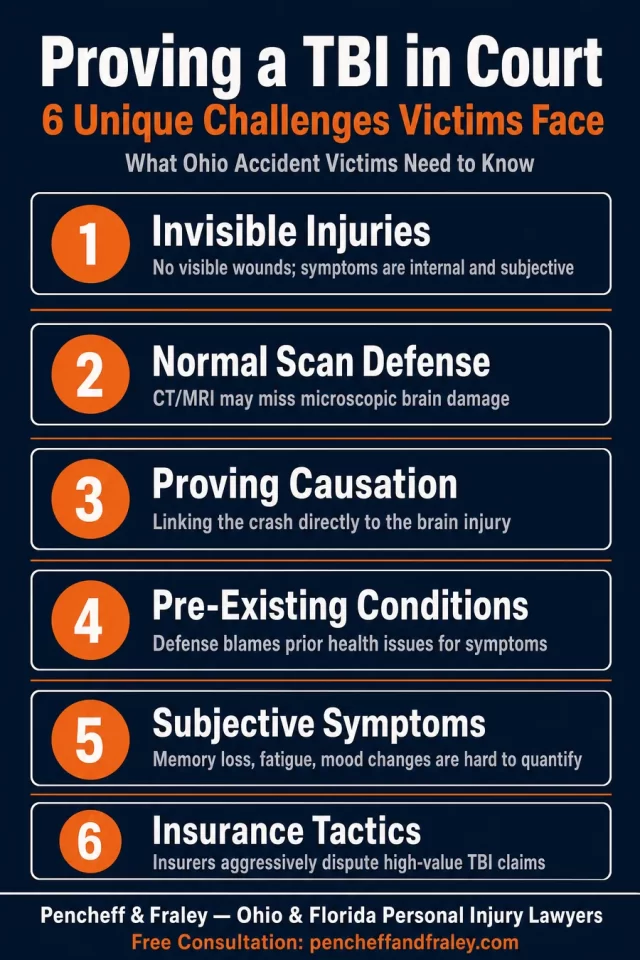
One of the primary challenges in any catastrophic personal injury claim involving a TBI is the absence of visible, external wounds. A victim might look perfectly fine on the outside while struggling with severe cognitive, emotional, and physical impairments on the inside.
Insurance companies and defense attorneys frequently exploit this lack of visible evidence. They may argue that your symptoms are exaggerated, pre-existing, or unrelated to the accident. Because a concussion or mild TBI might not appear on a standard CT scan or MRI, defendants often try to minimize the severity of the injury.
Why Standard Imaging Often Fails to Detect TBIs
In many emergency rooms, the first step after a head trauma is to order a CT scan. While CT scans are excellent for detecting life-threatening issues like skull fractures or massive intracranial bleeding, they are notoriously poor at identifying the microscopic cellular damage that characterizes many concussions and mild TBIs.
As Johns Hopkins Medicine notes, concussion symptoms can appear right away or come on slowly over time, and force transmitted from the body — not just a direct blow to the head — can cause a concussion. This is why a “normal” scan does not tell the whole story.
When an MRI or CT scan comes back “normal,” the defense will immediately use this as evidence that no injury occurred. Overcoming this “normal scan” defense is a significant hurdle. It requires specialized medical experts who can explain to a jury that a clear scan does not equate to a healthy brain. Advanced imaging techniques, such as SPECT scans or Diffusion Tensor Imaging (DTI), may be necessary to reveal the subtle, functional abnormalities caused by the trauma.
Proving Causation: Connecting the Crash to the Injury
Another major hurdle in TBI litigation is proving causation. You must clearly establish that the specific accident in question directly caused your brain injury. This can be particularly difficult if the accident involved a “low impact” collision or if there was no direct blow to the head.
Defense attorneys will quickly point out that without a severe impact or a loss of consciousness, a TBI is unlikely. However, medical science clearly shows that the rapid acceleration and deceleration forces in a car crash can cause the brain to violently strike the inside of the skull, resulting in a TBI even without direct head contact.
Overcoming the Pre-Existing Condition Defense
If you have a history of migraines, anxiety, depression, or previous head injuries, the defense will inevitably argue that your current symptoms are merely a continuation of these pre-existing conditions.
To defeat this argument, your legal team must establish a clear “before and after” picture of your life. This involves gathering extensive medical records from before the accident to show your baseline level of functioning. By contrasting your pre-accident health with your post-accident struggles, your attorney can demonstrate how the recent trauma either caused new impairments or significantly aggravated a pre-existing condition. This strategy is especially important in rear-end collision cases where pre-existing back or head injuries are involved.
Demonstrating the Long-Term Impact on Daily Life
A traumatic brain injury does not just cause headaches; it alters how a person thinks, feels, and interacts with the world. Proving these functional impairments in court is critical for securing a fair settlement.
Symptoms like memory loss, difficulty concentrating, extreme fatigue, and severe mood swings can make it impossible to return to work or maintain healthy relationships. Because these symptoms are largely subjective, they are easily challenged by the defense. This is why building a multi-layered evidence strategy is so important.
The Power of “Before and After” Witnesses
To prove the subjective impact of a TBI, personal testimony from the victim is rarely enough on its own. Juries and insurance adjusters need to hear from the people who know you best.
Co-workers, friends, and family members can provide powerful “before and after” testimony. A spouse can describe how a once-patient partner has become irritable and impulsive. An employer can testify about a noticeable decline in work performance or an inability to complete complex tasks. This community witness testimony translates abstract medical diagnoses into tangible, real-world losses that a jury can understand and value.
Documenting Functional Losses
Beyond witness testimony, you should document specific daily tasks that have become difficult or impossible since the injury. Consider the following areas:
- Work performance: Errors, reduced pace, missed shifts, or needing extra breaks.
- Driving: Avoidance of complex routes, slower reaction times, or difficulty with busy intersections.
- Home tasks: Forgetting steps in cooking, difficulty managing finances, or increased frustration with noise.
- Relationships: Mood swings, social withdrawal, and reduced patience with family members.
Keeping a detailed daily journal from the day of the accident is one of the most powerful things you can do to support your claim.
The Crucial Role of Expert Medical Testimony
Because the science of brain injuries is highly complex, expert medical testimony is the backbone of any successful TBI case. You cannot simply hand a jury a stack of medical records and expect them to understand the nuances of neuropsychology. Your legal team will likely need to retain several different types of experts.
Neurologists and Neuropsychologists
A neurologist can explain the physical mechanism of the injury and interpret complex imaging studies. However, it is often the neuropsychologist who plays the most critical role.
A neuropsychologist administers a battery of objective tests designed to measure cognitive function, memory, attention, and problem-solving skills. These tests can identify specific areas of brain dysfunction that standard imaging misses. As Dansker & Aspromonte explain, neuropsychologists are often the only specialists able to objectively document a TBI victim’s cognitive injuries. A skilled neuropsychologist can definitively link these deficits to the traumatic event.
Biomechanical Engineers
In cases where the defense argues that the impact was too minor to cause a brain injury, a biomechanical engineer may be necessary. These experts analyze the physical forces involved in the crash and explain how those specific forces act upon the human body and brain. They can demonstrate to a jury how even a seemingly minor rear-end collision can generate enough force to cause a concussion. This type of testimony is especially valuable in truck accident cases where the forces involved are extreme.
Defense Tactics and How to Counter Them
Insurance companies and defense attorneys are well-versed in minimizing TBI claims. Understanding their playbook is the first step to defeating it.
| Defense Tactic | How to Counter It |
| “The impact was too minor” | Biomechanical expert testimony on crash forces; consistent symptom documentation |
| “Your scan was normal” | Neuropsychological testing; advanced imaging (SPECT, DTI); expert explanation of imaging limitations |
| “You had pre-existing conditions” | Pre-accident medical records establishing a clear baseline; expert testimony on aggravation |
| “You seem fine now” | Documented flare-ups, missed work records, ongoing therapy notes, and witness testimony |
| “Your symptoms are subjective” | Objective neuropsychological test scores; employer and family witness testimony |
Key Steps to Protect Your TBI Claim in Ohio
If you suspect you have suffered a brain injury in an Ohio car accident, the actions you take immediately following the crash can significantly impact the success of your claim.
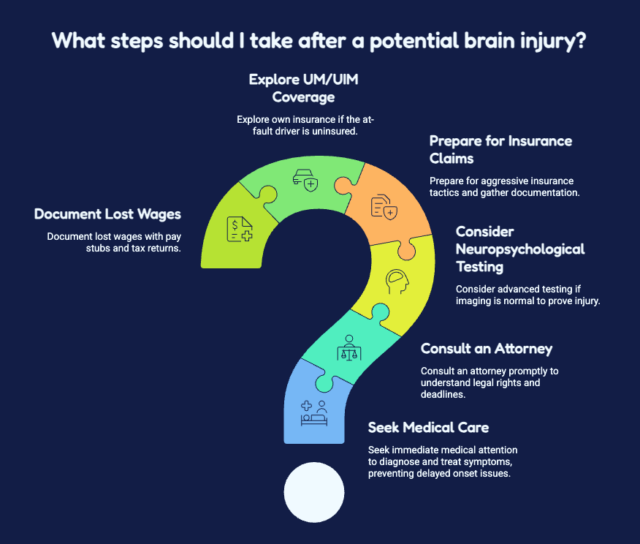
Step 1: Seek Immediate Medical Attention. Do not wait to see if your symptoms improve. Go to the emergency room or urgent care immediately and report all of your symptoms, no matter how minor they seem. The first medical record is a critical anchor for your case.
Step 2: Follow All Medical Advice. Attend all follow-up appointments, complete prescribed therapies, and follow your doctor’s restrictions. Gaps in treatment will be used against you by the insurance company.
Step 3: Keep a Detailed Symptom Journal. Document your daily struggles, pain levels, and how the injury is affecting your life, work, and relationships. This firsthand account is invaluable evidence.
Step 4: Avoid Social Media. Do not post photos or statements on social media that could be taken out of context to suggest you are not injured. Insurance companies routinely monitor claimants’ social media profiles. Learn more about why you should not post on social media after an injury.
Step 5: Consult an Experienced Attorney Promptly. TBI cases are highly specialized. You need a legal team with a proven track record of handling complex brain injury litigation. To understand your rights and the process, review our guide on how to start a personal injury claim in Ohio.
Ohio-Specific Considerations for TBI Claims
Ohio law governs the rights of accident victims in specific ways that directly affect TBI claims. Understanding these rules is essential for protecting your right to compensation.
The Ohio Statute of Limitations
Under Ohio Revised Code § 2305.10, you generally have two years from the date of the injury to file a personal injury lawsuit. Missing this deadline almost always means losing your right to sue. Because TBI symptoms can sometimes emerge days or weeks after an accident, it is vital to consult an attorney as soon as possible. For a full breakdown of these deadlines, see our guide on the statute of limitations for car accidents in Ohio.
Comparative Fault in Ohio
Ohio follows a modified comparative fault rule. If you are found to be partially at fault for the accident, your compensation will be reduced by your percentage of fault. If you are found to be more than 50% at fault, you may be barred from recovering any damages. This makes it critical to preserve all evidence that establishes the other driver’s negligence.
Dealing with Insurance Companies
Insurance adjusters are trained to minimize payouts. They may contact you quickly after the accident and offer a fast settlement before the full extent of your TBI is known. Never accept a settlement offer without first consulting an attorney. If an insurer is offering a low settlement, learn what to do in our guide on insurance companies offering low settlements.
What Compensation Can You Recover for a TBI?
A successful TBI claim can include compensation for a wide range of losses, both economic and non-economic.
Economic Damages cover your measurable financial losses, including:
- Past and future medical expenses (emergency care, surgery, rehabilitation, therapy)
- Lost wages and reduced earning capacity
- Cost of in-home care and assistive devices
- Home modification costs
Non-Economic Damages cover the intangible losses that are harder to quantify, including:
- Pain and suffering
- Emotional distress
- Loss of enjoyment of life
- Loss of consortium (the impact on your relationship with your spouse)
The value of your claim depends on many factors, including the severity of the injury, your age, your occupation, and the strength of the evidence. For a detailed overview of the factors that affect your compensation, see our guide on car accident settlement factors.
Frequently Asked Questions
What are the most common symptoms of a mild traumatic brain injury?
Symptoms often include persistent headaches, dizziness, confusion, memory problems, sensitivity to light or noise, extreme fatigue, and sudden mood changes. These symptoms may not appear immediately after the accident. Because of this delayed onset, many victims make the mistake of not seeking medical care right away, which can seriously harm their legal claim.
How long do I have to file a brain injury lawsuit in Ohio?
In Ohio, the statute of limitations for personal injury claims, including those involving a TBI from a car accident, is generally two years from the date of the injury. However, specific circumstances can alter this deadline. It is crucial to consult an attorney promptly to ensure you do not miss this critical window.
Can I still recover damages if my CT scan was normal?
Yes. A normal CT scan or MRI does not rule out a concussion or mild TBI. Advanced neuropsychological testing and expert medical testimony can prove the existence and severity of a brain injury even when standard imaging is clear. Many successful TBI cases are built entirely on neuropsychological evidence and witness testimony.
Why do insurance companies fight TBI claims so aggressively?
TBI claims often involve significant long-term medical care, lost earning capacity, and profound pain and suffering, making them high-value cases. Because the injuries are often invisible, insurers see an opportunity to minimize the payout by disputing the severity or causation of the injury. Having an experienced attorney levels the playing field.
What if the at-fault driver was uninsured?
If you are hit by an uninsured driver, you may still be able to recover compensation through your own uninsured/underinsured motorist (UM/UIM) coverage. Our attorneys can help you navigate the complexities of handling car accidents involving uninsured drivers.
How do I prove lost wages after a TBI prevents me from working?
Proving lost wages requires documentation such as pay stubs, tax returns, employer statements, and medical records confirming your inability to work. Our guide on how to prove lost wages after an accident provides a step-by-step breakdown.
Conclusion: You Deserve a Strong Advocate
Proving a traumatic brain injury in court is undeniably challenging. The invisible nature of the injury, the complexity of the medical science, and the aggressive tactics of insurance companies create significant hurdles for victims. However, with compelling medical evidence, strong witness testimony, and an experienced legal strategy, these challenges can be overcome.
If you or a loved one has suffered a brain injury due to someone else’s negligence, you do not have to face this battle alone. The attorneys at Pencheff & Fraley have the resources and expertise to build a strong case and fight for the maximum compensation you deserve. We serve clients throughout Ohio and Florida on a contingency fee basis — meaning you pay nothing unless we win.
Contact us today for a free consultation to discuss your legal options and protect your future.
References
- Centers for Disease Control and Prevention. “Concussion Basics.” https://www.cdc.gov/heads-up/about/index.html
- Johns Hopkins Medicine. “Concussion.” https://www.hopkinsmedicine.org/health/conditions-and-diseases/concussion
- Brain Injury Law Center. “Brain Injury Litigation: How to Link Trauma to Injury, Part 1.” https://www.brain-injury-law-center.com/brain-injury-litigation-part-1
- Dansker & Aspromonte. “The Medical and Legal Challenges of Traumatic Brain Injury Cases.” https://www.dandalaw.com/blog/the-medical-and-legal-challenges-of-traumatic-brain-injury-cases
- Delfino Green & Green. “Why Proving a Traumatic Brain Injury (TBI) in Court Is Difficult.” https://www.dgglaw.com/why-proving-a-traumatic-brain-injury-tbi-in-court-is-difficult/
- Ohio Revised Code § 2305.10. https://codes.ohio.gov/ohio-revised-code/section-2305.10