

Being involved in an accident is a terrifying experience that often leads to severe physical, emotional, and financial distress. While focusing on your recovery and dealing with medical expenses, you may also find yourself unable to work. This loss of income can be devastating for you and your family. If you are wondering how to prove lost wages after an accident, you are not alone. Securing the compensation you deserve requires careful documentation and a strategic legal approach.
When another party’s negligence causes your injuries, you have the right to seek reimbursement for the income you have lost. Whether you are an hourly worker, a salaried employee, or a self-employed professional, understanding the specific evidence required to build a strong lost wages claim is critical. At Pencheff and Fraley LPA, our experienced personal injury attorneys have helped countless accident victims navigate this complex process across Ohio and Florida. In this comprehensive guide, we will break down exactly what you need to know to successfully recover your lost earnings.
What Are Lost Wages in a Personal Injury Claim?
Lost wages refer to the income you would have earned if you had not been injured in the accident. This economic damage is a crucial component of any personal injury settlement. It encompasses far more than just your base salary or hourly pay.
A comprehensive lost wages claim should account for all forms of compensation you missed due to your inability to work. Depending on your employment situation and the severity of your injuries, your claim may include a wide range of income types. It is important to recognize that insurance companies will closely scrutinize every element of your claim, so having clear, documented proof for each category is essential.
Types of Recoverable Lost Income
When calculating your total lost wages, you and your attorney will examine every source of income affected by your injuries. Recoverable lost income can include:
- Base Salary and Hourly Wages: The standard income you missed while recovering from your injuries.
- Overtime Pay: If you regularly worked overtime before the accident, you can claim the overtime wages you would have earned.
- Bonuses and Commissions: Performance-based pay or sales commissions you missed due to your absence.
- Paid Time Off (PTO): If you were forced to use sick days, vacation days, or personal time to cover your absence, you can seek compensation for the value of those days.
- Lost Benefits: Missed retirement contributions, employer health insurance contributions, or other employer-provided perks.
- Missed Promotions and Raises: If your absence caused you to miss a scheduled raise or promotion, this lost earning potential can be included in your claim.
The following table summarizes the most common types of lost income and the documentation typically required to prove each:
| Type of Lost Income | Required Documentation |
| Base salary / hourly wages | Pay stubs, W-2 forms, employer verification letter |
| Overtime pay | Payroll records, employer statement of average overtime |
| Bonuses / commissions | Employment contract, performance records, employer letter |
| Paid time off used | PTO balance records, employer confirmation |
| Lost benefits | Benefits summary, employer statement of contributions |
| Missed promotion / raise | Offer letter, performance reviews, employer statement |
| Self-employment income | Tax returns, profit & loss statements, bank statements |
If you were injured in a car accident, the process of calculating these damages begins immediately. Gathering the right documentation early on will significantly strengthen your case and protect your right to full compensation.
How to Calculate Lost Wages After an Accident
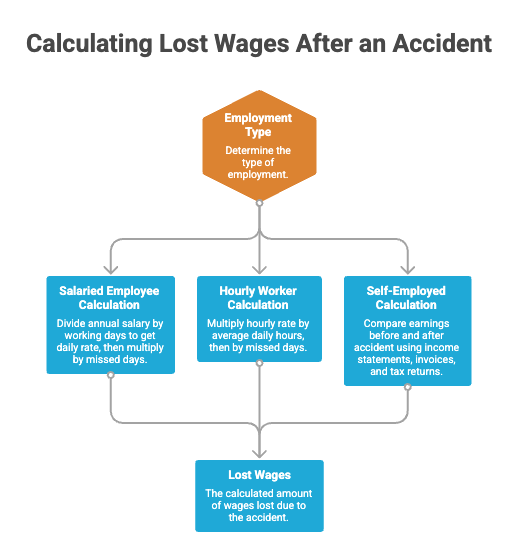
The method for calculating lost wages depends heavily on your employment type. The calculation is relatively straightforward for traditional employees, but it becomes more complex for those with variable income or self-employment.
Calculating Lost Wages for Salaried Employees
For salaried employees, the calculation involves dividing your annual salary by the number of working days in a year to arrive at your daily rate. You then multiply that daily rate by the number of days you missed. For example, if you earn $60,000 per year and missed 30 days of work, your lost wages would be approximately $6,986 (based on 257 working days in a year).
Calculating Lost Wages for Hourly Workers
For hourly workers, the process is equally direct. Multiply your hourly rate by the average number of hours you work per day, then multiply that figure by the total number of days you were unable to work. If you typically work 8 hours per day at $25 per hour and missed 20 days, your lost wages would be $4,000.
Calculating Lost Wages for Self-Employed Individuals
Calculating lost wages for self-employed individuals is more complex. This typically involves comparing your earnings before and after the accident. Income statements, invoices, and tax returns from previous years help establish an average income to determine what you have lost.
Essential Documentation to Prove Your Lost Wages
To successfully prove lost wages after an accident, you must provide concrete evidence that links your injuries directly to your missed work and resulting financial loss. Insurance companies will not simply take your word for it; they require a clear, verifiable paper trail.
The exact documents you need will depend on your employment status, but several key pieces of evidence apply to almost every case. Strong proof includes employer payroll and timekeeping records, a supervisor or HR wage verification, medical notes restricting you from work, and pay-related tax forms or bank statements.
Medical Records and Doctor’s Notes
The foundation of any lost wages claim is medical evidence. You must prove that your injuries were severe enough to prevent you from performing your job duties. Your medical records serve as the primary link between the accident and your inability to work.
Your doctor should provide a detailed statement outlining your injuries, the required treatment plan, and specific work restrictions. If your doctor places you on “light duty” and your employer cannot accommodate those restrictions, you can still claim lost wages for the time you are unable to fulfill your full duties. It is crucial to attend all medical appointments and strictly follow your doctor’s orders, as gaps in treatment can be used against you by the insurance company.
If you are involved in a truck accident, which often results in severe and long-lasting injuries, detailed medical documentation is even more critical to securing full compensation.
Employer Verification and Payroll Records
For traditionally employed individuals, an employer verification letter is one of the strongest pieces of evidence you can provide. This document, typically drafted by your human resources department or direct supervisor, should detail your employment status and the exact financial impact of your absence.
A comprehensive employer verification letter should include:
- Your job title and a description of your duties.
- Your normal rate of pay (hourly wage or annual salary).
- The exact dates and number of hours you missed due to the accident.
- Confirmation of any overtime, bonuses, or commissions you typically earn.
- The number of sick or vacation days you were forced to use.
- A statement confirming that your absence was directly related to your injuries.
In addition to this letter, you should provide copies of your recent pay stubs, W-2 forms, and tax returns from the previous one to two years to establish your baseline income. Timekeeping records and payroll reports can further corroborate the specific days and hours you missed.
Pay Stubs and Tax Returns
Pay stubs and tax returns are fundamental documents in any lost wages claim. Pay stubs provide a snapshot of your recent earnings, while tax returns offer a longer-term view of your income history. Together, they establish a reliable baseline that makes it difficult for an insurance company to dispute your earning capacity before the accident.
It is advisable to gather at least three to six months of recent pay stubs and the prior year’s tax return. If your income varies seasonally, providing two to three years of tax returns will give a more accurate picture of your average earnings.
Special Considerations for Self-Employed Individuals
Proving lost wages is inherently more complex if you are self-employed, an independent contractor, or a gig worker. Because you do not have a traditional employer to verify your missed time or a standard pay stub to show your income, you must rely on different types of financial documentation.
If you drive for a rideshare company and were injured in a crash, understanding your rights can be especially complicated. Our blog post on Uber & Lyft accident settlements in Florida provides detailed guidance on navigating these complex claims.
Gathering Proof of Self-Employment Income
To establish your lost income as a self-employed individual, you will need to provide a comprehensive view of your business finances. This typically involves demonstrating a measurable drop in revenue or missed opportunities that directly correlate with your accident and recovery period.
Key documents for self-employed individuals include:
- Federal and State Tax Returns: Your returns from the past two to three years help establish your average annual income and demonstrate a consistent earnings history.
- Profit and Loss Statements: Detailed financial statements showing your business income and expenses before and after the accident.
- Business Bank Statements: Records that demonstrate a regular pattern of deposits that ceased or decreased after your injury.
- Invoices and Contracts: Copies of canceled contracts, missed appointments, or correspondence from clients detailing work you could not complete.
- Platform Earnings Reports: If you work in the gig economy, printouts or screenshots of your earnings history from the platform’s app or website.
- 1099 Forms: These tax documents confirm income paid to you as an independent contractor.
Working with an experienced personal injury attorney is highly recommended for self-employed individuals. They can help compile this complex financial data into a compelling and organized claim that withstands insurance company scrutiny.
Future Lost Wages and Loss of Earning Capacity
In cases involving severe or catastrophic injuries, you may be out of work for months, years, or even permanently. When an accident impacts your ability to earn a living in the future, you are entitled to claim compensation for loss of earning capacity, also known as future lost wages.
Unlike past lost wages, which are relatively straightforward to calculate based on missed days, future lost earnings require complex projections. This calculation takes into account your age, education, career trajectory, the nature of your job, and the specific long-term limitations caused by your injuries.
Understanding the Difference Between Lost Wages and Lost Earning Capacity
It is important to distinguish between these two related but distinct concepts:
- Lost wages cover the income you have already missed from the date of the accident to the present.
- Lost earning capacity addresses the reduction in your future ability to earn income due to permanent or long-term impairments.
For example, a skilled tradesperson who suffers a permanent hand injury may be able to return to some form of work but can no longer perform the high-paying specialized work they did before. The difference between their pre-accident earning potential and their post-accident earning potential represents their loss of earning capacity.
Utilizing Expert Testimony to Prove Future Losses
To accurately calculate and prove future lost earnings, your legal team will often collaborate with medical and financial experts. Proving lost earning capacity and future earning capacity often requires testimony from medical experts, vocational specialists, and economists.
Vocational rehabilitation experts will assess your physical and cognitive limitations to determine what types of work, if any, you can perform in the future. Financial experts and economists will then project your lifetime financial losses, factoring in inflation, expected salary growth, and the loss of long-term benefits like retirement contributions.
If you suffered a severe injury, such as one resulting from a motorcycle accident, these expert testimonies are vital for securing a fair settlement that fully protects your financial future.
Common Challenges in Lost Wages Claims
While the concept of recovering lost wages seems straightforward, insurance companies frequently employ tactics to minimize or deny these claims. They are businesses focused on protecting their bottom line, and they will look for any weakness in your documentation or medical history.
Understanding these common challenges can help you and your attorney proactively address them and build a stronger, more resilient case.
How Insurance Companies Fight Lost Wages Claims
Insurance adjusters may argue that your time off work was not medically necessary or that your injuries were pre-existing conditions unrelated to the accident. They might dispute the value of your lost bonuses or overtime, claiming these amounts are too speculative to be included in a settlement.
If your income fluctuates or you are self-employed, the insurance company will likely challenge your average income calculations. They may demand excessive documentation or attempt to use minor discrepancies in your records to cast doubt on your entire claim. The insurance company won’t automatically believe you when you say that you experienced lost wages — you will need to prove that your losses are legitimate.
Having a robust file of evidence, including clear medical restrictions and thorough financial records, is your best defense against these tactics.
The Importance of Acting Quickly
Timely preservation of evidence matters enormously in a lost wages claim. Insurance companies implement strict deadlines, and if you fail to preserve necessary documents promptly, it could take weeks to obtain them through other means. At worst, missing documentation could result in portions of your claim being denied.
There is also a statute of limitations on personal injury claims in both Ohio and Florida. Missing this deadline could permanently bar you from recovering any compensation. If you have been hurt in a slip and fall accident or any other type of incident, it is critical to consult with an attorney as soon as possible to protect your rights.
How a Personal Injury Attorney Can Help You Prove Lost Wages
Navigating a personal injury claim while trying to recover from an accident is an overwhelming task. Proving lost wages requires meticulous attention to detail, a thorough understanding of the law, and the ability to negotiate effectively with aggressive insurance adjusters.
Hiring an experienced personal injury attorney provides you with a dedicated advocate who will handle the complex legal and financial aspects of your case, allowing you to focus entirely on your physical recovery.
What Pencheff and Fraley LPA Will Do for You
A skilled attorney will ensure that every aspect of your lost income is accounted for and properly documented. At Pencheff and Fraley LPA, our team will:
- Gather and organize all necessary documentation, including medical records, employer letters, and financial statements.
- Communicate directly with your employer and medical providers to obtain the evidence needed to support your claim.
- Retain vocational and financial experts if your case involves future lost earnings or loss of earning capacity.
- Aggressively negotiate with the insurance company to prevent them from undervaluing or dismissing your claim.
- Take your case to trial if the insurance company refuses to offer a fair settlement.
We understand the devastating impact that lost wages can have on your family’s financial stability. Our attorneys have a proven track record of recovering maximum compensation for accident victims across Ohio and Florida. You can review our case results to see the difference we have made for our clients.
If you have been injured in an accident and are unable to work, do not wait to seek legal guidance. Contact Pencheff and Fraley LPA today for a free consultation to discuss your case and learn how we can help you prove your lost wages and secure your financial future. Call us at 866-753-0919 or visit our contact page.
Frequently Asked Questions
Can I claim lost wages if I used my sick leave or vacation time?
Yes. If you were forced to use your accrued paid time off (PTO), sick leave, or vacation days to cover the time you missed due to the accident, you are entitled to compensation for the value of those days. You should not have to sacrifice your hard-earned benefits because of someone else’s negligence. Your employer’s records and your PTO balance statements will serve as proof.
How do I prove lost wages if I am paid in cash?
Proving cash income is challenging but possible. You will need to provide consistent documentation that establishes a clear pattern of earnings. This can include tax returns, bank deposit records, client invoices, and detailed personal ledgers or logbooks. An attorney can help you compile this evidence into a coherent and credible presentation for the insurance company.
What if I was unemployed at the time of the accident?
If you were unemployed but actively seeking work at the time of the accident, or if you had a firm job offer that you could not accept due to your injuries, you may still be able to claim lost earning capacity. You will need to provide evidence of your job search, past employment history, and any correspondence regarding potential job offers to demonstrate the income you would have earned.
How long does it take to receive a settlement for lost wages?
The timeline for receiving a settlement varies widely depending on the complexity of your case, the severity of your injuries, and the willingness of the insurance company to negotiate fairly. Some cases settle within a few months, while others may take over a year if they proceed to trial. Your attorney can provide a more accurate estimate based on the specific details of your claim.
Can I recover lost wages if I was partially at fault for the accident?
In many states, including Ohio and Florida, you can still recover compensation even if you were partially at fault for the accident, as long as your percentage of fault does not exceed a certain threshold. However, your compensation will be reduced in proportion to your degree of fault. An experienced attorney can evaluate the specific laws in your state and advise you on how shared fault may affect your lost wages claim.
This article is for informational purposes only and does not constitute legal advice. For guidance specific to your situation, please contact Pencheff and Fraley LPA for a free consultation.