

Orlando Car Accident Lawyer
An Orlando car accident lawyer can review how a crash happened, which insurance policies may apply, and what losses deserve attention. Pencheff & Fraley Injury and Accident Attorneys offers a free case review for people injured in Orlando-area crashes. Contact the firm to discuss your circumstances and possible next steps.
Request a free case review or call 904-749-5024. You do not need to have every document or know who was at fault before you reach out.
How an Orlando car accident lawyer may help
A car crash can leave you dealing with treatment, missed work, vehicle repairs, and calls from more than one insurer. A lawyer can help you understand which issues belong to which claim and what information may support each one.
Investigating the collision
Pencheff & Fraley may be able to investigate the crash and gather evidence. That work can include reviewing the crash report, contacting witnesses, looking for available video, and examining photographs or vehicle information. The evidence needed depends on how the collision occurred and what is disputed.
Managing insurance and documenting losses
An attorney may identify available coverage, communicate with insurers, and organize records of your injuries and financial losses. The review may involve your own policy as well as another driver’s policy. A lawyer can also assess questions about medical bills, lost income, future needs, and responsibility for the crash.
If the matter proceeds, the firm may negotiate with an insurer or represent a client in court when appropriate. Representation depends on the circumstances and an agreement with the firm. Learn more about the firm’s car accident practice and its Orlando personal injury services.
When to consider legal help after an Orlando crash
Not every vehicle-damage dispute requires the same level of legal assistance. An injury claim can become more complicated when the extent of treatment, available coverage, or responsibility for the crash is uncertain.
Situations worth discussing
A case review may be useful if any of these circumstances applies. An attorney can assess your facts and available options:
- Pain, disability, or treatment continues after the crash, or the expected course of care is unclear.
- You missed work, cannot perform your usual duties, or need help at home.
- An insurer disputes the cause of the crash, your injuries, or the amount of your losses.
- Several vehicles were involved, or a driver left the scene.
- A rental car, rideshare trip, commercial vehicle, or out-of-state policy may be involved.
- Your own insurer may need to consider a PIP or uninsured motorist claim.
- A loved one died, or a person cannot speak for themselves about the crash.
Choosing between handling a matter and hiring counsel
A straightforward property-damage issue and a disputed injury claim present different decisions. Consider the time needed to obtain records, respond to insurers, understand coverage, and evaluate an offer. Also consider the cost of representation and whether ongoing medical questions make the claim difficult to assess.
An attorney can explain whether the firm may be able to help and what a proposed agreement covers. You can ask questions and decide whether the arrangement fits your circumstances. A conversation alone does not mean the firm has accepted your case.
What to expect from a free case review
The contact page offers a free case review. Use it to describe the collision and ask how the firm evaluates a possible matter. You can also call the Orlando number shown on this page.
Information that can help the conversation
A useful starting point is a brief account of where and when the crash happened, who was involved, and what injuries you noticed. Mention any treatment, missed work, insurance contacts, and upcoming deadlines or requests. If you are unsure of an answer, say so rather than guessing.
Gather what you have, if available. These records can help clarify the people, policies, and losses involved:
- A crash report number, responding agency, or a copy of the report.
- Names and contact details for drivers, passengers, and witnesses.
- Photos, videos, vehicle locations, and any relevant messages.
- Auto insurance cards, policy declarations, and insurer claim numbers.
- Hospital or provider names, treatment dates, bills, and discharge papers.
- Pay information or records showing time away from work.
- Insurance letters, repair estimates, offers, and anything you signed.
Do not delay a conversation solely because something on this list is missing. Tell the firm what you have and what you have not been able to obtain.
Questions to ask before hiring a lawyer
Ask who would handle your matter and who would be your contact for questions. You can also ask whether another firm may become involved, how important developments will be communicated, and how decisions about an offer would be made. The answers should reflect the proposed representation, not assumptions about every case.
Request a clear explanation of the written fee agreement and case expenses. Ask what work the agreement covers, how liens or bills may affect your proceeds, and what happens if the matter ends without a recovery. Make sure you understand the terms before signing.
Attorney fees and case expenses
A fee arrangement and the expenses of preparing a claim are different issues. Discuss both before deciding whether to retain counsel.
How a contingency arrangement generally works
In a contingency arrangement, an attorney’s fee is generally calculated as a portion of a recovery under the written agreement. The percentage and the events that affect it depend on that agreement and applicable rules. Do not assume a particular percentage or fee structure from a general description.
Ask whether the agreement covers an appeal or other work outside the initial claim. Also ask how a change in representation would be addressed. The firm can explain the terms it proposes for your matter.
Costs, liens, and what you may receive
Case expenses may include charges for records, court filings, expert services, or other work needed for a claim. Depending on the written agreement, a client may be responsible for some case expenses whether or not there is a recovery. Ask which expenses may arise, who pays them as the case proceeds, and who is responsible if there is no recovery. An attorney-fee arrangement does not by itself answer those questions.
If money is obtained, medical balances or valid reimbursement claims may also affect the amount you receive. Ask for an explanation of how fees, expenses, and any applicable liens would be calculated and paid. The result depends on the agreement and the facts of the claim.
Orlando roads and local crash situations
An Orlando crash may involve a daily commute, a family visiting attractions, or a trip between the airport and a hotel. The road setting can affect which witnesses, records, and insurance policies are relevant. It does not establish who caused a collision.
I-4 and its connections
On I-4, a crash may involve merging traffic, lane changes, a stopped vehicle, or several impacts in a queue. A useful account identifies the direction of travel, nearby exit or interchange, lane, and the sequence of impacts. Photographs or a witness’s view may help distinguish an initial impact from a later collision.
If a crash happened on or near I-4, our separate guide covers what to do after an I-4 crash in Orlando. This page focuses on evaluating representation and a possible claim.
SR 408, SR 528, and local streets
The Central Florida Expressway Authority identifies SR 408 as the East-West Expressway, crossing downtown Orlando and connecting with other area roads. A collision near an interchange may turn on the positions of vehicles before and after a merge. Toll records or nearby video may be relevant if available, though their existence and retention cannot be assumed.
Florida’s Turnpike Enterprise identifies SR 528 as the Beachline Expressway, with connections toward I-4 and International Drive. Rental agreements, passenger details, and trip records may matter when visitors or airport travelers are involved. On surface streets such as Colonial Drive or Semoran Boulevard, signal timing, turning movements, and sight lines may be important questions.
Where the firm serves clients
The firm’s Orlando office page describes service across Orange and Seminole counties. It names communities including Winter Park, Lake Nona, College Park, Dr. Phillips, Conway, Baldwin Park, Hunters Creek, and MetroWest. The Orlando office address appears at the end of this page; the listed communities are not separate office locations.
Types of car accident claims
The way vehicles came together can shape the evidence and insurance issues. The following are examples of situations a lawyer may examine, not automatic findings of fault.
Rear-end and chain-reaction collisions
A rear-end impact may raise questions about following distance, braking, visibility, or a vehicle that stopped unexpectedly. The damage alone does not answer every question. Witness accounts, photos, and available vehicle data may help explain what happened.
In a chain reaction, each impact and each driver’s movement may need separate review. A passenger may have an account different from the drivers’ accounts. The number of vehicles can also affect the number of policies and people seeking payment.
Intersection, turning, and lane-change crashes
A turning collision can involve disputed signals, oncoming traffic, or an unclear view. For a side impact at an intersection, the point of contact and a witness’s position may help test each account. Available traffic-camera or nearby business footage can be important to identify quickly.
A lane-change crash may turn on whether a vehicle had entered the lane, whether either driver had time to react, and what the available footage shows. A lawyer can review these details rather than relying on a generic label for the crash.
Hit-and-run and unidentified-driver crashes
A driver who leaves may be identified through a report, witness information, vehicle fragments, or available camera footage. If the driver remains unidentified, the inquiry may shift to coverage available under your own policies. Whether uninsured motorist coverage applies depends on the policy, law, and facts.
Keep any report number, partial plate, vehicle description, or witness contact that you have. A lack of complete information does not prevent you from asking for a case review.
Parking areas, pedestrians, and other road users
Parking-lot crashes can involve reversing vehicles, pedestrians, delivery activity, or disputed visibility. Business records and photographs of the layout may help show where each person was positioned. A low-speed impact can still require a careful review of an individual’s injuries.
A car collision may also involve a bicyclist, pedestrian, motorcycle, truck, or rideshare vehicle. The identity of each party and the applicable insurance may differ from a two-car claim. An attorney can examine the circumstances rather than assume one policy covers everyone.
What can cause an Orlando car crash?
Driver conduct and road conditions
Distraction, speeding, unsafe turns, impaired driving, and following too closely are examples of conduct that may be relevant. Weather, road work, debris, or poor visibility may also affect how a collision happened. A cause is a question of evidence, not a conclusion based only on the type of crash.
Parties beyond the driver
Depending on the facts, a vehicle owner, employer, business, or another entity may have a role in a claim. That role is not automatic merely because a vehicle carried a business name or was rented. Ownership, control, the driver’s activities, and the applicable law require individual review.
Florida PIP and the 14-day treatment condition
Florida’s no-fault system makes personal injury protection, or PIP, an important starting point for many injury claims. No-fault does not mean that fault is irrelevant to every claim or that every medical bill is paid in full.
What PIP may pay
Subject to eligibility, policy terms, and statutory conditions, Florida’s PIP statute provides medical and disability benefits regardless of fault. It generally covers 80% of qualifying reasonable and medically necessary medical expenses and 60% of qualifying lost income and earning capacity. Eligible replacement services may also be covered.
The statute provides up to $10,000 for medical and disability benefits combined, plus a separate $5,000 death benefit per individual. These figures are limits, not automatic payments. Deductibles, elections, exclusions, and other policy or statutory conditions can affect benefits; see also Florida’s deductible and wage-exclusion provisions.
Initial treatment is different from a lawsuit deadline
For PIP medical benefits, the statute requires qualifying initial services and care within 14 days after the motor vehicle accident. Section 627.736 identifies qualifying providers and addresses eligible follow-up care. Not all follow-up treatment must occur within those first 14 days.
This is a condition for PIP medical benefits, not the deadline to file a negligence lawsuit. Missing that treatment window does not automatically extinguish every claim against another party or every category of PIP benefit. Discuss the dates and the treatment you received when you ask about coverage.
Emergency medical conditions and PIP medical limits
Florida’s PIP statute ties medical reimbursement to an emergency medical condition determination. If a listed provider determines there was no such condition, the statute limits reimbursement for qualifying medical services to $2,500. It allows up to $10,000 if an authorized provider makes the required affirmative determination. The combined medical and disability limit and other conditions still apply.
Where no authorized provider made an affirmative determination, Florida’s Third District Court of Appeal held that the $2,500 limit applied. That court sits in a different appellate district from Orlando. The governing decisions and facts of a particular claim matter.
The serious-injury threshold is a separate question
For actions covered by Florida Statutes section 627.737(2), a person may recover tort damages for pain, suffering, mental anguish, and inconvenience only if an injury meets a listed threshold. The statute lists significant and permanent loss of an important bodily function, a qualifying permanent injury, significant and permanent scarring or disfigurement, or death.
This is not a universal serious-injury requirement for all accident-related tort damages. Whether the section applies depends on the parties, required vehicle security, and other facts. The threshold is also different from the emergency-medical-condition rules that can affect PIP medical benefits.
Which insurance policies may apply?
A claim may involve several policies, but a policy is not the same as an available payment. Coverage depends on the people involved, the vehicle, the timing, policy terms, and applicable law.
| Possible source | What it may address | Useful information to review |
|---|---|---|
| PIP | Eligible medical and disability benefits, subject to statutory and policy conditions | Your declarations page, treatment dates, bills, and insurer notices |
| At-fault party’s bodily-injury liability coverage | Injury damages for which an insured is legally responsible, subject to the policy and defenses | Driver and vehicle owner details, claim number, and coverage information |
| Uninsured or underinsured motorist coverage | Eligible bodily-injury losses when the responsible motorist lacks sufficient applicable coverage | Your policy, any relevant household policies, limits, and insurer correspondence |
| Property-damage or collision coverage | Vehicle damage, subject to the relevant liability or first-party policy | Photos, repair estimate, vehicle valuation, deductible, and rental-car receipts |
| Health insurance or other benefits | Medical bills under the applicable plan and its rules | Insurance card, explanations of benefits, bills, and reimbursement notices |
Liability coverage and policy information
Florida Highway Safety and Motor Vehicles describes $10,000 in PIP and $10,000 in property-damage liability coverage as the ordinary registration minimum for a private passenger vehicle. Property-damage liability is not bodily-injury liability coverage. These minimums do not establish that every driver has bodily-injury coverage or that the listed limits apply to every vehicle.
Under section 627.4137, an insurer that does or may provide liability coverage must generally give specified policy information within 30 days of a claimant’s written request. The disclosure includes known liability limits and a copy of the policy. This is a disclosure rule, not a deadline requiring the insurer to settle or pay the claim.
More than one source may matter
For example, a hypothetical injured passenger might need to review coverage connected to the vehicle, the responsible driver, and the passenger’s own household. The correct sources and order depend on the facts and policies. A lawyer can examine available documents without assuming that every listed source will pay.
Uninsured and underinsured motorist claims
Uninsured motorist coverage, often called UM, may be relevant when a responsible driver lacks applicable liability coverage. Underinsured motorist coverage, often called UIM, may be relevant when available liability limits are insufficient for the injured person’s total damages. Coverage is not automatic just because the other driver cannot pay the entire loss.
What to review under your own policy
Florida Statutes section 627.727 addresses UM coverage, written rejection, lower-limit selections, and other conditions. Not every driver necessarily has UM coverage. Review the declarations page, policy, any rejection or selection forms, and potentially applicable household policies.
Ask whether the coverage is stacked or non-stacked and how the terms affect the available limit. Do not assume that UM pays for vehicle repairs or that the full limit is payable. Legal entitlement, injuries, other recoveries, and policy language matter.
Before accepting a liability settlement
A proposed settlement with an underinsured driver can affect a separate UIM claim. In circumstances covered by section 627.727(6), the statute requires written notice of the proposed settlement by certified or registered mail to the UIM insurers. The statute gives those insurers 30 days after receipt to respond in the manner it describes.
That period is not a general deadline for starting every UIM claim. Before signing a release, an attorney can review the offer, the proposed language, and any coverage that may remain. The effect of a release depends on its terms and the applicable law.
Rental cars, tourists, and rideshare accidents
Orlando visitors and residents may use vehicles or apps that introduce additional documents and insurers. The identity of the driver is only one part of a coverage review.
Rental cars and out-of-state visitors
A rental agreement may identify the renter, authorized drivers, rental period, and optional products purchased. A personal auto policy, a rental company’s coverage, or another source may also need review. Do not assume the rental company automatically pays for an injury or that a credit card benefit covers bodily injury.
Keep the rental contract, reservation, vehicle information, receipts, and any correspondence with the rental company. If you returned home after treatment in Orlando, list both local and home-area providers. Records from each location may help explain the course of care.
Uber, Lyft, and other app-based trips
For a rideshare collision, the driver’s app status and the trip’s stage may be important to identifying possible coverage. A passenger may have a trip receipt, pickup and drop-off details, messages, and information about the driver and vehicle. Those records can help an attorney ask the right coverage questions.
A hypothetical passenger injured during a ride might receive contact from more than one insurer. The passenger should keep each message and note who sent it. No particular app status or company name, by itself, establishes coverage or responsibility.
Shared fault and disputed responsibility
A driver may hear that they cannot have a claim because they may have contributed to the crash. Florida law requires a more careful inquiry into the applicable rule and the evidence.
How comparative fault can affect damages
For negligence actions governed by Florida Statutes section 768.81, a claimant’s share of fault generally reduces damages in proportion to that share. The statute also provides that a party found greater than 50% at fault for their own harm may not recover damages in actions where that bar applies. Exactly 50% is not greater than 50%, although a proportional reduction may still apply.
The rule’s application is fact-specific. The 2023 legislation contains transition and insurance-contract provisions, and its application can involve questions beyond the crash date alone. Do not assume every collision after a particular date falls under the same version of the law.
Challenging an insurer’s account
An insurer’s initial statement about fault is not the same as a final finding by a court. Ask what evidence supports the assessment and preserve any material that may address it. Photos, witness descriptions, vehicle positions, and video may be relevant.
In a hypothetical intersection crash, one driver may report a green light while another reports the opposite. A lawyer may look for independent observations, footage, and other evidence rather than treating either account as conclusive. A consultation can be useful even when you are concerned that you made a mistake.
Evidence an Orlando car accident lawyer may review
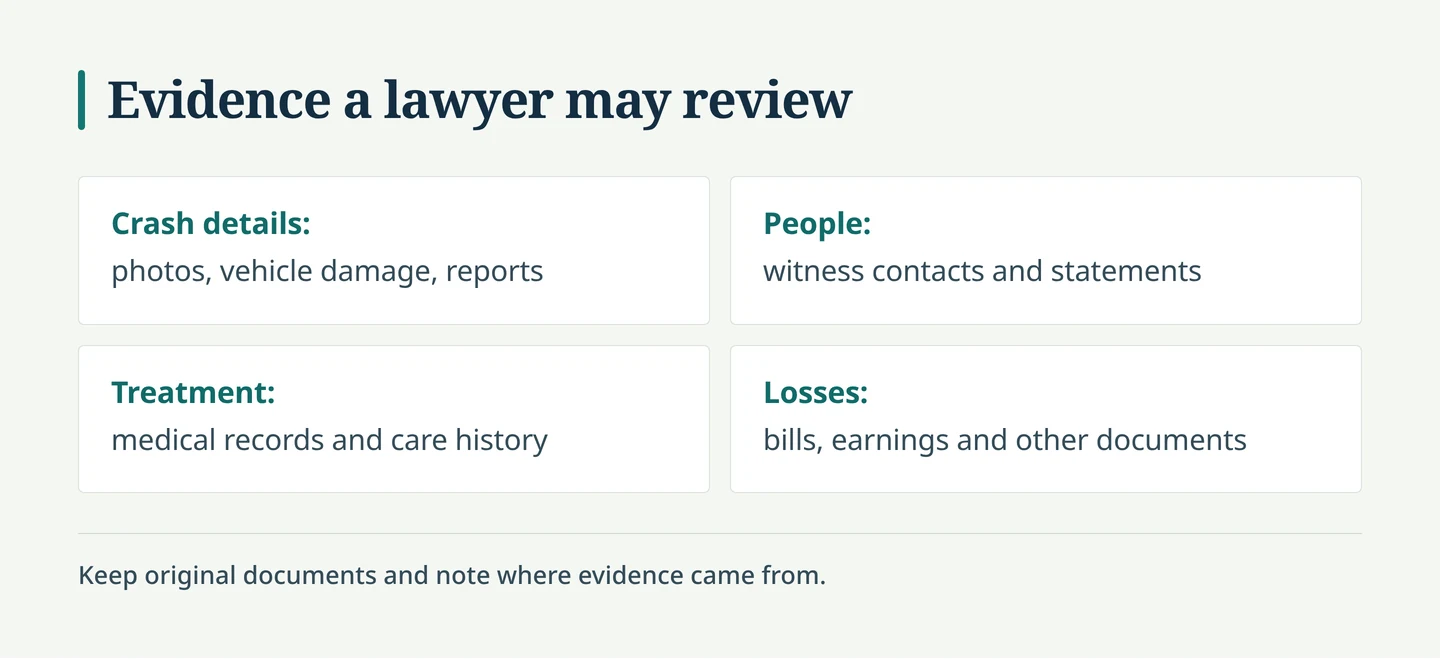
Evidence connects the crash to the people involved, the injuries, and the losses claimed. Different pieces may answer different questions, so an early review can help identify what exists and what may be missing.
Crash and vehicle evidence
A report can identify parties, vehicles, responding agencies, and witnesses, but it may not resolve every disputed fact. Photographs can show damage, vehicle positions, roadway markings, and conditions. A lawyer may also look for available video, vehicle data, repair records, or communications about the incident.
Tell the lawyer where a camera may have been located, even if you do not have a recording. Businesses, vehicles, or other sources may retain footage for limited periods. Availability and access vary, so do not assume a recording exists.
Medical, work, and daily-life records
Treatment records can show symptoms, diagnoses, care, and the course of recovery. Bills and insurance explanations can help distinguish amounts billed, paid, or still in dispute. A lawyer may need records from providers both before and after the collision to understand the medical picture.
Employment records may document missed time, pay, or changes in duties. A personal record of activities you could not do may help you describe the effect on daily life. Keep it accurate and dated; do not guess about limitations or medical conclusions.
A practical evidence checklist
- Save original photos and video when possible, along with the date and source.
- Keep names and contact information for witnesses and passengers.
- Retain insurer letters, texts, claim numbers, and notes about conversations.
- Organize medical bills, payment records, and explanations of benefits.
- Keep repair estimates, rental receipts, and transportation expenses.
- Tell the lawyer about any gaps, prior injuries, or records you cannot locate.
You need not investigate at the expense of your safety or care. A lawyer can discuss which information may be useful and how it might be obtained.
Getting and reviewing a Florida crash report
Florida Highway Safety and Motor Vehicles is the state’s official repository for traffic crash reports. Its Crash Portal provides a way to request available reports, subject to applicable access rules. The responding agency and report number can help identify the right record.
What the report can and cannot do
Check the report for the names of involved people, insurance information, location, and witness details. Tell an attorney if something appears incomplete or inconsistent with your recollection. Other evidence may be needed to evaluate a disputed account.
A report is useful even when you disagree with its description. You can request a case review while a report is unavailable or while you are still trying to locate it. If the other driver disputes responsibility, our related guide discusses what to do after a car accident that was not your fault.
Injuries and medical treatment after a collision
Car accident injuries vary widely, and symptoms do not always tell the whole story at the scene. The records and medical opinion needed to evaluate a claim depend on the injury and its effect on the person.
Injuries a claim may involve
A collision can involve neck or back injuries, fractures, soft-tissue injuries, head injuries, or internal injuries. More serious cases may involve a brain injury, spinal injury, lasting impairment, or visible scarring. A person may have more than one injury, with different treatment needs.
Ongoing symptoms and prior conditions
Tell your medical providers about your symptoms and follow their advice about evaluation and care. Keep track of appointments, referrals, and changes you notice. If symptoms develop after the initial visit, share that information with the provider and with your attorney.
A prior injury or health condition does not make the facts irrelevant. Earlier records and the post-crash course may help distinguish a preexisting condition from a claimed change. Be candid about what happened before and after the collision so the review is based on a complete history.
Damages in an Orlando car accident claim
Damages are the losses a claim seeks to address. The categories available depend on the facts, evidence, applicable law, and coverage; no list can establish the value of an individual case.
| Potential loss | Examples of supporting information | Questions for review |
|---|---|---|
| Medical expenses | Bills, treatment records, payment records, and expected care information | What treatment was related to the crash, and what amounts remain at issue? |
| Lost income or earning ability | Pay records, schedules, tax information, and work restrictions | What time or capacity was affected, and what proof is available? |
| Pain and other non-economic harm | Medical records and accounts of daily limitations | Does the applicable law permit the claimed damages, including any relevant injury threshold? |
| Vehicle and other property damage | Photos, estimates, vehicle valuation, and receipts | Which policy or party may address the loss, and what has already been paid? |
| Other documented expenses | Travel, assistance, and other relevant receipts | Were the expenses connected to the crash, and are they recoverable in this claim? |
Economic losses and future needs
Economic losses may include qualifying medical expenses, income loss, and other documented financial harm. A person who needs ongoing care may also ask how future medical needs or work limitations should be evaluated. That assessment requires evidence; it is not simply a projection from an initial bill.
Keep records of expenses as they arise and identify any insurance payments. The amounts billed, paid, and potentially recoverable are not necessarily the same. A lawyer can examine what evidence and legal rules apply to the particular loss.
Pain, suffering, and changes in daily life
Some claims may include pain, suffering, mental anguish, or inconvenience. These losses can be difficult to describe in a bill, so medical information and a person’s account of daily limitations may matter. For actions covered by section 627.737(2), the statutory injury threshold applies to those non-economic damages.
There is no reliable figure for an individual claim without reviewing the evidence and circumstances. The extent of injury, disputed fault, available coverage, and defenses may all affect negotiations. A prior result in another matter would not determine yours.
Vehicle damage, medical bills, and liens
An injury claim and a vehicle-damage issue may proceed on different tracks. Resolving a repair issue does not necessarily answer questions about medical care, but the wording of any release matters.
Repairs, a total loss, and transportation
Keep the repair estimate, insurer valuation, photographs, and receipts for a rental car or alternate transportation. If the vehicle is considered a total loss, ask the insurer how it calculated the valuation and what documents support it. A deductible or reimbursement question may depend on the policy and circumstances.
A vehicle may also be worth less after repairs, but a diminished-value question requires review of the facts, evidence, and applicable policy or claim. Do not assume such a payment is available in every case. Ask whether a proposed property settlement releases any separate injury claim before signing.
Bills, health coverage, and reimbursement claims
Medical providers, health plans, and others may have unpaid balances or assert a right to reimbursement. The existence and amount of a lien or reimbursement claim depend on the documents and applicable law. An attorney can review notices and explain how such claims may affect proceeds.
Keep bills even when an insurer has paid part of a charge. An explanation of benefits is different from a final bill, and balances can change. Share every notice with counsel so potential obligations are considered before a resolution.
A possible car accident claim process
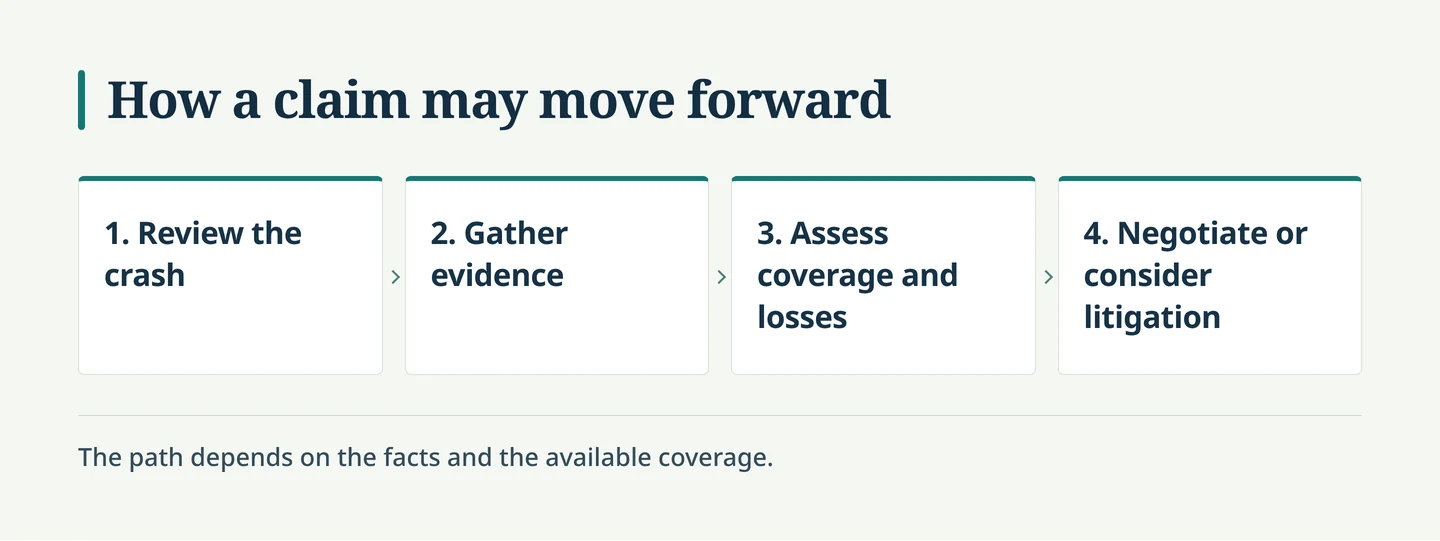
Not every case follows the same sequence, and a case may end without a lawsuit. The stages below show how a matter might progress after the firm agrees to representation.
1. Review and agreement
The first stage is a conversation about the crash, injuries, insurance, and potential deadlines. If the firm offers representation, ask when it begins and what the written agreement covers. You can review the terms and decide whether to proceed.
2. Investigation and medical information
A lawyer may gather reports, photos, insurance documents, witness information, and medical records. The investigation may continue while treatment is ongoing. A clear picture of future care or lasting limitations may take time to develop.
3. Evaluation and negotiation
When sufficient information is available, an attorney may assess responsibility, losses, available coverage, and possible defenses. A demand or other communication may then present the claim to an insurer. The insurer may request information, dispute part of the claim, or make an offer.
4. Resolution or litigation
Some claims resolve through an agreed settlement. Others require a decision about filing a lawsuit, and some lawsuits resolve before trial. Whether to accept an offer or pursue a case is a decision to discuss with counsel after reviewing the facts and terms.
How long can an Orlando car accident case take?
There is no single timeline for a car accident claim. The duration depends on medical recovery, the investigation, insurer responses, legal issues, and whether a lawsuit is filed.
Factors that can change the timeline
A claim involving limited disputed information may be ready for evaluation sooner than one involving extensive treatment or several parties. Missing records, disagreement about fault, questions about coverage, and multiple claimants can add work. Court scheduling can also affect a case that enters litigation.
A quick offer may arrive before the long-term effects of an injury are clear. Waiting for relevant information can help make an informed decision, but delay also carries risks when a legal deadline is approaching. Ask an attorney how those considerations apply to your circumstances.
Keep the case moving with clear information
Tell counsel about new treatment, insurer correspondence, and changes in contact details. Ask what records are still needed and how updates will be shared. If something is unclear, request an explanation rather than assuming that silence means a particular result.
Negotiating with insurers or filing a lawsuit
Evaluating an insurance offer
An offer is a proposal to resolve a claim on stated terms. Review the amount, what claims the release covers, any unpaid bills or liens, and how the offer relates to available coverage. An insurer’s valuation may differ from your view of the evidence.
A lawyer may respond with supporting records, ask for clarification, or negotiate. The other side may dispute fault, causation, treatment, or the amount of loss. No negotiation has a predetermined outcome.
When litigation may be considered
A lawsuit may be considered if an agreement cannot be reached, a deadline requires action, or another case-specific reason makes filing appropriate. Litigation can involve written requests, depositions, expert review, motions, and settlement discussions. A filing does not mean the case will necessarily reach trial.
Ask how litigation could change the time, expense, and work required under the proposed agreement. Also ask how the firm would keep you informed about significant decisions. The appropriate path depends on the evidence and your goals.
Negligence and Florida filing deadlines
What negligence generally involves
A negligence claim generally examines whether a person owed a duty of reasonable care, failed to meet it, and caused an injury and resulting losses. The evidence must connect the conduct to the harm claimed. A collision alone does not resolve each element.
A lawyer can assess possible defenses and whether other parties may share responsibility. For example, a hypothetical driver who ran a red light may dispute that the signal was red or that the impact caused the claimed injury. Each issue calls for evidence, not an assumption.
The 2023 transition for ordinary negligence actions
Florida’s current limitations statute generally gives two years to commence an action founded on negligence. The prior statute generally listed four years for negligence. Under HB 837, the change applies to causes of action accruing after March 24, 2023.
A cause of action accruing before that date generally falls under the former period; one accruing after it generally falls under the newer period. A claim accruing on March 24, 2023, deserves individual review rather than an automatic assumption. Section 95.031 addresses accrual, which is often the crash date in an ordinary injury case but is not universally the same for every claim.
Why the type of claim and other dates matter
A lawsuit deadline is not necessarily the deadline for an insurer notice, a PIP condition, or a contract claim. Tolling and special rules can apply in some circumstances; section 95.051 identifies specific grounds and conditions. A matter involving a public agency can also involve notice requirements under section 768.28.
Do not assume that negotiations extend the time to sue. For more context, see our guide to the Florida statute of limitations for car accidents. Discuss the dates, parties, and claim types with an attorney promptly.
Help for families after a fatal car accident
The loss of a family member creates practical and legal questions at a difficult time. A family can seek a review even if the crash investigation or insurance information is incomplete.
Who brings a wrongful death action?
Under Florida Statutes section 768.20, the personal representative brings the wrongful death action for the benefit of the survivors and estate. Section 768.19 describes when such an action may arise. Which losses and beneficiaries apply requires review of the family and estate circumstances.
Section 95.11 generally provides two years for a wrongful death action, with specific exceptions and rules that may affect a particular matter. A Florida appellate decision describes death as the general accrual date for a wrongful death action; special circumstances may differ. An attorney can review the relevant dates and any estate questions.
Information a family may have
Useful materials may include the crash report, available insurance information, medical and funeral records, and details of the person’s work and family relationships. A family member can also share the names of any estate representative or lawyer already involved. It is acceptable to begin the conversation without a complete file.
Frequently asked questions
How much does a case review cost?
Pencheff & Fraley offers a free case review through its contact page. Use the conversation to describe the crash and ask whether the firm may be able to assist. Any representation and fee terms would be addressed separately.
Who will handle my car accident case?
Ask the firm who would be responsible for your matter and who would answer routine questions. You can also ask whether another firm may become involved and how updates would be communicated. The proposed arrangement should be explained before you decide whether to retain counsel.
Do I need a lawyer if the other driver admits fault?
An admission may help explain the crash, but insurance coverage, the extent of injuries, and the amount of loss can still be disputed. A lawyer may review those issues and any proposed release. Whether representation makes sense depends on your circumstances and the terms offered.
Can I ask for help if I was partly at fault?
Yes, you can request a review even if you think you contributed to the collision. Under section 768.81, applicable comparative-fault rules can reduce damages, and the greater-than-50% bar applies in certain actions. The facts and the law’s application need individual review.
Does PIP pay all my medical bills?
Not necessarily. Florida’s PIP statute sets percentages, limits, and conditions for qualifying benefits. Eligibility, deductibles, other coverage, and the treatment received can affect payment.
Is the 14-day PIP rule the deadline to sue?
No. The 14-day condition concerns qualifying initial services and care for PIP medical benefits. A separate limitations analysis applies to a lawsuit, and missing the PIP medical window does not automatically end every tort claim.
What if the other driver has no insurance?
A lawyer can review whether the driver can be identified and whether an applicable UM policy or another source of coverage exists. Florida’s UM statute includes conditions and allows certain written rejections. A policy and the facts must be reviewed before assuming benefits are available.
Can a passenger or visitor request a case review?
Yes. An injured passenger or an out-of-state visitor can contact the firm about an Orlando crash. Bring or identify the policies, trip or rental documents, and treatment records you have, including records from care received after returning home.
What if the crash involved a rental car or rideshare?
The rental agreement, personal policies, trip details, and the driver’s activities may be relevant to coverage. Keep any reservation, trip receipt, and insurer correspondence. A lawyer can review the documents without assuming that the rental or app company is automatically responsible.
What if I already gave the insurer a statement?
You can still request a case review. Tell the lawyer what you said, whether the statement was recorded, and what documents you signed or received. A copy of the statement or related correspondence may help the review.
Do I have to accept an insurance offer?
An offer is a proposal, and its terms deserve review before you decide. Consider the release, the evidence of your losses, available coverage, fees, expenses, and any bills or liens. An attorney can explain the implications of the offer without predicting the result of further negotiations.
How much is my car accident claim worth?
Value depends on the evidence of injury and loss, responsibility for the crash, available coverage, and possible defenses. Medical bills alone do not determine the answer. A lawyer can evaluate the available information and discuss uncertainties specific to your claim.
How long do I have to file a lawsuit?
Ordinary negligence actions accruing after March 24, 2023, generally have a two-year period under section 95.11 and HB 837. Earlier accrual, accrual on the transition date, other claim types, and special rules require separate review. An insurance notice or PIP condition can involve a different deadline.
What if I cannot find the crash report or insurance information?
You can still contact the firm with the facts you know. The responding agency, report number, date, location, and names of the people involved may help identify missing records. Florida’s crash-report portal is another source for available reports.
How are attorney fees and case expenses handled?
A contingency fee generally means the attorney’s fee is calculated as a portion of a recovery under the agreement. Expenses and potential medical or reimbursement claims are separate questions. Depending on the written agreement, a client may be responsible for some costs whether or not there is a recovery; ask for the proposed written terms.
Can a family contact the firm after a fatal crash?
Yes. A family member can request a review and discuss the crash, insurance information, and any estate representative already appointed. Under section 768.20, the personal representative brings a Florida wrongful death action for the benefit of survivors and the estate.
Request a free Orlando car accident case review
Pencheff & Fraley Injury and Accident Attorneys lists its Orlando office at 24 S Semoran Blvd, Suite B, Orlando, FL 32807. Call 904-749-5024 or request a free case review online.
Tell the firm where the crash happened, what injuries you are dealing with, and any insurance questions you have. You can ask about representation, fees, and the documents that may help your review. You do not need to resolve the fault or coverage questions before contacting the firm.
This article is intended for general informational purposes only and does not constitute legal advice. Laws change, and the information above may not reflect the most recent legal developments. Please contact the Pencheff & Fraley team to discuss the specific facts of your case.
Written by
Pencheff & Fraley Editorial Team
Pencheff & Fraley represents injured people in Florida. Last reviewed: November 11, 2026.
- Record-Setting Verdicts
- No Upfront Fees
- Free Case Reviews
- Personalized Attention
- Maximized Payouts
- 98% Win Rate
- 5 Star Attorneys
- Faster Settlements
- Honest & Transparent
Pencheff & Fraley
Injury and Accident Attorneys
- ✓
- ✓
- ✓
- ✓
- ✓
- ✓
- ✓
- ✓
- ✓
Other Attorneys
- ✕
- ✕
- ✕
- ✕
- ✕
- ✕
- ✕
- ✕
- ✕
OUR LOCATIONS

© 2026 Pencheff & Fraley Injury and Accident Attorneys. All Rights Reserved. Privacy Policy *Client photos are illustrative only.