

Is Uber or Lyft liable for accidents in Florida? This question has become increasingly critical as millions of Floridians rely on rideshare services for daily transportation. When a rideshare accident occurs, determining liability is far more complex than in a typical car crash. Multiple insurance policies, intricate corporate structures, and specific state laws create a challenging legal landscape for victims to navigate. This comprehensive guide explains the nuances of Uber and Lyft liability in Florida, the insurance coverage available, and the steps you should take to protect your rights and secure the compensation you deserve.
At Pencheff & Fraley, our experienced Florida personal injury attorneys have a deep understanding of the laws governing transportation network companies (TNCs) like Uber and Lyft. We are committed to helping accident victims understand their legal options and fight for the maximum compensation available.
Understanding Uber and Lyft Liability in Florida Rideshare Accidents
To understand liability in a rideshare accident, it is essential to recognize what makes these cases different from standard car accidents. Uber and Lyft classify their drivers as independent contractors, not employees. This distinction is a cornerstone of their business model and a key factor in how they handle liability claims. By classifying drivers as independent contractors, these companies attempt to distance themselves from the actions of their drivers and limit their own financial responsibility in the event of an accident.
However, this does not mean Uber and Lyft are never liable. Florida has enacted specific laws to address the unique challenges of rideshare accidents and ensure that victims have access to compensation. The primary law governing this issue is Florida Statute § 627.748, which mandates that TNCs and their drivers carry specific insurance coverage. The applicability of this insurance, and therefore the liability of Uber or Lyft, depends entirely on the driver’s status at the time of the crash.
What Makes Rideshare Accidents Different from Regular Car Accidents?
The primary difference lies in the multiple layers of insurance coverage and potentially liable parties. In a typical car accident, you are usually dealing with two drivers and their respective insurance companies. In a rideshare accident, you could be dealing with:
- The Uber or Lyft driver’s personal auto insurance
- Uber or Lyft’s corporate insurance policy
- A third-party driver’s insurance, if another vehicle was involved
- Your own insurance policy
Navigating these multiple insurance policies and determining which one applies requires a thorough understanding of Florida’s rideshare laws.
The Independent Contractor Issue and Why It Matters
Because Uber and Lyft drivers are considered independent contractors, the legal doctrine of respondeat superior (which holds employers responsible for the actions of their employees) generally does not apply. This makes it more difficult to hold the company directly liable for a driver’s negligence. However, as we will explore, Florida law has created a framework to ensure that TNCs are held accountable, regardless of their drivers’ employment status.
Florida Rideshare Insurance Coverage: Understanding the Three Periods
Florida Statute § 627.748 establishes a three-tiered system for rideshare insurance coverage, based on the driver’s activity at the time of the accident. Understanding which period the driver was in is crucial to determining the available insurance coverage.
| Driver Status | Insurance Period | Coverage Details |
| App is on, waiting for a ride request | Period 1 | Contingent Liability Coverage: |
- $50,000 per person for bodily injury
- $100,000 per accident for bodily injury
- $25,000 per accident for property damage | | Ride request accepted, en route to pickup | Period 2 | $1 Million Combined Liability Coverage:
- Covers death, bodily injury, and property damage
- Covers death, bodily injury, and property damage
Period 1: Driver Online, Waiting for Ride Request
When a driver is logged into the Uber or Lyft app and is available to accept a ride request, but has not yet accepted one, they are in Period 1. During this time, the rideshare company’s contingent liability coverage applies, but only if the driver’s personal auto insurance does not provide coverage. This coverage is lower than the coverage available during an active ride.
Period 2: Driver En Route to Pick Up Passenger
Once a driver accepts a ride request and is on their way to pick up the passenger, they enter Period 2. From this moment, Uber or Lyft’s $1 million liability policy is triggered. This policy provides primary coverage for any accident that occurs while the driver is en route to the passenger.
Period 3: Passenger in Vehicle During Trip
From the moment a passenger enters the rideshare vehicle until they exit at their destination, they are in Period 3. The same $1 million liability policy that applies in Period 2 remains in effect throughout the entire trip.
What Happens When the App Is Completely Off?
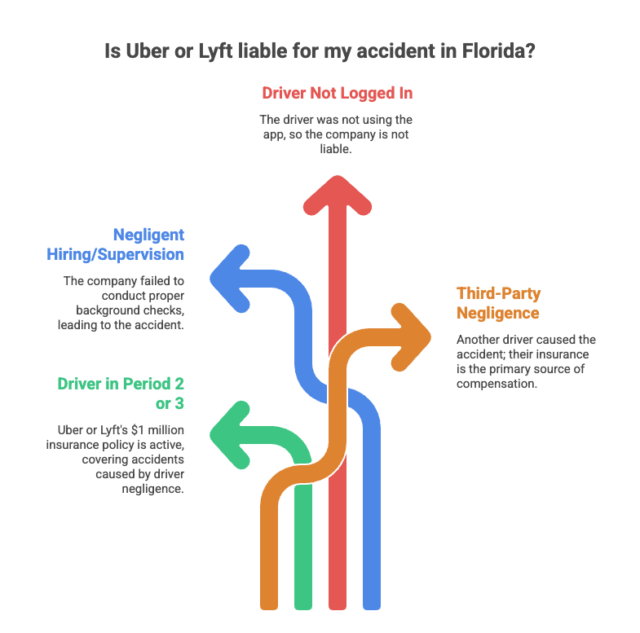
If a rideshare driver is not logged into the app, they are considered to be driving for personal reasons. In this case, only the driver’s personal auto insurance policy would apply to an accident. Uber and Lyft’s insurance would not provide any coverage.
When Is Uber or Lyft Liable for Accidents in Florida?
So, when is Uber or Lyft liable for an accident? The answer depends on the specific circumstances, primarily the driver’s status within the three-period framework. Generally, Uber or Lyft can be held liable for an accident if it occurs during Period 2 or Period 3, when their $1 million insurance policy is in effect.
Scenarios Where Uber or Lyft Is Directly Liable
Uber or Lyft’s insurance is designed to cover accidents caused by their drivers’ negligence during an active trip. If you are injured as a passenger in a rideshare vehicle, or as the occupant of another vehicle hit by a rideshare driver who is in Period 2 or 3, you can file a claim against the TNC’s $1 million policy.
Negligent Hiring and Supervision Claims Against Rideshare Companies
In some rare cases, it may be possible to hold Uber or Lyft directly liable for an accident, even if it falls outside the scope of their primary insurance coverage. This can occur if the company was negligent in its hiring or supervision of the driver. For example, if the company failed to conduct a proper background check and hired a driver with a history of DUIs or reckless driving, they could be held liable for negligent hiring.
When the Rideshare Company Is NOT Liable
As mentioned, if a rideshare driver is not logged into the app at the time of an accident, the company is not liable. Additionally, if an accident is caused by the negligence of a third-party driver, the primary source of compensation would be that driver’s insurance.
Multiple Parties Who Can Be Held Liable in Florida Rideshare Accidents
One of the complexities of rideshare accident claims is that there are often multiple parties who may be held liable for your injuries. These can include:
- The Rideshare Driver: If the driver’s negligence caused the accident, they can be held personally liable. However, their personal insurance may not cover the accident if they were driving for a TNC.
- Uber or Lyft: The company can be held liable through its insurance policy if the accident occurred during an active trip, or in some cases, for negligent hiring.
- Other Drivers: If another driver was at fault for the accident, their insurance company would be the primary source of compensation.
- Vehicle Manufacturers: If a vehicle defect contributed to the accident, the manufacturer could be held liable through a product liability claim.
- Government Entities: If a poorly maintained road or malfunctioning traffic signal caused the accident, a government entity could be held responsible.
An experienced rideshare accident attorney can help you identify all potentially liable parties and pursue claims against each of them to maximize your recovery.
How Florida’s No-Fault Insurance Law Affects Rideshare Accident Claims
Florida is a no-fault insurance state, which means that all drivers are required to carry Personal Injury Protection (PIP) insurance. This coverage provides for the payment of your initial medical expenses and lost wages, regardless of who was at fault for the accident.
What Is Florida’s No-Fault Insurance System?
Under Florida’s no-fault law, you must first turn to your own PIP insurance to cover your initial damages after an accident. All Florida drivers are required to carry a minimum of $10,000 in PIP coverage. This will cover 80% of your medical bills and 60% of your lost wages, up to the $10,000 limit. It is important to note that you must seek medical treatment within 14 days of the accident to be eligible for PIP benefits.
When Can You Step Outside the No-Fault System?
You can only pursue a liability claim against the at-fault party for damages beyond what your PIP insurance covers if you have suffered a “serious injury” as defined by Florida law. A serious injury includes:
- Permanent injury within a reasonable degree of medical probability
- Significant and permanent scarring or disfigurement
- Significant and permanent loss of an important bodily function
- Death
If your injuries meet this threshold, you can file a lawsuit against the at-fault party to recover the full extent of your damages, including pain and suffering.
How PIP Coverage Applies to Rideshare Passengers
If you are a passenger in a rideshare vehicle and have your own auto insurance policy, your PIP coverage will be the primary source of payment for your initial medical bills. If you do not own a vehicle or have your own PIP insurance, you may be able to use the PIP coverage from the rideshare driver’s insurance or the TNC’s policy.
Common Uber and Lyft Accident Scenarios in Florida
Rideshare accidents can occur in a variety of ways, and the determination of liability will depend on the specific facts of each case. Here are some common scenarios:
- Passenger Injured by Negligent Rideshare Driver: If your Uber or Lyft driver is at fault for the accident, you can file a claim against the TNC’s $1 million insurance policy.
- Third-Party Vehicle Strikes Uber or Lyft: If another driver hits the rideshare vehicle you are in, you would first file a claim against the at-fault driver’s insurance.
- Pedestrian and Bicycle Accidents Involving Rideshares: If you are a pedestrian or cyclist hit by a rideshare driver, the available insurance coverage will depend on which period the driver was in at the time of the accident.
- Accidents During Passenger Pickup or Dropoff: These situations can be complex, as the driver may be distracted or stopped in an unsafe location. Liability will depend on the specific circumstances of the accident.
Types of Compensation Available in Florida Rideshare Accident Claims
If you have been injured in a rideshare accident, you may be entitled to recover a wide range of damages. These are typically categorized as economic and non-economic damages.
| Damage Type | Examples |
| Economic Damages | – Past and future medical expenses |
- Lost wages and income
- Loss of future earning capacity
- Property damage
- Rehabilitation costs | | Non-Economic Damages | – Pain and suffering
- Emotional distress
- Loss of enjoyment of life
- Scarring and disfigurement
- Loss of consortium (for spouses) |
In rare cases of extreme negligence or intentional misconduct, it may also be possible to recover punitive damages, which are intended to punish the at-fault party and deter similar conduct in the future. In the tragic event of a fatal accident, our attorneys can help families pursue wrongful death claims to recover damages for their immense loss.
Key Florida Laws and Statutes for Rideshare Accident Claims
Navigating a rideshare accident claim requires a thorough understanding of several key Florida laws.
Florida Statute § 627.748: Transportation Network Company Insurance
As discussed, this statute is the foundation of rideshare liability in Florida. It outlines the specific insurance requirements for TNCs and their drivers, creating the three-tiered system that determines coverage based on the driver’s status.
Comparative Negligence in Florida Rideshare Cases
Florida follows a modified comparative negligence rule, as established by Florida Statute § 768.81. This means that your total compensation will be reduced by your percentage of fault for the accident. For example, if you are found to be 20% at fault, your total recovery will be reduced by 20%. It is important to note that if you are found to be more than 50% at fault, you will be barred from recovering any compensation at all.
Statute of Limitations for Rideshare Accident Claims
Under Florida Statute § 95.11, you have a limited amount of time to file a lawsuit after a rideshare accident. For personal injury claims, the statute of limitations is two years from the date of the accident. For wrongful death claims, it is also two years from the date of death. If you fail to file a lawsuit within this time frame, you will lose your right to recover compensation.
Step-by-Step Guide: Filing an Uber or Lyft Accident Claim in Florida
If you are involved in a rideshare accident, it is crucial to take the right steps to protect your rights and preserve your claim.
- Seek Medical Attention Immediately: Your health is the top priority. Call 911 and seek immediate medical attention, even if you do not feel seriously injured. Remember, you must see a doctor within 14 days to be eligible for PIP benefits.
- Report the Accident to the Police: A police report is a critical piece of evidence in any accident claim. Make sure the responding officer documents all the details of the crash.
- Document the Scene: If you are able, take photos and videos of the accident scene, including the vehicles involved, any injuries, and the surrounding area. Get the names and contact information of any witnesses.
- Report the Accident to Uber or Lyft: Use the app to report the accident to the rideshare company as soon as possible. This will create a record of the incident.
- Do Not Give a Recorded Statement: Do not give a recorded statement to any insurance company, including the rideshare company’s insurer, without first speaking to an attorney.
- Contact an Experienced Rideshare Accident Attorney: The sooner you involve an attorney, the better. An experienced lawyer can handle all communications with the insurance companies, gather evidence, and build a strong case on your behalf.
Overcoming Common Challenges in Florida Rideshare Accident Claims
Rideshare accident claims are often met with resistance from insurance companies. Some common challenges include:
- Insurance Coverage Disputes: Insurers may argue about which policy applies or try to shift blame to another party.
- Low Settlement Offers: Insurance adjusters are trained to minimize payouts. They may offer a quick, low settlement that does not fully cover your damages.
- Claim Denials: The insurance company may deny your claim altogether, arguing that the driver was not at fault or that your injuries are not related to the accident.
- Bad Faith Insurance Tactics: In some cases, insurance companies may act in bad faith by unreasonably delaying or denying a valid claim. An attorney can provide insurance claim assistance to fight these tactics.
An experienced attorney can anticipate these challenges and fight back against the insurance companies to ensure you are treated fairly.
Why Hire Pencheff & Fraley for Your Florida Rideshare Accident Claim?
The complexity of rideshare accident claims makes it essential to have a knowledgeable and experienced attorney on your side. At Pencheff & Fraley, we have the resources and expertise to handle even the most challenging rideshare cases. We will:
- Conduct a thorough investigation to determine all liable parties
- Gather all necessary evidence, including police reports, medical records, and witness statements
- Handle all communications and negotiations with the insurance companies
- Work with experts to calculate the full extent of your damages
- Fight for the maximum compensation you deserve, even if it means taking your case to trial
We work on a contingency fee basis, which means you pay no attorney fees unless we win your case. Contact us today for a free, no-obligation consultation to discuss your legal options.
Frequently Asked Questions About Uber and Lyft Liability in Florida
Is Uber or Lyft liable for accidents in Florida?
Yes, Uber and Lyft can be held liable for accidents in Florida, primarily through their mandated insurance policies. Liability depends on the driver’s status at the time of the accident.
Can I sue Uber or Lyft after an accident in Florida?
Yes, you can sue Uber or Lyft, but you will typically be filing a claim against their insurance policy rather than suing the company directly, unless there are grounds for a negligent hiring claim.
What insurance covers Uber accidents in Florida?
Uber’s insurance coverage depends on the driver’s status. They have a $1 million liability policy that covers accidents during an active trip (Periods 2 and 3).
What happens if the Uber driver’s app was off during the accident?
If the driver’s app was off, only their personal auto insurance would apply. Uber’s insurance would not provide coverage.
Can I sue the Uber driver personally?
While you can sue the driver personally, it is often more effective to pursue a claim against the applicable insurance policies, which have higher limits.
Does Florida’s no-fault insurance apply to rideshare accidents?
Yes, Florida’s no-fault law applies. You must first use your own PIP insurance before pursuing a liability claim.
How long do I have to file a rideshare accident claim in Florida?
The statute of limitations for personal injury claims in Florida is two years from the date of the accident.
What compensation can I get from an Uber or Lyft accident?
You can recover economic damages (medical bills, lost wages) and non-economic damages (pain and suffering).
Do I need a lawyer for a rideshare accident claim?
It is highly recommended to hire a lawyer due to the complexity of these cases and the challenges of dealing with multiple insurance companies.
How much does a rideshare accident lawyer cost?
Most rideshare accident lawyers, including Pencheff & Fraley, work on a contingency fee basis, meaning you only pay if they win your case.
What is the average settlement for Uber accidents in Florida?
Settlements vary widely depending on the severity of injuries, but they can range from thousands to over a million dollars.
Can passengers sue Uber or Lyft for injuries?
Yes, passengers injured due to a driver’s negligence can file a claim against the TNC’s insurance policy.
What if I was partially at fault for the rideshare accident?
Under Florida’s modified comparative negligence rule, your compensation will be reduced by your percentage of fault. If you are more than 50% at fault, you cannot recover any damages.
Protecting Your Rights After a Florida Rideshare Accident
If you or a loved one has been injured in an Uber or Lyft accident in Florida, you have rights. Understanding the complex web of insurance policies and liability laws is the first step toward securing the compensation you need to recover. The legal team at Pencheff & Fraley is here to guide you through every step of the process. We will handle the legal complexities so you can focus on your recovery.
Contact Pencheff and Fraley today for a free, no-obligation consultation. 904-770-4953 Our experienced Florida personal injury attorneys will review your case, explain your options, and help you make the best decision for your future. We understand the frustration you’re experiencing, and we’re here to provide the dedicated representation you deserve. Call us now or fill out our online form to take the first step towards better representation and a stronger case.
Looking for state-specific guidance? Read our detailed guide on How to start a personal injury claim in Ohio
Author: Pencheff and Fraley Legal Team
Disclaimer: This article is for informational purposes only and does not constitute legal advice. Every case is unique, and you should consult with a qualified attorney about your specific situation.