

Being in a car accident is a jarring experience under any circumstances, but when it happens during a rideshare ride, the confusion can feel overwhelming. You trusted Uber or Lyft to get you to your destination safely, and now you’re injured — and it wasn’t even your rideshare driver’s fault. What if another driver caused the Uber/Lyft accident? This is one of the most common questions our personal injury attorneys at Pencheff & Fraley hear from injured passengers, and the answer is more nuanced than most people expect.
The good news is that you have multiple avenues for compensation. The challenging news is that the path to recovery is significantly more complex than in a standard two-car accident. According to Insurify’s 2025 rideshare safety report, rideshare drivers are 73% more likely to be involved in an accident than the general driving population — and critically, Uber’s own safety data reveals that other drivers caused 95% of fatal crashes involving an Uber vehicle. In other words, the most dangerous element in a rideshare accident is often a driver who has nothing to do with the rideshare company at all.
This guide will walk you through exactly who pays, what Florida’s specific laws mean for your claim, and the critical steps you must take to protect your right to full compensation.
Understanding the Rideshare Insurance Landscape
When another driver is at fault for your Uber or Lyft accident, the insurance situation becomes a layered puzzle that most people have never had to navigate before. It is not as simple as filing a claim with the at-fault driver’s insurance and moving on. Both Uber and Lyft maintain substantial commercial insurance policies designed to protect passengers, but these policies only come into play at specific times and in a specific order. Understanding this framework is the foundation of any successful claim.
The Three-Phase Insurance System
Florida law, specifically Florida Statute § 627.748, divides a rideshare driver’s activity into three distinct phases, each with its own insurance requirements. While the at-fault third-party driver is the primary target for your compensation claim, knowing which phase your Uber or Lyft driver was in at the time of the crash determines when and how the rideshare company’s powerful backup coverage applies.
| Coverage Period | Driver Status | Minimum Insurance Requirements |
| Period 1 | App is on, waiting for a ride request | $50,000 per person / $100,000 per accident for bodily injury; $25,000 for property damage |
| Period 2 | Ride accepted, en route to pick up passenger | $1,000,000 for death, bodily injury, and property damage |
| Period 3 | Passenger is in the vehicle | $1,000,000 for death, bodily injury, and property damage |
What Changes When Another Driver Is at Fault
When a third-party driver causes the accident while you are a passenger in an active Uber or Lyft ride (Period 3), the primary source of compensation is that driver’s bodily injury liability insurance. However, Uber and Lyft’s $1 million commercial policy does not simply disappear.
Who Pays When Another Driver Causes Your Uber/Lyft Accident?
Successfully navigating a rideshare accident claim requires a strategic, tiered approach. You cannot simply choose which insurance policy to file against. The law dictates a specific order of operations, and failing to follow this process correctly can jeopardize your right to full compensation.
Step 1 – The At-Fault Driver’s Insurance Pays First
Your first claim is against the bodily injury liability policy of the driver who caused the crash. Their insurance is the primary source of compensation for your medical bills, lost wages, and pain and suffering. This is the most straightforward step, but it is also where the first major obstacle often arises. Many Florida drivers carry only the state minimum required insurance, which can be far too low to cover the full extent of serious injuries. When the at-fault driver’s policy limits are exhausted, you must move to the next level of coverage.
Step 2 – Your Own Insurance as a Final Backstop
If you have your own auto insurance policy with UM/UIM coverage, it may provide an additional layer of compensation after the other policies have been exhausted. This is less common in rideshare accident cases but can be a valuable asset in cases involving catastrophic injuries where damages exceed the rideshare company’s policy limits. An experienced attorney will investigate every possible source of recovery on your behalf.
Florida-Specific Rules That Affect Your Rideshare Accident Claim
Florida’s legal environment adds a unique layer of complexity to rideshare accident claims that does not exist in most other states. Working with an attorney who understands these Florida-specific nuances is not just helpful — it is essential.
Florida’s No-Fault PIP System
Florida is a no-fault state, which means that your own Personal Injury Protection (PIP) insurance is the first to pay for your medical expenses, covering 80% of medical bills and 60% of lost wages up to a limit of $10,000, regardless of who was at fault for the accident. This applies even when another driver caused the crash. If you do not own a vehicle and do not have your own PIP coverage, you may be able to access PIP benefits through the rideshare driver’s policy. Once your PIP benefits are exhausted, you can then pursue additional compensation from the at-fault driver and the rideshare company’s insurance.
Florida Statute § 627.748 and Rideshare Requirements
Florida Statute § 627.748 is the cornerstone of rideshare regulation in the state. This law requires Transportation Network Companies (TNCs) like Uber and Lyft to maintain specific minimum insurance coverage for their drivers at each phase of a trip.
The 2-Year Statute of Limitations
This is perhaps the most critical Florida-specific rule to understand. Due to the 2023 Florida tort reform, the statute of limitations for personal injury claims was cut in half — from four years to just two years from the date of the accident. If you miss this deadline, you permanently lose your right to seek compensation, no matter how serious your injuries. This shortened window makes it absolutely critical to consult with an attorney as soon as possible after your accident.
Common Scenarios When Another Driver Causes a Rideshare Accident
Every accident is unique, but certain situations arise repeatedly when a third-party driver is at fault. Understanding these scenarios can help you anticipate the challenges you may face.
The At-Fault Driver Fled the Scene (Hit-and-Run)
A hit-and-run accident presents a unique challenge because you may not know who the at-fault driver is, making it impossible to file a claim against their insurance. However, under Florida law, a hit-and-run driver is treated as an uninsured motorist.
Insurance companies are not in the business of paying out large claims without a fight. The at-fault driver’s insurer may argue that their driver was not responsible, that your injuries are not as severe as you claim, or that a pre-existing condition is to blame. They will conduct their own investigation with the goal of minimizing their payout. Having an experienced attorney means having someone who can gather and preserve evidence — including the police report, witness statements, traffic camera footage, and the rideshare app’s GPS data — to build an airtight case that leaves no room for doubt.
Multiple Parties Share Fault
Sometimes, both the third-party driver and the Uber or Lyft driver share responsibility for the crash. Florida uses a modified comparative negligence rule, which means you can still recover compensation even if multiple parties are at fault, as long as your own share of the blame does not exceed 50%. An attorney can analyze the accident, apportion fault correctly, and file claims against multiple insurance policies to maximize your total recovery.
What Compensation Can You Recover After a Rideshare Accident?
If you’ve been injured in a rideshare accident caused by another driver, you may be entitled to significant compensation for your losses. The amount of compensation an Uber passenger can receive varies widely depending on the severity of the injuries, the available insurance coverage, and the skill of your legal representation. Damages generally fall into three categories.
Economic Damages represent your tangible, measurable financial losses. These include all past and future medical expenses (emergency care, surgery, hospitalization, physical therapy, and medication), lost wages from time missed at work, and diminished future earning capacity if your injuries prevent you from returning to your previous occupation.
Non-Economic Damages compensate you for the intangible ways the accident has affected your life. These include physical pain and suffering, emotional distress, mental anguish, loss of enjoyment of life, and loss of consortium (the impact on your relationship with your spouse or family). While these damages are harder to quantify, they are often the largest component of a rideshare accident settlement.
Punitive Damages are awarded in rare cases where the at-fault party’s conduct was particularly egregious, reckless, or intentional. They are designed to punish the wrongdoer and deter similar behavior in the future. While not common, they can dramatically increase the total value of a claim.
Critical Steps to Take After Another Driver Causes Your Rideshare Accident
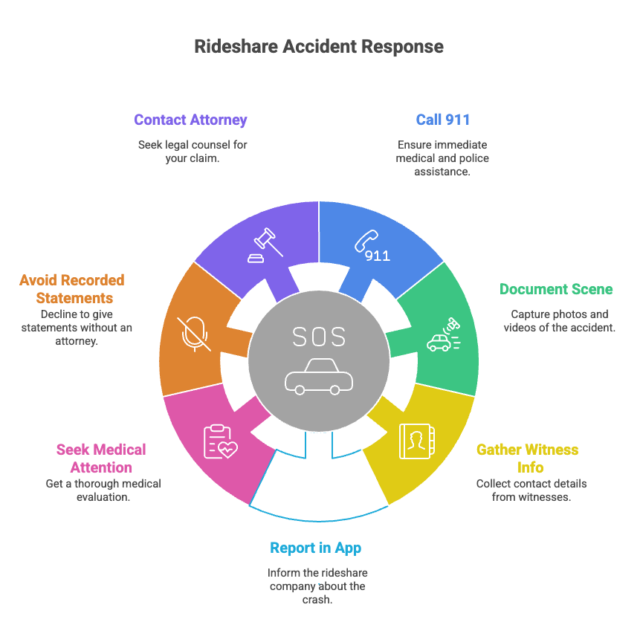
What you do in the immediate aftermath of a rideshare accident can have a profound impact on your ability to recover full compensation. Follow these steps carefully.
- Call 911 Immediately. Report the accident and request medical assistance, even if you feel fine. Adrenaline can mask serious injuries, and some conditions like traumatic brain injuries or internal bleeding may not present symptoms immediately.
- Document the Scene Thoroughly. Take photos and videos of all vehicles involved, the accident scene, road conditions, traffic signals, and your visible injuries. Get the names, contact information, driver’s license numbers, and insurance information from all drivers involved.
- Gather Witness Information. If anyone witnessed the accident, get their name and phone number. Witness testimony can be invaluable in disputed liability cases.
- Report the Accident in the Rideshare App. Use the Uber or Lyft app to report the crash as soon as possible. This creates an official record with the rideshare company and triggers their claims process.
- Seek Medical Attention Promptly. Get a full medical evaluation as soon as possible, even if you were treated at the scene. This creates a medical record that directly links your injuries to the accident, which is essential for your claim.
- Do Not Give a Recorded Statement Without an Attorney. Insurance adjusters from the at-fault driver’s company — and even from Uber or Lyft’s insurer — may contact you quickly and ask for a recorded statement. Politely decline and contact an attorney first. These adjusters are trained to ask questions in ways that can minimize your claim.
- Contact a Rideshare Accident Attorney. The sooner you involve an experienced attorney, the better. They can preserve critical evidence, handle all communications with insurance companies, and ensure you don’t make any of the common mistakes that can ruin your car accident claim.
Why Rideshare Accident Claims Are More Complex Than Regular Car Accidents
Many people underestimate the complexity of a rideshare accident claim, especially when a third party is at fault. These cases involve challenges that simply do not exist in a standard two-car collision.
Multiple Insurance Policies and Competing Interests
Juggling claims simultaneously with the at-fault driver’s personal insurance, the rideshare company’s commercial insurer, and potentially your own PIP carrier requires a sophisticated understanding of insurance law. Each insurer has its own team of adjusters and attorneys whose job is to minimize payouts. Without experienced legal representation, it is easy to accept a settlement that is far below the true value of your claim.
Evidence Preservation Challenges
Key evidence in a rideshare accident can disappear quickly. The rideshare driver’s app data, including GPS records and trip status at the time of the crash, is critical for establishing the applicable insurance period and proving the facts of the case. This data must be formally requested and preserved before it is overwritten or deleted. An attorney knows how to issue a timely legal hold notice to ensure this evidence is protected.
The Independent Contractor Defense
Uber and Lyft classify their drivers as independent contractors, not employees. While this does not eliminate the rideshare company’s insurance obligations, it is a legal distinction that these companies use to limit their direct liability. Understanding how to navigate this defense and focus on the appropriate insurance coverage is a key skill that an experienced rideshare accident attorney brings to your case.
Frequently Asked Questions About Rideshare Accidents Caused by Another Driver
Can I sue the driver who hit my Uber or Lyft?
Yes, absolutely. As an injured passenger, you have a direct legal claim against the driver who caused the accident. You can sue the at-fault driver for your medical expenses, lost wages, pain and suffering, and all other damages resulting from their negligence.
Do I need a lawyer if the other driver was clearly at fault?
Yes, strongly recommended. Even in seemingly clear-cut cases, insurance companies will work hard to pay out as little as possible. They may dispute the severity of your injuries, argue over the applicable insurance period, or attempt to shift partial blame onto you. An experienced attorney can accurately calculate the full value of your claim, negotiate aggressively, and take the case to trial if necessary.
How long do I have to file a claim in Florida?
Under the 2023 Florida tort reform, you have two years from the date of the accident to file a personal injury lawsuit. This is a hard deadline. Missing it means permanently losing your right to compensation. Do not wait to consult an attorney.
What if I was a pedestrian or cyclist hit by a rideshare vehicle?
If you were a pedestrian or cyclist struck by a rideshare vehicle, you may have claims against the at-fault driver (whether that is the rideshare driver or a third party) and potentially against the rideshare company’s insurance. The same tiered insurance system applies. Consult an attorney to understand your specific rights.
How Pencheff & Fraley Can Help You Fight for Maximum Compensation
If you were injured in a rideshare accident caused by another driver, you deserve an attorney who understands the full complexity of these cases and has the experience to fight for every dollar you are owed. The personal injury attorneys at Pencheff & Fraley have extensive experience handling rideshare accident claims throughout Florida and Ohio. We understand the tactics that insurance companies use to devalue claims, and we know how to build a powerful, evidence-driven case that stands up to scrutiny.
When you work with Pencheff & Fraley, we handle everything. We investigate the accident, gather and preserve critical evidence, identify all available insurance policies, communicate with adjusters on your behalf, and negotiate aggressively for a fair settlement. If the insurance companies refuse to offer what you deserve, we are fully prepared to take your case to trial. Unlike many firms, we take cases all the way through trial — and our results speak for themselves.
Contact us today for a free, no-obligation consultation. We will review your case, answer your questions, and explain your legal options. Learn how we can help you on the road to recovery. Pay nothing unless we win your case.
Call us at 904-770-4953 or visit our website at www.pencheffandfraley.com to schedule your free case consultation.
We’re Here for You 24/7
We are available 24/7 to take your call. If you are unable to travel, we will come to you. The sooner you call, the stronger your case can be. Your path to maximum compensation and justice starts with a single phone call to Pencheff & Fraley.
Author: Pencheff and Fraley Legal Team
Disclaimer: This article is for informational purposes only and does not constitute legal advice. Every case is unique, and you should consult with a qualified attorney about your specific situation.