

Being in a rideshare accident is a disorienting, frightening experience. One moment you are in the back of an Uber or Lyft heading to your destination, and the next, you are dealing with the aftermath of a crash — injuries, confusion, and a web of insurance questions that most people have never encountered before. If you are asking yourself, “What evidence should I collect after a rideshare accident?”, you are already thinking about this the right way.
The evidence you gather in the hours and days following a rideshare crash can make or break your personal injury claim. According to Uber’s most recent US Safety Report, there were 127 fatal crashes involving Uber vehicles in 2021 and 2022, resulting in 153 deaths. Lyft’s 2024 Safety Transparency Report revealed 111 motor vehicle fatalities between 2020 and 2022 — a 31% increase in incident frequency from the prior reporting period. And a peer-reviewed study published in the Journal of Safety Research found that one in three rideshare drivers reported being involved in a work-related crash. These are not rare events. They happen every day, and the victims who recover the most compensation are those who act quickly and collect the right evidence.
At Pencheff & Fraley, our experienced personal injury attorneys have helped rideshare accident victims across Florida and Ohio fight for the compensation they deserve. This guide draws on that experience to give you a comprehensive, step-by-step breakdown of every piece of evidence you need to protect your rights.
Why Evidence Is the Foundation of a Rideshare Accident Claim
Rideshare accidents are fundamentally different from standard car accidents, and the evidence requirements reflect that complexity. When you are injured in a crash involving an Uber or Lyft driver, you may be dealing with multiple insurance policies, a corporate entity with a legal team, and a driver who is classified as an independent contractor — not an employee — which creates significant liability questions.
Insurance adjusters for Uber, Lyft, and the driver’s personal insurer are trained to minimize payouts. They look for gaps in evidence, inconsistencies in your account, and any reason to argue that your injuries were pre-existing or that you bear some degree of fault. In Florida, the state follows a modified comparative negligence rule under Florida Statute 768.81, which means your compensation can be reduced by your percentage of fault — and if you are found to be more than 51% at fault, you may be barred from recovering anything at all. Strong, well-documented evidence is your best defense against these tactics.
Beyond fault, evidence also determines the value of your claim. Medical records establish the severity of your injuries. Wage documentation proves your financial losses. Photographs and video capture the physical reality of the crash in a way that no verbal description can replicate. Without this evidence, even a legitimate claim can be undervalued or denied.
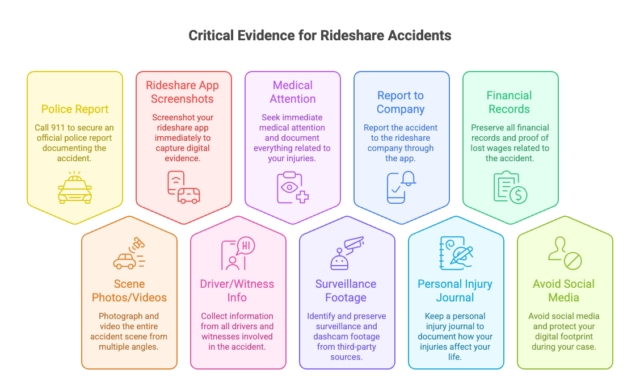
The 10 Critical Types of Evidence to Collect After a Rideshare Accident
1. Call 911 and Secure the Official Police Report
Your first call after ensuring your safety should be to 911. Even if the crash appears minor, having law enforcement respond to the scene is essential. The responding officer will document the accident, collect statements from all parties, and create an official police report — one of the most important pieces of evidence in any personal injury claim.
The police report typically contains the date, time, and precise location of the accident; the names, contact information, and insurance details of all drivers involved; statements from drivers, passengers, and witnesses; the officer’s observations about road conditions, weather, and traffic signals; any citations issued to the at-fault driver; and a preliminary assessment of fault.
You can obtain a copy of the police report from the responding law enforcement agency, usually within a few days of the accident. In Florida, you can request crash reports through the Florida Department of Highway Safety and Motor Vehicles (FLHSMV). While a police report is highly persuasive, it is not the final word on fault — an experienced attorney can challenge or supplement it with additional evidence.
2. Photograph and Video the Entire Accident Scene
Your smartphone is your most powerful evidence-gathering tool at the scene. Visual evidence is extraordinarily difficult to dispute and can capture details that no one can recreate once the scene is cleared. Tow trucks, emergency responders, and other vehicles will alter the scene within minutes, so act quickly.
Take photos and videos of all vehicles involved from multiple angles, including close-ups of damage and wide shots showing the vehicles’ final positions relative to each other and the road. Photograph skid marks and road debris, which can help reconstruct the speed and direction of vehicles before impact. Document traffic controls and road conditions, including traffic lights, stop signs, lane markings, and any construction zones. Capture weather conditions, visibility, and road surface conditions such as wet pavement or potholes.
Photograph the license plates of all vehicles involved, and take photos of any visible injuries — cuts, bruises, swelling — as soon as possible. Repeat this process over the following days, as bruising and swelling often worsen. Also capture nearby businesses, intersections, landmarks, and any surveillance cameras you can identify. These details establish the location and may help your attorney locate additional footage later.
Do not stop at still photos. Short video clips can capture the full scope of the scene in a way that a series of photographs cannot. Walk the perimeter of the accident scene while recording, narrating what you observe.
3. Screenshot Your Rideshare App Immediately
This is one of the most important — and most overlooked — steps in a rideshare accident case. The Uber or Lyft app contains a wealth of digital evidence that is unique to rideshare crashes and is not available in standard car accident cases. However, this information can be difficult to retrieve in its original form after the fact.
Before you close the app or the trip ends, take screenshots of the trip details page showing the date, time, pick-up location, drop-off location, and fare amount. This confirms you were an active passenger at the time of the crash. Also screenshot the route map showing the route taken during your trip, which can reveal if the driver was taking an unusual or dangerous path. Capture the driver’s profile showing their name, photo, vehicle make and model, and license plate number as displayed in the app. Save any in-app messages exchanged with the driver before, during, or after the trip.
Determining the driver’s status in the app at the time of the accident is critical because it dictates which insurance policy applies. As explained in our comprehensive guide on Uber & Lyft Insurance Coverage in Florida, the coverage available to you depends entirely on whether the driver was waiting for a request, en route to a pickup, or actively transporting a passenger.
4. Collect Information from All Drivers and Witnesses
While your phone is out, gather information from every person involved in or who witnessed the accident. From all drivers involved, collect their full legal name and contact information, driver’s license number and state of issue, vehicle make, model, year, and color, license plate number, and insurance company name and policy number.
From witnesses, collect their full name and contact information, along with a brief note about where they were positioned and what they saw. Witnesses are invaluable because they provide an unbiased, third-party account of the accident. Their testimony can corroborate your version of events and help establish fault, particularly in cases where the rideshare driver disputes what happened. Collect their information calmly and factually, and avoid discussing fault or making statements about the accident that could be used against you later.
5. Seek Immediate Medical Attention and Document Everything
Even if you feel fine after the accident, you must seek medical evaluation as soon as possible — ideally within 24 hours. Many serious injuries, including traumatic brain injuries (TBI), internal bleeding, and spinal cord damage, do not produce immediate symptoms. The adrenaline and shock of the crash can mask pain for hours or even days.
Seeking prompt medical care is critical for two reasons. First, it protects your health. Second, it creates a contemporaneous medical record that directly links your injuries to the accident. If you wait days or weeks to see a doctor, insurance companies will argue that your injuries were not serious, were pre-existing, or were caused by something other than the crash.
Medical documentation to collect and preserve includes emergency room or urgent care records from the day of the accident, all subsequent doctor’s notes, specialist referrals, and treatment plans, imaging results such as X-rays, MRIs, and CT scans, prescription records, physical therapy and rehabilitation records, and medical bills and receipts for all out-of-pocket expenses.
In Florida, it is also important to note that under the state’s no-fault insurance system, you must seek medical treatment within 14 days of the accident to be eligible for Personal Injury Protection (PIP) benefits under Florida Statute 627.736. Missing this deadline can significantly impact your ability to recover compensation.
6. Identify and Preserve Surveillance and Dashcam Footage
Video footage from third-party sources can be some of the most powerful evidence available in a rideshare accident case. Unlike photographs, video shows the sequence of events leading up to the crash — the speed of vehicles, the actions of drivers, and the conditions at the moment of impact.
Potential sources of video evidence include business surveillance cameras from restaurants, gas stations, retail stores, banks, and other businesses that may have exterior cameras capturing the accident. Traffic and red-light cameras at many intersections are operated by local governments or traffic management agencies. Residential doorbell cameras on homes near the accident scene may have captured the crash. The rideshare driver, other drivers involved, or nearby vehicles may also have dashcam footage.
Video footage is time-sensitive. Businesses typically overwrite their surveillance footage on a rolling basis, often within 24 to 72 hours. Your attorney can send a spoliation letter — a formal legal notice demanding that the footage be preserved — to businesses and other parties as quickly as possible. Do not delay in reporting this to your attorney.
7. Report the Accident to the Rideshare Company
Both Uber and Lyft have in-app mechanisms for reporting accidents. You should report the crash through the app as soon as possible after the accident. This creates an official record with the company and triggers their internal investigation process.
However, be cautious about what you say when reporting the accident. Provide the basic facts — the date, time, location, and that an accident occurred — but do not make any statements about fault, the severity of your injuries, or your willingness to settle. Any statements you make to the rideshare company can potentially be used against you. It is advisable to consult with an attorney before providing any detailed statements to Uber, Lyft, or their insurance representatives.
8. Keep a Personal Injury Journal
Starting the day of the accident, keep a detailed written record of how your injuries are affecting your daily life. This personal injury journal is a form of evidence that many accident victims overlook, but it can be enormously valuable in demonstrating the full impact of your injuries on your quality of life.
Your journal should document your pain levels each day on a scale of 1 to 10 and the location of the pain, activities you are unable to perform because of your injuries such as driving, cooking, or exercising, sleep disturbances caused by pain or anxiety, emotional and psychological effects including anxiety, depression, or post-traumatic stress, days missed from work and any impact on your professional performance, and the effect of your injuries on your personal relationships.
This type of documentation helps establish non-economic damages — the pain, suffering, and loss of enjoyment of life that are often the largest component of a rideshare accident settlement. For a detailed breakdown of how these damages are calculated, see our guide on How Much Compensation Can an Uber Passenger Get?
9. Preserve All Financial Records and Proof of Lost Wages
Your economic damages are among the most straightforward to document, but they require careful record-keeping. Preserve every financial document related to the accident and your recovery, including all medical bills, invoices, and Explanation of Benefits (EOB) statements from your health insurer; receipts for prescription medications and medical equipment such as crutches and braces; transportation costs to and from medical appointments; a letter from your employer documenting the dates you missed work and your rate of pay; pay stubs from before and after the accident to show any reduction in earnings; and documentation of any self-employment income lost due to your injuries.
If your injuries are severe and will affect your ability to work in the future, your attorney may retain a vocational expert or economist to calculate your loss of future earning capacity — a significant component of damages in serious rideshare accident cases.
10. Avoid Social Media and Protect Your Digital Footprint
In the age of social media, one of the most important things you can do after a rideshare accident is to stop posting. Insurance defense attorneys and adjusters routinely monitor the social media profiles of claimants, looking for any posts, photos, or videos that could be used to undermine your claim.
A photo of you at a social gathering, a post about a weekend activity, or even a simple status update saying you are “doing well” can be taken out of context and used to argue that your injuries are not as serious as you claim. For the duration of your case, do not post about the accident, your injuries, or your legal claim on any platform. Do not accept new friend requests from people you do not know. Review and tighten your privacy settings on all social media accounts. Inform friends and family not to tag you in photos or posts.
The Unique Challenges of Rideshare Accident Evidence
Rideshare accidents present evidence-gathering challenges that do not exist in standard car accident cases. Understanding these challenges helps explain why acting quickly — and working with an experienced attorney — is so important.
The Three-Period Insurance Problem
As discussed in our detailed guide on Uber & Lyft Insurance Coverage in Florida, the insurance coverage available after a rideshare accident depends entirely on the driver’s status in the app at the moment of the crash. The difference between a driver who is logged into the app (Period 1) and a driver who has accepted a ride (Period 2 or 3) can mean the difference between $50,000 in coverage and $1,000,000 in coverage.
The table below summarizes the three-period coverage system:
| Period | Driver Status | Uber/Lyft Coverage |
| Period 0 | App is off | Driver’s personal insurance only |
| Period 1 | App is on, waiting for a request | $50,000/$100,000 bodily injury; $25,000 property damage |
| Period 2 | Ride accepted, en route to passenger | $1,000,000 primary liability |
| Period 3 | Passenger in vehicle | $1,000,000 primary liability |
Rideshare companies have a financial incentive to argue that a driver was in Period 0 or Period 1 at the time of a crash, rather than Period 2 or 3. Proving the driver’s app status requires access to the company’s internal trip logs, GPS data, and server records — data that the company controls and may be reluctant to produce. An attorney can formally demand this data through the discovery process.
Digital Evidence Disappears Quickly
Rideshare companies do not retain trip data indefinitely. GPS logs, route data, and driver status records may be overwritten or deleted within weeks of an accident. Similarly, surveillance footage from businesses is typically overwritten within 24 to 72 hours. The moment you retain an attorney, they can send preservation letters to all relevant parties to prevent the destruction of this critical evidence.
The Independent Contractor Defense
Uber and Lyft classify their drivers as independent contractors, not employees. This classification is designed to limit the companies’ liability for their drivers’ actions. While this defense has been challenged in courts across the country, it remains a significant legal hurdle. Overcoming it requires evidence that goes beyond the accident itself — including evidence about the driver’s history, the company’s control over the driver’s work, and the specific circumstances of the crash.
What to Do If You Cannot Gather Evidence Yourself
If you are seriously injured and unable to gather evidence at the scene, do not panic. There are still steps you can take to protect your claim. Ask a bystander or companion for help — if you are with someone, ask them to take photos, collect witness information, and screenshot the rideshare app on your behalf. Rely on the police report, as the responding officer will document the scene, collect statements, and create an official record that your attorney can use.
Most importantly, contact an attorney as soon as possible. An experienced rideshare accident attorney can begin investigating the accident, sending preservation letters, and gathering evidence on your behalf — even before you have left the hospital.
At Pencheff & Fraley, we understand that our clients are often dealing with serious injuries when they first contact us. We handle all aspects of the evidence-gathering process so you can focus on your recovery. Learn more about your rights as an injured passenger in our guide on What to Do If You’re Injured as an Uber or Lyft Passenger in Florida.
Frequently Asked Questions About Rideshare Accident Evidence
How long do I have to file a rideshare accident claim in Florida?
Florida recently shortened the statute of limitations for personal injury claims from four years to two years. This means you have two years from the date of the accident to file a lawsuit. However, because evidence disappears quickly and insurance companies begin building their defense immediately, you should contact an attorney as soon as possible after the accident — ideally within days, not months.
Can I still file a claim if I didn’t collect evidence at the scene?
Yes. While evidence collected at the scene is valuable, it is not the only source of evidence in a rideshare accident case. An attorney can investigate the accident, obtain the police report, request data from Uber or Lyft, identify surveillance footage, and locate witnesses. The sooner you contact an attorney, the better your chances of preserving this evidence.
What if the rideshare driver’s app was off at the time of the accident?
If the driver’s app was off, they were not acting as a rideshare driver at the time of the crash, and Uber or Lyft’s insurance would not apply. In this case, you would need to pursue a claim against the driver’s personal auto insurance. An attorney can help you investigate the driver’s app status and determine the appropriate insurance coverage.
Should I give a recorded statement to the insurance company?
No. You are not legally required to give a recorded statement to the rideshare company’s insurance adjuster, and doing so can be harmful to your claim. Insurance adjusters are trained to ask questions in ways that can minimize your claim. Always consult with an attorney before providing any statements to insurance companies.
What if the Uber or Lyft driver was not at fault?
Even if the rideshare driver was not at fault, you may still have a claim against the driver who caused the accident. As a passenger, you are generally not considered at fault in a rideshare accident, which means you have the right to seek compensation from whoever caused the crash. An attorney can help identify all liable parties and pursue claims against each of them. For more information on liability, see our guide on Is Uber or Lyft Liable for Accidents in Florida?
The Pencheff & Fraley Advantage: Fighting for Rideshare Accident Victims in Florida and Ohio
Rideshare accident cases are among the most legally complex personal injury claims, involving multiple insurance policies, corporate defendants, and rapidly evolving state and federal law. The experienced attorneys at Pencheff & Fraley have a deep understanding of the unique challenges these cases present and a proven track record of fighting for our clients’ rights.
We handle every aspect of your case — from the initial investigation and evidence gathering to negotiating with insurance companies and, if necessary, taking your case to trial. We work on a contingency fee basis, which means you pay nothing unless we win. There are no upfront costs and no financial risk to you.
Contact us today for a free, no-obligation consultation. We will review your case, answer your questions, and explain your legal options. Learn how we can help you on the road to recovery. Pay nothing unless we win your case.
Call us at 904-770-4953 or visit our website at www.pencheffandfraley.com to schedule your free case consultation.
We’re Here for You 24/7
We are available 24/7 to take your call. If you are unable to travel, we will come to you. The sooner you call, the stronger your case can be. Your path to maximum compensation and justice starts with a single phone call to Pencheff & Fraley.
Author: Pencheff and Fraley Legal Team
Disclaimer: This article is for informational purposes only and does not constitute legal advice. Every case is unique, and you should consult with a qualified attorney about your specific situation.