
Catastrophic Truck Accident Injuries in Florida: A Comprehensive Guide to Your Rights & Compensation
In the blink of an eye, a commercial truck collision can irrevocably alter your life. The screech of tires and the crushing impact often leave victims and their families grappling with immense physical pain. Moreover, they face profound emotional and financial devastation. When injuries are this severe and life-altering, Florida law classifies them as catastrophic. Consequently, navigating a claim for Catastrophic Truck Accident Injuries in Florida requires more than just medical care. It demands a deep understanding of the law and, furthermore, a fierce advocate to fight for your future.
At Pencheff & Fraley, we have witnessed firsthand the immense toll these accidents take. We are a dedicated team of personal injury attorneys who specialize in representing victims of severe and catastrophic truck accidents across Florida. Therefore, we understand the intricate legal landscape and the aggressive tactics of trucking companies and their insurers. We know what it takes to secure the substantial compensation necessary to cover a lifetime of needs. Ultimately, this guide provides the critical information you need to understand your rights, the nature of catastrophic injuries, and the steps you can take to protect your family’s future.
The Sobering Reality of Florida Truck Accidents: A Look at the 2024 Statistics
To fully grasp the danger large commercial trucks pose on Florida’s bustling highways, it is essential to look at the data. The statistics, in fact, paint a grim picture of the frequency and severity of these collisions. According to the latest data published by the Florida Highway Safety and Motor Vehicles (FLHSMV) for 2024, the risks are significant and ever-present.
| 2024 Florida Commercial Motor Vehicle Crash Statistics | Number |
| Total Commercial Motor Vehicle (CMV) Crashes | 46,651 |
| Fatalities Resulting from CMV Crashes | 315 |
| Total Traffic Fatalities (All Vehicles) | 3,184 |
| Commercial Vehicles Placed Out of Service for Safety Violations | 14,091 |
| Commercial Vehicle Drivers Placed Out of Service for Safety Violations | 5,900 |
These numbers reveal a startling fact: nearly 10% of all traffic fatalities in Florida involve a commercial truck. Furthermore, the high number of vehicles and drivers that authorities take off the road for safety violations underscores a troubling pattern of negligence within the trucking industry. This data is not just a collection of numbers; on the contrary, it represents thousands of lives shattered by preventable accidents. When such an accident results in a catastrophic injury, holding the negligent parties accountable becomes a matter of justice.
What Legally Constitutes a “Catastrophic Injury” in Florida?
The term “catastrophic” is not merely a descriptive word; it holds a specific and critical legal meaning in Florida. Under Florida Statute 766.118, the law defines a catastrophic injury as a permanent impairment that leaves a person requiring assistance to perform daily living activities. This classification is reserved for the most severe, life-altering injuries. For instance, it includes conditions such as:
- Spinal cord injuries involving paralysis.
- Amputation of an arm, hand, foot, or leg.
- Severe brain or closed-head injuries.
- Second-degree or third-degree burns over 25% of the body.
- Third-degree burns over 5% of the face and hands.
- Total and permanent loss of vision or hearing.
Having an injury legally classified as catastrophic is profoundly significant for a personal injury claim. Specifically, it signals to insurance companies and courts that the victim will require a lifetime of medical treatment, adaptive equipment, and personal assistance. This legal designation is therefore crucial for justifying and securing the multi-million dollar settlements or verdicts often necessary to provide for a victim’s long-term well-being.
Common Types of Catastrophic Injuries in Florida Truck Accidents
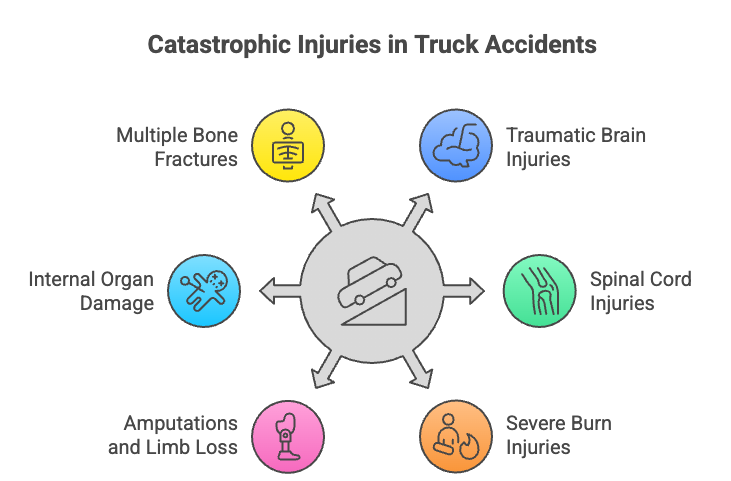
The immense weight and force of an 80,000-pound semi-truck colliding with a passenger vehicle create a uniquely destructive environment. As a result, the injuries are often severe and complex, requiring immediate and intensive medical intervention.
Traumatic Brain Injuries (TBIs): The Silent Epidemic
A traumatic brain injury is one of the most devastating outcomes of a truck accident. The violent impact can cause the head to strike the vehicle’s interior or be pierced by debris, which leads to direct trauma. Even without a direct blow, the rapid acceleration and deceleration forces can cause the brain to slam against the inside of the skull. This, in turn, results in diffuse axonal injury. The Centers for Disease Control and Prevention (CDC) identifies motor vehicle crashes as a leading cause of TBI-related hospitalizations.
According to the Mayo Clinic, TBIs can lead to a wide range of long-term complications. These include cognitive deficits, memory loss, personality changes, seizures, and an inability to live independently.
Spinal Cord Injuries (SCIs): A Lifetime of Challenges
The sheer force of a truck crash can fracture vertebrae and damage the delicate spinal cord, which can lead to permanent paralysis. In fact, the National Spinal Cord Injury Statistical Center reports that vehicular crashes are the leading cause of SCIs.
- Paraplegia: An injury to the thoracic, lumbar, or sacral region of the spine can result in paralysis of the lower body.
- Quadriplegia (or Tetraplegia): An injury to the cervical (neck) region of the spine can result in paralysis of all four limbs, the torso, and pelvic organs.
Consequently, a spinal cord injury necessitates a lifetime of medical care. This includes mobility aids like wheelchairs, home and vehicle modifications, and often, round-the-clock personal assistance.
Severe Burn Injuries: Agonizing and Disfiguring
Truck accidents that involve fuel spills or hazardous materials can result in catastrophic fires and explosions. In these events, victims can suffer third-degree burns, which destroy all layers of the skin and underlying tissue. These injuries require excruciatingly painful treatments, including skin grafts and reconstructive surgeries. Moreover, they often leave victims with permanent scarring and disfigurement, leading to profound psychological trauma.
Amputations and Limb Loss: A Permanent Alteration of Life
In high-speed or crush-related truck accidents, a victim’s limbs can be so severely damaged that surgeons must perform an amputation to save their life. The loss of a limb is a permanent disability. It requires extensive physical and occupational therapy, the use of costly prosthetics, and a fundamental readjustment to every aspect of daily life.
Internal Organ Damage: The Hidden Threat
Blunt force trauma from a truck accident can cause severe damage to vital internal organs, which can lead to life-threatening internal bleeding. Common injuries include ruptured spleens, lacerated livers, punctured lungs, and kidney damage. These injuries require immediate emergency surgery and, unfortunately, can result in long-term organ dysfunction.
Multiple Bone Fractures and Crush Injuries
The weight of a commercial truck can easily crush a smaller vehicle. This often results in complex and multiple bone fractures. Comminuted fractures, where a bone shatters into multiple pieces, are common. They frequently require complex surgeries that involve implanting plates, screws, and rods to stabilize the bone. Subsequently, the recovery process is long, painful, and often incomplete.
Unraveling the Complex Web of Liability in a Florida Truck Accident
Unlike a typical car accident involving two drivers, a commercial truck accident case often involves a complex network of potentially liable parties. Therefore, a thorough investigation is essential to identify every individual and entity whose negligence contributed to the crash.
- The Truck Driver: Driver negligence is a common cause of accidents. This can include speeding, distracted driving, driving under the influence (DUI), or violating federal hours-of-service rules.
- The Trucking Company (Motor Carrier): A trucking company may be directly liable for its own negligence. For example, they may have negligently hired an unqualified driver, provided inadequate training, or pressured drivers to meet unrealistic deadlines. They can also be held vicariously liable for their employees’ negligence.
- Maintenance and Repair Companies: If a third-party company performed faulty maintenance on the truck’s brakes, tires, or steering systems, they can be held responsible for a resulting mechanical failure.
- Cargo Loaders and Shippers: Improperly loaded or secured cargo can shift during transit, causing the driver to lose control. The company responsible for loading the cargo can be held liable in these situations.
- Vehicle and Parts Manufacturers: If a defective part, such as a faulty tire or a failing brake system, caused the accident, the manufacturer can be held liable under product liability laws.
The Critical Role of Federal and State Trucking Regulations
A comprehensive set of federal and state regulations governs the trucking industry to ensure safety on our roads. Proving that a driver or trucking company violated these regulations is often a cornerstone of a successful catastrophic injury claim.
Federal Motor Carrier Safety Administration (FMCSA) Regulations
The FMCSA sets the national standard for trucking safety. Key regulations include:
- Hours of Service (HOS): These rules strictly limit the number of hours a driver can be on duty and behind the wheel. The goal is to prevent driver fatigue, a leading cause of truck accidents. You can find more information on the FMCSA’s HOS page.
- Electronic Logging Devices (ELDs): Most commercial trucks must now have an ELD. This device automatically records driving time to ensure compliance with HOS rules.
- Maintenance and Inspections: The FMCSA mandates rigorous inspection, repair, and maintenance programs for all commercial vehicles.
- Drug and Alcohol Testing: Drivers are subject to strict drug and alcohol testing protocols, including pre-employment, random, and post-accident testing.
Florida-Specific Trucking Laws
In addition to federal rules, Florida has its own laws governing commercial trucks. These include minimum insurance coverage requirements that are significantly higher than those for passenger vehicles. An experienced attorney will use violations of these federal and state laws to build a powerful case for negligence.
Navigating the Legal Maze: Your Rights After a Catastrophic Truck Accident in Florida
The legal process following a catastrophic truck accident is complex and fraught with potential pitfalls. For this reason, understanding your rights and the critical deadlines involved is essential to protecting your claim.
The Statute of Limitations: A Critical Deadline You Cannot Miss
In Florida, you generally have two years from the date of the accident to file a personal injury lawsuit. While this may seem like a long time, it is crucial to act quickly. If you fail to file a lawsuit within this two-year window, the court will permanently bar you from recovering any compensation for your injuries. Contacting an attorney immediately allows them to begin preserving critical evidence, such as the truck’s black box data and the driver’s logs, before it can be lost or destroyed.
Understanding Florida’s Comparative Negligence Law
Florida follows a modified comparative negligence rule. This means you can still recover damages even if you were partially at fault for the accident, as long as your percentage of fault is not more than 50%. However, the court will reduce your total compensation by your percentage of fault. For example, if you are awarded $1 million but found to be 10% at fault, your award will be reduced by $100,000 to $900,000. Insurance companies are experts at trying to shift blame to victims to reduce their payout. For that reason, having a skilled attorney to fight these allegations is critical.
Maximizing Your Recovery: A Deep Dive into Compensation for Catastrophic Injuries
No amount of money can undo a catastrophic injury. However, a comprehensive settlement or verdict can provide the financial security needed to ensure a lifetime of quality care and dignity. Generally, compensation is divided into three main categories.
Economic Damages: Recovering Your Financial Losses
These are tangible, calculable losses that have a specific dollar amount attached. They include:
- All past, present, and future medical bills, from the initial emergency response to lifelong care.
- Lost wages and income from being unable to work.
- Loss of future earning capacity if you are unable to return to your previous career.
- Costs for physical, occupational, and vocational rehabilitation.
- Expenses for long-term care, such as in-home nursing or an assisted living facility.
- The cost of adaptive medical equipment, as well as modifications to your home and vehicle.
Non-Economic Damages: Compensation for Your Suffering
These damages are intended to compensate for the intangible, personal losses that have no price tag. They include:
- Pain and suffering (both physical and mental).
- Emotional distress and mental anguish.
- Loss of enjoyment of life.
- Permanent disfigurement and scarring.
- Loss of consortium, which compensates a spouse for the loss of companionship and intimacy.
Punitive Damages: Punishing Gross Negligence
In rare cases where the defendant’s conduct was found to be grossly negligent or intentionally malicious, a court may award punitive damages. These are not designed to compensate the victim. Instead, their purpose is to punish the defendant and deter similar conduct in the future.
What to Do Immediately After a Catastrophic Truck Accident in Florida
The moments following a truck accident are chaotic and overwhelming. The steps you take, however, can have a significant impact on your health and your ability to bring a successful legal claim.
- Prioritize Safety and Medical Care: First and foremost, your priority is your health. Call 911 immediately and accept emergency medical transport to a hospital. Even if you feel you are not seriously injured, you may have internal injuries that are not immediately apparent.
- Report the Accident: Next, ensure that you call law enforcement to the scene and that they file an official accident report.
- Document the Scene (If Possible): If you are physically able, or if a family member is present, take photos and videos of the accident scene. Be sure to include all vehicles, debris, road conditions, and your injuries.
- Gather Information: Then, collect the names, contact information, and insurance details for all drivers involved. Also, get the contact information of any witnesses.
- Do Not Admit Fault: It is important that you never apologize or say anything that could be construed as an admission of fault to anyone at the scene.
- Be Cautious with Insurance Companies: Do not give a recorded statement, sign any documents, or accept any initial settlement offers from an insurance company without first speaking to an attorney. Their goal is to minimize their payout, not to protect your interests.
- Contact an Experienced Florida Truck Accident Lawyer: Finally, the most important step you can take to protect your future is to contact a law firm that specializes in catastrophic truck accident cases as soon as possible.
Why Choose Pencheff & Fraley for Your Catastrophic Truck Accident Injury Claim?
Choosing the right legal team is the most critical decision you will make in the aftermath of a catastrophic truck accident. At Pencheff & Fraley, we are more than just attorneys; we are your dedicated advocates, committed to securing the justice and financial stability you deserve.
- Unmatched Experience and Specialization: Our firm focuses on complex personal injury cases. As a result, we have a deep and specific understanding of the nuances of truck accident litigation.
- Vast Resources: We have a network of leading experts, including accident reconstructionists, medical specialists, and financial analysts. These experts help us build an undeniable case for the full value of your claim.
- Compassionate, Client-Centered Representation: We understand that you are going through the most difficult time of your life. Therefore, we treat our clients with the compassion and respect they deserve, providing personalized attention and constant communication.
- A Proven Track Record of Success: We have a history of securing substantial, multi-million dollar settlements and verdicts for victims of catastrophic injuries.
- No-Fee Guarantee: We operate on a contingency fee basis. This means you pay us nothing unless and until we win your case. There is no financial risk to you.
Frequently Asked Questions (FAQ) About Catastrophic Truck Accidents in Florida
How much does it cost to hire a truck accident lawyer?
At Pencheff & Fraley, we work on a contingency fee basis. This means you pay no upfront costs, and we only collect a fee if we successfully recover compensation for you.
How long will my case take?
Catastrophic injury cases are complex and can take anywhere from several months to a few years to resolve, especially if a lawsuit needs to be filed. We will work to resolve your case as efficiently as possible while ensuring we do not sacrifice the value of your claim for a quick settlement.
What is my case worth?
Every case is unique. The value depends on many factors, including the severity of your injuries, the amount of your medical bills and lost income, and the degree of the defendant’s negligence. We will conduct a thorough analysis to determine the full, fair value of your claim.
Will I have to go to court?
We settle many truck accident cases out of court through negotiations with the insurance company. However, if the insurer refuses to offer a fair settlement, we are fully prepared to take your case to trial to fight for the compensation you deserve.
What if the truck driver was from out of state?
It does not matter where the truck driver or trucking company is from. If the accident occurred in Florida, your case will be governed by Florida law. We can pursue a claim against all negligent parties, regardless of their location.
Take the First Step Toward Justice and Recovery
The road to recovery after a catastrophic truck accident is long and challenging. However, you do not have to walk it alone. You have the right to seek justice and to demand the financial resources necessary to live your life with dignity and security. Indeed, the legal system can be a powerful tool for holding negligent trucking companies accountable and securing your future.
If you or a loved one has suffered a catastrophic injury in a Florida truck accident, do not wait.
Contact us today for a free, no-obligation consultation. We will review your case, answer your questions, and explain your legal options. Learn how we can help you on the road to recovery. Pay nothing unless we win your case.
Call us at 904-770-4953 or visit our website at www.pencheffandfraley.com to schedule your free case consultation.
We’re Here for You 24/7
We are available 24/7 to take your call. If you are unable to travel, we will come to you. The sooner you call, the stronger your case can be. Your path to maximum compensation and justice starts with a single phone call to Pencheff & Fraley.
Author: Pencheff and Fraley Legal Team
Disclaimer: This article is for informational purposes only and does not constitute legal advice. Every case is unique, and you should consult with a qualified attorney about your specific situation.
More related articles covering Catastrophic Personal Injuries and complete legal guides can be found here below:
Catastrophic Personal Injury Claim in Florida | Complete Legal Guide
Catastrophic Personal Injury Claim in Ohio: Complete Legal Guide