

Jacksonville Truck Accident on I-95: Who Is Liable and What to Do
If you were injured in a commercial vehicle crash, speaking with a truck accident lawyer in Jacksonville FL is the most important step you can take. Interstate 95 cuts directly through Duval County, carrying an enormous volume of commercial freight every single day. That constant flow of 18-wheelers, tractor-trailers, and heavy cargo vehicles makes I-95 one of the most dangerous highways in the entire country for passenger vehicle occupants.
When a loaded semi-truck collides with a car, the results are almost always catastrophic. Victims are left dealing with severe injuries, overwhelming medical expenses, lost income, and insurance companies that are determined to pay as little as possible. Understanding who is legally responsible and what actions to take immediately after the crash can mean the difference between a full financial recovery and a lifetime of hardship.
At Pencheff and Fraley LPA, our personal injury attorneys have the experience and resources to stand up to the largest trucking companies and their insurers. This guide will walk you through everything you need to know about Jacksonville truck accident liability and the critical steps to protect your claim.
Why I-95 in Jacksonville Is So Dangerous for Truck Accident Victims
Florida’s I-95 corridor is widely regarded as one of the most hazardous stretches of highway in the United States. The National Highway Traffic Safety Administration has identified I-95 in Florida as having the highest fatality rate of any road in the country. In the Jacksonville area alone, the Florida Highway Patrol documented 1,713 reported accidents on I-95 in a single year, resulting in 573 injuries and 25 deaths.
The Fuller Warren Bridge is particularly treacherous, with approximately 150,000 vehicles crossing it daily. This high-density traffic environment, combined with merging lanes, construction zones, and the sheer size of commercial vehicles, creates conditions where a momentary lapse in judgment by a truck driver can cause a multi-vehicle pileup.
The Scale of Commercial Truck Crashes in Florida and Duval County
The volume of truck crashes in Florida is staggering. In 2024, the state recorded 10,542 large truck crashes, which translates to an average of roughly 26 incidents per day. Duval County, which encompasses Jacksonville, accounted for 624 of those crashes in 2024, representing approximately 5.92% of all statewide commercial vehicle collisions. This places Duval County among the top four most dangerous counties in Florida for large truck accidents.
Nationally, the Federal Motor Carrier Safety Administration (FMCSA) reported that 5,472 people were killed in crashes involving large trucks in the United States in 2023. What makes these numbers particularly sobering is that 82% of fatalities in large truck crashes are not the truck drivers themselves—they are the occupants of passenger vehicles. The physics are unforgiving: a fully loaded semi-truck can weigh up to 80,000 pounds, compared to roughly 4,000 pounds for a typical passenger car.
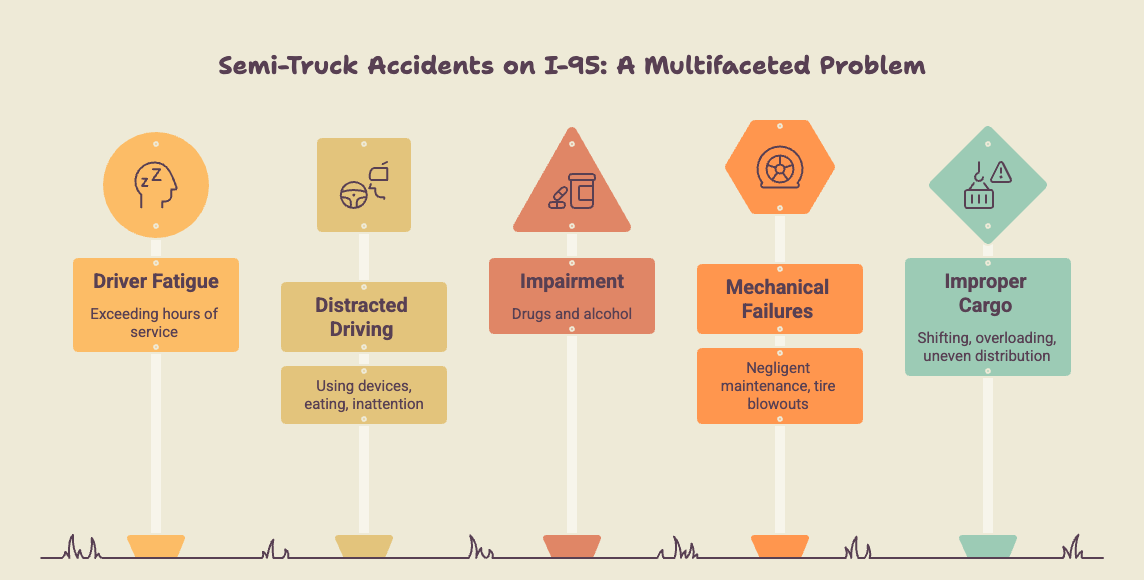
Common Causes of Semi-Truck Accidents on I-95
Understanding what causes commercial truck accidents is essential for building a strong legal claim. A truck accident lawyer in Jacksonville will conduct a thorough investigation to identify the root cause, because the cause directly determines who is liable and what evidence must be preserved.
Driver Fatigue and Hours of Service Violations
Driver fatigue is one of the most prevalent and deadly causes of commercial truck accidents. The FMCSA’s Hours of Service (HOS) regulations exist specifically to combat this danger. Under 49 CFR Part 395, a property-carrying truck driver may drive a maximum of 11 hours after 10 consecutive hours off duty and cannot drive beyond the 14th consecutive hour after coming on duty. Drivers must also take a mandatory 30-minute break after 8 cumulative hours of driving.
Despite these rules, trucking companies frequently pressure drivers to meet unrealistic delivery deadlines, leading to HOS violations. When a fatigued driver loses focus or falls asleep behind the wheel of an 80,000-pound vehicle on a busy stretch of I-95, the consequences are devastating. Electronic Logging Devices (ELDs) now track HOS compliance in real time, and this data is among the most critical evidence in any truck accident case.
Distracted Driving and Impairment
Distracted driving is a serious problem among commercial truck drivers. Using a handheld mobile device while operating a commercial motor vehicle is a federal violation, yet it remains a common cause of crashes. Beyond phone use, eating, adjusting navigation systems, and inattention all contribute to distraction-related accidents.
Drug and alcohol impairment is another significant factor. The FMCSA mandates pre-employment drug testing, random testing, and post-accident testing for all commercial drivers. When a trucking company fails to conduct required testing or retains a driver who has tested positive, it exposes itself to substantial liability.
Mechanical Failures and Negligent Maintenance
Federal law requires trucking companies to systematically inspect, repair, and maintain all commercial vehicles under their control. Drivers must complete pre-trip and post-trip inspections and document any defects on a Driver Vehicle Inspection Report (DVIR). When these requirements are ignored, brake failures, tire blowouts, and steering malfunctions can cause catastrophic accidents.
Tire blowouts are particularly common on Florida’s hot asphalt and are a leading cause of jackknife accidents on I-95. A sudden blowout at highway speed can cause a driver to lose control instantly, sending the trailer swinging across multiple lanes of traffic.
Improperly Loaded or Overloaded Cargo
Cargo securement is governed by strict federal and state standards. If freight is improperly loaded, unevenly distributed, or exceeds the vehicle’s weight limits, it can shift during transit and cause the driver to lose control. Overloaded trucks also have significantly longer stopping distances, making rear-end collisions far more likely.
Who Is Liable in a Jacksonville Truck Accident?
This is the central question in every commercial vehicle crash case, and the answer is almost always more complex than it appears. Unlike a standard two-car accident where one driver is typically at fault, a semi-truck collision can involve a web of corporate entities, each with its own legal responsibilities and insurance policies. Identifying every liable party is essential, because it directly determines the total compensation available to you.
The Truck Driver’s Personal Liability
The driver behind the wheel is the most obvious potential defendant. If the driver was speeding, driving while fatigued, texting, impaired, or otherwise negligent, they can be held personally liable for the damages they caused. However, pursuing only the driver is rarely sufficient, as individual drivers typically carry limited personal assets.
The Trucking Company’s Liability
The trucking company is often the most important defendant in a commercial vehicle case. Under the legal doctrine of respondeat superior, an employer is vicariously liable for the negligent actions of its employees performed within the scope of their employment. This means that if a company driver causes an accident while on duty, the company is legally responsible for the resulting harm.
Beyond vicarious liability, trucking companies can also be held directly liable for their own negligence. This includes negligent hiring—failing to conduct proper background checks or hiring a driver with a history of violations—as well as negligent retention of a driver who poses a known safety risk. If the company pressured the driver to violate HOS rules or knowingly operated a vehicle with known mechanical defects, it faces direct liability for those decisions.
Third-Party Liability: Cargo Loaders, Manufacturers, and Contractors
The chain of liability can extend well beyond the driver and carrier. If improperly secured or overloaded cargo contributed to the crash, the third-party loading company or shipper may be independently liable. Florida Statute § 316.515 governs cargo securement on Florida roads, and violations of this statute can serve as direct evidence of negligence.
If the accident was caused by a defective component—faulty brakes, a defective tire, or a malfunctioning steering system—the manufacturer of that component may face a product liability claim under a strict liability theory. Similarly, if a third-party maintenance contractor performed negligent repairs that contributed to a mechanical failure, they can be joined as a defendant in the lawsuit.
| Potential Liable Party | Primary Basis for Liability |
| Truck Driver | Negligent driving: speeding, fatigue, distraction, or impairment. |
| Trucking Company | Vicarious liability, negligent hiring, HOS pressure, or poor fleet maintenance. |
| Cargo Loader / Shipper | Improperly secured freight, overloaded trailer, or uneven weight distribution. |
| Vehicle / Parts Manufacturer | Defective brakes, tires, steering columns, or other safety-critical components. |
| Maintenance Contractor | Substandard repairs or failure to identify critical mechanical defects during inspection. |
| Government Entity | Poorly maintained roads, missing signage, or defective traffic signals on I-95. |
Florida’s Modified Comparative Fault Law and Your Claim
Understanding Florida’s negligence framework is critical before you pursue a truck accident claim. In 2023, Florida enacted significant tort reform through House Bill 837, transitioning from a pure comparative negligence system to a modified comparative fault model. This change has a direct and significant impact on Jacksonville personal injury cases.
How the 50% Bar Rule Works
Under the modified comparative fault system, you can recover damages even if you were partially responsible for the accident, as long as your share of the fault is 50% or less. Your total financial award will be reduced proportionally by your percentage of fault. For example, if a jury awards you $500,000 but finds you 20% at fault, you would receive $400,000.
However, if a jury determines that you are more than 50% responsible for the crash, you are entirely barred from recovering any compensation whatsoever. This is a critical threshold that commercial trucking insurers will aggressively try to exploit.
How Insurance Companies Use This Law Against You
Trucking companies’ insurance carriers are sophisticated adversaries. They deploy rapid-response investigators to crash scenes within hours of an accident, often before victims have even left the hospital. Their goal is to gather evidence that shifts the blame onto the passenger vehicle driver. Common arguments include claims that you were tailgating, driving in the truck’s blind spots, making an unsafe lane change, or speeding.
This is precisely why you need an experienced truck accident lawyer in Jacksonville FL in your corner from the very beginning. A skilled attorney will build a counter-narrative supported by physical evidence, black box data, and eyewitness testimony to keep your fault percentage below the 50% threshold.
What Compensation Can You Recover?
Victims of commercial truck accidents in Florida may be entitled to recover both economic damages and non-economic damages. In cases involving particularly egregious misconduct, punitive damages may also be available.
Economic Damages
Economic damages compensate you for your tangible, measurable financial losses. These include all past and future medical expenses, such as emergency room care, surgeries, hospitalization, physical rehabilitation, and long-term home health care. They also include lost wages for time missed from work during your recovery, as well as loss of future earning capacity if your injuries prevent you from returning to your career.
Property damage to your vehicle and personal belongings is also recoverable, along with out-of-pocket expenses such as transportation costs to medical appointments and home modifications required by your injuries.
Non-Economic Damages
Non-economic damages compensate you for the intangible ways the accident has affected your life. These include physical pain and suffering—both past and future—as well as emotional distress, mental anguish, and loss of enjoyment of life. If your injuries have caused permanent scarring or disfigurement, you are entitled to compensation for that as well. Spouses of seriously injured victims may also recover for loss of consortium.
The FMCSA’s own economic analysis values the average injury truck crash at $148,279 and a fatal truck crash at $7.2 million. Cases involving catastrophic injuries—spinal cord damage, traumatic brain injuries, or amputations—routinely result in seven-figure settlements and verdicts.
What to Do Immediately After a Truck Accident on I-95
The actions you take in the hours and days following a commercial vehicle crash are critical to the success of your legal claim. Evidence disappears quickly, and the trucking company’s legal team is already working against you.
Step 1: Call 911 and Seek Medical Attention
Your health is the absolute first priority. Call 911 immediately and request emergency medical services. Do not decline an ambulance at the scene, even if you feel fine. Adrenaline is a powerful masking agent, and serious injuries such as internal bleeding, spinal damage, and traumatic brain injuries may not be immediately apparent.
Under Florida’s Personal Injury Protection (PIP) law, you must seek medical treatment within 14 days of the accident to preserve your right to your initial $10,000 in PIP benefits. Delaying treatment not only risks your health but also gives the insurance company grounds to argue that your injuries are unrelated to the crash.
Step 2: Report the Accident and Document the Scene
When law enforcement arrives, provide a clear and factual account of what happened. Do not admit fault or speculate about the cause of the accident. Ensure that an official police report is filed, as this document is foundational to your claim.
If you are physically able to do so safely, document the crash scene thoroughly. Photograph the truck’s USDOT number, license plate, and company name on the trailer. Take pictures of all vehicle damage, the final resting positions of the vehicles, skid marks, road conditions, and any visible injuries. Collect the names and contact information of all eyewitnesses.
Step 3: Do Not Speak to the Trucking Company’s Insurer
The trucking company’s insurance adjuster may contact you very quickly after the accident, sometimes within hours. They may seem sympathetic and helpful, but their goal is to gather information that minimizes or eliminates your claim. Do not provide a recorded statement, do not accept any settlement offers, and do not sign any documents without first consulting an attorney.
Step 4: Contact a Jacksonville Truck Accident Lawyer Immediately
Time is of the essence in commercial vehicle cases. Critical evidence has a very short lifespan. ELD data and dashcam footage can be overwritten within 30 to 90 days. Driver qualification files and maintenance records may be purged on a regular schedule. Your attorney must send a formal spoliation letter to the trucking company immediately, demanding the preservation of all relevant evidence.
Contact Pencheff and Fraley LPA as soon as possible after your accident. We will take immediate action to preserve evidence, investigate the crash, and protect your legal rights.
The Evidence That Wins Truck Accident Cases
Commercial truck accident cases are won and lost on evidence. The categories of evidence available in these cases are far more extensive than in a standard car accident claim, and knowing what to look for is a hallmark of an experienced truck accident attorney in Jacksonville.
Electronic Logging Device (ELD) Data
Since December 2017, most commercial motor vehicles are required to use ELDs to track driving hours and ensure HOS compliance. The ELD creates a precise, tamper-resistant record of when the driver was driving, on duty, off duty, or in the sleeper berth. If the data shows the driver exceeded the 11-hour driving limit or the 14-hour on-duty window, it is powerful evidence of negligence.
The Event Data Recorder (Black Box)
The truck’s Event Data Recorder (EDR), commonly called the black box, captures critical data in the seconds before and during a crash. This includes vehicle speed, throttle position, brake application, and steering input. This data can definitively establish whether the driver was speeding, failed to brake in time, or made an evasive maneuver. It must be preserved immediately, as the data can be overwritten.
Driver Qualification Files and Drug Test Records
Federal law requires trucking companies to maintain detailed qualification files for every driver, including their CDL, medical certificates, driving history, and training records. These files can reveal whether the driver was qualified to operate the vehicle and whether the company conducted the required background checks. Post-accident drug and alcohol testing records are also critical evidence.
Maintenance and Inspection Records
If a mechanical failure contributed to the crash, the trucking company’s maintenance records become central to the case. These records document all inspections, repairs, and identified defects. A pattern of deferred maintenance or ignored defects can establish that the company knowingly operated an unsafe vehicle.
Florida’s Statute of Limitations for Truck Accident Claims
You have a limited window of time to file a personal injury lawsuit in Florida. Under Florida Statute § 95.11, as amended by House Bill 837 in 2023, the statute of limitations for personal injury claims—including truck accidents—is two years from the date of the accident.
This deadline applies to accidents occurring on or after March 24, 2023. If your accident occurred before that date, the prior four-year deadline may still apply. Missing the statute of limitations means your case will almost certainly be dismissed, regardless of how strong your evidence is.
Given the complexity of truck accident investigations—multiple parties, federal regulations, and specialized evidence—early legal involvement is not just advisable; it is essential. The two-year window sounds generous, but the most critical investigative work must happen in the first days and weeks after the crash.
Why Choose Pencheff and Fraley LPA for Your Jacksonville Truck Accident Case
Truck accident litigation is not like any other area of personal injury law. It requires a deep understanding of FMCSA regulations, experience with corporate defendants and their insurers, and the financial resources to retain accident reconstruction experts, medical specialists, and other expert witnesses. Not every law firm has these capabilities.
At Pencheff and Fraley LPA, we have a proven track record of securing significant results for our clients, including an $800,000 truck accident settlement. We serve clients from our Jacksonville office at 1437 San Marco Blvd, and we are easily accessible from I-95 and I-295. We operate on a contingency fee basis, which means you pay nothing unless we win your case.
Our team handles the full spectrum of personal injury cases in Jacksonville, including car accidents, motorcycle accidents, and wrongful death claims. We also represent clients in workers’ compensation matters. Whatever your situation, we are here to fight for you.
To review our history of successful outcomes for clients, visit our case results page. To learn more about our team, visit our firm overview. When you are ready to take the first step, contact us for a free, no-obligation consultation.
Frequently Asked Questions
Who is liable in a Jacksonville truck accident on I-95?
Can more than one party be held liable for a truck accident in Jacksonville?
Yes, and in most commercial vehicle cases, multiple parties share liability. The truck driver may be personally liable for negligent driving. The trucking company is often vicariously liable under respondeat superior and may also face direct liability for negligent hiring, inadequate training, or maintenance failures. Third parties such as cargo loading companies, parts manufacturers, and maintenance contractors can also be held responsible depending on the cause of the crash. Identifying every liable party is critical because it maximizes the total insurance coverage available to compensate you.
What should I do immediately after a truck accident on I-95?
Call 911 and seek medical attention right away, even if you do not feel injured. Adrenaline can mask serious trauma. Document the scene by photographing the truck’s USDOT number, all vehicle damage, skid marks, and road conditions. Do not give a recorded statement to the trucking company’s insurance adjuster. Contact a truck accident lawyer in Jacksonville FL as soon as possible so that a spoliation letter can be sent to preserve the truck’s black box data, ELD records, and dashcam footage before they are overwritten.
How does Florida’s modified comparative fault law affect my truck accident claim?
Under Florida’s 2023 tort reform, you can recover damages as long as you are 50% or less at fault for the accident. Your award will be reduced proportionally by your percentage of fault. However, if a jury finds you more than 50% responsible, you are completely barred from recovering any compensation. Trucking company insurers aggressively try to push your fault percentage above this threshold, which is why having an experienced attorney to counter these arguments is essential.
How long do I have to file a truck accident lawsuit in Florida?
Florida’s statute of limitations for personal injury claims, including truck accidents, is two years from the date of the accident for crashes occurring on or after March 24, 2023. Missing this deadline will almost certainly result in your case being dismissed. Because critical evidence can disappear within weeks, you should contact an attorney as soon as possible after the crash—do not wait until the deadline approaches.
What compensation can I recover after a truck accident in Jacksonville?
You may be entitled to recover economic damages, including all past and future medical expenses, lost wages, loss of future earning capacity, and property damage. You may also recover non-economic damages for pain and suffering, emotional distress, loss of enjoyment of life, and permanent disfigurement. In cases involving egregious misconduct, punitive damages may also be available. The FMCSA values the average fatal truck crash at $7.2 million, reflecting the enormous financial stakes in these cases.
Why do I need a specialized truck accident lawyer and not just any personal injury attorney?
Commercial truck accident cases involve a distinct body of federal law—the FMCSA regulations—that governs every aspect of the trucking industry, from driver qualifications to vehicle maintenance to cargo securement. An attorney who is not familiar with these regulations may overlook critical evidence or fail to identify all liable parties. Additionally, trucking companies carry insurance policies worth hundreds of thousands to millions of dollars, which means they will deploy experienced defense teams. You need a lawyer who is equally prepared and experienced.
Conclusion: Do Not Face the Trucking Companies Alone
A commercial truck accident on I-95 can change your life in an instant. The physical, emotional, and financial toll is immense, and the legal battle ahead is complex. Trucking companies and their insurers are well-funded, experienced, and motivated to minimize your recovery. You deserve an equally powerful advocate in your corner.
The truck accident lawyers in Jacksonville FL at Pencheff and Fraley LPA are ready to fight for you. We will investigate every aspect of your crash, identify every liable party, preserve critical evidence, and pursue every dollar of compensation you are owed. Our contingency fee arrangement means there is no financial risk to you—we only get paid when you win.
Do not wait. Evidence disappears quickly, and the statute of limitations clock is running. Contact Pencheff and Fraley LPA today for a free, confidential consultation. Let us handle the legal battle so you can focus on your recovery.
Contact our Jacksonville office today at 904-770-4953 or visit our contact page to schedule your free consultation. Let our team of dedicated personal injury lawyers in Jacksonville put their experience to work for you.
Author: Pencheff and Fraley Legal Team
Disclaimer: This article is for informational purposes only and does not constitute legal advice. Every case is unique, and you should consult with a qualified attorney about your specific situation.
References
Federal Motor Carrier Safety Administration (FMCSA). “Summary of Hours of Service Regulations.” https://www.fmcsa.dot.gov/regulations/hours-of-service
The Florida Senate. “Florida Statutes § 768.81 – Comparative Fault.” https://www.flsenate.gov/Laws/Statutes/2023/768.81
The Florida Senate. “Florida Statutes § 627.736 – Required Personal Injury Protection Benefits.” https://www.flsenate.gov/Laws/Statutes/2023/627.736
Pencheff and Fraley LPA. “Case Results.” https://pencheffandfraley.com/case-results/