

What to Do After Car Accident Tampa FL: Your Complete 2026 Guide
If you are wondering what to do after car accident Tampa FL, you are not alone. According to FLHSMV crash data, Hillsborough County recorded 24,864 crashes in 2025 — an average of 68 collisions every single day.
From the congested lanes of Interstate 275 to the busy intersections of Dale Mabry Highway, Tampa’s roads are among the most dangerous in Florida. Knowing exactly what to do in the moments after a crash can protect your health, your rights, and your financial recovery.
The Tampa, FL personal injury attorneys at Pencheff and Fraley LPA have guided countless clients through this stressful process. This guide walks you through every critical step.
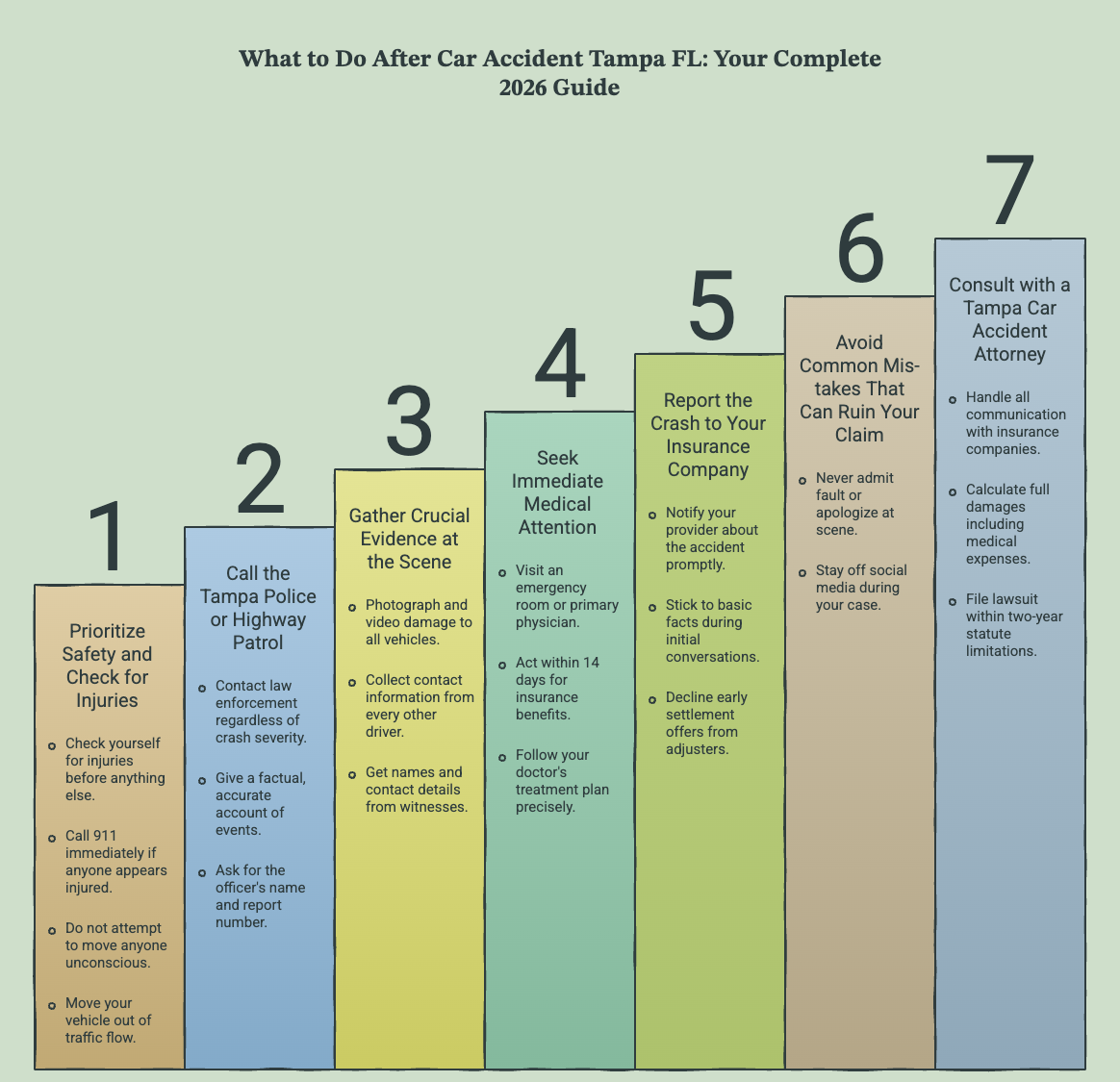
1. Prioritize Safety and Check for Injuries
Your first priority is always safety. Check yourself for injuries before anything else — the adrenaline rush following a crash can mask serious pain, so do not assume you are fine simply because you feel okay.
If you are able to move safely, check on your passengers and the occupants of the other vehicles. Call 911 immediately if anyone appears injured. Emergency responders can transport victims to nearby facilities like Tampa General Hospital or St. Joseph’s Hospital.
Do not attempt to move anyone who is unconscious or complaining of neck or back pain unless there is an immediate life threat, such as a vehicle fire.
If the crash is minor and there are no apparent injuries, Florida law requires you to move your vehicle out of the flow of traffic. Pull to the shoulder, a nearby parking lot, or a side street. Turn on your hazard lights immediately.
2. Call the Tampa Police or Highway Patrol
You must contact law enforcement regardless of how minor the crash appears. Under Florida Statute § 316.065, you are legally required to report any accident involving injury, death, or property damage exceeding $500.
Depending on your location, the Tampa Police Department, the Hillsborough County Sheriff’s Office, or the Florida Highway Patrol will respond. When the officer arrives, give a factual, accurate account of what happened. Do not guess or speculate.
The responding officer will generate an official accident report, which is one of the most important pieces of evidence for your insurance claim. Ask for the officer’s name, badge number, and the accident report number before they leave the scene.
Having an official police report is a key factor when determining your car accident settlement.
3. Gather Crucial Evidence at the Scene
While waiting for law enforcement, document everything — but only if it is safe to do so. The evidence collected at the scene is often the most reliable and hardest for insurance companies to dispute.
Use your smartphone to photograph and video the damage to all vehicles, skid marks, traffic signals, road conditions, and your visible injuries. Take wide-angle shots of the full scene as well as close-ups of specific damage.
Collect the following from every other driver involved:
- Full name and contact information
- Driver’s license number
- License plate number and vehicle description
- Insurance company name and policy number
If there are witnesses, get their names and contact details. Independent testimony is especially valuable in disputed-liability cases or when handling car accidents involving uninsured drivers.
4. Seek Immediate Medical Attention
Even if you feel fine, visit an emergency room, urgent care center, or your primary care physician as soon as possible. Injuries like whiplash, concussions, and internal bleeding may not show symptoms for days or even weeks after the crash.
Florida’s no-fault insurance system requires you to act fast. Under the state’s 14-day rule, you must seek initial medical treatment within 14 days of the accident to qualify for Personal Injury Protection (PIP) benefits. Miss that window and your insurance company can deny your medical claims entirely.
Follow your doctor’s treatment plan precisely. Attend every follow-up appointment and complete all prescribed therapy. Gaps in your treatment history give insurance adjusters ammunition to argue your injuries are less severe than claimed.
Consistent medical documentation is essential when calculating how much your Florida car accident claim is worth.
5. Report the Crash to Your Insurance Company
Notify your auto insurance provider about the accident as soon as possible. Most policies require prompt reporting, and delays can complicate your claim.
When speaking with your insurer, stick to the basic facts: date, time, location, and the parties involved. Do not provide a recorded statement or sign any documents without first consulting an attorney.
Insurance adjusters — even those from your own company — are trained to minimize payouts. Avoid discussing the full extent of your injuries until you have been thoroughly evaluated by a doctor, as your condition may worsen over time.
If the insurer pressures you to accept an early settlement offer, decline. Initial offers are almost always far below what you actually deserve. If you find yourself in that position, read our guide on what to do when an insurance company offers a low settlement.
6. Avoid Common Mistakes That Can Ruin Your Claim
The actions you take in the days and weeks after a crash can make or break your case. Many victims inadvertently sabotage their own claims through easily avoidable errors.
Never admit fault or apologize at the scene. Even a simple “I’m sorry” can be interpreted as an admission of guilt. Let the police and insurance investigators determine liability based on the evidence. Our guide on what to do after a car accident that’s not your fault covers how to protect your narrative from the start.
Stay off social media. Insurance defense investigators routinely monitor the social media accounts of accident victims. A photo of you at a family gathering or a post about a workout can be used to argue you are not genuinely injured.
Pause all social media activity until your case is fully resolved. Review the full list of common mistakes that can ruin your car accident claim to make sure you are not leaving money on the table.
7. Consult with a Tampa Car Accident Attorney
Navigating the aftermath of a serious crash is complex, especially when you are dealing with injuries, medical bills, and aggressive insurance adjusters. Hiring an experienced attorney levels the playing field.
A skilled lawyer will handle all communication with the insurance companies, gather evidence, consult with medical experts, and calculate your full damages. That includes current and future medical expenses, property damage, and lost wages after the accident.
An attorney can also help you uncover the hidden costs of car accidents you may not have considered, including the psychological effects after a car accident that can affect your quality of life long after the physical injuries heal.
You must act quickly. The Florida statute of limitations for car accidents gives you just two years from the date of the accident to file a personal injury lawsuit.
Understanding Tampa Car Accident Statistics
Tampa’s roads are among the most dangerous in Florida. According to 2025 FLHSMV crash data, Hillsborough County recorded 158 fatal crashes resulting in 169 deaths — roughly one fatal crash every two to three days.
A 7-year crash trend analysis by Steinger, Greene & Feiner shows that total crashes in Hillsborough County have risen 18% since 2020, driven by rapid population growth, increased tourism, and distracted driving.
| Crash Statistic | Hillsborough County (2025) |
| Total Annual Crashes | 24,864 |
| Average Daily Crashes | 68 |
| Fatal Crashes | 158 |
| Total Fatalities | 169 |
| Most Dangerous Roads | I-275, I-4, Dale Mabry Highway |
The leading causes are distracted driving (35%), speeding (30%), and impaired driving (20%). Whether you are rear-ended on I-275 or involved in a multi-vehicle pileup, the steps above remain the same.
Pre-existing conditions can also complicate your claim. Understanding how pre-existing back injuries affect settlement values in rear-end collision cases is critical if you have a prior medical history.
Frequently Asked Questions (FAQs)
How long do I have to report a car accident in Tampa?
You must report any accident involving injury, death, or property damage over $500 to law enforcement immediately. For your insurance company, report the crash as soon as possible — typically within a few days of the incident.
What is the 14-day rule in Florida?
Florida’s 14-day rule requires you to seek initial medical treatment within 14 days of the crash to qualify for Personal Injury Protection (PIP) benefits. If you miss this deadline, your insurer can deny your medical claims entirely.
Do I need a lawyer for a minor car accident in Tampa?
Not always, but a free consultation is always worth it. Injuries often appear days after a crash, and an attorney can advise you on your rights before you accept any settlement offer.
What if the other driver doesn’t have insurance?
Your own PIP coverage will pay for initial medical expenses. If your damages exceed PIP limits, you can file a claim under your Uninsured Motorist (UM) coverage, provided you elected to carry it.
Can I change my personal injury lawyer if I am unhappy?
Yes. You have the right to change legal representation at any time. Read our guides on what is the process for changing personal injury lawyers and what to do if you’re unhappy with your current lawyer for step-by-step guidance.
Contact Pencheff and Fraley LPA Today
Knowing what to do after car accident Tampa FL is only the first step. Securing the compensation you deserve requires experienced, aggressive legal advocacy.
The dedicated personal injury lawyers at Pencheff and Fraley LPA are ready to fight for your rights. We serve clients throughout Tampa and all of Florida with no upfront fees and a 98% win rate.
Contact our Jacksonville office today at 904-770-4953 or visit our contact page to schedule your free consultation. Let our team of dedicated personal injury lawyers in Jacksonville put their experience to work for you.
Author: Pencheff and Fraley Legal Team
Disclaimer: This article is for informational purposes only and does not constitute legal advice. Every case is unique, and you should consult with a qualified attorney about your specific situation.