

To get a Kissimmee crash report, request it from the agency that handled the collision or use Florida’s Crash Portal when the report becomes available. Kissimmee Police routes city incidents through its records process; the Osceola County Sheriff lists a separate request path. A Kissimmee car accident lawyer can help explain how the document fits into an injury claim.
Florida reports may take up to 10 days to appear in the state portal. The local agency may have a different process or timeline. Once you obtain a copy, check its basic details, keep your supporting evidence, and contact your insurer as required by your policy.
Why a Kissimmee car accident report matters
A crash report can help you confirm the date, location, vehicles, parties, witnesses, investigating officer, and insurers recorded after a collision. Florida’s crash-report statute describes information included in long-form reports. The report can help you organize questions for an insurer or lawyer.
It is not a final ruling on fault or a promise about an insurance decision. It is one record among several. Photographs, witness details, medical records, repair documents, and your own timeline may also matter.
How to get a Kissimmee and Osceola car accident report
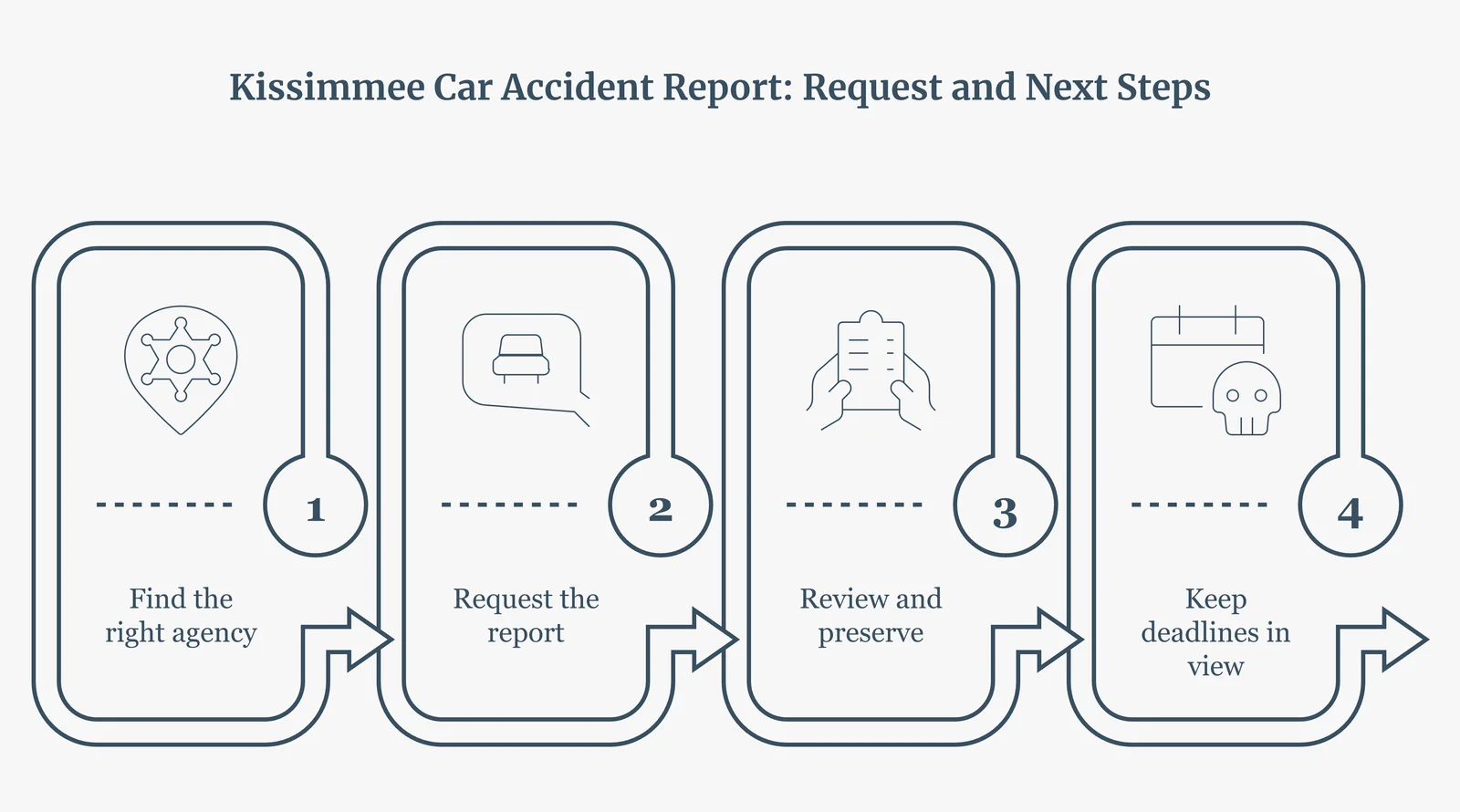
Kissimmee car accident reports can be held by different agencies. An Osceola crash report may follow a separate route, so begin by confirming who responded.
Start with the agency that handled the crash
Use the agency name on any exchange form, business card, incident number, or other paperwork from the scene. If you do not have it, contact the agency that responded. Share the crash date, approximate time, exact location, names involved, vehicle details, and report number if you have one.
Location details help distinguish records. Instead of writing only “Kissimmee,” include the road, direction of travel, nearest cross street, intersection, or interstate exit. For example, FDOT lists I-4 Exit 64 at US 192 and Exit 65 at Osceola Parkway. Include those names only if they match your crash location.
If Kissimmee Police responded
The City of Kissimmee Police Records page says to confirm that the incident occurred within city limits before submitting a request. City records requests go through its online public-records process. If the incident happened outside city limits, the City directs people to the county or state agency that was the primary responder.
The City says it may charge a fee when a request requires more than 30 minutes of staff time. If you need help with the request, its page lists the Police Department Records contact as 407-846-3333 and kpdrecords@kissimmee.gov.
If the Osceola County Sheriff or FHP handled it
For a report handled by the Osceola County Sheriff’s Office, use its Accident Reports page. The office lists a $2 fee per traffic crash report and asks requesters to allow 3–5 business days. During the first 60 days, its page says reports are available to people involved in the crash or their representatives with identification.
If Florida Highway Patrol investigated, search through the official Florida Crash Portal or follow the FLHSMV report-request instructions. Different agencies may keep a local copy, so use the reporting agency’s directions if the state search does not find your record.
Use the Florida Crash Portal when the report is filed
FLHSMV says reports may take up to 10 days to become available. The portal charges $10 per report plus a $2 convenience fee for each online transaction. After purchase, the download link is emailed and the report must be downloaded within 48 hours. Save the PDF somewhere secure as soon as it arrives.
If the report does not appear, confirm the date, county, names, and responding agency. Then contact the agency that investigated the crash. A report may not be searchable yet, or the local agency may use a separate records process.
If no officer prepared a report
Do not assume a self-report is appropriate just because a crash seems minor. Florida Statute §316.066 says a driver must submit a written report within 10 days when a crash does not require a law-enforcement report. The Kissimmee Police self-report page directs eligible drivers to the official FLHSMV form.
There is a mismatch in official materials about the property-damage threshold for immediately notifying law enforcement. The 2026 text of Florida Statute §316.065 lists apparent damage of at least $2,000, while FLHSMV’s online crash guidance still lists $500. If the threshold could affect what you do, contact law enforcement or the responding agency. Do not rely on the older web-page figure alone.
What the report can—and cannot—tell you
Read the whole report rather than focusing only on a diagram or a brief narrative. Check the names, date, time, location, vehicle descriptions, insurer information, and witness details. Note anything missing or inconsistent. The report may help you identify follow-up questions, but it does not replace other evidence or decide the final outcome of an insurance claim.
If you find an objective error, such as a misspelled name or incorrect vehicle detail, ask the investigating agency how to request a factual correction or supplemental report. Explain the specific entry and provide any supporting document. If you disagree with an officer’s interpretation, preserve your own account and related evidence. Avoid assuming that a correction request will change an opinion or guarantee a particular result.
What to do after you receive the crash report
Save the record and check the details
Download the complete file and keep a copy of the report number. Review every page for names, dates, road details, vehicle information, insurance names, and witnesses. Make a short list of questions while the events are still fresh.
Preserve evidence in one place
Keep photographs and videos in their original form. Save witness names and contact details, repair estimates, towing or rental receipts, medical records, appointment notes, and insurer communications. Write a dated timeline of what happened and when you took each follow-up step. Do not edit original images or discard documents that may later help explain the claim.
Notify your insurer and keep a record
Follow the notice requirements in your policy. Record the claim number, the date you reported the crash, and the name of each person you speak with. Ask the insurer what documents it needs and where to send them. Keep copies of what you submit. If you are unsure how a recorded statement or release may affect your situation, ask a qualified professional before signing or agreeing to terms.
Get medical care and track expenses
Seek appropriate medical attention and follow the advice of your healthcare provider. Florida’s PIP statute generally conditions medical benefits on receiving initial services and care within 14 days after a motor-vehicle accident. The statute also sets provider and coverage requirements. This is not a reason to delay urgent care or to choose treatment based on an insurance deadline.
Keep bills, receipts, and records of time missed from work. A simple log can help you remember dates and questions. Your own insurer can explain the forms and policy terms that apply to your coverage.
Florida deadlines to keep in mind
A report request and an injury claim have different timelines. Under Florida Statute §316.066, certain drivers must submit a written crash report within 10 days when law enforcement is not required to make a report. The state portal may also take up to 10 days to show a filed report. These are separate steps.
Florida’s 2026 statute of limitations lists two years for an action founded on negligence. Exceptions and claim-specific rules may change the deadline. Do not use a general article to calculate the time for a particular case. Ask a qualified Florida attorney to review the relevant dates promptly.
When a Kissimmee car accident lawyer may help
You may want legal guidance if you were hurt, the insurer disputes what happened, the report has important omissions, several vehicles or policies are involved, or you are unsure how Florida’s deadlines apply. A lawyer can review the available records and explain possible next steps based on the facts. No lawyer can promise a particular result from a report or a claim.
Pencheff & Fraley’s Kissimmee office serves people in Kissimmee and Osceola County. You can also read about the firm’s car-accident practice. Jacksonville uses a different local-agency structure: the firm’s Jacksonville car-accident report guide outlines FLHSMV, Jacksonville Sheriff’s Office, and FHP routes for Duval County. In Kissimmee, start with Kissimmee Police for eligible city incidents; the Osceola County Sheriff’s Office lists a separate $2 process, and FLHSMV offers the statewide portal. Use the Jacksonville guide for Duval-specific instructions only. If the crash was on I-4 nearer Orlando, see the firm’s Orlando I-4 car-accident guide.
Frequently asked questions
Where do I request a Kissimmee car accident report?
Request it from the agency that handled the crash. Kissimmee Police accepts records requests for incidents within city limits. The Osceola County Sheriff’s Office lists a separate accident-report process. You can also search the official Florida Crash Portal once the report is available.
How long does a Kissimmee crash report take?
FLHSMV says crash reports may take up to 10 days to become available. The Osceola County Sheriff’s Office asks requesters to allow 3–5 business days for its reports.
How much does an Osceola crash report cost?
The Osceola County Sheriff’s Office lists $2 per traffic crash report. FLHSMV lists $10 per report plus a $2 convenience fee per online transaction. Confirm the method and fee with the agency handling your request.
Can I get a crash report during the first 60 days?
Florida law restricts access to crash reports containing personal information for 60 days after filing. Involved parties, their legal representatives, insurers, and other listed people or entities may qualify during that period. The agency may require identification and an eligibility statement.
Does a crash report decide who was at fault?
No. A crash report records information gathered by the investigating agency, but it is not a final decision about insurance responsibility or the outcome of an injury claim. Check it for factual errors and keep other evidence.
Does Florida PIP have a 14-day treatment rule?
Florida’s PIP statute generally requires initial services and care within 14 days after a motor-vehicle crash for medical benefits, subject to provider and coverage requirements. Review the statute and policy or ask a qualified professional about your circumstances.
How long do I have to file a Florida car accident lawsuit?
Florida Statute §95.11 lists two years for an action founded on negligence, but exceptions and claim-specific rules may apply. The deadline depends on the facts, so do not rely on a general article to calculate it.
What if police did not make a report?
Ask the responding agency what record exists and whether you should submit a Driver Report of Traffic Crash. Kissimmee Police and FLHSMV provide self-report instructions for crashes that do not require a law-enforcement report.
Talk with Pencheff & Fraley’s Kissimmee office
A crash report can be a useful starting point, but it is only one part of the record. If you have questions about what to request or how the report relates to an injury claim, contact Pencheff & Fraley’s Kissimmee office at 407-449-8010 or use the firm’s contact page. You can choose whether to reach out; there is no pressure to do so.
Written by the Pencheff & Fraley Editorial Team.
This article is intended for general informational purposes only and does not constitute legal advice. Laws change, and the information above may not reflect the most recent legal developments. Please contact the Pencheff & Fraley team to discuss the specific facts of your case.
Contacting us does not create an attorney-client relationship.