

If you are searching for “Social Security Disability Denial in Ohio: How to Appeal and Win in 2026,” start with one urgent point: do not let the denial letter sit. In most cases, you have 60 days after receiving an SSA notice to request the next appeal. SSA generally assumes that you received the notice five days after its mailing date.1
A denial is not always the end of a claim. It may identify a medical-evidence problem, a work-credit issue, a work-activity problem, an SSI financial issue, or a missed procedural requirement. The correct response depends on the reason stated in your notice. This guide explains the Ohio process, filing forms, deadlines, evidence strategy, hearing preparation, and common mistakes.
Important: This article provides general legal information. It is not legal advice. Your deadline, appeal level, benefit program, and evidence needs depend on the facts in your file. Confirm the instructions in your notice and consider speaking with a qualified representative promptly.
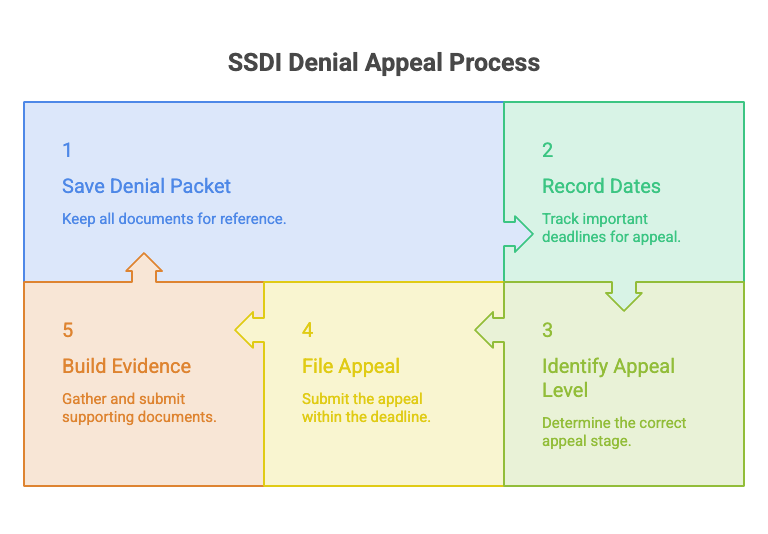
What to do in the first 24 hours after an Ohio SSDI denial
1. Save the entire denial packet
Keep every page of the notice. Save the envelope if you still have it. The notice can identify the decision date, the stated reason, your appeal level, and the deadline. It can also show whether SSA treated the decision as medical or non-medical.
Take clear photographs or scans. Store them in more than one secure place. Do not send your original documents unless SSA specifically requires them.
2. Write down the dates
Create a short deadline record with these dates:
- The date printed on the notice.
- The date you actually received it.
- The presumed receipt date, usually five days after mailing.
- The calculated 60-day appeal deadline.
- The date and method of filing.
- The confirmation number, fax report, receipt, or delivery record.
If your notice arrived late, record why. A late appeal can sometimes be accepted for good cause, but you should explain the reason in writing and request an extension.1
3. Identify the exact decision being appealed
Do not assume that every denial requires a new application. Read the last section of the notice. It should tell you whether to request reconsideration, an administrative law judge hearing, Appeals Council review, or federal-court review.
A new application may be appropriate in limited situations. Filing a new application without analyzing the pending claim can create onset-date, date-last-insured, or res judicata problems. Get advice before abandoning an appeal.
4. File first and complete the record next
Do not wait until every medical record arrives. Missing the appeal deadline can be harder to fix than submitting additional evidence later. File through the correct SSA route, then build the evidence record.
SSA says that select forms may be completed, uploaded, faxed, or mailed. Your local Social Security office remains the usual routing point unless your notice gives different instructions.11 Keep proof of everything you submit.
Why Social Security disability claims are denied in Ohio
A denial reason is not just a label. It tells you what part of the claim needs attention. The same medical condition can lead to different appeal strategies depending on whether the problem is medical, vocational, work-related, financial, or procedural.
Medical evidence does not show work-preclusive limitations
SSA does not decide disability based on a diagnosis alone. It considers how an impairment limits physical and mental work activities. Those activities can include sitting, standing, walking, lifting, reaching, concentrating, remembering, responding to supervisors, and adapting to workplace changes.9
A record may be denied when it lacks consistent treatment notes, objective findings, functional descriptions, medication effects, or a clear timeline. A short statement that a person is “disabled” may carry less weight than a detailed explanation of specific work limits supported by the record.
Earnings may suggest substantial gainful activity
A person who is working above the applicable substantial gainful activity, or SGA, level may be denied at an early step. The rule is not a simple test of whether someone worked one day or received one paycheck. SSA can examine earnings, the nature of the work, self-employment, unsuccessful work attempts, impairment-related work expenses, and work incentives.
For 2026, SSA lists monthly SGA amounts of $1,690 for a non-blind disabled person and $2,830 for a statutorily blind person. SSA notes that the non-blind amount applies to Social Security and SSI disability benefits, while the blind amount does not apply to SSI.3
The impairment may not meet the duration rule
Adult disability generally requires an impairment that has lasted, or can be expected to last, for a continuous period of at least 12 months. The issue is not whether the person is having a difficult month. The issue is whether the medical and functional limitations meet the duration requirement.
Your appeal should address expected duration when the condition is still developing. It should also explain the combined effect of multiple impairments. One condition may not meet a listing alone, but several conditions can still affect the residual functional capacity analysis.
Work credits or the date last insured may be a problem
SSDI is an insurance program. SSA looks at work covered by Social Security taxes and the credits earned from that work. SSA states that a person generally needs disability-insured status, which includes at least 20 credits during the last 10 years for many adults, although exceptions apply.7
The date last insured, or DLI, is important. You may need to prove that disability began on or before that date. A person can have serious limitations today but still face an SSDI denial if the record does not establish disability while insured.
SSI income or resources may be over the limit
SSI is different from SSDI. SSI is based on financial need. SSA looks at countable income and resources as well as disability, blindness, age, citizenship or qualifying noncitizen status, and other requirements.8
For 2026, SSA lists countable-resource limits of $2,000 for an individual and $3,000 for a couple, subject to exclusions and program rules.8 An SSI denial may therefore require financial records, not only medical records.
SSA says the claimant did not cooperate
SSA may need forms, medical releases, work history, financial information, or an examination. A person who cannot attend an appointment should contact SSA promptly. Explain the reason and ask how to reschedule.
Do not ignore a consultative examination notice. Do not assume that a missed appointment automatically ends the claim. The file should show the reason, the communication with SSA, and any good-cause explanation.
Treatment history is incomplete or difficult to interpret
Gaps in treatment can raise questions. They do not prove that a person was not disabled. Cost, transportation, insurance, side effects, mental illness, caregiving duties, homelessness, and limited access to specialists may explain a gap.
Explain the reason with evidence where possible. A treatment history should be read with the person’s symptoms, resources, and medical recommendations in mind.
SSDI versus SSI: the denial reason changes your appeal
| Issue | SSDI | SSI |
| Basic program | Insurance based on covered work | Needs-based program |
| Key non-medical question | Did the claimant have insured status when disability began? | Does the claimant meet income, resource, and other SSI rules? |
| Medical definition | SSA disability standard | The same adult disability standard generally applies |
| Evidence often needed | Work history, earnings, credits, DLI, medical and functional proof | Medical and functional proof plus income, resource, living-arrangement, and financial proof |
| Common appeal mistake | Focusing only on current symptoms and ignoring the DLI | Focusing only on medical evidence and ignoring financial eligibility |
SSDI denials often require a date and work-history review
An SSDI appeal should compare the alleged onset date, last day worked, earnings, medical evidence, and date last insured. Small date errors can change the legal question. Work attempts should be described carefully, including reduced hours, help from coworkers, absences, and why the work ended.
SSI denials require a financial review as well
For SSI, gather bank statements, income records, lease or housing information, benefit notices, vehicle and insurance information, and records of property or transfers. The medical appeal and the financial appeal may require different evidence.
Concurrent SSDI and SSI claims need a coordinated review
Some people apply for both programs. A favorable medical decision may not resolve every non-medical issue. The appeal should identify which title or program was denied and whether the notice addresses medical eligibility, insured status, financial eligibility, or more than one issue.
How Ohio’s disability decision process works
Ohio’s Division of Disability Determination reviews medical eligibility
Ohio’s Division of Disability Determination, within Opportunities for Ohioans with Disabilities, works with SSA to determine medical eligibility for Ohioans who apply for SSDI and SSI.6 SSA field offices generally handle the application and appeal intake. The state disability agency develops medical evidence for the initial and reconsideration stages.
This division of responsibility matters. A claimant may speak with a local SSA office, receive development requests from Ohio’s disability agency, and later receive hearing notices from SSA’s Office of Hearings Operations. Keep each notice and respond to the correct office.
SSA uses a five-step disability evaluation
SSA’s evaluation asks, in sequence:
- Are you working at a level that is substantial gainful activity?
- Is the impairment severe?
- Does the impairment meet or equal a listed impairment?
- Can you perform past relevant work?
- Can you adjust to other work in the national economy?
At steps four and five, SSA assesses residual functional capacity, or RFC. RFC describes what a person can still do despite impairments and related symptoms. SSA then considers past work, age, education, training, and work experience.9
The appeal should answer the reason for the denial
A strong appeal does not simply repeat “I disagree.” It connects evidence to the disputed issue. For example, a work-capacity appeal can explain how a person’s symptoms affect attendance, pace, concentration, lifting, standing, sitting, reaching, or the need for unscheduled breaks.
The goal is a complete record. The record should make the functional effect of the impairment understandable to the decision-maker.
How to appeal a Social Security Disability denial in Ohio
SSA describes four opportunities to appeal a decision.2 The next level depends on the notice you received.
| Appeal level | When it usually applies | Main task | Common form or route |
| Reconsideration | Initial medical or non-medical denial | Ask SSA to review the claim again | Online appeal or SSA-561; medical appeals may also use SSA-3441 and SSA-827 |
| ALJ hearing | Unfavorable reconsideration | Present the record and explain the disputed issues | Online request or HA-501, with related disability forms when required |
| Appeals Council | Unfavorable ALJ decision or dismissal | Show legal, factual, procedural, or evidentiary error | Online iAppeal or HA-520 |
| Federal district court | Unfavorable Appeals Council action or no review | Seek judicial review of the final agency action | Civil action under the court instructions and applicable rules |
Reconsideration: the first appeal after an initial denial
For a medical denial, SSA identifies online appeal options and Form SSA-561, Request for Reconsideration. SSA also identifies SSA-827, Authorization to Disclose Information, for medical reconsideration requests.11
Use the denial notice as your checklist. State the decision being appealed. Give updated provider information. Explain changes in symptoms, treatment, work, medication, and daily functioning. Do not submit a bare form if the form gives you space to identify the issue.
Administrative law judge hearing: the evidence and testimony stage
After an unfavorable reconsideration, request a hearing before an administrative law judge. SSA identifies Form HA-501 for this request. For a disability hearing, SSA also identifies SSA-3441 and SSA-827.12
A hearing is not a trial with a jury. It is an administrative proceeding. The ALJ may question you. A medical expert or vocational expert may testify. You and your representative may question witnesses.4
Prepare for the questions that matter. Explain what you can do, what you cannot do consistently, what happens when you try, and how symptoms affect a normal workday. Avoid guessing. If you do not know an answer, say so and explain what you do know.
Appeals Council review: identify a reviewable error
The Appeals Council reviews requests but may deny review if it finds no basis to disturb the ALJ decision. It may also review the case itself or return it to an ALJ.1
A request should identify specific errors. Examples can include an unsupported RFC finding, a failure to address important evidence, a legal error, an incomplete vocational analysis, or a procedural problem. Additional evidence should be identified and explained. SSA’s current process recognizes that additional evidence may matter when it meets the agency’s rules.1
Form HA-520, Request for Review of Hearing Decision/Order, is one route for requesting Appeals Council review. The request is generally due within 60 days after receipt of the ALJ decision.1
Federal district court: judicial review, not a new disability hearing
If the Appeals Council denies review or issues an unfavorable action, the claimant may file a civil action in federal district court. SSA states that the action is generally filed in the district where the claimant lives or has a principal place of business. The deadline is generally 60 days after receipt of the Appeals Council action.5
Federal court reviews the administrative record. It does not usually conduct a new disability hearing or receive unlimited new evidence. The case may result in affirmance, remand for further proceedings, or another court-ordered disposition. Court filing, service, fee, and local-rule requirements matter.
Ohio has both a Northern District and a Southern District. Their local rules and case procedures should be checked before filing. The Northern District of Ohio’s local civil rules and the Southern District of Ohio’s local rules are official starting points.
Ohio SSDI appeal deadlines: the 60-day rule and a practical date check
How the 60-day rule works
SSA generally gives you 60 days after receiving the notice to request the next appeal. SSA usually assumes receipt five days after the notice date unless you show that you received it later.1
Your notice may contain a different instruction for a special situation. Follow the notice. If you are close to the deadline, file first and ask questions after the filing is protected.
What if the 60-day deadline has passed?
File the appeal as soon as possible. Include a written explanation. Ask SSA to extend the deadline for good cause. Explain the facts, dates, barriers, and the steps you took after the barrier ended.
Good cause is not automatic. SSA decides whether to accept the late request. A person who missed a deadline should not assume that a new application is the only option.
Build proof that SSA received the appeal
Use a filing method that creates a record. Save the online confirmation page. Keep fax confirmation. Request a receipt for in-person delivery. Use tracking for mail. Record the office, date, time, form names, and attachments.
If you speak with SSA by phone, write down the date, the representative’s name or identification number if provided, and the instructions you received. Phone notes do not replace the written filing, but they can help document your effort.
Illustrative deadline example
Assume an initial denial is dated March 1, 2026, and you actually receive it on March 4. If SSA’s five-day presumption applies, the presumed receipt date would generally be March 6. The 60-day period would then be calculated from that receipt date, subject to SSA’s counting rules and the notice instructions.
This is an example, not a deadline calculation for your case. Weekends, holidays, late receipt, central-print processing, and the exact notice can affect the analysis. Do not rely on an online calculator without checking the notice.
Evidence that can help you win an SSDI appeal
Explain function, not only diagnosis
A diagnosis is important. It is not the entire disability case. Explain the work-related effect of the condition. Use specific examples.
A useful function description can address:
- How long you can sit, stand, walk, lift, reach, or use your hands.
- How often pain, fatigue, panic, or migraines interrupt activity.
- How symptoms affect concentration, pace, memory, or task completion.
- How often you need breaks or miss appointments.
- Whether medication causes drowsiness, nausea, dizziness, or slowed thinking.
- Whether you can sustain a schedule five days each week.
- What happens when you attempt household tasks or work.
Organize medical records into a timeline
Create a timeline with providers, dates, diagnoses, tests, treatment changes, emergency visits, therapy, medication changes, and work events. Note when a symptom became worse. Note when a provider described a limitation.
A timeline helps identify gaps. It also helps a representative compare the denial rationale with the underlying record.
Medical opinions should be supported and consistent
For claims filed on or after March 27, 2017, SSA does not give a medical opinion automatic controlling weight. The regulation identifies supportability and consistency as the most important factors. Supportability asks whether the source explains the opinion with relevant evidence. Consistency asks whether the opinion fits the other evidence.10
Ask a provider to explain specific limitations and their expected duration. A conclusory sentence may be less useful than a detailed explanation tied to examination findings, treatment history, and observed functioning.
Mental-health evidence should be functional and longitudinal
Mental impairments can affect attendance, persistence, pace, social interaction, and adaptation. A record should show changes over time. It should also address treatment, medication effects, crisis events, work attempts, and the person’s ability to function outside a structured setting.
Daily activities should not be treated as proof that a person can sustain full-time work. Describe the pace, assistance, breaks, after-effects, and frequency of each activity.
Explain failed work attempts
A short work attempt can provide important context. Record the dates, hours, pay, accommodations, help from coworkers, missed days, reduced duties, and why the work ended.
Do not hide work. Report it accurately. SSA may evaluate whether the attempt was an unsuccessful work attempt or evidence of sustained work capacity.
Use third-party statements carefully
Statements from family members, former coworkers, caregivers, or friends can describe observable changes. They should focus on what the person saw. Useful details include missed activities, rest periods, confusion, panic, falls, reminders, and failed work attempts.
A third-party statement does not replace medical evidence. It can add context that a short clinical visit does not capture.
Explain treatment gaps and medical examinations
If treatment was delayed or interrupted, state why. If you could not afford care, lacked transportation, lost insurance, experienced side effects, or had a mental-health barrier, document that context where possible.
If SSA scheduled a consultative examination, attend if you can. If you cannot, contact SSA before the appointment. Keep the notice and any rescheduling records.
How to prepare for an Ohio disability hearing
Read the Notice of Hearing carefully
SSA generally sends a hearing notice at least 75 days before the hearing. The notice explains the date, time, and way to attend. SSA may offer audio, agency video, or online video options, subject to the notice and the claimant’s rights.4
Keep your address, telephone number, and email current. A missed notice can cause avoidable problems.
Submit written evidence on time
For a disability hearing, SSA states that written evidence should be submitted or identified no later than five business days before the hearing. Failure to meet the rule may result in the ALJ declining to consider the evidence.4
Do not wait until the hearing week to request records. Tell your representative and the hearing office about new evidence as soon as you receive it.
Prepare answers, not a speech
The ALJ may ask about your symptoms, treatment, daily activities, past work, and work attempts. The best preparation is a truthful, consistent explanation.
Describe a typical day. Then describe the bad days and how often they occur. Explain what happens after an activity. If pain causes you to rest for two hours after grocery shopping, say that. If you can prepare food only with a chair and breaks, say that.
Understand the vocational expert’s role
A vocational expert may answer questions about past work and other work. The answer depends on the limitations included in the ALJ’s hypothetical.
Your testimony should make the limitations understandable. A representative may ask questions about absences, off-task time, pace, breaks, postural limits, hand use, environmental exposure, or the need for supervision.
If you cannot attend the hearing
Contact the hearing office immediately. SSA instructs claimants who cannot attend to explain the reason before the hearing and provide the explanation in writing.4 A missed hearing can lead to a dismissal. Act quickly.
2026 numbers and statistics: what they can and cannot tell you
The 2026 SGA amount is not a guaranteed eligibility test
The 2026 non-blind SGA amount is $1,690 per month. The 2026 blind amount is $2,830 per month.3 The amount is important, but the analysis can include work incentives, impairment-related work expenses, self-employment, and unsuccessful work attempts.
A person who is below the amount is not automatically approved. A person above the amount is not necessarily assessed without context. Earnings are one part of the five-step process.
National statistics are not Ohio approval odds
SSA’s disability statistical report explains that application outcomes can change while claims remain pending. It also notes that its tables include Social Security-only and concurrent applications but not SSI-only applications.16
That matters when reading online claims about denial rates or “approval odds.” A national rate, a medical allowance rate, an award rate, a hearing disposition rate, and an Ohio office result are not interchangeable. A responsible article should identify the program, stage, period, denominator, and pending-claim caveat.
Ohio routing, offices, and local help
Use the official office locators
SSA’s current hearing-office locator lists Ohio hearing offices in Akron, Cincinnati, Cleveland, Columbus, Dayton, and Toledo.17 The office that handles your case can depend on jurisdiction and agency assignment. Check the current locator and the contact information printed on your notice.
SSA’s general telephone number is 1-800-772-1213. The TTY number is 1-800-325-0778. Do not send Social Security numbers or claim details through an unsecured online form.
Consider a qualified representative
You may represent yourself. You may also appoint an attorney or another qualified representative. SSA explains that an appointment must be made in writing. Form SSA-1696 is the standard appointment form.14
A representative can review the file, identify the denial issue, organize evidence, prepare testimony, and handle written arguments. Representation does not guarantee approval. It can help ensure that the record addresses the rules that apply to your claim.
Understand the fee rules before signing
SSA must authorize a representative’s fee. Under the fee-agreement process, the fee generally cannot exceed the lesser of 25% of past-due benefits or the specified dollar limit. SSA states that the current specified limit is $9,200 for favorable decisions issued on or after November 30, 2024, if the statutory conditions are met.5
A fee agreement and a fee petition are different processes. Case expenses may be separate. Ask for the fee arrangement in writing and ask what services and expenses it covers.
If an accident caused the disability
SSDI or SSI is separate from a personal-injury or workers’ compensation claim. One case asks whether you meet federal disability rules. Another may ask who caused an injury and what damages are recoverable.
If you are also evaluating an accident claim, start with the firm’s personal injury practice page. Its existing article, 5 Questions to Ask Before Hiring an Accident Lawyer in Ohio or Florida, addresses how to choose a personal injury lawyer and the best accident lawyer questions to raise during a consultation. Keep the deadlines for each claim separate.
Common mistakes after an Ohio disability denial
Deadline and filing mistakes
- Waiting for perfect evidence before filing. Protect the appeal deadline first.
- Filing the wrong level of appeal. Follow the notice and use the correct form.
- Treating the diagnosis as the entire case. Explain work-related functional limits.
- Ignoring work credits or the DLI. SSDI eligibility has an insurance component.
- Ignoring SSI finances. Income, resources, and living arrangements may decide an SSI claim.
- Submitting medical records without an explanation. Identify what the records show and why it matters.
Evidence and hearing mistakes
- Missing a consultative examination. Contact SSA before the appointment if you cannot attend.
- Submitting evidence after the hearing deadline. Tell the hearing office about evidence no later than five business days before the hearing when the rule applies.
- Giving vague hearing testimony. Use specific examples, frequency, duration, and after-effects.
- Assuming a new application fixes every problem. Compare the appeal and new-application options first.
- Ignoring a late deadline. File immediately and explain the reason for the delay.
- Changing addresses without telling SSA. A missed notice can create a new deadline problem.
Frequently asked questions about Ohio SSDI denials and appeals
How long do I have to appeal a Social Security disability denial in Ohio?
You generally have 60 days after receiving the notice. SSA usually assumes that you received it five days after the mailing date unless you show otherwise.1 Your notice controls. File promptly and keep proof of submission.
Can I appeal an SSDI denial without a lawyer?
Yes. SSA does not require a representative. You may appoint an attorney or qualified non-attorney representative by submitting an appointment in writing.4 A representative may help with evidence, testimony, deadlines, and written arguments, but no representative can guarantee approval.
What is the first step after an initial SSDI denial?
The first step is generally reconsideration. SSA identifies online filing and Form SSA-561 for a request for reconsideration. A medical request may also require SSA-3441 and SSA-827.11
Is an ALJ hearing a new application?
No. An ALJ hearing is an appeal of the reconsideration decision. It is an administrative proceeding that may include questions for the claimant and testimony from medical or vocational experts.4 The issues depend on the claim file and the notice.
Can I submit new evidence to the Appeals Council?
You should identify additional evidence when requesting review. The Appeals Council applies its own rules to whether evidence is considered. Do not assume that all later evidence is excluded. Explain what the evidence is, what period it covers, and why it could affect the decision.1
What happens if I miss my 60-day deadline?
File as soon as possible. Explain the reason for the delay and request an extension for good cause. SSA decides whether to accept the late request. Do not assume that you must start over with a new application.
What is the difference between SSDI and SSI after a denial?
SSDI depends on insured status and work credits. SSI depends on financial need as well as disability and other eligibility rules. The evidence needed for an appeal can therefore differ. A concurrent claim may involve both programs.
What is the 2026 SGA limit for disability claims?
SSA lists $1,690 per month for a non-blind disabled person and $2,830 per month for a statutorily blind person in 2026.3 SGA analysis can involve work incentives, expenses, self-employment, and unsuccessful work attempts. The amount is not a complete disability decision.
What should I bring to a consultation about an Ohio SSDI appeal?
Bring the denial or reconsideration notice, all SSA correspondence, medical-provider information, medication list, work history, earnings records, hearing notices, prior appeal forms, and any evidence you already submitted. If you do not have every document, do not delay contacting a representative.
Conclusion: act before the appeal deadline
An Ohio Social Security Disability denial should trigger a deadline review, not resignation. First identify the decision being appealed. Then file the correct appeal, preserve proof, and build evidence that explains how your conditions affect sustained work.
Pencheff & Fraley’s Social Security practice page describes assistance with disability claims in Ohio. The firm’s existing Social Security FAQs and Social Security forms page provide additional site resources. To discuss your situation, use the firm’s free and confidential consultation page.
Do not wait until the last week if you can act today. A timely filing protects your opportunity to continue the appeal. A careful record gives the decision-maker a better basis to understand your claim.
References
[1] Social Security Administration, Appeals Process
[2] Social Security Administration, Appeal a Decision We Made
[3] Social Security Administration, Substantial Gainful Activity Amounts
[4] Social Security Administration, Hearing Process
[5] Social Security Administration, Fee Agreements
[6] Opportunities for Ohioans with Disabilities, Disability Determination
[7] Social Security Administration, Insured Status Requirements
[8] Social Security Administration, SSI Eligibility Requirements, 2026 Edition
[9] Social Security Administration, How We Decide if You Are Disabled
[11] Social Security Administration, Form SSA-561, Request for Reconsideration
[12] Social Security Administration, Form HA-501, Request for Hearing by Administrative Law Judge
[13] Social Security Administration, Form SSA-3441, Disability Report – Appeal
[14] Social Security Administration, Form SSA-1696, Claimant’s Appointment of a Representative
[15] Social Security Administration, Federal Court Review Process
[16] Social Security Administration, Disability Insurance Annual Statistical Report 2024, Section 4
[17] Social Security Administration, Hearing Office Locator
*Attorney advertising. Prior results do not guarantee a similar outcome. *
This article is intended for general informational purposes only and does not constitute legal advice. Laws change, and the information above may not reflect the most recent legal developments. Please contact a qualified personal injury attorney to discuss the specific facts of your case.