

When a loved one dies because of another person’s negligence or wrongful conduct, the family may have a civil claim. Wrongful death claims in Jacksonville raise two separate questions: who can bring the case, and what can be recovered? Under Florida law, the decedent’s personal representative normally files one action for the benefit of eligible survivors and the estate. The potential damages depend on each survivor’s relationship, dependency, losses, and the facts of the death.
This guide explains the Florida Wrongful Death Act in plain language. It covers personal representatives, spouses, children, parents, dependent relatives, estate damages, deadlines, evidence, and the process in Jacksonville. It does not estimate a specific recovery or replace advice about an individual case.
Quick answer: In Florida, the personal representative of the decedent’s estate brings the wrongful-death action. Eligible survivors and the estate may benefit from the recovery. Potential damages can include lost support and services, companionship, mental pain and suffering, medical and funeral expenses, lost earnings, and certain net accumulations. The general wrongful-death filing period is two years, but exceptions and special procedures can apply.
Who files a wrongful death claim in Florida?
The personal representative files the action
Florida Statutes §768.20 states that the action must be brought by the decedent’s personal representative. The representative seeks damages for the benefit of the decedent’s survivors and estate. Read the current language in Florida Statutes §768.20 4.
The personal representative may be named in a will. If there is no will, the probate court follows Florida’s statutory order of preference. See Florida Statutes §733.301 14. The appointment process can affect timing, authority, and the documents needed to investigate or file a claim.
A spouse, child, or parent may have a right to receive damages. That does not necessarily mean that person files a separate lawsuit. Florida generally uses one wrongful-death action that identifies potential beneficiaries and their relationships to the decedent.
Survivors and the estate have different roles
The words “survivor,” “beneficiary,” “estate,” and “personal representative” are not interchangeable.
| Person or legal interest | Main role in the claim |
| Personal representative | Files and prosecutes the statutory action for the survivors and estate. |
| Survivor | May recover specific losses allowed by Florida law. Eligibility depends on relationship and facts. |
| Estate | May recover certain losses belonging to the decedent’s estate. Estate awards can be subject to creditor claims. |
| Expense payer | A survivor or the estate may recover qualifying medical or funeral expenses, depending on who paid or was charged. |
Florida’s Wrongful Death Act 1 provides the statutory framework. A lawyer should identify every potential beneficiary before making settlement or litigation decisions.
A civil wrongful-death claim is separate from a criminal case
A death may lead to a criminal investigation, a criminal prosecution, a civil lawsuit, or several proceedings. A criminal conviction is not the same as a civil judgment. A family should not assume that a civil claim must wait for a criminal case to finish.
Florida Statutes §768.19 provides a civil right of action when death results from a wrongful act, negligence, default, or breach of contract or warranty. The statute also says liability may exist even when the circumstances constitute a felony. Review Florida Statutes §768.19 3 for the statutory language.
Who may qualify as a survivor?
Florida’s statutory survivor definition
Florida Statutes §768.18 defines “survivors” for the Wrongful Death Act. The definition includes the decedent’s spouse, children, and parents. It can also include blood relatives and adoptive brothers and sisters who were partly or wholly dependent on the decedent for support or services.
The statute defines minor children as children under 25 for this Act. It also contains rules involving support, household services, and a child born out of wedlock. Read Florida Statutes §768.18 2 before relying on a general family relationship alone.
| Potential survivor | Key issue to evaluate |
| Surviving spouse | Loss of support, services, companionship, protection, and mental pain may be relevant. |
| Minor child | Florida’s Wrongful Death Act uses an under-25 definition. Parental companionship, instruction, guidance, and mental pain rules may apply. |
| Adult child | Recovery depends on the applicable statutory subsection and whether a spouse survives. Medical-negligence claims have additional restrictions. |
| Parent of a deceased minor child | Mental pain and suffering may be recoverable under the statute. |
| Parent of an adult child | Eligibility is limited and can depend on whether other survivors exist. Medical-negligence restrictions may apply. |
| Blood relative or adoptive sibling | Partial or whole dependency on the decedent for support or services is important. |
| Estate | The estate may recover categories such as certain lost earnings, net accumulations, and qualifying expenses. |
The table is a screening guide, not a legal conclusion. Two people with the same family relationship can have different rights because dependency, age, marital status, payment records, and the cause of death can change the analysis.
Can adult children recover damages?
Adult children do not automatically recover every category of wrongful-death damages. Florida law distinguishes between children who meet the statutory definition of minor children and adult children. It also provides different rules when there is no surviving spouse.
Medical-negligence cases require additional care. Florida Statutes §768.21(8) restricts certain damages for adult children and parents of adult children in claims involving medical negligence. A family should obtain a case-specific review before assuming that a parent or adult child can recover noneconomic damages.
Can parents recover after the death of an adult child?
Parents of an adult child may have a claim in some circumstances. Florida Statutes §768.21 includes a condition involving the absence of other survivors. The statute also contains a medical-negligence limitation.
This is one reason a page that says “parents can always recover” is incomplete. The family structure, claim type, and statutory restrictions matter. A lawyer should review the complete family tree and the cause of death.
Can a sibling or other relative bring a claim?
A sibling or other blood relative is not automatically eligible because of the family relationship. Florida’s survivor definition can include a blood relative or adoptive sibling who was partly or wholly dependent on the decedent for support or services.
Dependency can include money or contributions in kind. Household services may matter too. A family should preserve records showing recurring support, shared expenses, caregiving, transportation, household work, or other services.
What can be recovered in a Jacksonville wrongful-death claim?
Survivor damages and estate damages are different
Florida Statutes §768.21 organizes damages by beneficiary and loss. The statute addresses both survivor losses and losses belonging to the estate. Read Florida Statutes §768.21 5 for the current categories.
| Potential recovery | Who may claim it | What must be evaluated |
| Lost support and services | Each eligible survivor | Past and future support, services, relationship, probable income, replacement value, and life expectancy. |
| Spousal companionship and protection | Surviving spouse | Loss from the date of injury, including the relationship’s actual facts. |
| Mental pain and suffering | Certain spouses, children, and parents | The relationship, survivor category, date of injury, and statutory limits. |
| Parental companionship, instruction, and guidance | Minor children and children when no spouse survives | Child’s statutory status and whether a spouse survives. |
| Medical or funeral expenses | Survivor who paid them, or the estate in certain circumstances | Who paid, who was charged, and whether another subsection controls. |
| Lost earnings before death | Estate | Earnings from injury to death, less statutory deductions for survivor support. |
| Prospective net accumulations | Estate in specified circumstances | Survivor status, expected savings, personal expenses, support, and present value. |
| Punitive damages | Only when legally supported | Pleading threshold, clear and convincing proof, conduct, defendant type, and statutory caps. |
A gross settlement is not the same as money ultimately distributed. Liens, creditor claims, attorney fees, litigation costs, expenses, court approval, and allocation issues can affect net proceeds.
Lost support and services
An eligible survivor may seek the value of lost support and services. Florida law addresses losses from the date of injury through death. It also addresses future losses from death, reduced to present value.
Support may include money and contributions in kind. Services can include household tasks that survivors now need to replace. The analysis may consider the relationship, probable net income, replacement value, life expectancies, and the period of a child’s minority under the statute.
Examples can include lost financial contributions, childcare, transportation, home maintenance, cooking, or caregiving. The family should not assume that an income statement alone measures the full loss.
Loss of companionship, protection, and parental guidance
A surviving spouse may seek damages for loss of companionship and protection. The spouse may also seek mental pain and suffering from the date of injury, subject to the statute and facts.
Minor children may seek damages for lost parental companionship, instruction, and guidance. The statute also addresses children when no surviving spouse exists. These are not automatic awards. The relationship and statutory category must be verified.
Medical and funeral expenses
Medical and funeral expenses can be recoverable. The statute distinguishes expenses paid by a survivor from expenses that became a charge against the estate or were paid by or for the decedent.
Keep invoices, payment confirmations, insurance statements, benefit explanations, and reimbursement records. These records can help prevent double counting or confusion about which beneficiary claims a particular expense.
Estate earnings and net accumulations
The estate may recover certain lost earnings from the injury to death. The statute requires deductions for lost support of survivors, with specific treatment for contributions in kind.
The estate may also recover prospective net accumulations in specified circumstances. Net accumulations generally concern income the decedent would likely have retained as savings and left to the estate. The calculation can involve taxes, personal expenses, support, pension benefits, expected work life, and present value.
Do not rely on a simple “annual income multiplied by years” estimate. Economic experts may be needed in cases involving high earnings, business ownership, benefits, life expectancy, or complex household contributions.
Punitive damages are possible only in limited cases
Punitive damages are not ordinary wrongful-death damages. They require proof of more serious conduct and a separate statutory analysis.
Under Florida Statutes §768.72 10, a punitive-damages claim requires a reasonable evidentiary showing. The fact finder must find intentional misconduct or gross negligence by clear and convincing evidence.
Florida Statutes §768.73 provides ordinary punitive-damages caps and exceptions. The statute describes a greater-of-three-times-compensatory-damages-or-$500,000 limit, a financial-gain exception with a greater-of-four-times-or-$2-million limit, and a specific-intent exception. Read Florida Statutes §768.73 11.
A claim against a corporation, employer, or government entity raises additional questions. The defendant type and conduct must be analyzed before punitive damages are included in a demand.
Comparative fault can affect recovery
Insurance companies may argue that the decedent or another person contributed to the death. Florida’s comparative-fault rules can reduce damages in negligence cases. Florida Statutes §768.81 12 includes allocation rules and a medical-negligence exception to the greater-than-50-percent bar.
The personal representative and survivors should preserve evidence that addresses fault. Useful evidence can include photographs, vehicle data, medical records, toxicology records, incident reports, witness statements, employment records, and expert analysis.
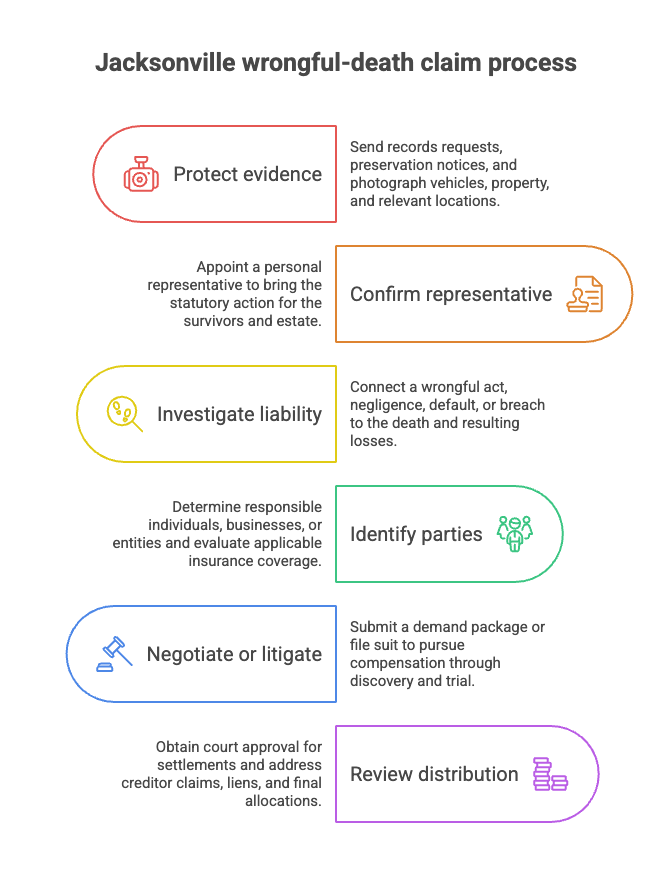
How does the Jacksonville wrongful-death claim process work?
1. Protect evidence immediately
Evidence can disappear quickly after a fatal accident. Send records requests and preservation notices when appropriate. Photograph vehicles, property, road conditions, safety equipment, products, and relevant locations when it is safe to do so.
For a Jacksonville traffic death, the family may need crash records, 911 records, vehicle data, witness information, and medical documentation. The Florida Highway Safety and Motor Vehicles crash dashboard 13 provides public crash-information resources. Pencheff & Fraley also has a guide on getting a Jacksonville car-accident police report.
2. Confirm the estate and representative
The case usually requires a personal representative. The representative may need probate documents, letters of administration, the will, death certificate, and family information.
The representative is not automatically the person who suffered the largest loss. The legal role is to bring the statutory action for the survivors and estate. The complaint must identify potential beneficiaries and their relationships under §768.21.
3. Investigate the cause of death and liability
A wrongful-death case requires more than proof that a death occurred. The investigation must connect a wrongful act, negligence, default, or breach to the death and resulting losses.
Depending on the facts, the investigation may involve accident reconstruction, medical review, trucking records, employment records, product testing, premises evidence, security footage, or expert testimony. Multiple defendants may share responsibility.
4. Identify insurance and other responsible parties
The responsible party may be an individual, driver, business, trucking company, property owner, manufacturer, healthcare provider, employer, or public entity. Insurance coverage can involve multiple policies and different limits.
A claim against a government agency or subdivision may involve sovereign-immunity limits and special notice rules. Florida Statutes §768.28 9 includes written presentation, denial, claim-limit, attorney-fee, and filing provisions. The exact procedure depends on the defendant and claim.
5. Negotiate or litigate the claim
A demand package may include liability evidence, medical and funeral expenses, income records, dependency proof, household-service evidence, expert opinions, and a damages analysis. The family should avoid signing a release before understanding every potential claim and beneficiary.
If negotiations fail, the personal representative may file suit. Litigation can include discovery, depositions, expert testimony, mediation, dispositive motions, and trial. A lawyer should explain the likely costs, time, risks, and decisions before filing.
6. Review settlement approval and distribution
A settlement may require court involvement. Under Florida Statutes §768.25 8, a settlement affecting a minor or incompetent survivor, or objected to by a survivor, is not effective unless approved by the court.
Florida law also protects amounts awarded for minors or incompetent survivors. See Florida Statutes §768.23 7.
Before distribution, the representative and counsel may need to address creditor claims, liens, fees, costs, expenses, tax questions, allocation between survivors and estate, and court orders. The amount advertised in a settlement announcement may not equal the amount any one survivor receives.
What is the Florida wrongful-death filing deadline?
The general rule is two years
Florida Statutes §95.11(5)(e) places an action for wrongful death in the two-year limitations category. The period is generally measured from the date of death. Read the current Florida Statutes §95.11 6.
A deadline is not a reason to wait. The estate appointment, evidence preservation, notice rules, expert review, and filing work can take time. Missing a limitations period can be fatal to a claim.
Exceptions and special procedures can change the analysis
Florida’s current statute also contains special rules. Section 95.11(11) addresses certain intentional torts resulting in death from acts described in Florida Statutes §§782.04 or 782.07. That provision concerns an action against a natural person and has specific statutory language.
Government claims can involve additional notice and presentation rules under §768.28. Medical-negligence cases can involve presuit requirements, separate damages restrictions, and different factual questions. The correct deadline should be confirmed by counsel after reviewing the defendant, date of death, claim type, and available tolling issues.
Do not rely on a generic online deadline
A search result that says “two years” may be incomplete. It may not address a government defendant, intentional conduct, medical negligence, a minor, tolling, a later-discovered issue, or a different legal theory.
For related Florida deadline education, see Pencheff & Fraley’s Florida statute-of-limitations guide. That page concerns car-accident limitations and does not replace a wrongful-death deadline review.
Jacksonville wrongful-death scenarios that may require different analysis
Fatal car, truck, or motorcycle crashes
Traffic deaths can involve driver negligence, impaired driving, distracted driving, speeding, defective vehicles, roadway conditions, commercial carriers, or multiple insurers. A Jacksonville fatal-crash investigation may require crash reconstruction and electronic data.
Pencheff & Fraley’s existing Jacksonville truck-accident article about I-95 liability can support related internal navigation. The wrongful-death article should remain focused on family eligibility and damages.
Medical negligence and hospital deaths
Medical-negligence wrongful-death claims have specialized rules. They can involve presuit investigation, medical records, expert review, provider definitions, and statutory limits affecting certain parent and adult-child damages.
Do not use a general car-accident damages explanation for a medical-negligence death. The claim type can change both the procedure and the damages analysis.
Nursing-home neglect or abuse
A nursing-home death may involve neglect, medication errors, falls, pressure injuries, dehydration, infection, abuse, or inadequate supervision. The investigation may require facility records, staffing records, care plans, incident reports, medication administration records, and regulatory materials.
Workplace deaths and third-party claims
Workers’ compensation laws can affect claims involving an employee’s death. A separate third-party claim may exist against a manufacturer, contractor, property owner, driver, or another responsible party.
The family should not assume that workers’ compensation is the only possible source of recovery. A lawyer should review employment records, contracts, safety evidence, insurance, and the identities of all involved parties.
Premises, negligent security, and public-entity claims
Deaths at apartments, stores, hotels, parking areas, construction sites, or public property may require proof about notice, dangerous conditions, lighting, security, maintenance, warnings, or code compliance.
When a city, county, state agency, or public employee is involved, the government-claim provisions deserve early attention. Do not treat a public-entity death like an ordinary private-party claim.
What documents should a family gather?
A family does not need every document before seeking help. Early consultation can identify what to request and what to preserve. Useful materials may include:
- Death certificate and funeral-home records.
- Probate documents, will, and letters of administration.
- Medical records, bills, health-insurance statements, and pharmacy records.
- Police, crash, fire, incident, or workplace reports.
- Photographs, videos, dashcam footage, messages, and social-media posts.
- Names and contact information for witnesses.
- Pay records, tax returns, benefits statements, pension information, and employment files.
- Evidence of financial support, household services, caregiving, or shared expenses.
- Insurance policies, claim letters, recorded statements, and settlement offers.
- Information about the defendant, vehicle, employer, property owner, or public agency.
- Records showing medical or funeral expenses paid by a survivor or the estate.
Do not delete messages or change photographs. Do not post case details online. Do not give a recorded statement or sign a release without understanding the legal consequences.
How to choose a wrongful-death or personal-injury lawyer
Families often search for the “best accident lawyer” after a death. A better approach is to ask focused questions about experience, communication, investigation, fees, and the firm’s willingness to take the case to trial.
Pencheff & Fraley’s existing guide provides questions to ask before hiring an accident lawyer. Consider asking:
- Who will serve as the day-to-day contact? Ask how often the firm reports progress and who answers urgent questions.
- Who will investigate the death? Ask about accident reconstruction, medical experts, economists, trucking experts, or other specialists.
- Has the firm handled wrongful-death cases with similar facts? Experience should match the cause of death and defendant type.
- Will the firm prepare for trial? A settlement-only approach may not fit every case.
- How does the fee agreement work? Ask about attorney fees, case costs, expert expenses, liens, and what happens if there is no recovery. Review the firm’s existing information about the cost of hiring a personal-injury lawyer.
- How will the firm handle multiple survivors? The lawyer should explain conflicts, allocation, court approval, and communication.
- What is the current filing deadline? The answer should account for the defendant, claim type, date of death, and special procedures.
- What should the family avoid doing? A good consultation should include evidence preservation and communications guidance.
A free consultation is an opportunity to ask questions. It is not a promise that a claim exists or that a particular result will follow.
Jacksonville resources and next steps
Pencheff & Fraley lists its Jacksonville office and provides a Jacksonville personal-injury attorney page. Families can also review the firm’s Florida personal-injury claim guide for general claim-process information.
For a private intake conversation, use the existing free Jacksonville case-review page. The Jacksonville office phone listed on the firm site is 904-770-4953.
Before contacting a lawyer, write down the date of death, location, known parties, insurance information, probate status, and urgent deadlines. Bring questions rather than waiting for a complete file.
Frequently Asked Questions About Jacksonville Wrongful Death Claims
Who can file a wrongful-death lawsuit in Jacksonville?
The decedent’s personal representative generally files the Florida wrongful-death action. The representative brings the claim for eligible survivors and the estate. Individual survivors usually do not file separate wrongful-death lawsuits for the same death.
Can a spouse sue for wrongful death in Florida?
The spouse may be an eligible survivor. Potential damages can include lost support and services, loss of companionship and protection, and mental pain and suffering. The representative files the statutory action, and the spouse’s recoverable categories depend on the facts and current law.
Can children recover after a parent dies?
Children may have rights under Florida’s Wrongful Death Act. The analysis depends on age, whether a surviving spouse exists, the type of damages, and whether the claim involves medical negligence. Florida uses an under-25 definition for “minor children” in this Act.
Can parents sue after an adult child dies?
Parents may have a claim in some circumstances. Florida law includes conditions involving other survivors, and medical-negligence claims have additional restrictions. A lawyer should review the family structure and the cause of death before giving a definite answer.
Can siblings recover wrongful-death damages?
A sibling is not automatically entitled to damages. Florida’s survivor definition can include an adoptive sibling or blood relative who was partly or wholly dependent on the decedent for support or services. Proof of dependency can be important.
What damages are available in a Florida wrongful-death claim?
Potential damages include lost support and services, spousal companionship and protection, certain mental-pain damages, parental companionship and guidance, medical and funeral expenses, estate lost earnings, and qualifying net accumulations. The available categories depend on the survivor, estate, claim type, and facts.
Is there a cap on wrongful-death damages in Florida?
There is no single cap that applies to every private wrongful-death claim. Different rules can apply to punitive damages, government defendants, medical negligence, and specific statutory categories. A lawyer should identify the defendant and legal theory before discussing limits.
How long do I have to file a wrongful-death claim in Florida?
The general period is two years under Florida Statutes §95.11(5)(e). Exceptions and special rules can apply. Government defendants, intentional acts, medical negligence, tolling, and other facts can change the analysis, so obtain legal advice promptly.
Does a criminal conviction need to happen first?
No general rule requires a criminal conviction before a civil wrongful-death claim can proceed. Criminal and civil proceedings use different standards and serve different purposes. The facts can support both proceedings at the same time.
Can a government agency be sued for wrongful death?
A claim may be possible, but Florida’s sovereign-immunity statute creates special notice, presentation, limits, and fee rules. The agency, subdivision, employee status, date of accrual, and type of death matter. Government claims should receive prompt legal review.
Do I need a wrongful-death lawyer?
A lawyer is not legally required in every civil claim. Wrongful-death cases often involve probate, multiple beneficiaries, experts, insurers, deadlines, liens, and settlement allocation. A consultation can help the family understand the issues before making an irreversible decision.
How much is a Jacksonville wrongful-death case worth?
There is no reliable universal settlement amount. Value depends on liability, the decedent’s age and income, dependency, household services, family relationships, medical and funeral costs, fault allocation, insurance, defendant limits, and evidence. An online average cannot value an individual claim.
Is a wrongful-death claim the same as a survival claim?
A wrongful-death action addresses losses recognized by Florida’s Wrongful Death Act for survivors and the estate. A survival issue can involve different facts and legal rules. Ask counsel to identify every available claim instead of assuming that one label covers every loss.
Conclusion: Get a prompt, fact-specific review
Wrongful death claims in Jacksonville are controlled by Florida statutes and the facts of the death. The personal representative generally files the action. The survivors and estate may recover different categories of damages. Spouses, children, parents, dependent relatives, and estates do not all have the same rights.
The most important steps are to preserve evidence, confirm the estate representative, identify all potential beneficiaries, review the filing deadline, and avoid signing releases before understanding the claim. If your family needs help evaluating a fatal accident or another death caused by negligence, contact Pencheff & Fraley’s Jacksonville personal-injury team or request a free Jacksonville case review.
**Prior results do not guarantee a similar outcome. This article is for general information and does not create an attorney-client relationship. **
This article is intended for general informational purposes only and does not constitute legal advice. Laws change, and the information above may not reflect the most recent legal developments. Please contact a qualified Florida personal injury attorney to discuss the specific facts of your case.