

When a passenger vehicle collides with a fully loaded commercial truck, the consequences are often catastrophic. The immense size and weight disparity between an 80,000-pound semi-truck and a standard passenger car means that victims frequently suffer devastating, life-altering injuries. If you or a loved one has been seriously hurt in such a crash, finding the right truck accident lawyer in Florida is the most critical decision you can make toward protecting your future.
Commercial vehicle accidents are not simply larger versions of car crashes. They involve a complex web of federal regulations, multiple potentially liable parties, and aggressive corporate insurance defense teams. Navigating this legal minefield while recovering from catastrophic trauma requires specialized legal expertise. At Pencheff & Fraley, our dedicated Florida personal injury attorneys understand the unique challenges these cases present and possess the resources necessary to hold negligent trucking companies accountable.
This comprehensive guide explains what makes commercial truck accidents so legally complex, how liability is established under Florida law, what evidence is needed to build a winning case, and what compensation you may be entitled to recover.
What Counts as a Commercial Vehicle in Florida?
Not every large vehicle on the road qualifies as a “commercial vehicle” under Florida law. Understanding this distinction matters because commercial vehicles are subject to a separate and far more demanding set of federal and state regulations.
Under Florida Statute § 316.302, Florida adopts the Federal Motor Carrier Safety Regulations for commercial motor vehicles operating within the state. A commercial motor vehicle generally includes any vehicle used in commerce that has a gross vehicle weight rating (GVWR) of 10,001 pounds or more, is designed to transport 16 or more passengers, or is used to transport hazardous materials requiring placards.
Types of Commercial Vehicles Involved in Serious Crashes
Commercial vehicles that frequently cause serious injuries on Florida roads include:
- Semi-trucks and 18-wheelers: The largest and most dangerous, capable of weighing up to 80,000 pounds when fully loaded.
- Tanker trucks: Carry liquid or gaseous cargo, which can shift unexpectedly and cause rollovers.
- Flatbed trucks: Carry unsecured or improperly secured loads that can fall onto other vehicles.
- Box trucks and delivery vans: Increasingly common due to the growth of e-commerce and last-mile delivery.
- Dump trucks and cement mixers: Heavy construction vehicles operating in and around urban areas.
- Garbage trucks: Operate on tight residential schedules, often in areas with heavy pedestrian traffic.
Each vehicle type presents unique hazards and is subject to specific regulatory requirements. Identifying the exact type of commercial vehicle involved in your crash is an important first step in building your case.
Why Commercial Vehicle Accidents in Florida Are Highly Complex
Florida’s bustling economy and extensive highway system make it a major hub for commercial transportation. The state’s ports, distribution centers, and tourism industry generate enormous commercial vehicle traffic on roads like I-4, I-75, I-95, and US-41. According to the Florida Department of Highway Safety and Motor Vehicles (FLHSMV), Florida records tens of thousands of commercial motor vehicle crashes each year.
When these accidents occur, the resulting legal claims are far more complicated than standard auto accident cases. Several factors drive this complexity.
The Scope of Federal and State Regulations
Unlike everyday drivers, commercial truck operators and their employers must comply with an extensive body of federal and state regulations. The Federal Motor Carrier Safety Administration (FMCSA) governs virtually every aspect of the commercial trucking industry. These regulations cover:
- Hours of Service (HOS): Strict limits on how long a driver can operate a vehicle before mandatory rest periods.
- Vehicle Maintenance: Requirements for pre-trip and post-trip inspections, as well as detailed maintenance logs.
- Driver Qualifications: Standards for obtaining and maintaining a Commercial Driver’s License (CDL), including background checks and medical certifications.
- Drug and Alcohol Testing: Mandatory pre-employment, random, post-accident, and reasonable suspicion testing under FMCSA Part 382.
- Cargo Securement: Specific requirements under FMCSA Part 393 for how cargo must be loaded, blocked, braced, and tied down.
When a commercial vehicle causes a serious injury, a skilled truck accident lawyer will meticulously investigate whether any of these regulations were violated. A proven violation serves as powerful evidence of negligence.
Identifying Multiple Liable Parties
In a typical car accident, liability usually rests with the at-fault driver. In commercial vehicle crashes, however, the web of responsibility often extends much further. A thorough investigation may reveal that several parties share the blame for your injuries.
| Potentially Liable Party | Basis for Liability |
| The Truck Driver | Distracted driving, speeding, HOS violations, impaired driving |
| The Trucking Company (Motor Carrier) | Negligent hiring, inadequate training, pressure to violate safety rules |
| The Cargo Loader | Improperly secured or overweight cargo causing instability |
| The Vehicle Owner | Failure to maintain the vehicle in safe operating condition |
| The Manufacturer | Defective parts such as faulty brakes, tires, or steering components |
| The Maintenance Provider | Negligent repairs or failure to identify safety-critical defects |
Identifying all liable parties is crucial because it maximizes the potential sources of compensation available to cover your extensive medical needs. For a broader overview of how multiple parties can be held responsible, read our detailed guide on what to do if you are injured in a truck accident.
The Independent Contractor Defense
One tactic trucking companies sometimes attempt is classifying their drivers as independent contractors to escape liability. However, Congress addressed this deceptive practice decades ago. Under 49 C.F.R. § 376.12(c)(1), any company leasing trucks assumes “exclusive possession, control and use of the trucking equipment for the duration of the lease and assumes responsibility for the operation of the equipment.” An experienced truck accident attorney can quickly dismantle this defense.
Overcoming Aggressive Corporate Defense Tactics
Trucking companies and their commercial insurance providers recognize that serious injury claims can cost them millions of dollars. They often dispatch rapid response teams to the crash scene immediately to control the narrative and gather evidence favorable to their side.
These corporate defense teams may attempt to shift blame onto the victim, utilizing Florida’s modified comparative negligence law to reduce the compensation they owe. They might also pressure victims into accepting lowball settlement offers before the full extent of their injuries is known. Having a formidable Tampa truck accident lawyer on your side levels the playing field.
Common Causes of Commercial Truck Accidents in Florida
Understanding how commercial vehicle accidents happen is vital for establishing negligence. While driver error is a frequent factor, systemic issues within the trucking company often play a significant role.
Driver Fatigue and Hours of Service Violations
Driver fatigue is one of the most pervasive and dangerous problems in the commercial trucking industry. Despite strict FMCSA Hours of Service regulations, the pressure to deliver goods quickly often leads to violations. The FMCSA limits property-carrying drivers to 11 hours of driving after 10 consecutive hours off duty and prohibits driving beyond the 14th consecutive hour after coming on duty.
Fatigued drivers suffer from delayed reaction times, impaired judgment, and the risk of microsleep. At highway speeds, even a two-second lapse in attention can result in a catastrophic collision.
Distracted and Impaired Driving
Operating a massive commercial vehicle demands complete, undivided focus. Distractions such as using a mobile phone, adjusting a GPS device, or eating while driving can have deadly consequences at 70 miles per hour. Furthermore, driving under the influence of alcohol, illegal drugs, or certain prescription medications severely impairs a commercial driver’s ability to operate their vehicle safely.
Improper Loading and Cargo Securement Failures
Improperly loaded or unsecured cargo is a frequently overlooked cause of serious truck accidents. When cargo shifts during transit, it can cause the truck to become unstable and roll over. Cargo that falls from a flatbed or open trailer creates an immediate hazard for other motorists. FMCSA Part 393 establishes specific requirements for cargo securement, and violations of these rules can establish direct liability against the cargo loader.
Inadequate Maintenance and Equipment Failure
Commercial trucks endure immense wear and tear and require rigorous, regular maintenance. When trucking companies cut corners to save money, the results can be catastrophic. Brake failures, tire blowouts, and steering system malfunctions are common causes of accidents that could have been prevented with proper inspection and upkeep. The FMCSA requires carriers to maintain detailed maintenance records, which become critical evidence in litigation.
Negligent Hiring and Inadequate Training
Trucking companies have a legal duty to hire qualified drivers and provide adequate training. When a company hires a driver with a history of traffic violations, DUI convictions, or prior accidents, they can be held liable for negligent hiring. Similarly, if a driver was not properly trained to handle the specific type of vehicle or cargo they were operating, the company bears responsibility for any resulting harm.
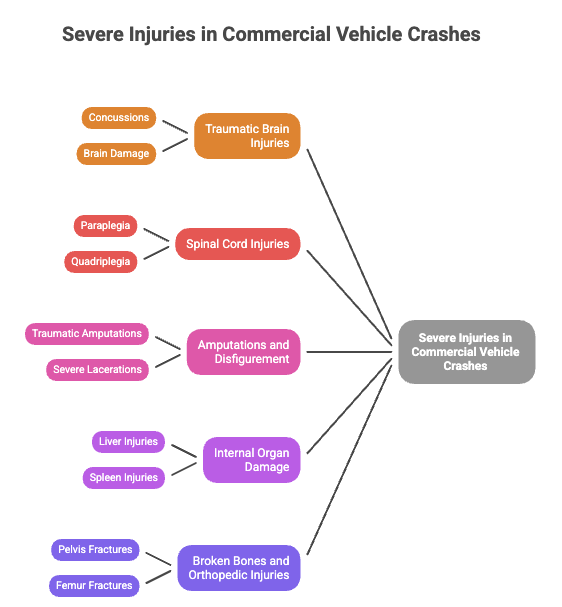
Severe Injuries Sustained in Commercial Vehicle Crashes
The sheer force generated by a collision with a fully loaded commercial truck frequently causes catastrophic, life-altering injuries. Victims often face long, arduous recoveries and permanent disabilities that fundamentally change every aspect of their lives.
Traumatic Brain Injuries (TBI)
The violent impact of a truck crash can cause severe trauma to the head, resulting in a Traumatic Brain Injury (TBI). TBIs range from concussions to profound brain damage, potentially causing permanent cognitive impairment, memory loss, personality changes, and a loss of motor function. These injuries often require lifelong medical care, extensive rehabilitation, and significant in-home support.
Spinal Cord Injuries and Paralysis
Damage to the spinal cord is another devastating consequence of commercial vehicle accidents. Depending on the location and severity of the injury, victims may suffer partial or complete paralysis. Paraplegia affects the lower body, while quadriplegia affects all four limbs. This permanent loss of mobility requires significant home modifications, specialized medical equipment, and ongoing personal care, generating lifetime costs that can reach into the millions of dollars.
Amputations and Severe Disfigurement
In the most severe crashes, limbs may be crushed or severed, leading to traumatic amputations. Severe lacerations and burns can cause permanent scarring and disfigurement. These injuries cause immense physical pain and result in profound emotional and psychological trauma that requires long-term mental health support.
Internal Organ Damage
The blunt force trauma of a truck collision can rupture internal organs, causing life-threatening internal bleeding. Injuries to the liver, spleen, kidneys, and lungs may not be immediately apparent at the crash scene, making prompt medical evaluation absolutely critical.
Broken Bones and Orthopedic Injuries
Fractures of the pelvis, femur, ribs, and other major bones are common in truck accidents. These injuries often require surgical intervention, hardware implantation, and months of physical therapy. In some cases, they result in chronic pain and permanent limitations in mobility.
Building a Strong Case: Critical Evidence in Trucking Accidents
Successfully pursuing a claim against a commercial trucking company requires gathering and preserving specialized evidence that is not typically involved in standard car accident cases. Time is of the essence, as crucial evidence can quickly disappear or be deliberately destroyed.
Sending a Spoliation Letter Immediately
One of the first and most important actions your attorney should take is sending a spoliation letter to the trucking company. This formal legal notice demands that the company preserve all evidence related to the crash, including the truck itself, electronic data, maintenance records, and driver logs. Failure to comply with a spoliation letter can result in severe legal sanctions and adverse jury instructions.
Electronic Logging Devices (ELD) and Black Box Data
Modern commercial trucks are equipped with Electronic Logging Devices (ELDs) that record the driver’s hours of service, providing direct evidence of HOS violations. Additionally, Event Data Recorders (EDRs), commonly called “black boxes,” capture critical data in the moments leading up to a crash, such as the truck’s speed, braking patterns, and steering input. This data is often automatically overwritten after a short period, making immediate legal action essential.
Driver Qualification and Employment Records
A thorough investigation must include an examination of the truck driver’s employment history and qualifications. This includes reviewing their Commercial Driver’s License (CDL) record, background checks, and the results of mandatory pre-employment and post-accident drug and alcohol tests. If the trucking company hired a driver with a history of safety violations, they can be held liable for negligent hiring.
Vehicle Maintenance and Inspection Logs
To prove that equipment failure contributed to the crash, your attorney must obtain the truck’s maintenance and inspection records. These logs can reveal whether the company neglected necessary repairs or ignored safety warnings, establishing a clear and documented pattern of negligence.
Dashcam and Surveillance Footage
Many commercial trucks are equipped with forward-facing and driver-facing dashcams. Additionally, surveillance cameras at nearby businesses, traffic cameras, and toll plazas may have captured the crash. Your attorney must act quickly to obtain this footage before it is overwritten or deleted.
Understanding Florida Law and Your Right to Compensation
Navigating the legal landscape following a commercial vehicle accident in Florida requires a deep understanding of state-specific laws and statutes. Several key legal concepts will directly affect your case.
Florida’s No-Fault System and the Serious Injury Threshold
Florida operates under a “no-fault” insurance system, requiring drivers to carry Personal Injury Protection (PIP) coverage. In minor accidents, PIP covers initial medical expenses and lost wages regardless of fault, up to a limit of $10,000. However, this coverage is vastly insufficient for the catastrophic injuries common in truck accidents.
To step outside the no-fault system and pursue a lawsuit against the at-fault commercial driver or trucking company, your injuries must meet Florida’s “serious injury threshold” under Florida Statute § 627.737. This threshold is met when injuries result in:
- Significant and permanent loss of an important bodily function;
- Permanent injury within a reasonable degree of medical probability;
- Significant and permanent scarring or disfigurement; or
Given the severity of injuries in most commercial truck accidents, this threshold is frequently met. For more details on navigating these claims under Florida law, review our comprehensive guide on what to do if injured in a truck accident in Florida.
Florida’s Modified Comparative Negligence Rule
Florida follows a modified comparative negligence system under Florida Statute § 768.81. Under this rule, you can recover damages even if you were partially at fault for the accident, as long as you are not found to be more than 50% responsible. Your total compensation is reduced by your percentage of fault.
For example, if a jury awards you $1,000,000 but finds you 20% at fault, you would receive $800,000. Trucking companies and their insurers will aggressively attempt to inflate your percentage of fault to minimize their payout. An experienced attorney will counter these tactics with compelling evidence.
The 14-Day PIP Rule
Florida’s PIP statute requires you to seek initial medical treatment within 14 days of the accident to access your PIP benefits. Even if you feel relatively fine immediately after the crash, adrenaline can mask serious injuries. Failing to see a doctor within 14 days can jeopardize your right to PIP coverage and give the defense an argument that your injuries were not caused by the accident.
Types of Damages You Can Recover
When a commercial vehicle causes serious injuries, the financial burden can be overwhelming. A skilled truck accident lawyer will fight to recover all applicable damages.
| Category | What It Covers |
| Economic Damages | Past and future medical expenses, rehabilitation costs, lost wages, loss of future earning capacity, property damage |
| Non-Economic Damages | Physical pain and suffering, emotional distress, mental anguish, loss of enjoyment of life, loss of consortium |
| Punitive Damages | Available in cases of gross negligence or intentional misconduct; designed to punish and deter |
| Wrongful Death Damages | Available to surviving family members; covers funeral expenses, loss of financial support, and loss of companionship |
The Statute of Limitations in Florida
It is critical to act swiftly following a commercial vehicle accident. Under Florida Statute § 95.11, you generally have two years from the date of the accident to file a personal injury lawsuit. If you fail to file within this strict timeframe, you will almost certainly lose your right to seek compensation forever. Engaging an attorney immediately ensures that your claim is filed promptly and all critical evidence is preserved before it disappears.
How Pencheff & Fraley Fights for Truck Accident Victims
At Pencheff & Fraley, we handle commercial vehicle accident cases with the seriousness and depth they demand. Our approach begins the moment you contact us and continues until you receive the full compensation you deserve.
Immediate Evidence Preservation
We act immediately to send spoliation letters, retain accident reconstruction experts, and secure all available electronic data from the truck. We understand that the window for preserving critical evidence is narrow, and we move quickly to close it.
Thorough Investigation and Expert Consultation
Our team works with a network of trusted experts, including accident reconstructionists, FMCSA compliance specialists, medical professionals, and vocational rehabilitation experts. These professionals help us build an airtight case that demonstrates the full scope of the trucking company’s negligence and the true extent of your damages.
Aggressive Negotiation and Litigation
We are not intimidated by large trucking companies or their high-powered insurance defense teams. We negotiate aggressively on your behalf and are fully prepared to take your case to trial if the other side refuses to offer fair compensation. Our track record of results speaks for itself.
FAQ
How is a commercial truck accident different from a regular car accident?
Commercial truck accidents are significantly more complex due to the severe nature of the injuries, the involvement of strict federal and state regulations like FMCSA rules, and the presence of multiple potentially liable parties. These parties can include the trucking company, cargo loaders, and vehicle manufacturers, in addition to the driver.
Who can be held liable if a commercial vehicle causes my injuries?
Liability can extend well beyond the truck driver. The trucking company (motor carrier), the owner of the truck or trailer, the company responsible for loading the cargo, and the manufacturer of any defective parts that contributed to the crash can all be held responsible depending on the facts of the case.
What evidence is crucial in a commercial vehicle accident case?
Critical evidence includes data from the truck’s Electronic Logging Device (ELD) and Event Data Recorder (EDR or “black box”), the driver’s employment and qualification records, drug and alcohol test results, vehicle maintenance and inspection logs, and any available dashcam or surveillance footage.
Do I have to use my own PIP insurance if a commercial truck hit me?
Yes, Florida is a no-fault state, meaning you must initially use your Personal Injury Protection (PIP) coverage. However, because commercial truck accidents typically cause injuries that far exceed PIP limits and meet Florida’s serious injury threshold, you can usually file a lawsuit against the at-fault parties for full and comprehensive compensation.
How long do I have to file a lawsuit after a truck accident in Florida?
In Florida, the statute of limitations for filing a personal injury lawsuit is generally two years from the date of the accident under Florida Statute § 95.11. It is crucial to consult an attorney as quickly as possible to ensure your claim is filed on time and all evidence is preserved before it is lost.
Conclusion
The aftermath of a collision with a commercial truck is a chaotic and overwhelming experience. The physical, emotional, and financial toll can be devastating, and the legal hurdles are immense. You do not have to face the aggressive tactics of trucking companies and their insurers alone.
Securing experienced legal representation is vital to protecting your rights and securing the comprehensive compensation you need to rebuild your life. The dedicated legal team at Pencheff & Fraley possesses the knowledge, resources, and tenacity to hold negligent commercial operators accountable.
Contact us today for a free, no-obligation consultation. We will review your case, answer your questions, and explain your legal options. Learn how we can help you on the road to recovery. Pay nothing unless we win your case.
Call us at 904-770-4953 or visit our website at www.pencheffandfraley.com to schedule your free case consultation.
We’re Here for You 24/7
We are available 24/7 to take your call. If you are unable to travel, we will come to you. The sooner you call, the stronger your case can be. Your path to maximum compensation and justice starts with a single phone call to Pencheff & Fraley.
Author: Pencheff and Fraley Legal Team
Disclaimer: This article is for informational purposes only and does not constitute legal advice. Every case is unique, and you should consult with a qualified attorney about your specific situation.