
What to Do After a Motorcycle Accident in Florida: A Complete 2025 Guide
Florida’s year-round sunshine and scenic roads make it a paradise for motorcycle enthusiasts. However, this popularity comes with a serious risk. A motorcycle accident can happen in an instant, leaving riders with devastating injuries, overwhelming medical bills, and an uncertain future. Knowing what to do after a motorcycle accident in Florida is not just important, it’s critical to protecting your health, your rights, and your ability to recover the compensation you deserve.
At Pencheff and Fraley, our experienced Florida motorcycle accident attorneys have seen firsthand how a crash can turn a life upside down. This guide provides a comprehensive overview of the immediate steps you should take, the complex Florida laws that will affect your claim, and how to navigate the challenging road ahead.
Understanding Florida’s Motorcycle Accident Crisis
Florida has the unfortunate distinction of being one of the most dangerous states for motorcyclists. The latest data from the Florida Department of Highway Safety and Motor Vehicles (FLHSMV) paints a grim picture of the risks on our roads.
2024 Florida Motorcycle Accident Statistics
According to the most recent official data, Florida saw a staggering number of motorcycle-related incidents in 2024. These numbers highlight the vulnerability of riders and the importance of understanding your legal options.
| Statistic | 2024 Figure |
| Total Motorcycle Crashes | 9,420 |
| Motorcycle Fatalities | 589 |
| Motorcycle Injuries | Over 8,000 |
These statistics reveal that motorcycle fatalities account for a disproportionate 18.50% of all traffic deaths in Florida, despite motorcycles making up a much smaller percentage of registered vehicles. The high rate of injury in these crashes underscores the need for immediate and proper action following an accident.
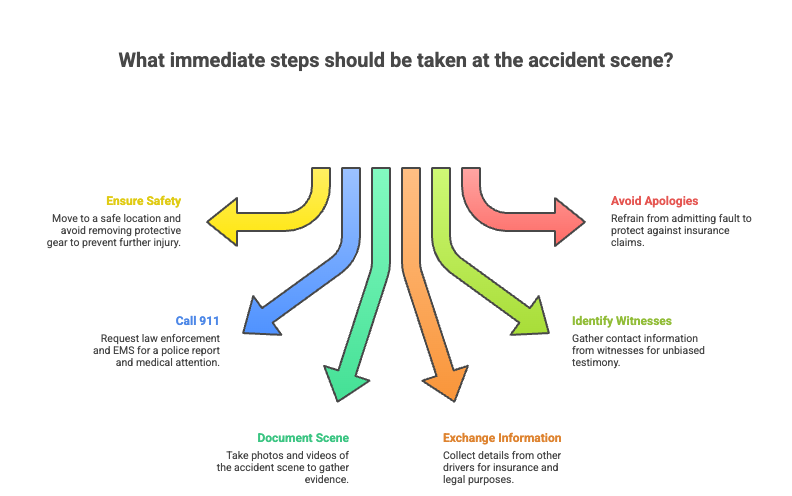
Immediate Steps to Take at the Scene of a Florida Motorcycle Accident
The moments following a motorcycle crash are chaotic and stressful. What you do in these first few minutes can have a significant impact on your health and any future legal claim. If you are involved in an accident, try to remain calm and follow these steps.
Ensure Your Safety First
If you are able, move to a safe location off the roadway to avoid being struck by other vehicles. Do not attempt to remove your helmet or other protective gear, as this could worsen a potential head, neck, or spinal injury. Wait for emergency medical personnel to arrive.
Call 911 and Request Emergency Services
Immediately call 911 to report the accident. Request both law enforcement and emergency medical services (EMS). A police report will be a crucial piece of evidence, and prompt medical attention is essential for your health and your claim.
Document the Accident Scene
If you are physically able, use your smartphone to take pictures and videos of the accident scene. Document everything, including:
- Damage to your motorcycle and any other vehicles involved
- Your injuries
- Skid marks, debris, and road conditions
- Traffic signs and signals
- The overall scene from multiple angles
Exchange Information with Other Parties
Collect the following information from all drivers involved:
- Full name and contact information
- Driver’s license number
- Insurance company and policy number
- License plate number
- Make, model, and color of all vehicles
Identify and Speak with Witnesses
Independent witnesses can provide an unbiased account of what happened. If anyone saw the accident, ask for their name and contact information. Their testimony can be invaluable in proving fault.
What NOT to Say at the Scene
Be polite, but do not apologize or admit fault. Statements made at the scene, even a simple “I’m sorry,” can be used against you later by insurance companies. Stick to the facts when speaking with law enforcement and other drivers.
Critical Actions in the Hours After Your Motorcycle Crash
Once you have left the scene of the accident, there are several important steps you need to take to protect your rights and begin the recovery process.
Seek Immediate Medical Attention
Even if you feel fine, it is crucial to get a thorough medical evaluation. Adrenaline can mask serious injuries, such as internal bleeding, concussions, or soft tissue damage. Seeking prompt medical care creates an official record of your injuries, which is essential for your insurance claim.
Report the Accident to Law Enforcement
Under Florida Statutes § 316.065, you must report any accident involving injury, death, or property damage exceeding $500. If you did not call 911 at the scene, you must file a report with the local police department or sheriff’s office as soon as possible.
Notify Your Insurance Company (But Be Careful)
Report the accident to your insurance company promptly. However, be cautious in your communications. Provide only the basic facts of the accident and avoid giving a recorded statement or speculating about fault until you have spoken with a Florida motorcycle accident attorney.
Preserve All Evidence
Keep all physical evidence from the accident, including your damaged motorcycle, helmet, and any torn or bloody clothing. Do not have your motorcycle repaired until it has been inspected. Also, keep a file of all documents related to the accident, including medical bills, receipts, and correspondence with insurance companies.
Understanding Florida Motorcycle Laws That Impact Your Case
Florida has a unique and complex set of laws that apply to motorcycle accidents. Understanding these laws is key to navigating your claim successfully.
Florida’s Modified Comparative Negligence System (50% Rule)
Florida follows a “modified comparative negligence” system under Florida Statutes § 768.81. This means that if you are found to be partially at fault for the accident, your compensation will be reduced by your percentage of fault. However, if you are found to be more than 50% at fault, you are barred from recovering any damages at all.
Example: If your total damages are $100,000 and you are found to be 20% at fault, you would recover $80,000. However, if you are 51% at fault, you would recover nothing.
PIP Exemption: Why Motorcyclists Are Different
Unlike drivers of four-wheeled vehicles, motorcyclists in Florida are not required to carry Personal Injury Protection (PIP) insurance. This means that after an accident, you cannot simply file a claim with your own insurance for medical benefits. Instead, you must seek compensation from the at-fault party’s insurance company, making it essential to prove liability.
Florida Helmet Law and Its Impact on Your Claim
Florida Statutes § 316.211 requires all motorcycle riders to wear a helmet. However, riders over the age of 21 can legally ride without a helmet if they carry at least $10,000 in medical insurance benefits. While riding without a helmet may be legal in some cases, it can still affect your injury claim. If you suffer a head injury, the defense may argue that your failure to wear a helmet contributed to your injuries and attempt to reduce your compensation.
Statute of Limitations: You Have 2 Years to File
As of a recent change in Florida law, the statute of limitations for filing a negligence claim, including a motorcycle accident lawsuit, is now two years from the date of the accident. This change was implemented through tort reform legislation in March 2023. If you fail to file a lawsuit within this time frame, you will lose your right to seek compensation forever.
Common Causes of Motorcycle Accidents in Florida
Most motorcycle accidents are not caused by reckless riding but by the negligence of other drivers. Some of the most common causes include:
- Left-Turn Collisions: A driver turning left in front of an oncoming motorcycle is one of the most frequent causes of serious motorcycle accidents.
- Blind Spot Accidents: Drivers often fail to see motorcycles in their blind spots before changing lanes.
- Distracted and Impaired Drivers: Texting, talking on the phone, or driving under the influence of drugs or alcohol significantly increases the risk of a crash.
- Florida-Specific Road Hazards: Tourist drivers unfamiliar with the area, sudden downpours, and road construction can create dangerous conditions for motorcyclists.
Types of Motorcycle Accident Injuries in Florida
Due to the lack of protection, motorcyclists often suffer severe and life-altering injuries, including:
- Traumatic Brain Injuries (TBI): Even with a helmet, a TBI can have lifelong consequences.
- Spinal Cord Injuries: These can lead to partial or complete paralysis.
- Road Rash: Severe abrasions that can cause permanent scarring and infections.
- Broken Bones and Fractures: Multiple fractures are common in motorcycle accidents.
- Internal Injuries: Damage to organs and internal bleeding can be life-threatening.
Dealing with Insurance Companies After a Florida Motorcycle Accident
Insurance companies are for-profit businesses, and their goal is to pay out as little as possible. Be wary of their tactics.
Why Insurance Adjusters Are Not Your Friends
The insurance adjuster may seem friendly and concerned, but their job is to minimize the value of your claim. They may try to get you to admit fault, downplay your injuries, or accept a quick, lowball settlement.
Avoiding Recorded Statements
Never give a recorded statement to the other driver’s insurance company without first consulting with an attorney. They can use your words out of context to deny or devalue your claim.
Understanding Lowball Settlement Offers
Insurance companies often make a quick, low settlement offer before the full extent of your injuries and damages is known. While it may be tempting to accept, this offer is almost always far less than what your case is actually worth.
The Importance of Uninsured Motorist Coverage
Since PIP coverage does not apply to motorcycles, Uninsured/Underinsured Motorist (UM/UIM) coverage is one of the most important investments a Florida rider can make. If you are hit by a driver with little or no insurance, your own UM/UIM policy can cover your medical bills, lost wages, and other damages.
What NOT to Do After a Motorcycle Accident in Florida
Avoiding these common mistakes can be just as important as taking the right steps:
- Don’t Admit Fault or Apologize: Even a simple apology can be twisted into an admission of guilt.
- Don’t Post on Social Media: Insurance companies will monitor your social media accounts for any evidence they can use against you.
- Don’t Accept the First Settlement Offer: It is almost certainly less than you deserve.
- Don’t Delay Medical Treatment: Gaps in treatment can be used to argue that your injuries are not serious.
- Don’t Sign Anything Without Legal Review: Do not sign any documents from an insurance company without having them reviewed by an attorney.
Compensation Available for Florida Motorcycle Accident Victims
You may be entitled to recover a wide range of damages after a motorcycle accident, including:
Economic Damages
Economic damages compensate you for financial losses that can be calculated and documented:
- Medical Expenses: Past and future medical bills, including emergency care, hospitalization, surgery, rehabilitation, and ongoing treatment
- Lost Wages: Income you have lost due to time off work
- Reduced Earning Capacity: If your injuries prevent you from returning to your previous job or working at the same capacity
- Property Damage: Repair or replacement costs for your motorcycle and other damaged property
Non-Economic Damages
Non-economic damages compensate you for intangible losses that don’t have a specific dollar value:
- Pain and Suffering: Physical pain and discomfort caused by your injuries
- Emotional Distress: Anxiety, depression, and psychological trauma resulting from the accident
- Loss of Enjoyment of Life: Inability to participate in activities you once enjoyed
- Disfigurement and Scarring: Permanent physical changes that affect your appearance and self-esteem
Punitive Damages
In cases of extreme negligence, such as a DUI crash or reckless driving, you may be awarded punitive damages intended to punish the at-fault party and deter similar conduct in the future.
When to Hire a Florida Motorcycle Accident Attorney
Navigating the legal system and dealing with insurance companies after a motorcycle accident can be overwhelming, especially when you are trying to recover from your injuries. An experienced Florida motorcycle accident attorney can handle all aspects of your claim, from investigating the accident to negotiating with the insurance company and, if necessary, taking your case to trial.
At Pencheff and Fraley, we work on a contingency fee basis, which means you pay nothing unless we win your case. Our attorneys will:
- Investigate the accident and gather all necessary evidence
- Handle all communications with insurance companies
- Calculate the full value of your claim, including future damages
- Negotiate aggressively for maximum compensation
- Take your case to trial if a fair settlement cannot be reached
Frequently Asked Questions About Florida Motorcycle Accidents
Q: How much is my motorcycle accident case worth?
A: The value of your case depends on many factors, including the severity of your injuries, the amount of your medical bills and lost wages, and the degree of fault of the other party. An experienced attorney can evaluate your case and provide an estimate based on similar cases.
Q: Can I still recover compensation if I wasn’t wearing a helmet?
A: Yes. While it may reduce the amount you can recover for a head injury under Florida’s comparative negligence system, it does not bar you from seeking compensation for other injuries.
Q: What if the other driver doesn’t have insurance?
A: If you have Uninsured/Underinsured Motorist (UM/UIM) coverage on your own motorcycle insurance policy, you can file a claim with your own insurance company to recover damages.
Q: How long do I have to file a lawsuit?
A: Under current Florida law, you have two years from the date of the accident to file a personal injury lawsuit. Missing this deadline will permanently bar your claim.
Q: Should I accept the insurance company’s first settlement offer?
A: Almost never. Initial settlement offers are typically far below the true value of your claim. Consult with an attorney before accepting any offer.
Contact Pencheff and Fraley for Your Florida Motorcycle Accident Case
If you have been injured in a motorcycle accident in Florida, you don’t have to face the fight alone. The experienced and compassionate attorneys at Pencheff and Fraley are here to help you every step of the way. We will fight to protect your rights and recover the maximum compensation you deserve.
Contact us today for a free, no-obligation consultation. We will review your case, answer your questions, and explain your legal options. Learn how we can help you on the road to recovery. Pay nothing unless we win your case.
Call us at 904-770-4953 or visit our website at www.pencheffandfraley.com to schedule your free case consulatation.
Click Here for a complete motorcycle accident Ohio Guide
Author: Pencheff and Fraley Legal Team
Disclaimer: This article is for informational purposes only and does not constitute legal advice. Every case is unique, and you should consult with a qualified attorney about your specific situation.