

If you’ve been injured in a crash involving an Uber or Lyft in Florida, one of the first questions you’re likely asking is: does Florida’s no-fault insurance apply to rideshare accidents? The short answer is yes — but the way it applies is far more layered than in a standard car accident. Florida’s no-fault system, combined with the tiered insurance structure required of rideshare companies, creates a complex web of coverage that can be difficult to navigate without legal guidance.
Understanding how Personal Injury Protection (PIP) interacts with rideshare insurance policies is critical to protecting your rights and maximizing your compensation. At Pencheff & Fraley, our experienced Florida personal injury attorneys help injured victims cut through the confusion and pursue every dollar they are owed.
What Is Florida’s No-Fault Insurance System?
Florida is one of a small number of states that operates under a no-fault insurance system. Under this framework, every driver in Florida is required to carry a minimum of $10,000 in Personal Injury Protection (PIP) coverage, as mandated by Florida Statute § 627.736. This coverage pays for your own medical expenses and lost wages after an accident, regardless of who caused the crash.
What Does PIP Actually Cover?
PIP is designed to provide quick, fault-free access to medical benefits. Specifically, Florida PIP covers:
- 80% of all necessary and reasonable medical expenses
- 60% of lost wages due to the injury
- Up to $5,000 in death benefits for surviving family members
The maximum benefit under a standard PIP policy is $10,000 — but there is an important distinction. If your injuries are classified as an Emergency Medical Condition (EMC), you can access the full $10,000. If your injuries are not classified as an EMC, your PIP benefits are capped at $2,500.
The Critical 14-Day Rule
One of the most important and frequently overlooked aspects of Florida’s no-fault system is the 14-day treatment rule. Under Florida Statute § 627.736, you must seek initial medical treatment within 14 days of the accident to be eligible for PIP benefits. Missing this deadline — even by a single day — can permanently disqualify you from receiving PIP coverage, leaving you responsible for your own medical bills.
Important: Even if you feel fine immediately after a rideshare accident, you should see a doctor within 14 days. Some serious injuries, such as traumatic brain injuries and soft tissue damage, may not present symptoms immediately.
How Does Florida’s No-Fault System Apply to Rideshare Accidents?
Yes, Florida’s no-fault insurance applies to rideshare accidents — but which PIP policy applies depends on your role in the accident and the driver’s status at the time of the crash. The legal framework governing rideshare insurance in Florida is established by Florida Statute § 627.748, which was enacted in 2017 to regulate Transportation Network Companies (TNCs) like Uber and Lyft.
If You Are a Passenger in an Uber or Lyft
As a passenger, your own PIP policy (if you own a vehicle) is the primary source of coverage for your initial medical expenses. If you do not own a vehicle and therefore do not have your own PIP policy, the rideshare company’s insurance policy must provide PIP coverage that meets Florida’s minimum requirements. According to Florida Statute § 627.748(c), during a prearranged ride (Phase 2 and Phase 3), the TNC’s insurance must provide PIP benefits that meet the higher requirements applicable to limousines.
If You Are Another Driver or Pedestrian
If you are a driver or pedestrian injured by a rideshare vehicle, your own PIP coverage applies first. Once your PIP is exhausted, you may pursue a claim against the at-fault party’s liability insurance — which could be the rideshare driver’s personal policy or the TNC’s policy, depending on the driver’s status at the time of the crash.
If You Are the Rideshare Driver
As a rideshare driver, your PIP coverage depends on the phase you were in when the accident occurred. When the app is off, your personal PIP applies. During Phases 1, 2, and 3, the TNC’s insurance policy must include the required PIP coverage.
The Three Phases of Rideshare Insurance Coverage in Florida
The most critical factor in any Florida rideshare accident claim is the driver’s app status at the moment of the crash. Florida law creates three distinct phases of coverage, and the financial protection available to you changes dramatically from one phase to the next.
Phase 1: App On, No Ride Accepted
When a rideshare driver has the Uber or Lyft app turned on and is available to accept rides but has not yet been matched with a passenger, limited coverage is in effect. Most personal auto insurance policies contain a commercial use exclusion, meaning they will deny claims that arise while the driver is operating as a rideshare driver. To fill this gap, Florida law requires the following minimum coverage during Phase 1:
- $50,000 for bodily injury or death per person
- $100,000 for bodily injury or death per accident
- $25,000 for property damage
- PIP meeting Florida’s minimum requirements
This coverage can be provided by the driver’s personal policy, the TNC’s policy, or a combination of both. Critically, under Florida Statute § 627.748(e), the TNC’s policy does not need to wait for the driver’s personal insurer to deny the claim first — it must provide coverage from the first dollar.
Phase 2: Driver En Route to Pick Up a Passenger
Once the driver accepts a ride request and is on the way to pick up the passenger, the TNC’s full commercial insurance policy is activated. This is a significant jump in coverage.
Phase 3: Passenger in the Vehicle
The highest level of coverage applies from the moment a passenger enters the vehicle until they exit. During Phases 2 and 3, Uber and Lyft are required to maintain:
- $1,000,000 in primary liability coverage for death, bodily injury, and property damage
- PIP benefits meeting the higher limousine requirements under Florida law
| Driver Status | Applicable Coverage | Liability Limits |
| App Off (Personal Use) | Driver’s Personal Auto Insurance | State Minimum |
| App On, No Ride Accepted (Phase 1) | TNC’s Limited Liability or Driver’s Policy | $50k/$100k/$25k |
| En Route to Pickup (Phase 2) | TNC’s Full Commercial Policy | $1,000,000 |
| Passenger in Vehicle (Phase 3) | TNC’s Full Commercial Policy | $1,000,000 |
For a deeper breakdown of how these policies work in practice, see our comprehensive guide on Uber & Lyft Insurance Coverage in Florida.
When Can You Step Outside Florida’s No-Fault System?
Florida’s no-fault system is designed to limit lawsuits for minor injuries. However, the law recognizes that some injuries are too severe to be adequately compensated by PIP alone. If your injuries meet the “serious injury threshold” defined under Florida Statute § 627.737, you have the right to step outside the no-fault system and file a liability claim against the at-fault party for pain and suffering, emotional distress, and other non-economic damages.
What Qualifies as a “Serious Injury” in Florida?
To meet the serious injury threshold, your injuries must include at least one of the following:
- Significant and permanent loss of an important bodily function
- Permanent injury within a reasonable degree of medical probability, other than scarring or disfigurement
- Significant and permanent scarring or disfigurement
- Death
Injuries that commonly meet this threshold in rideshare accidents include traumatic brain injuries (TBIs), spinal cord injuries, severe fractures, and injuries requiring surgery or long-term rehabilitation.
What Damages Can You Recover Beyond PIP?
Once you qualify to step outside the no-fault system, you can pursue a full range of damages, including:
- Economic Damages: All past and future medical expenses beyond PIP, lost income, loss of future earning capacity, and property damage.
- Non-Economic Damages: Physical pain and suffering, emotional distress, mental anguish, loss of enjoyment of life, and permanent disfigurement.
- Punitive Damages: In rare cases involving grossly negligent or intentional misconduct by the driver, Florida courts may award punitive damages.
The Coverage Gap Problem: What Happens During Phase 1?
One of the most significant and underappreciated risks in rideshare accidents is the coverage gap that can arise during Phase 1. When a driver has the app on but has not yet accepted a ride, their personal auto insurance may deny the claim due to a commercial use exclusion. While the TNC’s limited liability coverage is supposed to fill this gap, the process of getting that coverage to apply can be contentious and time-consuming.
This gap is particularly dangerous because many accident victims assume they are fully covered the moment they see an Uber or Lyft sticker on a vehicle. In reality, the level of coverage available to you can vary dramatically depending on the precise moment the accident occurred. An experienced rideshare accident attorney can investigate the driver’s app data and logs to determine exactly which phase applied at the time of your crash.
Florida Rideshare Accident Statistics
The stakes are high in Florida. According to data from the Florida Highway Safety and Motor Vehicles (FLHSMV), Florida recorded over 388,000 traffic accidents in a recent year, with nearly 10,000 crashes involving rideshare drivers. Approximately 30% of rideshare crashes result in injuries serious enough to require hospitalization. In 2025, some Florida counties saw a 20% rise in rideshare-related accidents, reflecting the growing presence of these services on Florida roads.
Nationally, Lyft’s 2024 Safety Transparency Report documented 111 motor vehicle fatalities during the reporting period — a 31% increase in incident frequency from the previous report. These figures underscore why understanding your insurance rights after a rideshare accident is not just a legal matter but a matter of financial survival.
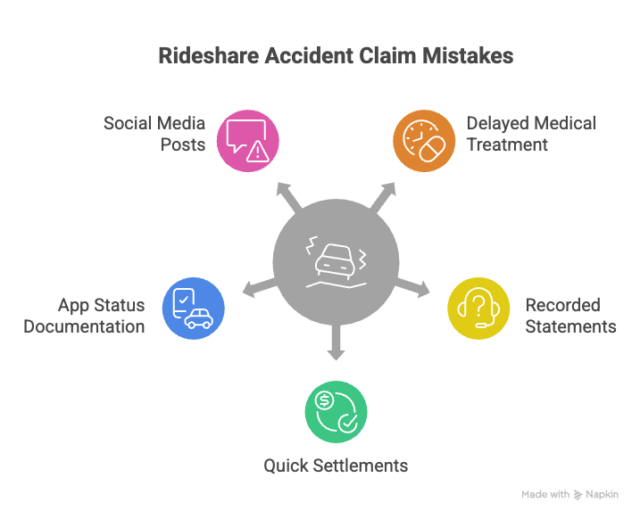
Common Mistakes That Can Hurt Your Florida Rideshare Accident Claim
Insurance companies representing Uber, Lyft, and other drivers are experienced at minimizing payouts. Avoiding these common errors is essential to protecting the value of your claim.
- Waiting More Than 14 Days to Seek Medical Treatment This is the single most damaging mistake. Missing the 14-day PIP deadline eliminates your right to no-fault benefits entirely.
- Giving a Recorded Statement to the Insurance Adjuster You are not legally required to give a recorded statement to the at-fault party’s insurer. Adjusters are trained to ask questions designed to minimize your claim. Politely decline and contact an attorney first.
- Accepting a Quick Settlement Offer The first settlement offer is almost always a lowball figure that does not account for your future medical needs or long-term losses. Accepting it means permanently waiving your right to seek additional compensation.
- Failing to Document the Driver’s App Status The driver’s app status at the time of the crash is the single most important factor in determining which insurance policy applies. Take screenshots of the app, preserve the ride receipt, and ask your attorney to subpoena the TNC’s driver logs.
- Posting on Social Media Insurance companies actively monitor the social media accounts of claimants. Any post that could be interpreted as inconsistent with your claimed injuries can be used against you.
What to Do Immediately After a Florida Rideshare Accident
Taking the right steps in the immediate aftermath of a rideshare accident can make the difference between a successful claim and a denied one. For a full guide, see our article on what to do if you’re injured as an Uber or Lyft passenger in Florida.
Step 1: Ensure Safety and Call 911 Move to a safe location if possible and call 911 immediately. A police report is a critical piece of evidence in any personal injury claim.
Step 2: Seek Medical Attention Even if you feel fine, see a doctor immediately — and no later than 14 days after the accident. This protects your PIP eligibility and creates a medical record linking your injuries to the crash.
Step 3: Document the Scene Take photos and videos of all vehicles, the accident scene, road conditions, and your visible injuries. Capture the driver’s name, vehicle information, and license plate from the app.
Step 4: Collect Witness Information Get the names and contact information of any witnesses. Their accounts can be invaluable if liability is disputed.
Step 5: Report the Accident to the Rideshare Company Use the Uber or Lyft app to report the accident. This creates an official record and preserves the driver’s app data.
Step 6: Contact a Florida Rideshare Accident Attorney Before speaking to any insurance company, consult with an experienced attorney. The legal landscape for rideshare accidents is complex, and having professional guidance from the start can significantly impact your outcome.
How Florida’s 2023 Tort Reform Affects Rideshare Claims
Florida’s 2023 tort reform legislation made significant changes that directly affect rideshare accident claims. Most critically, the statute of limitations for negligence claims was reduced from four years to two years. This means you now have only two years from the date of the accident to file a lawsuit. Given the complexity of rideshare claims — which often involve multiple insurance companies, disputed liability, and extensive medical documentation — acting quickly is more important than ever.
Additionally, Florida now follows a modified comparative negligence rule. If you are found to be more than 50% at fault for the accident, you are completely barred from recovering any damages. Insurance companies will aggressively attempt to assign fault to you to reduce or eliminate their liability. An experienced attorney can counter these tactics and build a strong case on your behalf.
How Pencheff & Fraley Can Help You After a Rideshare Accident
Navigating a Florida rideshare accident claim requires a thorough understanding of multiple overlapping legal frameworks: Florida’s no-fault insurance system, the TNC insurance phase structure, the serious injury threshold, and the 2023 tort reform changes. At Pencheff & Fraley, our Florida personal injury attorneys bring deep expertise in all of these areas to every case we handle.
We can help you by:
- Investigating the accident to determine the driver’s app status and establish liability
- Gathering and preserving evidence, including driver logs, app data, and dashcam footage
- Coordinating your medical care to ensure your injuries are properly documented
- Negotiating aggressively with Uber’s, Lyft’s, and other insurers’ adjusters
- Filing a lawsuit if the insurance companies refuse to offer fair compensation
- Maximizing your recovery across all available insurance policies
We handle rideshare accident cases on a contingency fee basis — meaning you pay nothing unless we win. To understand what your case may be worth, explore our guide on Uber & Lyft Accident Settlements in Florida.
Frequently Asked Questions About Florida No-Fault Insurance and Rideshare Accidents
Does Florida’s no-fault insurance apply if I was a passenger in an Uber or Lyft?
Yes. If you were a passenger in a rideshare vehicle, Florida’s no-fault system still applies. Your own PIP coverage (if you have it) is the first source of payment for your medical bills, regardless of fault. If you do not have your own PIP, the rideshare company’s insurance must provide PIP coverage for you.
What if my PIP coverage runs out after a rideshare accident?
If your $10,000 PIP limit is exhausted and your injuries meet Florida’s serious injury threshold, you can file a liability claim against the at-fault driver’s insurance for additional compensation, including pain and suffering.
Can I sue Uber or Lyft directly after an accident in Florida?
In most cases, you will file a claim against the TNC’s insurance policy rather than suing the company directly. Uber and Lyft classify their drivers as independent contractors, which limits their direct liability. However, if the TNC’s insurer refuses to pay a fair settlement, a lawsuit may be necessary.
How long do I have to file a rideshare accident claim in Florida?
Under Florida’s 2023 tort reform, you have two years from the date of the accident to file a personal injury lawsuit. However, you should contact an attorney as soon as possible, as evidence can be lost and witnesses’ memories fade over time.
What is the 14-day rule for PIP in Florida?
Florida law requires you to seek initial medical treatment within 14 days of the accident to be eligible for PIP benefits. Missing this deadline permanently disqualifies you from receiving no-fault coverage.
Conclusion: Know Your Rights After a Florida Rideshare Accident
Does Florida’s no-fault insurance apply to rideshare accidents? Yes — but the way it applies is uniquely complex. Your PIP coverage is the first line of defense for your medical bills, but the 14-day rule, the serious injury threshold, and the driver’s app status all play critical roles in determining the full scope of your compensation. The tiered insurance structure required by Florida Statute § 627.748 means that the coverage available to you can range from a few thousand dollars to $1 million, depending on the specific circumstances of your crash.
The most important steps you can take are to seek medical treatment immediately, document everything, and consult with an experienced Florida rideshare accident attorney before speaking to any insurance company.
At Pencheff & Fraley, we are committed to fighting for the rights of rideshare accident victims across Florida. We understand the tactics insurance companies use to minimize your claim, and we know how to counter them. Our team is ready to review your case, answer your questions, and guide you through every step of the claims process.
Contact us today for a free, no-obligation consultation. We will review your case, answer your questions, and explain your legal options. Learn how we can help you on the road to recovery. Pay nothing unless we win your case.
Call us at 904-770-4953 or visit our website at www.pencheffandfraley.com to schedule your free case consultation.
We’re Here for You 24/7
We are available 24/7 to take your call. If you are unable to travel, we will come to you. The sooner you call, the stronger your case can be. Your path to maximum compensation and justice starts with a single phone call to Pencheff & Fraley.
Author: Pencheff and Fraley Legal Team
Disclaimer: This article is for informational purposes only and does not constitute legal advice. Every case is unique, and you should consult with a qualified attorney about your specific situation.