


If you searched for “uber lyft accident settlements florida,” the answer depends on the crash, the injuries, and the insurance that applies. A settlement is a negotiated resolution, not a set payment. The driver’s app status, available coverage, evidence of fault, medical care, and any competing claims can all affect the outcome.
A person injured in a rideshare crash may be a passenger, a driver, a pedestrian, or someone in another vehicle. Each position raises different questions. The same collision can involve several insurers, several injured people, and different accounts of what happened.
This guide explains how Florida Uber and Lyft accident claims are evaluated. It also outlines coverage, records, deadlines, and the choices that can arise during negotiations. Examples are hypothetical and are not predictions of any result.
What to do after an Uber or Lyft accident in Florida
Safety and medical needs come before paperwork. If there is an emergency, call 911 when it is safe to do so. Florida law requires a driver involved in a crash with an injury or death to notify law enforcement immediately by the quickest means; see section 316.065.
Depending on the circumstances, useful steps may include:
- Move to safety when possible. Do not enter traffic or move an injured person when doing so could cause harm.
- Seek appropriate medical care. Tell a provider about symptoms and how the collision happened. PIP medical benefits have a separate initial-care condition discussed below.
- Identify the people and vehicles. Record available driver names, vehicle details, insurer information, and witness contacts.
- Preserve trip information. Save the receipt, app screen, pickup location, and any messages about the ride.
- Document what is safe to document. Photos, the responding agency, and a report number can help preserve details.
- Keep claim communications. Save letters, claim numbers, and requests from the platform or insurers. A report to one organization is not the same as a lawsuit or a report to every insurer.
If a document or record is unavailable, note that rather than guessing. The appropriate next step depends on the injury, the people involved, and the coverage. The firm’s guide explains more about what to do after a car accident that was not your fault.
Who can have a claim after a Florida rideshare crash?
The facts determine who may have a claim and which coverage may respond. A trip receipt can establish that a passenger requested a ride. It does not, by itself, establish why the crash happened or which driver caused it.
Rideshare passengers
A passenger can be injured while riding, entering or leaving a vehicle, or waiting for pickup. The app may record the trip, but the parties can disagree about the exact time and location of an injury. A receipt, a screenshot, and the driver’s details can help clarify the sequence.
A passenger may not know whether the rideshare driver or another motorist caused the collision. An investigation can consider both. A passenger’s own insurance and the driver’s policies may also matter, depending on the facts and applicable law.
For a closer look at passenger issues, see the firm’s article on Uber passenger compensation. The possible sources of payment still depend on the particular trip and injury.
Uber and Lyft drivers
A driver may be injured by another motorist while signed in, on the way to a pickup, or transporting a rider. The app phase can affect available rideshare coverage. Personal coverage, optional coverage, and the other driver’s policy may also require review.
Drivers may need records from both the platform and their own insurer. A trip-history screenshot can be useful, but it may not include every status change. Platform records and policy documents can provide a fuller picture.
A driver may also face a claim by a passenger or another road user. Reporting the event and preserving coverage documents are separate from determining fault. Each policy’s notice provisions and exclusions matter.
People in other vehicles
A motorist or passenger in another car may not know that a driver was using a rideshare app. A placard or statement at the scene can provide a lead. It does not establish whether the app was active at the time of impact.
Other-vehicle occupants can preserve the name and contact details of the driver and witnesses. A crash report and insurer correspondence may help identify coverage. When information conflicts, a platform’s trip and status records may become important.
Pedestrians, cyclists, and other road users
A person walking or cycling may have no trip receipt or direct access to the driver’s app. Witnesses, video, vehicle information, and the report can help reconstruct the event. Whether particular insurance applies depends on the driver’s activity and the policy terms.
Pickup and drop-off areas can create questions about vehicle position, visibility, and the actions of several people. A map of the scene and photographs can show details that memories may not preserve. These records do not decide fault on their own.
Families after a fatal crash
A fatal collision can involve legal claims that differ from an injured person’s claim. The available claims, representatives, and deadlines depend on the facts and applicable law. For a focused overview, see Jacksonville wrongful death claims.
A family may need both collision records and records about the person who died. Those can include medical records, income information, and documents identifying family relationships. A legal professional can explain how the rules apply without assuming that every relative has the same claim.
Who might be responsible for a rideshare accident?
Responsibility is not decided solely by the name on a trip receipt. The evidence may point to the rideshare driver, another road user, more than one person, or another legally responsible party. Insurance coverage and legal responsibility are related, but they are not the same question.
The rideshare driver
A driver’s speed, attention, lane changes, and response to traffic signals may be relevant. So may the point of impact and the driver’s explanation. App records can help establish trip timing, but they do not automatically show whether the driver drove negligently.
Consider a hypothetical pickup near an Orlando hotel. A rider says the car stopped abruptly, while the driver says another vehicle cut in. Photos, witness accounts, video, and vehicle positions could help clarify both accounts. The example does not predict how a real claim would be resolved.
Another driver or more than one driver
A crash can involve a rideshare vehicle and a separate motorist. Each driver’s conduct and insurance can be examined. A police report may provide useful initial information, but an insurer can still investigate disputed facts.
In a hypothetical Jacksonville intersection crash, one driver says the light was green. The other says the same thing. Witnesses or video may help resolve the disagreement, but a claim can remain disputed when that evidence is unavailable.
The platform and other possible parties
The presence of an Uber or Lyft trip does not automatically establish that the company is legally responsible for a driver’s conduct. A claim involving a platform requires its own factual and legal analysis. Platform insurance that may respond is a different issue from whether the platform itself is liable.
Other entities may be relevant in unusual circumstances. Examples include a vehicle owner, a maintenance provider, or a party responsible for a road condition. The possible duties, evidence, and notice rules depend on the particular facts. An investigation may find no basis for a claim against some or all of them.
Why several claims can overlap
One crash may result in claims by a passenger, a rideshare driver, and occupants of another vehicle. The people involved can have different injuries and different views of fault. An insurer may need to investigate several claims against available coverage.
This does not mean that each person automatically receives a separate policy limit. A coverage document can distinguish between limits for one person and limits for one occurrence. Actual policy language and the number of valid claims matter.
Florida locations and records: Tampa, Jacksonville, and Orlando
A rideshare crash can occur on a neighborhood street, near an airport, in a hotel pickup area, or on a highway. The location helps identify the responding agency and possible records. It does not change the basic need to establish what happened and examine available coverage.
Finding the right report and local assistance
The agency listed on a report may be a city police department, a county sheriff’s office, or another responding authority. A report number and the crash date can make a records request easier. The firm’s guide to obtaining a Jacksonville car accident report explains one local process.
People who want to discuss an injury can contact the firm’s Tampa, Jacksonville, or Orlando teams. Local contact does not determine which insurer covers a claim or promise an outcome.
Trips involving visitors
A visitor may return home before treatment or the insurer investigation is complete. The trip receipt, report details, provider names, and contact information remain useful after departure. Follow-up care and records from more than one location can also matter when the injury is evaluated.
A visitor’s own policy, the vehicle’s coverage, and the location of the crash may raise separate questions. Policy terms and the applicable law need review. Do not assume that an out-of-state insurance card answers every Florida coverage question.
Florida Uber and Lyft insurance coverage by app status
Florida law sets different insurance requirements for different phases of a prearranged ride. The question is not simply whether the vehicle had an Uber or Lyft sticker. It is what the driver was doing when the crash occurred and which policy applies.
The table summarizes the requirements in Florida Statutes section 627.748. These are statutory coverage requirements, not settlement amounts. The particular policy, facts, other available coverage, and any valid claims still matter.
| Driver’s status | Florida rideshare liability requirement | Practical question |
|---|---|---|
| App off | The rideshare statute’s logged-on and prearranged-ride requirements do not apply merely because the person drives for a platform. | What personal or other coverage applies, and did another driver have insurance? |
| Logged on and available, but not engaged in a prearranged ride | At least $50,000 for death and bodily injury per person, $100,000 for death and bodily injury per incident, and $25,000 for property damage. | Can records establish that the driver was logged on but had not accepted a ride? |
| Ride accepted through the last rider’s exit | At least $1 million in primary liability coverage for death, bodily injury, and property damage. | When was the request accepted, and when did the last rider leave the vehicle? |
App off: start with the actual policies
When the app is off, a driver’s personal auto policy may be relevant. Another responsible driver’s policy may also matter. Personal policies vary, so a declarations page alone may not answer every exclusion or coverage question.
The statutory rideshare phases do not apply just because a person sometimes drives for a platform. A collision during an ordinary personal errand requires an examination of the actual activity and insurance. The platform’s liability policy should not be assumed to cover an app-off crash.
App on, waiting for a request
The middle phase applies when the participating driver is logged on but not engaged in a prearranged ride. Florida requires the primary liability limits shown in the table. The statute also addresses personal injury protection and uninsured or underinsured vehicle coverage as required by law.
The required coverage may be maintained by the driver or vehicle owner, the platform, or a combination. If the driver’s required insurance has lapsed or does not provide the required coverage, the statute requires the platform’s insurance to provide that coverage from the first dollar. A platform policy cannot be made dependent on a personal insurer first denying the claim.
A hypothetical driver may have opened an app but received no request before a collision. App records could help establish the status. The time on a phone screenshot and the time in a platform record might differ, so the underlying records deserve a closer look.
How can app status be confirmed?
During a coverage investigation, section 627.748 requires a platform to provide precise log-on and log-off times upon request by a directly involved party or the driver’s insurer. The rule covers the 12 hours before and the 12 hours after the crash. Those records can help distinguish a signed-in driver from someone who was offline.
The law also requires the driver to disclose, upon request by specified people involved in the crash, whether the driver was logged on or engaged in a prearranged ride. Log-on and log-off times alone do not necessarily show when a request was accepted or the last passenger exited. Other trip records may still be needed.
From accepting a ride through drop-off
Florida defines a prearranged ride as beginning when the driver accepts a request through the platform’s digital network. It continues during transportation and ends when the last rider exits and is no longer occupying the vehicle. The accepted-request stage therefore includes travel toward pickup.
During that phase, the required primary liability coverage is at least $1 million for death, bodily injury, and property damage. This is a combined liability requirement, not a separate payment of that amount for each passenger or each type of loss. It is not a promise that any claim will be paid.
The driver’s app status may be contested after a crash at pickup or drop-off. A receipt may show the trip but not every relevant transition. Records from the platform, driver, rider, and insurer can help establish the timing.
What is different about Uber and Lyft coverage?
The Florida statutory framework applies to qualifying transportation network companies and drivers. The actual policy, insurer, terms, and records can differ. Uber’s insurance overview and Lyft’s insurance overview describe their general coverage, but neither replaces the policy in effect on the crash date.
Ask which certificate and policy apply to the specific trip and date. A certificate can identify coverage, while the policy and endorsements supply more detail. A change in a company’s insurer or terms does not necessarily change the coverage that applied to an earlier collision.
Liability coverage is not the same as every other benefit
Liability coverage generally addresses a covered insured’s responsibility for harm to someone else. Coverage for an injured driver’s own losses can raise different questions. PIP, uninsured motorist coverage, collision coverage, and any optional benefits do not all serve the same purpose.
A property-damage limit is not an injury limit. Vehicle repairs also do not determine the value of an injury claim. Deductibles, exclusions, other insurance, and policy conditions may affect particular benefits.
Uninsured and underinsured motorist coverage after a rideshare crash
Uninsured motorist coverage may matter when a responsible driver has no applicable liability insurance. Underinsured motorist coverage can matter when available liability limits are insufficient for the injured person’s damages. Whether either applies depends on the policy and the facts.
Why coverage must be checked, not assumed
Florida’s rideshare statute refers to uninsured and underinsured vehicle coverage as required by section 627.727. That statute also addresses written rejection and selection of lower limits in applicable circumstances. Do not assume that every Florida Uber or Lyft trip has a separate $1 million uninsured motorist benefit.
The relevant questions include who is insured, what coverage was purchased or rejected, which vehicle was involved, and which policy was in effect. A passenger’s own policy may be relevant in some circumstances. The platform’s policy, any rejection forms, and policy endorsements can also matter.
Settlements with one insurer can affect another claim
A liability settlement and an uninsured or underinsured motorist claim are distinct. A release of the responsible driver can affect rights involving another insurer. Florida’s uninsured motorist statute includes notice and other procedures for certain proposed underinsured-motorist settlements.
Before an offer is accepted, a person can ask an attorney to review the release, any notice requirements, and the potential effect on other coverage. The answer depends on the applicable policy and the proposed agreement. A check from one insurer does not automatically resolve every other coverage issue.
Hit-and-run and disputed identity
A hit-and-run can leave the injured person without immediate information about another driver’s insurer. A report, witness details, photographs, and available video can help identify the vehicle or establish the circumstances. Coverage rules and policy conditions still matter.
If the other driver is unidentified, that fact alone does not establish coverage or the value of a claim. The insurer may investigate contact, identification, and the available evidence. An attorney can help interpret the applicable policy without assuming the answer.
Florida PIP and medical bills after a rideshare accident
Personal injury protection, or PIP, is part of Florida’s no-fault insurance framework. It can provide defined benefits for a covered person’s injury without first establishing who caused the crash. Eligibility, priority between policies, exclusions, and remaining benefits depend on the circumstances.
PIP is not a promise that all medical bills will be paid. It also does not decide whether a separate claim against a responsible person or another insurer is available. The applicable policies and law must be considered together.
The initial treatment requirement
Under Florida’s PIP statute, eligible medical benefits generally require qualifying initial services and care within 14 days after the motor vehicle accident. The law identifies types of providers and settings that can furnish qualifying care. It does not say every injured person must visit one particular kind of doctor.
The time requirement is a coverage condition, not a reason to delay care. Symptoms can appear or change after a collision. A qualified medical professional can evaluate symptoms and recommend appropriate care based on the person’s condition.
What PIP may pay
For eligible claims, the statute provides medical benefits for 80% of reasonable, medically necessary expenses, subject to its rules. It also provides disability benefits based on 60% of qualifying lost gross income and earning capacity. The law sets a combined $10,000 limit for medical and disability benefits, along with conditions and exclusions.
The medical reimbursement limit depends in part on whether a qualifying provider determines that the injured person had an emergency medical condition. The statute describes reimbursement up to $10,000 with that determination. It limits reimbursement to $2,500 if a listed provider determines there was no emergency medical condition. The actual available benefit can be affected by other applicable terms and payments.
Which policy pays first?
A rider may have a personal auto policy, live with a person who has coverage, or have no personal policy. A driver or pedestrian may have a different coverage situation. The order of benefits is not identical for every person involved in a collision.
The PIP statute addresses covered people, exclusions, and priority. Insurers may request information to identify the applicable policy. An injured person can discuss the facts and any conflicting insurer responses with counsel.
PIP and a separate injury claim
A PIP benefit is different from a liability claim against an allegedly responsible party. A person may face unpaid losses even after available benefits are considered. The rules governing recoverable damages and offsets depend on the claim and applicable law.
It is misleading to say that PIP automatically covers every bill or that it always must be exhausted before any other claim can be considered. The policies, parties, and legal basis must be reviewed. Keep benefit statements and bills so the payment history can be checked.
Florida’s serious-injury threshold and comparative fault
A claim’s value involves more than adding medical bills. Florida law can affect which damages are recoverable and how fault is allocated. Those rules are separate from the question of which policy provides coverage.
When the serious-injury threshold matters
For certain tort actions arising from the use of a motor vehicle, Florida Statutes section 627.737 restricts recovery for pain, suffering, mental anguish, and inconvenience unless the statutory injury threshold is met. The categories include significant and permanent loss of an important bodily function, permanent injury within a reasonable degree of medical probability, significant and permanent scarring or disfigurement, or death.
The threshold is not a rule that every injury is worthless without permanent harm. It addresses specified non-economic damages in the actions covered by the statute. Medical evidence and the particular defendants matter, and economic losses raise separate issues.
How comparative fault can affect damages
Under Florida’s comparative-fault statute, a claimant’s share of fault can proportionately reduce damages in a covered negligence action. The statute also says that a party found more than 50% at fault for their own harm cannot recover damages in an applicable negligence action. The statute contains exceptions, and the relevant law depends on when the action was filed and its legal basis.
An insurer’s initial allegation is not the same as a final finding of fault. A passenger can also face a fault argument in an appropriate case. Witness accounts, photographs, vehicle data, and other evidence may help clarify what each person did.
Why exact timing and legal theory matter
The 2023 reform law addresses when its changes apply. Its general application provision refers to causes of action filed after its effective date, while the limitations amendment has a separate accrual rule. The enacted session law supplies the actual language.
Older incidents, pending cases, and different legal theories can raise different questions. A person should not assume an insurer’s percentage is correct or that every claim is governed by the same version of the law. A case-specific review can identify the relevant rule.
Florida rideshare accident deadlines and notices
A claim can involve more than one deadline. A lawsuit deadline is different from a policy’s notice requirement or a condition for a particular benefit. Negotiating with an insurer does not automatically stop a limitations period.
Negligence and wrongful-death actions
The current Florida limitations statute lists two years for an action founded on negligence and two years for an action for wrongful death. The negligence change made by the 2023 session law applies to causes of action accruing after March 24, 2023. Earlier-accruing actions may be governed by a different rule.
Accrual depends on the type of claim and the law. Florida generally measures a limitations period from accrual, as described in section 95.031. A wrongful-death claim and an injured person’s negligence claim are not necessarily measured from the same event.
Exceptions and other claims
Certain circumstances can change the analysis, including an applicable tolling rule or a claim against a governmental entity. Other legal theories and insurance claims can have different periods. A minor’s age does not automatically mean every deadline is suspended.
Florida’s tolling statute and government-claim statute contain specific conditions. The facts determine whether they apply. A legal professional can evaluate the correct dates and any required notices.
Reporting a crash is not the same as filing a lawsuit
An app report, a police report, an insurance claim, and a lawsuit serve different purposes. Making one report does not automatically satisfy every other deadline or requirement. A platform confirmation also does not establish that a particular insurer accepted coverage.
The Florida Department of Highway Safety and Motor Vehicles explains crash-report access and identifies parties who may request reports. The responding agency and the report’s availability can vary. Keep the report number and any confirmation for reference.
What affects Florida Uber and Lyft accident settlements?
A Florida rideshare settlement reflects the particular crash, the injuries, and the evidence available to both sides. A passenger, rideshare driver, pedestrian, or occupant of another vehicle may have a different experience. There is no reliable settlement figure based on the type of ride alone.
Economic losses: the measurable costs
Economic losses are the financial effects of an injury. They can include treatment bills, medication, rehabilitation, travel to appointments, and income lost while recovering. In some cases, an injury also affects future care needs or the ability to earn a living.
A bill shows a charge, but it does not tell the whole story. Records may also show payments, adjustments, and balances. Those details can matter when the parties discuss the claimed loss and any reimbursement issues.
Income records should fit the person’s work. An hourly employee might have schedules, pay statements, and a note explaining missed shifts. A self-employed driver might use business records, booking histories, and prior earnings to explain interrupted work.
Future expenses require more than a guess. A treating professional may be able to describe anticipated care and limitations. The available evidence may still leave uncertainty about what treatment will be needed or what it will cost.
Pain, daily life, and other non-economic losses
Non-economic losses concern the human effects of an injury rather than a receipt. Pain, interrupted sleep, emotional distress, and changes in ordinary activities may be relevant. The impact depends on the person and the circumstances, not just the diagnosis.
Specific descriptions are more informative than a broad statement that life changed. A parent might describe difficulty lifting a child. A cook might explain how standing through a shift became difficult, or a passenger might describe anxiety during car trips.
A personal journal can show changes over time, including improvements. Treatment notes or observations from people who know the injured person may provide additional context. The goal is an accurate account, not a claim that every activity became impossible.
Recovery, future care, and MMI
A claim is harder to evaluate while the medical picture is still developing. Early records may identify an injury without explaining its lasting effects. Later visits can clarify whether symptoms are improving and whether a provider expects further care.
Maximum medical improvement, or MMI, generally describes a point when substantial further improvement is not expected. It does not necessarily mean a person has no symptoms or no need for treatment. A person may still need care to manage an ongoing condition.
Reaching MMI is not a universal prerequisite for a settlement. Some people resolve claims while treatment continues, though future needs may then be less certain. Medical decisions belong with the treating professionals, not with an insurer or a settlement timetable.
Hypothetical: A rideshare passenger with a shoulder injury is awaiting a specialist’s assessment. The present bills show care received so far, but they do not establish the need for future treatment. The assessment may help the passenger and the adjuster discuss that uncertainty.
Responsibility and the strength of the records
Settlement discussions also turn on what the evidence suggests about the crash. A report may identify the drivers and describe the scene. Photos, witness accounts, and available video may support or challenge competing explanations.
Responsibility may be disputed even when an injury is clear. The parties may disagree about a lane change, a traffic signal, or whether a condition existed before the collision. A prior condition does not erase a new complaint, but its history may need careful explanation.
Records that help explain the claim
| Factor | Supporting records | Why they matter |
|---|---|---|
| Injury and treatment | Examination notes, imaging reports, therapy records | They show what was found and how care developed. |
| Financial losses | Itemized bills, payment records, receipts | They help separate charges, payments, and out-of-pocket expenses. |
| Lost income | Pay statements, schedules, business records | They connect a work interruption with documented earnings. |
| Daily effects | Symptom notes, activity descriptions, provider observations | They show how the injury affects ordinary life. |
| Crash circumstances | Photos, reports, witness contacts, available video | They help compare the accounts of what happened. |
| Future needs | Provider opinions, treatment plans, work restrictions | They provide context for uncertainty beyond current bills. |
An offer is not the same as the amount a person ultimately receives. Agreed attorney fees and case costs, if any, may reduce the proceeds. Outstanding medical bills, valid liens, or repayment obligations can also affect the final distribution. A settlement may resolve the claims covered by its terms, making the release as important as the proposed amount.
Common rideshare injuries and treatment records
Injuries can look different even after similar collisions. A diagnosis, the course of care, and the effect on daily life each help explain the individual experience. The following examples are not a substitute for a medical evaluation.
Neck, shoulder, and other soft-tissue injuries
A sudden impact may be followed by neck pain, a shoulder problem, or other soft-tissue symptoms. MedlinePlus explains that whiplash is a neck sprain or strain. The same source notes that treatment depends on the cause and can include physical therapy.
A sprain involves a ligament, while a strain affects a muscle or tendon. Pain or limited movement may affect driving, desk work, reaching, or lifting. A provider can assess the symptoms and recommend appropriate care.
Useful records might include the first examination, follow-up notes, and therapy progress reports. They can show a change in motion or a continuing work restriction. Appointment records also help explain gaps, such as a referral delay or difficulty finding transportation.
Hypothetical: A Lyft passenger reports shoulder pain after a side impact. Therapy notes describe difficulty reaching overhead, while a work schedule shows missed duties. Neither document proves every issue by itself, but together they can help explain the claimed effect.
Head injuries and concussion symptoms
A concussion can affect more than the head. The CDC lists possible symptoms involving balance, concentration, mood, and sleep. Some symptoms appear later rather than immediately after the injury.
A person who has concerning symptoms can discuss them with a health professional. The CDC advises emergency care for danger signs such as repeated vomiting, worsening headache, or difficulty waking. Recording symptoms is never a replacement for urgent care.
Emergency notes, follow-up evaluations, and work or school restrictions may describe different stages of recovery. A symptom log can add practical detail, such as trouble reading or sensitivity to light. It should reflect the person’s experience rather than assume a diagnosis.
Back and spinal injuries
Back pain after a collision can have different causes and levels of seriousness. A clinician’s assessment is important because a description such as “back injury” does not identify the underlying problem. Records may include examination findings, imaging when ordered, referrals, and treatment plans.
For a suspected spinal injury, MedlinePlus advises calling for emergency help and avoiding movement unless there is urgent danger. Evidence gathering can wait. No photograph or app screenshot is worth increasing the risk of injury.
For an ongoing claim, notes about lifting limits or difficulty sitting can help explain function. A provider may also address whether symptoms are consistent with the reported injury. An imaging report should be read alongside the clinical findings, not treated as a complete account on its own.
Fractures and recovery from broken bones
A fracture is a broken bone. According to MedlinePlus, assessment can include an examination and imaging. Treatment may involve a cast or splint, and some fractures require surgery.
The injured body part and the person’s daily duties both matter. A wrist fracture may interfere with typing or preparing meals. A leg fracture may change how a person gets to appointments or moves around at work.
Records can include imaging reports, orthopedic visits, surgery notes if applicable, and rehabilitation instructions. Receipts for prescribed equipment and transportation can show practical expenses. Follow-up records can also show progress rather than simply repeat the initial diagnosis.
Emotional effects and care
A crash can leave a person anxious about travel or disrupt sleep and concentration. These reactions vary, and they do not automatically mean someone has a particular disorder. The National Institute of Mental Health describes common reactions and when professional help may be useful.
If a person seeks counseling, the existence of appointments and related expenses may help explain that care. Detailed therapy notes can contain sensitive information, so the scope of any request deserves attention. A person can discuss privacy concerns and the relevance of requested records with a lawyer or provider.
An accurate account can include both difficult and improving days. Changes in sleep, travel, or social activity are more useful when described in concrete terms. A diagnosis should come from an appropriate professional, not from the claim paperwork.
Connect the records without changing treatment
A treatment timeline can identify the provider, the concern addressed, and the records available. It can also distinguish a new symptom from a preexisting condition. When a record appears incomplete or inaccurate, the patient can ask the provider about its correction process.
Copies of referrals, prescriptions, discharge instructions, and billing statements may fill gaps between office visits. Keep the clinical record separate from a personal description of symptoms. Treatment choices should reflect medical advice and the patient’s needs, not what might make a claim look stronger.
Evidence that can support a rideshare accident claim
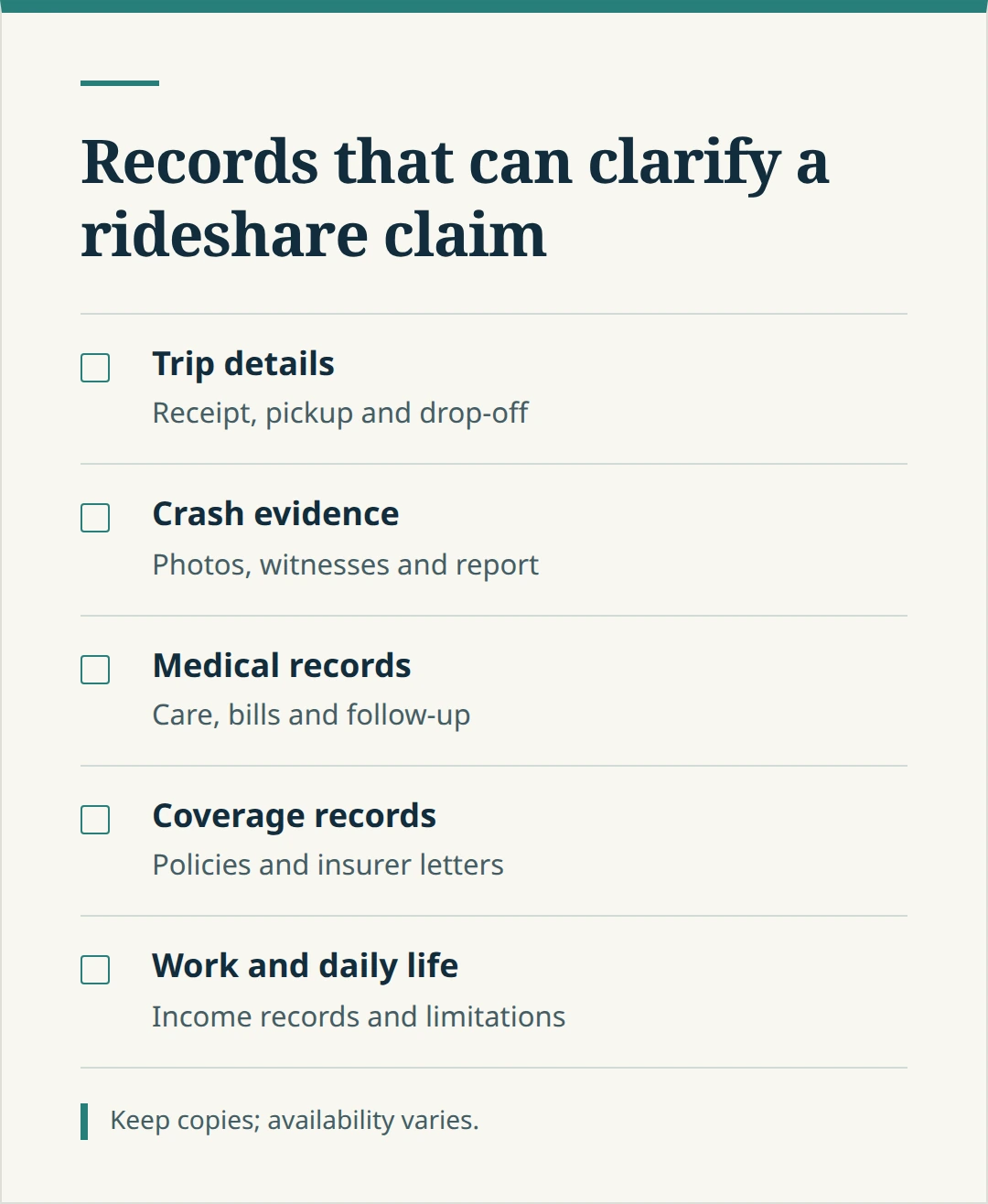
Evidence can connect a person to the ride, explain the crash, and show what happened afterward. Not every item exists in every case. Safety and medical care come before collecting information, and no one needs to enter traffic or private property for a photograph.
Practical evidence checklist
- Scene photographs: If safe, capture vehicle positions, damage, traffic controls, road conditions, and relevant landmarks. Photos taken from a safe location can still be useful.
- Visible injuries: Photographs may show bruising or cuts as they change. They should not delay a medical evaluation or replace treatment records.
- App screens and receipts: Save the available trip screen, receipt, ride status, and driver or vehicle details. Include relevant dates and times as displayed, without altering the image.
- Reports and claim messages: Keep the crash report number, the agency name, and copies of reports to Uber or Lyft. Save claim acknowledgments and correspondence separately.
- Witness information: If someone is willing, note their name and preferred contact details. Record what they personally observed, without suggesting an answer.
- Travel receipts: Keep receipts for rides, parking, or other travel connected to care. A short note can link each expense to an appointment.
- Provider list: Record the names of hospitals, clinics, therapists, and other providers involved in care. Include referrals and follow-up locations when known.
- Lost-income records: Preserve work schedules, pay statements, leave records, and business documents. Note which missed work relates to the injury or treatment.
Trip records and company-held information
A rider’s receipt can help identify the trip, but it may not contain every event around the crash. Uber explains how riders can view trip details and receipts. Lyft describes its ride history and receipt export.
Screenshots may show different information from an emailed receipt. Save the original files where possible, including any details about the ride’s status. An incomplete or canceled trip may appear differently, and a passenger may not control the account used to request it.
A company or driver may hold additional records, such as trip logs or dash-camera footage. Their existence and availability vary. A rider’s screenshot is not a substitute for the company’s underlying data, and access should not be assumed.
Reports, witnesses, and conflicting accounts
The Florida Department of Highway Safety and Motor Vehicles provides a portal for requesting available crash reports. The agency also explains access requirements. For a local example, see this guide to getting a Jacksonville car accident police report.
A report can help identify the involved people and vehicles. It may also contain observations or statements that need context. If something appears wrong, note the issue and ask the agency about its process rather than changing the document.
Witnesses can describe what they saw before or after impact. Their contact information matters because an insurer or lawyer may want to follow up. A witness who saw the aftermath may still be useful, even without seeing the collision itself.
Preserve what exists and protect private information
Video, app data, and electronic messages may not remain available indefinitely. A nearby business or the rideshare company may control relevant records, so a request to preserve them may be worth discussing with a lawyer. Preservation does not ensure that a record exists or that it will be released.
Keep originals and unedited copies where possible. Avoid cropping away timestamps or other context from the only saved image. If a file is forwarded, retain the original message or attachment as well.
Crash reports and medical records can contain addresses, identifying numbers, and sensitive health details. Share them through appropriate channels with people who need the information. A broad request for records or account access can raise privacy questions; a lawyer can help assess its scope before information is shared.
Hypothetical: A pedestrian remembers a storefront camera near a collision involving a rideshare vehicle. The pedestrian can note the location without entering the property or approaching traffic. A preservation request may then be explored, although the camera may not have captured the crash.
How a Florida rideshare claim can move toward resolution
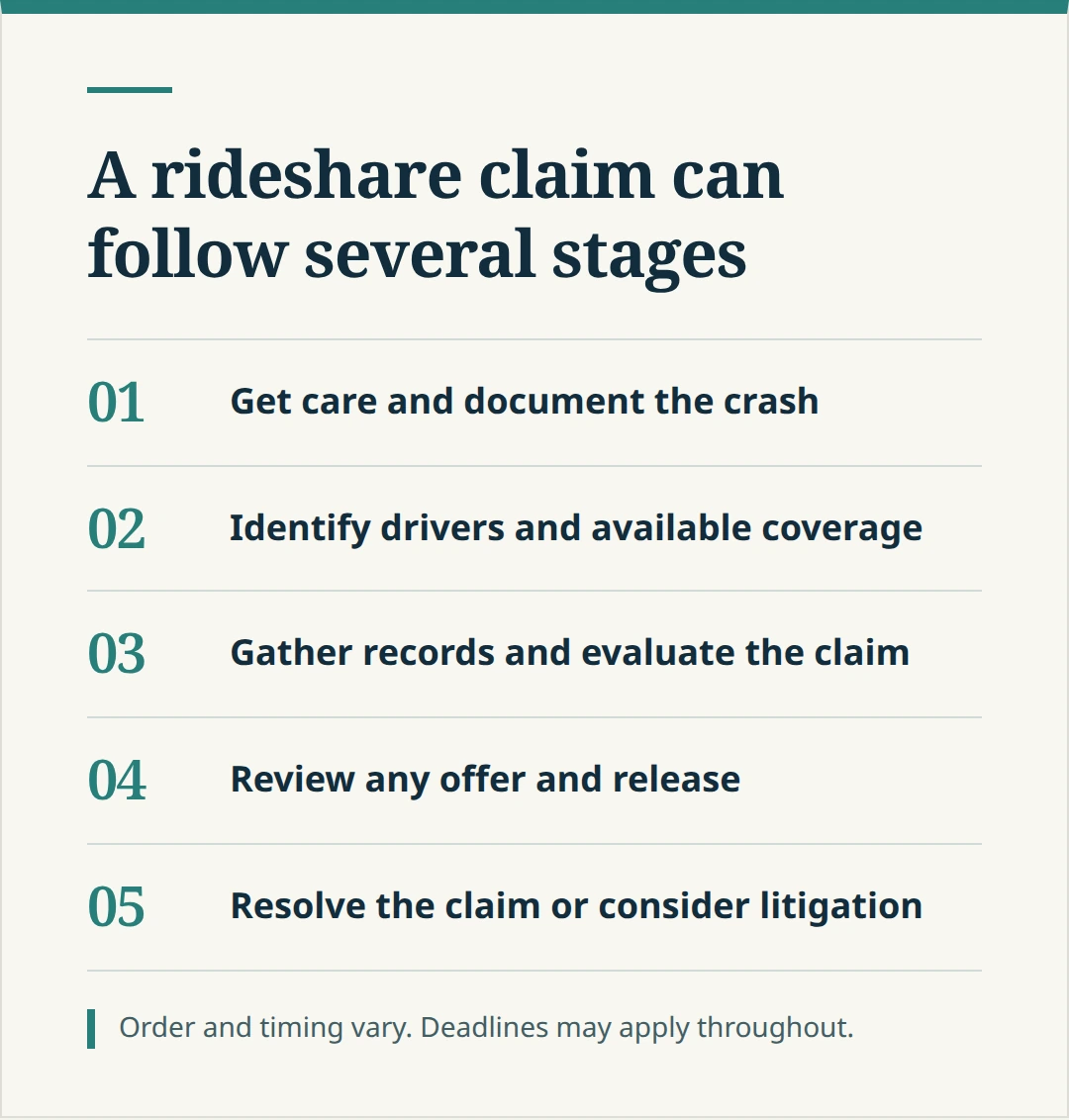
A rideshare claim does not always follow a fixed path. Reporting, medical care, and investigation may overlap, and the parties may settle at different points. If they cannot agree, a lawsuit or mediation may become part of the process.
Reporting the crash and opening a claim
A person may report the crash to the rideshare company and provide basic information to an insurer handling a claim. The appropriate contacts depend on the people and vehicles involved. A report to an app is not the same as an acceptance of responsibility or an agreement to pay.
The person reporting may have a trip receipt, a crash report number, or photographs. If some information is missing, that can be noted rather than guessed. The insurer may assign a claim number and identify an adjuster as a contact.
Investigation and requests for information
An adjuster typically gathers information and evaluates the claim for the insurer. That may include reviewing the crash report, speaking with involved people, and requesting medical or income records. The adjuster may also seek information from the rideshare company or other sources.
The parties can disagree about how the collision happened or which symptoms it caused. An early record may be incomplete, and a later medical opinion may change the discussion. Neither a request for documents nor an ongoing investigation means the insurer has accepted the claim.
Preparing a demand and reviewing an offer
A demand is a request to resolve a claim on proposed terms. It may summarize the crash, treatment, losses, and supporting records. A demand can also explain future needs when there is evidence to support them.
The adjuster may respond with an offer, ask for more information, or dispute part of the claim. An offer reflects the insurer’s assessment; it is not a neutral finding of the claim’s value. The parties may exchange further information and discuss a counteroffer, but agreement is not assured.
A useful review looks beyond the proposed payment. It considers the strength of the evidence, the remaining medical uncertainty, and any expenses or repayment claims. It also considers what rights the written agreement would resolve.
Negotiation when important facts are uncertain
Some uncertainty can be narrowed with records or a professional opinion. Other questions may remain contested even after investigation. Waiting for more information can clarify a claim, but it can also postpone resolution; there is no single sequence that fits everyone.
Hypothetical: An Uber passenger has returned to work but still reports headaches. The adjuster questions whether all symptoms relate to the crash. Further medical records may inform the discussion, but they do not predetermine either side’s decision.
An injured person may discuss options with a Florida lawyer before responding to an offer. Counsel can explain how the facts, documents, and proposed terms fit together. The choice to accept an agreement remains an important individual decision.
The release and settlement terms
A release is a written agreement identifying claims that the signer gives up as part of a settlement. Its scope depends on its language. It may identify the people or entities released and describe which claims are resolved.
The document may also address payment, confidentiality, or other obligations. A person should understand whether the agreement covers only particular claims or has broader wording. Settling a claim may prevent a later request for more money for the claims released, even if recovery takes an unexpected turn.
If anything is unclear, the terms can be reviewed with a lawyer before signing. A verbal discussion about an offer is not a substitute for understanding the final document. Keep a copy of the signed agreement and related settlement correspondence.
Settlement funds, bills, and possible repayment
The gross settlement is the amount agreed upon before applicable deductions or payments. Net proceeds are what remains for the injured person after those items are addressed. A written breakdown helps make the difference visible.
Depending on the circumstances, the breakdown may include agreed attorney fees, case costs, and outstanding medical bills. A medical provider may assert a lien or another claim to payment. A health insurer or government health program may also seek reimbursement for related care, depending on the applicable circumstances.
A bill, a lien, and a reimbursement request are not automatically the same thing. Their validity and amount may need review, and some may be disputed or negotiated. The Florida Bar discusses circumstances in which disputed funds are held while a claim is addressed.
If a lawyer receives settlement funds, disbursement may follow review of the applicable payments and closing documents. The person can ask for an itemized explanation of deductions and any funds held pending a dispute. The final proceeds may differ from an earlier estimate.
Litigation, mediation, and confidentiality
If negotiations do not resolve the claim, a lawsuit may be considered. Filing does not rule out a later settlement. The parties may exchange information through the court process and continue discussing resolution.
Mediation offers another setting for discussion. A neutral mediator helps the parties communicate but does not decide the outcome for them. The parties may reach a complete agreement, a partial agreement, or no agreement at mediation.
Privacy should not be assumed from the word “settlement.” The Florida courts explain that mediation discussions generally have confidentiality protections subject to exceptions. A signed mediated agreement is not automatically confidential; the agreement’s terms and applicable law matter.
A proposed confidentiality clause may limit what a person can share about a resolution. Court filings may present separate privacy questions. Anyone concerned about those terms can discuss them with a lawyer before agreeing.
Frequently asked questions about Florida Uber and Lyft settlements
Is there an average Uber or Lyft accident settlement in Florida?
There is no reliable amount that applies to every claim. Injuries, evidence, fault, available insurance, and other claimants can differ widely. A published result in another matter does not predict what will happen in yours. An evaluation requires the particular records and policy information.
Does a rideshare passenger automatically receive a settlement?
No. Being a passenger does not automatically establish another person’s legal responsibility or require an insurer to pay a settlement. The facts, injuries, available coverage, and any defenses matter. More than one insurer may need to be identified before the issues are clear.
Does the rideshare company’s insurance pay the passenger directly?
Not necessarily. A platform may maintain coverage, but a claim is generally handled under the applicable policy and insurer’s process. Other coverage may also be relevant. A trip receipt does not by itself establish the insurer, coverage, fault, or the value of a claim.
What if another driver caused the crash?
The other driver’s conduct and insurance may be important. The rideshare driver’s conduct and any other applicable coverage may also need review. Investigators can compare vehicle positions, witness accounts, video, and the crash report. Coverage depends on the facts and the policies, not just which car the injured person occupied.
What if the Uber or Lyft driver caused the crash?
The driver’s app status, the trip records, and the relevant policies help identify possible coverage. The evidence must also address how the crash happened. A platform’s insurance and the platform’s own legal responsibility are separate questions. Neither the existence of an app nor a trip alone establishes liability.
Does a policy limit mean the injured person receives that amount?
No. A policy limit is a coverage ceiling subject to policy terms, not a promised payment. A claim can be disputed, and several injured people may seek payment under the same occurrence limit. The value of a claim and the amount available under a policy are different questions.
What happens if the driver was waiting for a ride request?
Florida’s rideshare statute addresses coverage while a driver is logged in and available but has not accepted a ride. That phase is different from an accepted trip. The applicable insurer, actual policy language, and proof of the driver’s status still matter. See Florida Statutes section 627.748.
Can I bring a claim if I was walking or cycling?
A pedestrian or cyclist may have a claim, depending on the facts. The investigation may consider the driver’s conduct, the injured person’s conduct, and applicable insurance. Witnesses, photos, and vehicle information can help establish the circumstances. A trip receipt is not required for someone who was not a passenger.
Can I pursue a claim if I was partly at fault?
Possibly. Florida’s comparative-fault rules may reduce damages and can bar recovery in some negligence actions when a claimant’s share of fault exceeds the statutory threshold. The rule and its exceptions depend on the claim and timing. Florida Statutes section 768.81 contains the applicable framework.
How long does a Florida rideshare accident claim take?
There is no fixed settlement schedule for every claim. The time can depend on treatment, the evidence, coverage questions, competing claims, and negotiations. A lawsuit can add other steps. Separate legal deadlines can apply while negotiations continue, so an ongoing claim does not necessarily preserve every right.
What is the deadline for a Florida rideshare accident lawsuit?
The applicable deadline depends on the type of claim, when it accrued, and any relevant exceptions. Changes to Florida law also make timing important. The deadline for a personal injury claim should not be assumed to control every other claim. See the firm’s discussion of the Florida car accident statute of limitations and the official Florida limitations statute.
Can I seek payment for treatment after a settlement?
A release can resolve specified claims, including claims for injuries that continue after payment. Its wording matters. Before accepting an offer, a person can ask what future care is anticipated, which claims the release covers, and whether any unpaid bills or reimbursement obligations remain. Future payment is not automatic.
Can a preexisting injury affect a claim?
Yes. A prior condition can complicate the medical evidence, but it does not by itself resolve whether a crash caused a new injury or worsened an existing one. Records from before and after the collision, along with a treating professional’s assessment, may help clarify the issue.
Will my personal injury protection coverage apply?
It may, but eligibility and the order of coverage depend on the person, the vehicle, the policies, and Florida law. Personal injury protection is not a substitute for investigating every other possible source of coverage. The official Florida PIP statute describes important conditions and limits.
What if the driver has no insurance or too little insurance?
Other coverage may be available, but it is not automatic. Uninsured or underinsured motorist protection depends on the relevant policy, applicable law, and the facts. The driver’s rideshare status can also affect the coverage inquiry. Reviewing the actual policies is important before assuming a particular benefit applies.
What if an insurance company denies the claim?
A denial is not necessarily the end of the inquiry. The reason may involve disputed fault, app status, policy language, medical evidence, or another issue. The written denial and supporting records can help identify the dispute. An attorney can review the explanation and discuss whether other evidence or coverage merits examination.
How can I find out whether the driver was logged on?
In a claims coverage investigation, Florida law requires the platform to provide specified log-on and log-off times on request by a directly involved party or the driver’s insurer. See section 627.748. Other records may still be needed to establish when a ride was accepted or ended.
What if several people were hurt in the same crash?
Each person’s injuries and claim can be different. At the same time, multiple claims can involve a shared policy limit. That can affect the coverage available to resolve all claims. The applicable policy, other insurance, and the facts determine how the situation is handled.
Is a settlement the same as a court verdict?
No. A settlement is an agreement to resolve specified claims. A verdict is a decision reached through a court proceeding. Either can involve additional steps, and neither outcome is certain. A reported verdict in an unrelated case should not be treated as a settlement prediction.
Is a Florida rideshare accident settlement taxable?
Federal tax treatment depends on what a payment is intended to replace and the facts of the claim. The IRS explains that compensatory damages received on account of a physical injury are generally excluded from gross income, including qualifying lost wages. Punitive damages generally are not excluded. A tax professional can assess the particular settlement.
Can I talk to an attorney before responding to an offer?
Yes. A person can discuss the offer, release, medical records, available coverage, and possible reimbursement obligations with an attorney. The firm can explain the questions raised by the available information. A conversation does not mean that a claim will settle or that a particular amount will be paid.
Discuss a Florida rideshare accident with Pencheff & Fraley
A rideshare crash can leave unanswered questions about care, insurance, and the next step. Pencheff & Fraley can review the circumstances and explain how the available information relates to a potential claim. Bring any trip details, medical records, insurer letters, or report information that are available.
To discuss a specific situation, contact the Pencheff & Fraley team. The firm also provides information about car accident claims and its Florida locations.
This article is intended for general informational purposes only and does not constitute legal advice. Laws change, and the information above may not reflect the most recent legal developments. Please contact the Pencheff & Fraley team to discuss the specific facts of your case.
Written by
Pencheff & Fraley Editorial Team
The firm represents injured people in Ohio and Florida.
Last reviewed: November 11, 2026.