

A sudden fall can change your life in an instant. One moment you are walking through a store or crossing a parking lot, and the next you are on the ground in pain. If you are asking, what do you need to prove in a slip and fall case?, you have come to the right place. Victims across Ohio and Florida face mounting medical bills, lost wages, and emotional distress after these accidents. The path to compensation, however, requires more than just showing you were injured. You must demonstrate that a property owner’s negligence directly caused your fall. This guide breaks down every legal element, the evidence you need, and the strategies that win cases.
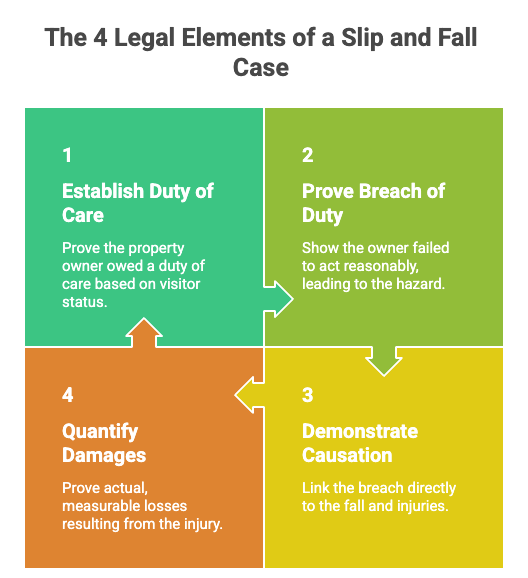
The 4 Legal Elements You Must Prove in a Slip and Fall Case
To succeed in a personal injury claim, you must establish four distinct elements of negligence. Courts in both Ohio and Florida require proof of each element. Missing even one can derail your entire case.
Element 1: Duty of Care
The first element is proving that the property owner owed you a duty of care. This is a legal obligation to maintain reasonably safe conditions for people on the premises. The duty owed depends on your legal status as a visitor.
An invitee is someone invited onto the property for a business purpose, such as a customer in a grocery store. Property owners owe invitees the highest level of care. They must regularly inspect the premises, fix known hazards, and warn visitors of dangers. A licensee is a social guest, such as someone visiting a friend’s home. Owners owe licensees a reasonable duty to warn of known dangers. A trespasser generally receives the least protection, though exceptions exist, particularly for children near attractive nuisances like swimming pools.
Establishing your visitor status is the foundation of your case. Your attorney will use this classification to define the exact standard of care the owner owed you.
Element 2: Breach of Duty
Once you establish the duty of care, you must show it was breached. A breach occurs when the property owner fails to act as a reasonable person would under similar circumstances. This can mean failing to clean up a spill, ignoring a broken handrail, or not placing warning signs near a wet floor.
Breach of duty can be shown in three ways. Actual knowledge means the owner was directly aware of the hazard. For example, an employee reported a leaking pipe but management ignored it. Constructive knowledge means the hazard existed long enough that the owner should have discovered it through reasonable inspection. A pothole in a parking lot that has been there for months is a classic example. Failure to inspect means the owner did not conduct regular safety checks, which is itself a form of negligence.
Element 3: Causation
Proving causation means showing a direct link between the breach of duty and your injury. It is not enough to prove the hazard existed. You must demonstrate that this specific hazard caused your specific fall and injuries. This is where strong evidence becomes critical.
For example, if you slipped on a wet floor and the store had no “wet floor” sign posted, causation is relatively clear. However, if the defense argues you tripped over your own feet, your attorney must use evidence to refute that claim. Medical records, surveillance footage, and witness statements all work together to establish this essential link.
Element 4: Damages
Finally, you must prove you suffered actual, measurable damages. A fall without injury does not support a lawsuit. Damages in slip and fall cases typically fall into two categories.
Economic damages are quantifiable financial losses. They include medical bills, future medical expenses, lost wages, and reduced earning capacity. Non-economic damages are harder to quantify but equally real. They include pain and suffering, emotional distress, and loss of enjoyment of life. In severe cases involving permanent disability, damages can be substantial. Keeping thorough records of every expense and every way the injury has affected your life is essential for maximizing your recovery.
What Evidence Do You Need for a Slip and Fall Case?
Strong evidence is the backbone of every successful premises liability claim. According to the National Safety Council, falls to the same level resulted in over 400,000 injuries in a single recent year. Furthermore, slips, trips, and falls represent a major portion of workplace and home accidents. OSHA statistics also highlight the severity of these incidents, and general slip and fall statistics show they are a leading cause of accidental injuries and significant settlements. With so many accidents occurring, insurance companies are experienced at defending these claims. You need compelling proof to overcome their tactics.
Photographs and Video Evidence
Visual evidence is among the most powerful tools in a slip and fall case. Immediately after your fall, photograph the exact location where you fell. Capture the hazard that caused it, the surrounding area, any missing or inadequate warning signs, and the lighting conditions. Take wide shots and close-ups from multiple angles.
Surveillance footage is equally valuable. Many stores and commercial properties have security cameras running continuously. Your attorney can send a formal legal preservation letter to the property owner demanding they preserve this footage. Once deleted, it is gone forever. Acting quickly to secure this evidence can make or break your case.
Witness Statements
Eyewitnesses provide objective, third-party accounts of what happened. If anyone saw your fall, collect their names and contact information immediately. Witnesses can confirm the hazard existed, that no warning signs were present, and that you did not act carelessly. Their testimony can directly counter a defense claim of comparative negligence.
Additionally, if employees or managers were present, their statements can reveal whether the owner had prior knowledge of the dangerous condition. A store employee who admits the floor had been wet for an hour is powerful evidence of constructive knowledge.
Incident Reports
Always file an official incident report with the property owner or manager before you leave. Request a copy for your records. An incident report creates an immediate, contemporaneous record of the accident. It documents the time, location, and circumstances of your fall. If the property owner later claims the accident never happened or the details were different, this report is your proof.
Medical Records and Documentation
Seek medical attention immediately, even if your injuries seem minor. Some injuries, including traumatic brain injuries and internal bleeding, may not present obvious symptoms right away. A medical evaluation creates a formal record linking your injuries to the fall.
Keep every piece of medical documentation. This includes emergency room records, doctor’s notes, imaging results, physical therapy records, and prescription receipts. These documents establish the nature and extent of your injuries. They are also used to calculate the full value of your economic damages.
Maintenance and Inspection Records
Property owners are required to conduct regular safety inspections. Requesting their maintenance logs and inspection records can reveal a pattern of neglect. If records show the hazard was reported multiple times but never fixed, this is powerful evidence of a breach of duty. Your attorney can obtain these records through the legal discovery process if the owner refuses to provide them voluntarily.
Expert Testimony
In complex cases, expert witnesses can be decisive. A safety engineer can testify that the property failed to meet industry safety standards. A medical expert can explain the severity of your injuries and their long-term impact. An economist can calculate your future lost earning capacity. These professionals translate technical information into terms a judge or jury can understand.
Slip and Fall Laws in Ohio and Florida
Premises liability laws have important state-specific nuances. Whether you were injured in Columbus, Jacksonville, Tampa, or Orlando, knowing the local rules is essential.
Ohio Premises Liability and Negligence Law
Ohio follows a modified comparative negligence standard. This means you can recover compensation as long as you are found to be less than 50% at fault for the accident. However, your damages will be reduced by your percentage of fault. If you are 20% responsible, you receive 80% of the total damages.
Ohio law also recognizes the “open and obvious” doctrine. If a hazard was clearly visible and any reasonable person would have avoided it, the property owner may not be liable. However, this doctrine has exceptions. If the owner should have anticipated that a visitor might be distracted or unable to avoid the hazard, liability can still attach.
Understanding how to start a personal injury claim in Ohio and the overview of Ohio premises liability law is the critical first step. The statute of limitations in Ohio for personal injury claims is generally two years from the date of the injury. Missing this deadline permanently bars you from seeking compensation.
Florida Premises Liability and Negligence Law
Florida updated its comparative negligence law in 2023. Under the new rule, you cannot recover any damages if you are found to be more than 50% at fault. This makes it even more important to have a skilled attorney who can minimize any attribution of fault to you.
Florida also has specific requirements for proving a property owner’s knowledge of the hazard. In commercial cases, you must show the owner had actual or constructive knowledge of the dangerous condition. Constructive knowledge can be established by showing the condition existed for a sufficient length of time that the owner should have discovered it.
The statute of limitations in Florida for premises liability claims is two years from the date of the accident. This deadline was shortened from four years in 2023. If you were injured in Florida, acting quickly is more important than ever.
Common Defenses in Slip and Fall Cases
Property owners and their insurance companies use several standard defenses to reduce or eliminate their liability. Knowing these defenses in advance allows your attorney to prepare strong counterarguments.
Comparative Negligence
The most frequently used defense is comparative negligence. The defense will argue that you contributed to your own fall. They may claim you were distracted by your phone, wearing inappropriate footwear, or ignoring warning signs. Your attorney will counter by demonstrating that the hazard was the primary cause of your fall and that you acted as a reasonable person would.
The Open and Obvious Doctrine
As discussed above, property owners may argue the hazard was open and obvious. To overcome this, your attorney will show that the hazard was not as apparent as the defense claims, or that you were reasonably distracted by the circumstances of the environment.
Lack of Notice
A property owner may claim they had no knowledge of the hazardous condition. Countering this defense requires showing either that the owner was directly informed of the hazard, or that the condition existed for so long that they should have discovered it through reasonable inspection. Maintenance records, prior complaints, and witness testimony are all valuable here.
Assumption of Risk
In some cases, the defense may argue you voluntarily assumed the risk of injury. This defense is more common in recreational settings. Your attorney will argue that you did not knowingly accept the specific risk that caused your injury.
What to Do Immediately After a Slip and Fall Accident
The actions you take in the hours and days after a fall can significantly impact your case. Follow these steps to protect your rights.
Step 1: Seek Medical Attention Right Away
Your health is the top priority. Call 911 or go to an emergency room immediately. Even if you feel okay, get a full evaluation. Some injuries take time to manifest. A medical record created on the day of the accident is far more credible than one created weeks later.
Step 2: Document the Scene
Before leaving, photograph everything. Capture the hazard, the location, the lighting, and any warning signs or lack thereof. If you cannot do this yourself, ask a bystander to help. This evidence is time-sensitive and may disappear quickly.
Step 3: Report the Accident
Notify the property owner, manager, or security personnel. File a formal incident report and request a copy. Do not leave without this documentation.
Step 4: Collect Witness Information
Get the names and phone numbers of anyone who witnessed the fall or was present at the scene. Their accounts could prove invaluable later.
Step 5: Avoid Social Media
Do not post about your accident or injuries on any social media platform. Insurance companies actively monitor social media. A single post can be used to undermine your claim. Learn more about the reasons why you shouldn’t post on social media after an injury.
Step 6: Contact a Personal Injury Attorney
Consult with an experienced attorney as soon as possible. They can preserve critical evidence, handle communications with the insurance company, and guide you through the legal process. If you are wondering about the cost to hire a personal injury lawyer, most personal injury attorneys work on a contingency fee basis. You pay nothing unless they win your case.
How Much Is a Slip and Fall Case Worth?
The value of a slip and fall case depends on several factors. There is no universal average settlement. Each case is unique.
The severity of your injuries is the most significant factor. A broken hip requiring surgery and months of rehabilitation will yield a much higher settlement than a minor sprain. The strength of your evidence also matters enormously. Cases with clear surveillance footage and strong witness testimony settle for more. The degree of the property owner’s negligence and your percentage of fault also influence the final number.
If you are wondering whether it is worth making a personal injury claim, the answer is almost always yes. Even seemingly minor injuries can have long-term consequences. A free consultation with a personal injury attorney will help you understand the realistic value of your specific case.
Why Choose Pencheff and Fraley for Your Slip and Fall Case
At Pencheff and Fraley, we have spent years fighting for injury victims across Ohio and Florida. We understand the physical, emotional, and financial toll a slip and fall accident takes on you and your family. Our attorneys handle every aspect of your case, from gathering evidence to negotiating with insurance companies to taking your case to trial if necessary.
We serve clients in Westerville, Mansfield, Jacksonville, Tampa, Orlando, and throughout both states. We work on a contingency fee basis, meaning you pay nothing unless we win. Our track record includes millions recovered for our clients.
If you have questions about your rights, visit our personal injury FAQs page or contact us today for a free, no-obligation consultation. You deserve an advocate who will fight for every dollar you are owed.
Frequently Asked Questions
What do you need to prove in a slip and fall case?
You must prove four legal elements: duty of care (the property owner had a legal obligation to keep the premises safe), breach of duty (the owner failed to meet that obligation), causation (the breach directly caused your fall and injuries), and damages (you suffered measurable harm as a result). All four elements must be established to win your case.
How long do you have to file a slip and fall lawsuit in Ohio or Florida?
In both Ohio and Florida, the statute of limitations for personal injury claims is generally two years from the date of the accident. Missing this deadline will almost certainly bar you from recovering any compensation. Contact an attorney as soon as possible to ensure your claim is filed on time.
What evidence is most important in a slip and fall case?
The most critical evidence includes photographs and video footage of the scene, surveillance camera recordings, witness statements, the official incident report, and your medical records. Maintenance logs and prior complaints about the hazard can also be decisive in establishing the property owner’s knowledge and negligence.
Can I still recover compensation if I was partially at fault?
Yes, in most cases. Both Ohio and Florida follow modified comparative negligence rules. You can recover damages as long as you are found to be 50% or less at fault. However, your compensation will be reduced by your percentage of fault. For example, if you are 20% at fault and your damages total $100,000, you would recover $80,000.
What if the property owner says the hazard was obvious?
The “open and obvious” defense is common but not absolute. Your attorney can counter it by showing that you acted reasonably, that you were distracted by the environment in a foreseeable way, or that the owner should have anticipated that visitors might not notice the hazard. This defense does not automatically eliminate liability.
How much does it cost to hire a slip and fall attorney?
At Pencheff and Fraley, we work on a contingency fee basis. This means there are no upfront costs and no fees unless we win your case. The cost of quality legal representation should never be a barrier to justice.
Call us at 904-770-4953 or visit our website at www.pencheffandfraley.com to schedule your free case consultation.
We’re Here for You 24/7
We are available 24/7 to take your call. If you are unable to travel, we will come to you. The sooner you call, the stronger your case can be. Your path to maximum compensation and justice starts with a single phone call to Pencheff & Fraley.
Author: Pencheff and Fraley Legal Team
Disclaimer: This article is for informational purposes only and does not constitute legal advice. Every case is unique, and you should consult with a qualified attorney about your specific situation.