

Can You Claim Compensation for Trauma After Sexual Assault?
Content note: This page discusses sexual assault, trauma, and legal options. If you are in immediate danger, call 911. If you want confidential survivor support before making any legal decision, the RAINN National Sexual Assault Hotline is available 24/7.
Ohio legal information, updated September 30, 2026. This article is general education, not legal or medical advice. A deadline, claim, or potential defendant can depend on facts that a webpage cannot evaluate.
Can you claim compensation for trauma after sexual assault? In Ohio, a civil claim may be possible in some situations. The facts, available evidence, legal duties, and filing deadlines all matter. A civil case may examine the harm you experienced and whether an individual or another responsible party can be held legally accountable.
Trauma is real, even when it is not visible. The U.S. Department of Veterans Affairs explains that survivors can experience a range of emotional, behavioral, and physical effects after sexual assault. There is no “right” reaction and no requirement to have a specific diagnosis before seeking support or asking about legal options.
Can You Claim Compensation for Trauma After Sexual Assault?
A claim for compensation may be available when the facts support a civil cause of action. In Ohio, Ohio Revised Code § 2307.60 provides that a person injured by a criminal act may recover full damages in a civil action unless another law limits that recovery.
That statute does not decide any individual case. A legal review may consider who caused the harm, whether another person or organization had a relevant legal duty, what losses can be documented, and which deadline applies. A careful attorney should also explain potential obstacles before suggesting any path forward.
The core question is not only whether harm occurred. It is also whether there is a viable civil claim against a legally responsible person or entity. That is why a survivor-focused consultation should begin with listening and clear information, not promises.
Start With Your Well-Being and Your Choices
You do not have to make every decision at once. Safety, medical care, counseling, advocacy support, reporting, a criminal process, a civil consultation, and a compensation-program application are different options. One option does not automatically require the others.
If you want support without speaking to a law firm, RAINN offers confidential help, local referrals, and information about legal and medical resources through its National Sexual Assault Hotline. Its trained support specialists can help a survivor think through next steps at their own pace.
Ohio also has a separate public resource. The Ohio Attorney General’s Victims Compensation program says financial assistance may be available to qualifying innocent victims of violent crime for expenses such as medical or counseling bills and work loss. That program is not the same as a civil lawsuit.
Civil Claim, Criminal Case, and Victim Compensation: What Is the Difference?
These paths may overlap, but they serve different purposes. A survivor may want to ask an attorney or advocate how they fit together in a specific situation.
| Path | Main purpose | Who generally starts or manages it | Possible result |
| Criminal case | Enforce criminal law | Public law-enforcement and prosecution system | Criminal penalties if charges are proven |
| Civil claim | Seek damages for legally recognized harm | The person bringing the civil claim | A settlement or court judgment, if legal responsibility is established |
| Ohio victim compensation | Help eligible crime victims with certain covered costs | Application through the state program | Reimbursement or assistance for eligible expenses, subject to program rules |
A civil case can be complex, even when a criminal investigation exists. A qualifying criminal judgment may have an evidentiary effect in a later civil proceeding under Ohio Revised Code § 2307.60. That does not mean a webpage can predict what will happen in either process.
What Trauma-Related Compensation May Include
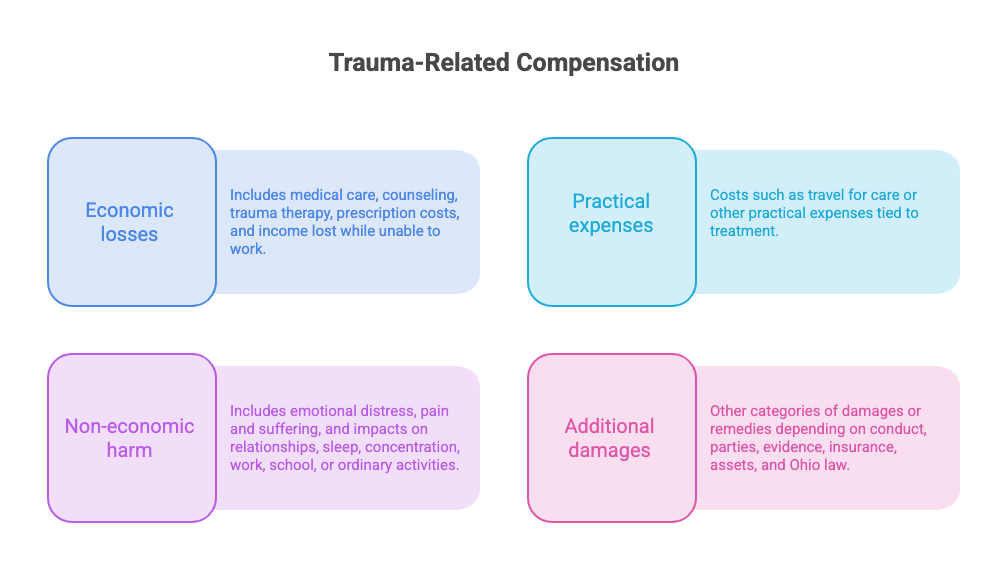
When a civil claim is viable, an attorney may evaluate the full impact of the harm rather than looking only at one bill or one moment in time. The categories below are examples, not a promise that any particular item will be recovered.
Treatment, income, and other financial losses
Potential economic losses can include medical care, counseling or trauma therapy, prescription costs, and income lost while a person could not work. Future treatment needs or reduced earning capacity may also require careful evidence. Documentation can help, but a person should never delay needed care to “build a case.”
A survivor may also have costs that are easier to overlook, such as travel for care or practical expenses tied to treatment. Whether a specific expense is legally recoverable depends on the claim and proof. An attorney can explain what records may be helpful without treating them as prerequisites.
Emotional harm and changes to daily life
The law may recognize non-economic harm in appropriate cases. This can include emotional distress, pain and suffering, and the ways trauma affects relationships, sleep, concentration, work, school, or ordinary activities. These harms are personal. They should not be reduced to a formula or a promised dollar amount.
The VA’s clinical overview of adult sexual assault notes that survivors can experience reactions such as anxiety, numbness, sleep problems, depression, and post-traumatic stress symptoms. A lawyer does not diagnose these conditions. Health professionals provide care, while legal counsel may explain how documented harm can relate to a civil claim.
Other damages in the right circumstances
Some cases may involve additional categories of damages or remedies. Those questions can turn on the conduct, the parties, the available evidence, insurance or assets, and Ohio law. It is important to be wary of anyone who promises a settlement value before understanding the facts.
Who Could Be Responsible in a Civil Case?
The person alleged to have committed an assault may be one focus of a civil case. In some fact patterns, a legal review may also examine whether another party had a duty connected to the harm. That could involve a business, property owner, employer, school, residential setting, organization, or professional relationship.
Claims involving another organization or property
A third-party claim is never automatic. The key questions may include what the organization knew or should have known, what control it had, what safety responsibilities applied, and whether its actions or inaction legally contributed to the harm. Each category has different rules and evidence issues.
For example, a property-security concern is not enough by itself to establish liability. The facts, the relationship between the parties, prior information, and applicable law all matter. An attorney should identify both the possible theory and the legal limits before advising that a claim exists.
A short illustrative example
Illustrative example—not a real case: A person may be harmed at a venue. A lawyer could ask whether the venue had notice of a foreseeable risk and what safety measures it controlled. The venue’s location alone would not establish liability.
Why a fact-specific investigation matters
A civil case may require records, witness information, policies, communications, or other evidence that is no longer easy to find as time passes. Early legal advice can help a person understand preservation issues. It should not pressure anyone to make a report, contact an alleged perpetrator, or share sensitive details through an online form.
Why Timing Matters in Ohio Sexual Assault Claims
Deadlines can be difficult because the correct period may depend on the claim, the person or entity involved, a survivor’s age at the time of harm, when relevant facts became known, and changes in the law. The safest step is to ask for an individualized review as soon as you are ready.
Ohio Revised Code § 2305.111 states a general one-year period for an assault or battery action in division (B). It also contains a separate framework for qualifying childhood sexual-abuse claims in division (C). A specialized provision, Ohio Revised Code § 2305.115, applies to certain sexual-conduct claims involving a mental-health professional and a patient.
These provisions show why there is no safe universal answer online. A person should not assume that a familiar personal-injury deadline applies to a sexual-assault matter. For a general discussion of why prompt review matters, see Pencheff & Fraley’s guide to time limits that can affect an injury claim.
What Evidence and Records May Help?
A person does not need to collect everything before asking for help. An attorney or advocate can explain what may be useful, how to protect privacy, and what can be obtained later. Survivors should make choices that feel safe for them.
Health, counseling, and work information
Medical records, counseling records, bills, work schedules, wage information, and notes about daily limitations can help show the effects of harm. These documents can be sensitive. Ask before signing broad authorizations or sharing therapy records, and discuss what privacy protections or limits may be available.
Receiving medical or mental-health care is about well-being, not proving a claim. A survivor who has not sought care may still benefit from legal information and support. Conversely, a record alone does not determine whether a lawsuit is viable.
Communications and other documentation
Relevant communications, photographs, incident reports, digital information, or witness details can sometimes matter. If it is safe, preserve original messages and avoid altering files. Do not put yourself at risk to gather evidence or confront another person.
An initial consultation can also address practical questions: who should communicate with insurers or organizations, how to store records privately, and what information is helpful to share first. The goal is to give a survivor more control over the next step.
How to Choose a Personal Injury Lawyer After Sexual Assault
Choosing counsel is personal. A survivor may want a lawyer who explains options in plain language, does not guarantee results, and respects boundaries around sensitive information. Experience in the relevant type of civil claim, clear communication, and a transparent fee agreement are all worth discussing.
It can also help to understand the firm behind the conversation. You can learn about Pencheff & Fraley’s Ohio history before deciding whether to contact the team. Their broader personal injury representation page explains the firm’s general approach and case-evaluation process.
Best accident lawyer questions to ask in a consultation
A first conversation is an opportunity to ask questions, not a commitment to hire anyone. Consider asking:
- Have you handled civil claims involving trauma or sensitive evidence?
- Who would work on my case and communicate with me day to day?
- What facts could affect the claim, the deadline, or the parties involved?
- What information would you need first, and what can wait?
- How do attorney fees, case costs, and expenses work if a case does not succeed?
- How will you protect my privacy and communicate in a way that feels safe?
For a broader interview checklist, read these questions to ask before hiring an accident lawyer in Ohio or Florida. You can also review the firm’s explanation of personal injury lawyer fees and contingency arrangements. The right answer will depend on the fee agreement and the case.
A Survivor-Controlled Next Step
You do not have to decide whether to file a lawsuit before asking a question. A free case evaluation can be a place to learn whether the firm can help, what information is useful, and what deadlines or privacy issues may need attention. You can also ask how the firm handles sensitive communications before sharing details.
If you would like to explore whether Pencheff & Fraley may be able to assist, contact the firm for a free case evaluation. If the firm is not the right fit, a reputable legal team should explain that clearly and help you understand your next options.
Frequently Asked Questions
Can I bring a civil claim if I have not decided whether to report the assault?
A webpage cannot decide that question. Reporting choices, criminal proceedings, and civil options can involve different processes. A survivor can seek support or legal information before deciding what to do next. An attorney can explain how the specific facts, evidence, and Ohio law may affect a civil claim.
Do I need a criminal conviction to ask about a civil claim?
A civil claim and a criminal case have different purposes. Ohio law provides a civil action for damages for injury from a criminal act, and a qualifying criminal judgment can have a later evidentiary effect. A lawyer can explain the significance of any criminal process in the particular situation.
Can compensation include counseling, PTSD, or emotional trauma?
Potential damages may include treatment costs, lost income, and non-economic harm in an appropriate civil claim. There is no automatic amount or required diagnosis. A legal review may consider documented effects, while a health professional can provide any needed care or diagnosis.
How long do I have to take action after sexual assault in Ohio?
The answer depends on the type of claim and other facts. Ohio’s assault-and-battery and childhood-sexual-abuse provisions are different, and some specialized claims have their own rules. Speak with an attorney promptly for an individualized deadline review instead of relying on a general online timeline.
Can a business, employer, school, or property owner be sued?
Possibly, but only in fact-specific circumstances. A legal review may examine whether another party had a relevant duty and whether its conduct legally contributed to the harm. Being connected to an event or location does not automatically make an organization liable.
What should I bring to a first case evaluation?
Bring only what feels safe and available. Helpful items can include a brief timeline, existing records, communications, bills, or questions you want answered. You do not need every document before speaking with counsel, and you can ask about privacy before sharing sensitive materials.
How much does it cost to speak with a personal injury lawyer?
Pencheff & Fraley advertises free case evaluations for its personal-injury services. Before hiring any lawyer, ask about the written fee agreement, litigation costs, and how expenses are handled. A free conversation does not guarantee that a firm will accept a case or that a recovery will result.
References and Support Resources
- Ohio Revised Code § 2307.60 — Civil action for damages for criminal act
- Ohio Revised Code § 2305.111 — Assault or battery actions; childhood sexual abuse
- Ohio Revised Code § 2305.115 — Specified mental-health-professional sexual-conduct claims
- Ohio Attorney General — Apply for Victims Compensation
- S. Department of Veterans Affairs — Sexual Assault Experienced as an Adult
- RAINN National Sexual Assault Hotline
Disclaimer: This article provides general information and does not create an attorney-client relationship. Florida law, insurance policies, deadlines, and reporting procedures can change or depend on the facts. Talk with a qualified Florida attorney about your situation.
