

An Ohio and Florida guide to protecting your evidence, deadlines, and settlement rights.
Legal pitfalls to avoid: common mistakes in personal injury claims include delaying care, losing evidence, missing deadlines, and settling too soon. An accident can leave you overwhelmed. Yet decisions made during recovery can affect your ability to prove what happened and document your losses.
The solution is not to fear every conversation or assume one mistake ends your case. Seek appropriate care, preserve accurate records, and understand which rules apply. This guide explains twelve avoidable errors, key Ohio and Florida differences, and how to choose legal help.
Pencheff & Fraley represents injury victims across both states. Its personal injury legal services cover cases that require careful investigation and individualized advice.
Legal information checked October 19, 2026. This article provides general information, not advice about your particular claim.
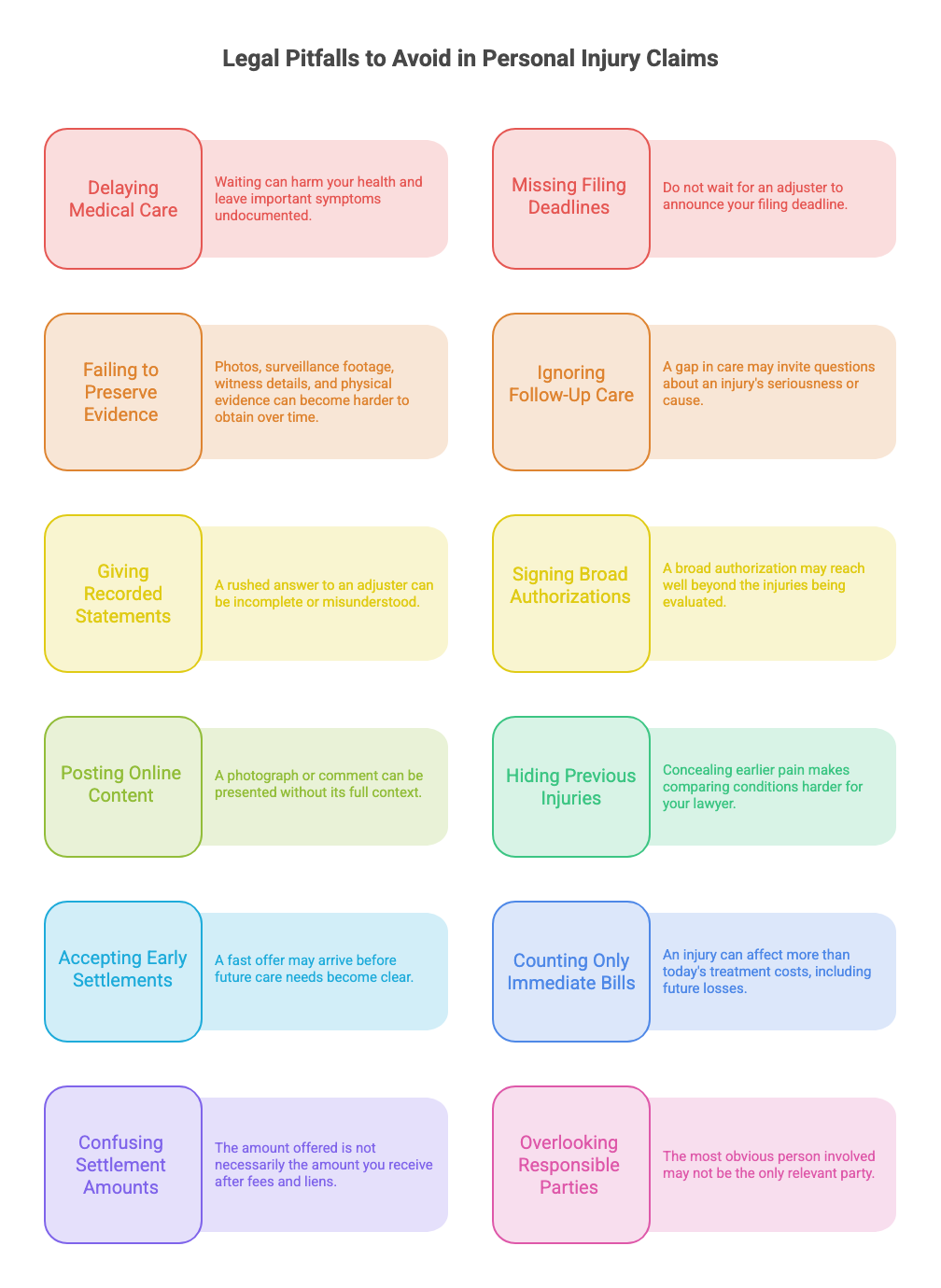
Legal Pitfalls to Avoid: Common Mistakes in Personal Injury Claims
Protect your health first. Then protect your evidence and legal options. Some problems are urgent, including treatment needs and disappearing video. Others arise later, such as signing a release without understanding its scope.
An insurance claim and a lawsuit are different. A claim asks an insurer to pay. A lawsuit seeks relief through a court. Negotiations alone should not be assumed to preserve your right to sue.
1. Delaying Medical Care After an Accident
Waiting can harm your health and leave important symptoms undocumented. Get emergency help for urgent symptoms. Otherwise, arrange appropriate evaluation and explain how the accident happened.
Describe all symptoms honestly, including sleep problems, dizziness, anxiety, and limitations at work. Do not exaggerate injuries or minimize them to seem resilient. Keep discharge instructions and follow-up recommendations.
Florida’s 14-Day PIP Rule
For qualifying Florida auto accidents, Florida Statutes section 627.736 ties PIP medical benefits to initial qualifying care within fourteen days. PIP means personal injury protection. Coverage also depends on statutory and policy requirements.
This is not the deadline for every injury lawsuit. Missing the PIP care window does not automatically eliminate every possible liability claim. The firm’s guide explains what Florida no-fault coverage pays.
When Treatment Is Difficult to Afford
Tell your provider and lawyer about cost, transportation, or scheduling barriers. Ask about appropriate available options. Do not sign a treatment-financing agreement without understanding its repayment terms.
2. Missing the Deadline to File a Personal Injury Lawsuit
Do not wait for an adjuster to announce your filing deadline. The applicable period depends on the claim, governing law, and relevant dates. Special rules can change the calculation.
Ohio Injury Lawsuit Deadlines
Ohio Revised Code section 2305.10 generally gives two years for bodily injury actions after the claim accrues. Ordinary accident claims typically accrue when the injury occurs. Exceptions and different claim categories require separate analysis.
For collision-specific context, see the firm’s Ohio car accident filing deadline guide.
Florida Negligence Lawsuit Deadlines
Current Florida Statutes section 95.11 provides two years for actions founded on negligence. Older accidents may involve different application rules. Do not assume that outdated four-year advice applies to your case.
The firm’s Florida car accident statute of limitations guide provides additional collision-related context.
Cases That Need Separate Deadline Review
Medical malpractice, wrongful death, government defendants, minors, and certain other circumstances need individualized review. Insurance notice requirements may also differ from lawsuit deadlines. Ask for a written deadline assessment early.
3. Failing to Preserve Accident Evidence
Photos, surveillance footage, witness details, and physical evidence can become harder to obtain over time. Collect what you safely can. Never delay medical care or enter an unsafe area for photographs.
Useful evidence may include:
- Wide-angle scene photos and close-ups of relevant hazards or damage.
- Witness names and reliable contact details.
- Crash or incident report information.
- Original videos, messages, receipts, and insurance correspondence.
- Damaged items and photographs of visible injuries.
Ask a lawyer whether preservation requests are needed. A business may routinely overwrite video before anyone requests it.
Hypothetical example: A customer slips beside a leaking cooler. A close-up shows the puddle, but wider photos reveal its location and nearby warning signs. Witnesses and video may help explain how long the condition existed.
See what a slip-and-fall case must show about a property owner’s knowledge. Injury alone does not establish every required element of liability.
4. Ignoring Follow-Up Care or Leaving Treatment Gaps Unexplained
A gap in care may invite questions about an injury’s seriousness or cause. It does not necessarily mean you recovered. Missed appointments may reflect illness, transportation problems, insurance barriers, or another reasonable explanation.
Follow medical advice and tell your provider when treatment is not helping. Ask about alternatives instead of silently stopping care. Record why appointments were missed and when symptoms changed.
A second opinion may be appropriate for unresolved symptoms or treatment concerns. It is not automatically required for every claim. Medical decisions should address your health, not manufacture evidence.
Give your lawyer accurate updates about referrals, restrictions, and recovery. Clear communication helps explain the actual treatment history.
5. Giving a Recorded Statement Without Understanding the Request
An adjuster may ask about the accident, your injuries, and previous medical problems. A rushed answer can be incomplete or misunderstood. Do not guess about speed, distances, diagnoses, or fault.
Identify who is calling and which insurer they represent. Ask whether the interview will be recorded. Request time to review the request with counsel before giving a detailed statement.
Your own insurer is different from the opposing party’s insurer. Your policy may require notice or cooperation. Do not ignore legitimate requests or assume every statement is optional. A lawyer can review the policy and advise how to respond.
Be truthful with police, medical providers, and insurers. Protecting a claim does not mean withholding required information or inventing a better account.
6. Signing Broad Authorizations Without Reviewing Their Scope
An insurer may request medical records or ask you to sign an authorization. Relevant records can be important. But a broad authorization may reach well beyond the injuries being evaluated.
Before signing, ask what information is requested, why it is needed, and which time period it covers. Have counsel review the scope where possible. Keep a copy of the signed document.
Do not assume that all medical history is either irrelevant or automatically off-limits. Discovery obligations and legitimate relevance questions depend on the case. Discuss sensitive information privately with your lawyer.
The goal is accurate, appropriate disclosure—not concealment and not unrestricted access without explanation.
7. Posting About the Accident—or Deleting Relevant Content
A photograph or comment can be presented without its full context. A brief outing does not necessarily prove full recovery. Yet a post may create questions about restrictions or symptoms.
Avoid discussing fault, injuries, settlement demands, or attorney conversations online. Ask friends not to post updates about your case. Privacy settings do not guarantee that relevant material will remain unavailable.
Do not delete, edit, or destroy relevant posts to hide them. Preserve existing content and ask counsel how to handle it. The same caution applies to texts, emails, videos, and app records.
For more context, read why social media can affect an injury claim.
8. Hiding Previous Injuries or Giving Inconsistent Accounts
A previous back problem does not automatically mean a new accident caused no additional harm. The important question is what changed. Your lawyer needs the full history to evaluate that issue.
Explain prior symptoms, treatment, restrictions, and activity levels. Then describe the new symptoms and limitations accurately. Avoid claiming you were symptom-free if records show otherwise.
Keep a factual timeline rather than rehearsing a story. If an earlier statement contains an error, tell your lawyer promptly. Ask how to address it accurately.
Hypothetical example: Someone with occasional back pain develops persistent leg symptoms after a collision. Earlier records and new evaluations may help distinguish the conditions. Concealing the earlier pain makes that comparison harder.
9. Accepting a Settlement Before Understanding the Release
A fast offer may arrive before future care needs become clear. Review the evidence and proposed terms rather than assuming the first offer is fair—or automatically unfair.
A settlement release may permanently resolve the claims it covers. Read which parties, injuries, and losses are being released. Ask whether property damage and bodily injury are addressed separately.
Consider outstanding bills, expected treatment, lost income, insurance limits, and disputed liability. A lawyer should explain both the strengths and risks of continuing the case.
If you face an insurance company offering a low settlement, gather supporting records before responding. Do not sign simply because the adjuster sets a short response window. Seek timely advice about any genuine deadline.
10. Counting Only Immediate Medical Bills
An injury can affect more than today’s treatment costs. Depending on the facts and applicable law, a claim may include lost income, future care, reduced earning ability, and noneconomic harm.
Document the losses rather than relying on a rough estimate. Useful records include bills, receipts, pay statements, work schedules, tax records where relevant, and employer confirmations.
Keep a short factual journal of sleep disruption, pain, mobility limits, and missed activities. Describe psychological symptoms to an appropriate provider. Do not self-diagnose or assume every emotional effect supports the same damages claim.
Future losses need support. Serious cases may require medical, vocational, or economic assessment. The firm’s guide explains how to prove lost wages after an accident.
11. Confusing the Settlement Amount With Your Net Recovery
The amount offered is not necessarily the amount you receive. Attorney fees, case expenses, unpaid bills, and valid reimbursement claims may affect the final distribution.
For example, CMS explains Medicare’s recovery process for conditional payments related to liability, no-fault, and workers’ compensation cases. Medicare repayment issues should not be ignored when resolving a claim.
Other health plans or providers may assert payment rights. Their validity and amount require review. Do not assume every asserted lien is correct or that every lien can be eliminated.
Ask for an estimated settlement breakdown before authorizing an agreement. Review the firm’s personal injury fee information and confirm your own written fee and expense terms.
12. Overlooking Responsible Parties and Available Insurance
The most obvious person involved may not be the only relevant party. A commercial collision may raise questions about the driver, employer, maintenance, or another contributor. Responsibility must be supported by evidence.
Give your lawyer every potentially relevant insurance policy and denial letter. Uninsured or underinsured motorist coverage may require separate review. Do not assume a denial ends every possible route to recovery.
For commercial crashes, the firm’s truck accident legal services explain its investigation focus. Different evidence may be needed than in an ordinary passenger-car collision.
A workplace injury may also raise workers’ compensation and third-party liability questions. Those are distinct pathways with different rules. Ask about both rather than assuming they are interchangeable.
How Comparative Fault Can Affect Ohio and Florida Claims
An insurer’s accusation of fault is not the same as a final legal determination. Still, disputed responsibility can affect a claim’s value. Preserve evidence and avoid unsupported guesses about what caused the accident.
Ohio’s Comparative Fault Rule
Under Ohio Revised Code section 2315.33, a plaintiff’s fault cannot exceed the combined fault of the other responsible persons. Recoverable compensatory damages are reduced proportionally. In the usual percentage allocation, fault above fifty percent bars recovery under this rule.
Florida’s Comparative Fault Rule
Florida Statutes section 768.81 bars recovery above fifty percent fault in negligence actions to which that rule applies. The statute excludes medical negligence actions from that particular bar. Application to older cases requires review.
An Illustrative Damages Calculation
Suppose assessed damages are $100,000 and the injured person is twenty percent at fault. A proportional twenty-percent reduction leaves $80,000 before other adjustments. This illustrates the arithmetic only. It does not predict a settlement, establish liability, or account for insurance limits, fees, or expenses.
How to Choose a Personal Injury Lawyer
Choose based on relevant experience, clear communication, and candid advice—not promises of a guaranteed payout. Ask whether the lawyer handles your claim type and can represent you in the relevant jurisdiction.
The American Bar Association’s guidance on questions to ask a lawyer recommends checking licensing and standing. It also suggests discussing experience, written terms, case staffing, and possible outcomes. The ABA specifically warns against guaranteed victories or large settlements.
Review attorney biographies and independently verify current licensing through the relevant state authority. A consultation should clarify your options, not pressure you to sign immediately.
Best Accident Lawyer Questions to Ask Before Signing
Bring these questions to your consultation:
- Have you handled injuries and liability issues like mine?
- Who will manage my case and return my calls?
- Which deadlines and insurance requirements need immediate attention?
- What evidence should we preserve now?
- How are attorney fees and case expenses calculated?
- What are the strongest and weakest parts of my claim?
- What happens if settlement negotiations fail?
- How will medical bills and reimbursement claims affect my recovery?
For a focused consultation resource, see questions to ask before hiring an accident lawyer in Ohio or Florida.
When Early Legal Help Matters Most
Seek advice promptly for serious injuries, disputed fault, commercial vehicles, multiple insurers, or pressure to sign a release. Government defendants, deaths, minors, and approaching deadlines also warrant early review.
You do not need every medical record before contacting a lawyer. Bring what you have and explain what is missing. Early advice can help prioritize the next steps.
What to Do If You Already Made a Claim Mistake
Do not assume your case is over. The effect depends on what happened, the available evidence, and applicable rules. Prompt, honest action is usually more useful than trying to conceal the problem.
Tell your lawyer about missed appointments, inaccurate statements, existing posts, signed documents, and prior injuries. Preserve copies. Do not alter records or ask witnesses to change their accounts.
If you signed a release or believe a deadline passed, request immediate review. Do not assume the problem can be reversed. A lawyer needs the documents and dates to evaluate your options.
A Practical Personal Injury Claim Checklist
Use this checklist to organize the next conversation with your lawyer:
- Seek appropriate care and keep treatment instructions.
- Save original photos, video, witness details, and report information.
- Maintain a timeline of symptoms, appointments, and missed work.
- Keep bills, receipts, policy documents, and insurer correspondence.
- Ask about lawsuit deadlines and separate policy requirements.
- Review statements, authorizations, and releases before signing.
- Preserve relevant digital material without altering it.
- Discuss fees, expenses, and reimbursement issues before settlement.
Store records securely. Send sensitive information through an appropriate private channel, not public comments or social posts.
Frequently Asked Questions
What are the most common mistakes in personal injury claims?
Common mistakes include delayed medical care, lost evidence, unexplained treatment gaps, premature settlement, and missed deadlines. Other risks involve inaccurate statements, relevant social media activity, and incomplete loss records. Keep truthful documentation and seek advice before signing documents that may affect your rights.
How long do I have to file an injury lawsuit in Ohio or Florida?
Ohio generally allows two years for bodily injury actions after accrual. Florida currently provides two years for negligence actions. Exceptions, older Florida accidents, and special claim types can change the analysis. Ask a lawyer to confirm your specific deadline rather than treating these general periods as universal.
Does Florida’s 14-day rule apply to every personal injury claim?
No. Florida’s fourteen-day requirement concerns initial qualifying care for PIP medical benefits after qualifying auto accidents. It is not a general lawsuit filing deadline. Missing it does not automatically eliminate every possible liability claim. Coverage and other rights require separate review.
Do I have to give an insurance adjuster a recorded statement?
The answer depends on who requests it, your policy, and applicable obligations. Your own insurer may have contractual cooperation requirements. Requests from another party’s insurer raise different issues. Ask counsel to review the request, and do not ignore required notice or cooperation duties.
Can I still have a claim if I had a previous injury?
Possibly. A prior condition does not automatically resolve whether an accident caused additional harm. Earlier records, new evaluations, and an accurate symptom history may help explain what changed. Tell your lawyer and providers about previous injuries rather than concealing them.
Should I delete social media posts after an accident?
Do not delete or alter relevant content to hide it. Preserve existing posts, messages, photos, and videos, and ask counsel how to handle them. Avoid new public discussion of fault, injuries, settlements, or attorney communications. Privacy settings alone do not eliminate legal relevance.
What should I ask before hiring a personal injury lawyer?
Ask about similar cases, relevant jurisdictional experience, staffing, communication, deadlines, fees, expenses, and settlement risks. Also ask how medical bills and reimbursement claims will be addressed. Look for clear explanations and realistic advice. No lawyer should guarantee a particular settlement or court result.
Is my injury claim ruined if I already made a mistake?
Not necessarily. The effect depends on the mistake, evidence, documents, timing, and applicable law. Tell a lawyer promptly and preserve relevant records. Do not conceal the issue or alter evidence. Signed releases and missed deadlines need immediate review because some consequences may be difficult to reverse.
Protect Your Next Decision With Pencheff & Fraley
Avoiding claim mistakes starts with appropriate care, preserved evidence, accurate information, and timely advice. You should also understand settlement documents and what affects your net recovery. These steps help you make informed decisions without promising a particular result.
Pencheff & Fraley serves injury victims across Ohio and Florida. The firm’s attorney team includes Joseph A. Fraley, whose biography describes extensive personal injury and trial experience.
Request a free consultation to discuss your accident, records, and next steps. Call 866-753-0919 for Ohio or 904-562-1371 for Florida. You can contact the team even if your records are incomplete.
Reading this article or contacting the firm does not by itself create an attorney-client relationship. Results depend on the facts and applicable law.
References
- Ohio Revised Code section 2305.10: Bodily injury limitation periods.
- Ohio Revised Code section 2315.33: Contributory fault and recovery.
- Florida Statutes section 95.11: Limitation periods.
- Florida Statutes section 768.81: Comparative fault.
- Florida Statutes section 627.736: Personal injury protection benefits.
- CMS: Medicare’s recovery process.
- American Bar Association: Questions to ask a lawyer.
