

Florida No-Fault Insurance Car Accident Tampa
If you are searching for Florida no-fault insurance car accident Tampa, you may be trying to understand what happens after a crash. Your own Personal Injury Protection (PIP) coverage usually pays part of your initial medical expenses and lost income. That is true regardless of who caused the crash. Florida’s no-fault system does not mean the at-fault driver is never responsible. You generally start with your PIP policy before pursuing a bodily-injury claim against someone else.
The most important early steps are simple. Seek qualifying medical care within 14 days, preserve evidence, and report the crash. Avoid accepting a settlement before you understand your injuries and available coverage. Serious or permanent injuries may allow you to pursue damages beyond PIP. This guide explains the rules, Tampa crash steps, and how to choose a personal injury lawyer.
Quick answer: Florida PIP generally pays 80% of reasonable medical expenses and 60% of lost wages, subject to policy limits. The standard PIP limit is $10,000, and initial care must be received within 14 days of the crash. A separate claim against the at-fault driver may be available when the injury meets Florida’s serious-injury threshold.
Florida No-Fault Insurance Car Accident Tampa: What It Covers
Florida’s no-fault law requires covered vehicle owners to maintain PIP security. Under Florida Statute § 627.7407, the Florida Motor Vehicle No-Fault Law applies to people subject to the state’s PIP requirements.
In practical terms, an injured person usually looks first to the PIP benefits available through the relevant auto policy. PIP can apply even when the insured person caused the collision. The system is designed to provide prompt, limited benefits without requiring an immediate determination of fault for every medical bill.
Florida’s no-fault system is therefore a first-party insurance system, not a promise that every loss will be paid. PIP has limits, exclusions, percentage reductions, treatment requirements, and documentation rules. It also does not automatically pay the full value of a serious injury, all lost income, or pain and suffering.
Who May Receive Florida PIP Benefits?
Under Florida Statute § 627.736, required PIP coverage can protect the named insured, qualifying relatives who live in the same household, people operating the insured vehicle, passengers, and certain people struck by the vehicle while outside a self-propelled vehicle.
The coverage analysis can change when the injured person owns a vehicle or lives in another household. It can also change when the person was riding in a different vehicle, walking, or riding a bicycle. A policy’s priority rules and exclusions can also matter. If more than one policy may apply, ask which insurer is first in line and whether another policy may respond.
What Florida No-Fault Insurance Does Not Mean
Florida no-fault insurance does not mean that:
- The driver who caused the crash has no legal responsibility.
- You can skip medical treatment and still receive PIP benefits.
- PIP will pay every medical bill or all lost wages.
- You can automatically recover pain and suffering for any collision.
- Property damage is handled under the same rules as injury benefits.
- An insurance adjuster’s first settlement offer reflects the full value of your claim.
Understanding this distinction is central to evaluating a Tampa car accident claim. The Florida Bar’s consumer automobile-insurance pamphlet explains that PIP is intended to reduce the need to sue for reimbursement of certain medical and related expenses. It does not replace a full legal analysis when injuries are serious or coverage is disputed.
How PIP Insurance Works in Florida
Florida’s minimum PIP coverage is limited. The Florida Highway Safety and Motor Vehicles insurance guidance states that PIP covers 80% of necessary and reasonable medical expenses up to $10,000. This applies to a covered injury regardless of who caused the crash. The Florida Bar also identifies 60% of lost wages and $5,000 in death benefits as PIP benefits.
| PIP benefit | General amount | What it can cover |
| Medical expenses | 80% of reasonable, necessary expenses | Medical, surgical, X-ray, dental, rehabilitative, ambulance, hospital, and nursing services when statutory requirements are met |
| Lost income and replacement services | 60% of qualifying lost gross income and earning capacity | Certain income losses and ordinary household services the injured person can no longer perform |
| Death benefit | $5,000 | A statutory death benefit in addition to medical and disability benefits |
| Standard policy limit | Up to $10,000 in medical and disability benefits | The available limit can be affected by the emergency-medical-condition determination and policy terms |
PIP does not mean that an insurer automatically pays 80% of every invoice. The services must be medically necessary, related to the crash, lawfully provided, and supported by the required records. Deductibles, exclusions, coordination issues, and policy language can affect the amount actually paid.
Florida’s 14-Day PIP Rule After a Car Accident
To qualify for PIP medical benefits, Florida law generally requires initial services and care within 14 days after the motor vehicle accident. The relevant providers and facilities appear in Florida Statute § 627.736.
The 14-day rule is one of the most important deadlines after a Tampa crash. Do not wait because the pain seems minor or because you expect it to disappear. Do not delay because an adjuster says the claim can be handled later. Symptoms from whiplash, concussion, and soft-tissue injuries may become more apparent after the initial adrenaline wears off.
Seek appropriate medical evaluation as soon as possible. Tell the provider that the visit relates to the crash. Describe all symptoms accurately and follow the treatment plan. Keep copies of bills, discharge instructions, prescriptions, referrals, and work restrictions.
Missing the 14-day window can create a serious PIP coverage problem. It does not automatically answer every question about a possible third-party claim, other insurance, or another legal remedy. Those issues require a review of the facts and policies in the individual case.
What Is an Emergency Medical Condition Under Florida PIP Law?
Florida law distinguishes between treatment for an emergency medical condition and treatment when no emergency medical condition is determined. If a qualifying medical professional makes the emergency determination, the statute permits reimbursement for covered services up to $10,000. If a qualifying provider makes the opposite determination, medical benefits can be limited to $2,500.
An emergency medical condition is a medical determination. It is not something an injured person should self-diagnose. Ask your treating provider to explain the diagnosis, the expected treatment, and how the condition is being documented.
Can PIP Pay for Lost Wages?
PIP can cover 60% of qualifying lost gross income and loss of earning capacity caused by the injury. It can also cover certain ordinary and necessary replacement services that the injured person would otherwise have performed for the household.
Keep evidence of your income and work restrictions. Useful records may include pay stubs, tax documents, employer statements, schedules, disability notes, and correspondence about missed work. If your injury affects future earning capacity, the analysis may require medical and vocational evidence beyond a simple payroll calculation.
When Can You Sue the At-Fault Driver in Florida?
Florida’s no-fault system restricts some tort claims for bodily injury, but it does not eliminate them. Under Florida Statute § 627.737, a person may pursue pain, suffering, mental anguish, and inconvenience damages when the injury meets a statutory threshold.
The threshold includes one or more of the following:
- Significant and permanent loss of an important bodily function.
- Permanent injury within a reasonable degree of medical probability, other than scarring or disfigurement.
- Significant and permanent scarring or disfigurement.
Medical records, diagnostic testing, physician opinions, treatment history, and the effect on daily activities can all matter. A crash that appears minor at the scene can still produce a serious injury. Conversely, the fact that a vehicle sustained significant damage does not by itself prove that the bodily-injury threshold is met.
PIP Versus a Bodily-Injury Claim
PIP is generally a claim against the applicable first-party auto policy. A bodily-injury claim is a claim against the driver or other legally responsible party whose negligence caused the crash. The two claims may involve different insurers, different proof, and different categories of damages.
A third-party claim may seek losses that exceed PIP benefits. Liability, causation, injury, comparative fault, and insurance limits still matter. Depending on the case, damages may include unpaid medical expenses, future medical care, lost income, reduced earning capacity, pain and suffering, and emotional distress.
Do not assume that receiving PIP benefits prevents a claim against the other driver. Do not assume that qualifying for a third-party claim guarantees a particular settlement. The available recovery depends on the evidence, the injury, the parties responsible, and the insurance coverage.
How Comparative Fault Can Reduce Recovery
Under Florida Statute § 768.81, contributory fault generally reduces damages proportionately in a covered negligence action. A party found more than 50% at fault for their own harm may not recover damages in an action to which the statute applies. For example, a $100,000 award could be reduced to $70,000 if the claimant is found 30% at fault.
Fault percentages depend on evidence. Do not assume that a traffic citation, a rear-end impact, or an insurance adjuster’s opinion settles the issue. Statements, photographs, vehicle data, witness testimony, road conditions, and expert analysis may all affect the evaluation.
What If the At-Fault Driver Has No Insurance?
Your PIP coverage may still be available after a crash with an uninsured driver. PIP, however, may not cover the full value of a serious injury. The Florida Bar explains that optional uninsured-motorist coverage can help when an at-fault driver has no insurance, insufficient insurance, or cannot be identified after a hit-and-run.
Review your declarations page and policy endorsements for UM/UIM coverage. The limits, stacking options, rejection or selection language, notice requirements, and claim procedures can matter. An insurer may also assert defenses based on the policy or the facts, so a coverage review is important before signing a release.
Who Pays for Damage to the Vehicle?
PIP is primarily an injury-benefit system. It does not pay to repair another person’s vehicle, and it does not automatically pay to repair your own vehicle. Vehicle damage may involve property-damage liability coverage, collision coverage, a rental-reimbursement endorsement, a lienholder’s requirements, or a claim against the responsible driver.
The Florida Bar automobile-insurance guide distinguishes PIP, property-damage liability, collision, comprehensive, medical-payments, and uninsured-motorist coverage. Read the policy before accepting a check that purports to resolve property damage and bodily injury together.
What to Do After a Tampa Car Accident
The following steps are designed to protect health, evidence, and insurance rights. For a more detailed local checklist, see Pencheff & Fraley’s guide to what to do after a car accident in Tampa.
1. Move to Safety and Call for Help
If you can do so safely, move out of active traffic and turn on your hazard lights. Call 911 for injuries, danger, or a crash requiring emergency services. Do not move a person who may have a serious neck or back injury unless there is an immediate life-threatening danger.
2. Report the Crash as Required
The Florida Highway Safety and Motor Vehicles crash guidance states that a driver involved in a crash involving injury, death, or at least $500 in estimated vehicle or property damage must immediately contact local law enforcement. Follow the responding officer’s instructions and obtain the report or incident number when available.
Give a factual account. Do not guess about speed, distance, fault, or the extent of an injury. Statements made in shock can later be taken out of context.
3. Exchange Information and Preserve Evidence
Collect names, addresses, phone numbers, driver’s-license information, license-plate numbers, vehicle descriptions, and insurance information. If it is safe, photograph the vehicles, road layout, traffic controls, debris, lighting, weather, visible injuries, and the surrounding area.
Ask witnesses for contact information. Save dash-camera files before they are overwritten. Keep damaged clothing, vehicle parts, medical devices, receipts, and other physical evidence when practical.
4. Seek Medical Care Within 14 Days
Prompt care protects your health and helps satisfy the PIP timing requirement. Tell medical providers about every symptom, even if it seems unrelated or minor. Follow up when instructed and tell the provider if pain, dizziness, numbness, sleep problems, anxiety, or mobility limits develop.
A gap in treatment does not automatically destroy a claim. It can, however, create questions about causation, severity, and whether the treatment was necessary. Explain any missed appointment or interruption to the provider and keep the explanation documented.
5. Notify Your Insurer Without Guessing or Speculating
Report the crash as required by your policy. Use accurate basic facts. Be cautious with recorded statements, broad medical authorizations, social-media posts, and releases that you do not fully understand.
An insurance adjuster may be courteous and still work for the insurer’s financial interests. Before accepting a settlement, confirm what claims and rights the document releases. A release can affect future medical expenses, bodily-injury claims, property damage, or subrogation rights.
6. Keep a Claim File
Create a folder for the crash report, photographs, medical records, bills, wage documents, insurance letters, claim numbers, adjuster contact information, and a daily symptom or activity log. Record how the injury affects driving, work, childcare, sleep, exercise, household duties, and other normal activities.
For broader accident guidance, you can also review the firm’s Florida car-accident practice page. It discusses evidence, medical attention, lost wages, property damage, and factors that may affect compensation.
If you decide to pursue a broader injury claim, the firm’s guide on how to start a personal injury claim in Florida explains the general process from initial documentation through negotiation and litigation.
Tampa-Specific Issues That Can Complicate a Claim
Tampa claims can involve heavy traffic, multiple lanes, commercial vehicles, tourists unfamiliar with local roads, rideshare drivers, pedestrians, bicyclists, and crashes near major corridors. The legal principles remain Florida principles, but the evidence may be spread across different agencies, businesses, vehicles, and insurers.
Multi-Vehicle and Chain-Reaction Crashes
In a chain-reaction crash, more than one driver may share responsibility. The sequence of impacts, vehicle positions, event-data records, witness accounts, traffic-camera footage, and damage patterns may matter. A person who was struck from behind is not automatically responsible for every impact in a multi-vehicle event.
Rideshare and Delivery-Vehicle Crashes
A rideshare or delivery crash can involve the driver’s personal policy, a commercial policy, a platform policy, an employer, or another vehicle owner. Coverage often depends on whether the driver was logged in, waiting for a trip, en route to a passenger, or actively transporting someone.
Preserve app screenshots, trip receipts, messages, and identifying information. Do not rely on a driver’s statement about which insurance applies. The firm’s existing Florida Uber and Lyft insurance coverage guide can serve as a related resource.
Pedestrian and Bicycle Collisions
Florida PIP rules can apply differently to people who do not occupy a vehicle. The applicable policy, household status, and facts of the collision may affect which insurer is first in line. Photograph crosswalks, signals, lighting, sight lines, clothing, bicycle damage, and nearby businesses or cameras when safe.
Serious or Delayed Symptoms After a Crash
A concussion, spinal injury, fracture, nerve injury, internal injury, or psychological trauma may not be fully understood on the date of the crash. Do not minimize symptoms to an adjuster or a medical provider. Ask for a clear explanation of the diagnosis and expected recovery.
If your injuries may be permanent, the question is not only how much PIP will pay. It is also whether the injury meets Florida’s tort threshold and how the evidence proves the long-term impact.
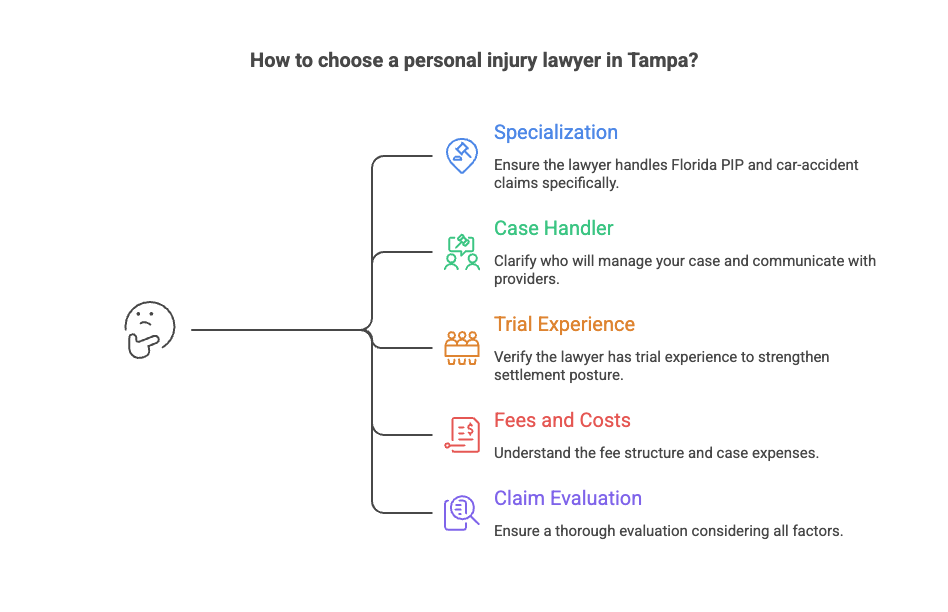
How to Choose a Personal Injury Lawyer in Tampa
The phrase how to choose a personal injury lawyer reflects an important commercial-intent question. A lawyer who handles general legal matters may not be the best fit for a Florida auto-injury claim involving PIP, bodily-injury liability, UM/UIM coverage, medical evidence, and a possible permanent-injury threshold.
Use the initial consultation as an interview. The best accident lawyer questions are specific, evidence-focused, and easy to compare. Pencheff & Fraley’s existing article, 5 Questions to Ask Before Hiring an Accident Lawyer in Ohio or Florida, provides a related question framework.
Does the Lawyer Handle Florida PIP and Car-Accident Claims?
Ask how often the attorney handles Florida car accidents, PIP disputes, serious-injury claims, uninsured-motorist cases, and cases involving more than one insurer. The lawyer should be able to explain the difference between a PIP claim and a third-party bodily-injury claim in plain language.
Who Will Actually Handle the Case?
Ask whether you will work directly with the attorney, a case manager, or a broader team. Confirm who will answer questions, communicate with medical providers, negotiate with insurers, and prepare the case if litigation becomes necessary.
Does the Lawyer Have Trial Experience?
Many cases settle. A settlement posture is stronger when the insurer understands that the legal team can prepare the case for court. Ask about experience with depositions, expert witnesses, mediation, and trial—not only advertising results.
What Are the Fees and Case Costs?
Ask whether the firm works on a contingency fee, how the percentage changes if a lawsuit is filed, which costs are advanced, and what happens if there is no recovery. Request the agreement in writing and read the provisions about liens, medical bills, case expenses, and settlement authority.
How Will the Lawyer Evaluate the Claim?
A responsible evaluation should account for medical evidence, treatment history, lost income, future care, policy limits, fault, comparative responsibility, PIP benefits, UM/UIM coverage, and the possibility that symptoms change over time. Be cautious of anyone who guarantees a result or quotes a settlement value before reviewing the evidence.
Hypothetical Tampa Car Accident Example
Consider a hypothetical Tampa driver who is rear-ended at a signal and develops neck pain and dizziness. The driver seeks an initial evaluation within 14 days. The treating provider documents an emergency medical condition, and the driver incurs $12,000 in reasonable, accident-related medical expenses.
PIP may cover 80% of qualifying medical expenses up to the applicable limit, subject to the policy and statutory requirements. It does not automatically pay the entire $12,000. If the injuries later prove permanent or otherwise meet the threshold in Florida Statute § 627.737, the driver may also evaluate a claim against the at-fault driver for damages not covered by PIP.
This example is for explanation only. The result in an actual case depends on the policy, medical evidence, fault analysis, available insurance, prior conditions, and other facts.
Florida Car Accident Deadlines and Legal Help
For most negligence actions, Florida Statute § 95.11 provides a two-year limitations period. The exact deadline can depend on the claim type, accident date, parties involved, and statutory exceptions. An insurance claim or settlement negotiation does not necessarily replace the need to track a lawsuit deadline.
Do not wait until the deadline is near. Evidence can disappear, witnesses can move, medical records can become harder to collect, and an insurer may use delay to its advantage. Pencheff & Fraley’s Florida statute-of-limitations guide for car accidents explains the current two-year negligence deadline and related issues.
Frequently Asked Questions About Florida No-Fault Insurance and Tampa Car Accidents
Is Florida a no-fault state for car accidents?
Yes. Florida uses a no-fault auto-insurance system centered on PIP coverage. After a covered crash, your own PIP policy is generally the first source for certain medical expenses and lost income, regardless of who caused the collision. Serious injuries may still support a claim against the at-fault party.
How much does Florida PIP insurance pay after a crash?
PIP generally pays 80% of qualifying medical expenses and 60% of qualifying lost wages, subject to the policy and statutory limits. The standard limit is $10,000 in medical and disability benefits, with a $5,000 death benefit. Deductibles, exclusions, treatment timing, and the emergency-medical-condition determination can affect payment.
What is the 14-day rule after a Florida car accident?
You generally must receive initial qualifying medical services and care within 14 days after the crash to access PIP medical benefits. Do not wait for symptoms to worsen or for an adjuster to tell you what to do. Seek appropriate medical evaluation promptly and keep the records showing when care began.
Can I sue the other driver if I have PIP insurance?
Possibly. PIP is not a complete bar to a third-party claim. Under Florida Statute § 627.737, an injury must meet a statutory threshold for pain, suffering, mental anguish, and inconvenience damages. The claim also requires proof of fault, causation, damages, and available coverage.
What if the other driver has no insurance?
Your PIP coverage may still apply to initial benefits. If you purchased uninsured- or underinsured-motorist coverage, it may provide additional protection when the at-fault driver has no insurance or insufficient limits. Review the policy and do not sign a release before understanding what coverage and claims are available.
Do I need a Tampa car accident lawyer for a minor crash?
Not every minor crash requires a lawyer. A consultation can be worthwhile when you have ongoing symptoms, missed work, disputed fault, a PIP denial, a serious injury, multiple vehicles, a rideshare driver, an uninsured driver, or pressure to accept a quick settlement. Early advice can help you avoid waiving rights unintentionally.
How do I choose the best accident lawyer for my case?
Ask about Florida car-accident experience, PIP and UM/UIM knowledge, similar injury cases, trial readiness, who will handle daily communication, fee terms, and the evidence needed to evaluate the claim. Choose a lawyer who explains uncertainty honestly rather than guaranteeing a result before reviewing your records.
How long do I have to file a Florida car accident lawsuit?
For many negligence-based personal-injury actions, Florida law provides a two-year limitations period. Exceptions and different claim types may change the analysis. Because missing the deadline can be fatal to a case, speak with a Florida personal injury attorney promptly instead of relying on a general online deadline.
Contact a Tampa Personal Injury Lawyer
Florida no-fault insurance can provide important first-party benefits after a Tampa car accident, but PIP is limited and does not answer every question about serious injuries, fault, insurance coverage, or future losses. Seeking medical care within 14 days, preserving evidence, and obtaining advice before signing a release can protect your options.
If you were injured in Tampa, contact Pencheff & Fraley’s Tampa personal injury lawyers for a free case review. You can also request a free consultation through the firm’s contact page. The firm states that it offers contingency-fee representation, so ask for a written explanation of fees and case costs during the consultation.
This article is for general information and does not create an attorney-client relationship or provide legal advice. Every claim depends on its facts, policy language, medical evidence, and current law. Prior results do not guarantee a similar outcome.
Website disclaimer: This website contains attorney advertising and is intended for informational purposes. It is not formal legal advice and does not create an attorney-client relationship. Prior results do not guarantee a similar outcome. Every claim is different.
This article is intended for general informational purposes only and does not constitute legal advice. Laws change, and the information above may not reflect the most recent legal developments. Please contact a qualified Florida personal injury attorney to discuss the specific facts of your case.
Author: Pencheff & Fraley Legal Team
References
- Florida Statute § 627.736 — Required personal injury protection benefits, exclusions, priority, and claims
- Florida Statute § 627.737 — Tort exemption and injury threshold
- Florida Statute § 768.81 — Comparative fault
- Florida Statute § 627.7407 — Application of the Florida Motor Vehicle No-Fault Law
- Florida Statute § 95.11 — Limitations other than recovery of real property
- Florida Highway Safety and Motor Vehicles — Florida Insurance Requirements
- Florida Highway Safety and Motor Vehicles — Involved in a Crash?
- The Florida Bar — Consumer Pamphlet: Automobile Insurance
- Pencheff & Fraley — Tampa personal injury lawyers
- Pencheff & Fraley — Contact Us