
After the shock of a collision subsides and the dust settles, you are left with a mounting stack of medical bills, a damaged vehicle, and the stress of missing work. It is in this chaotic aftermath that accident victims inevitably ask one critical question: “How much is my Florida car accident claim worth?”
The reality is that there is no universal “Florida car accident settlement calculator.” The value of your claim depends on a complex interplay of factors, including the severity of your injuries, the limits of available insurance policies, and Florida’s specific legal statutes. In 2024, traffic crashes resulted in nearly 40,000 fatalities nationwide [1], underscoring the severe impact of these incidents. In Florida, the path to compensation is uniquely governed by a no-fault insurance system, making it essential to understand the rules before negotiating with an insurance adjuster.
This comprehensive guide will walk you through the factors that determine auto accident compensation in Florida, how Personal Injury Protection (PIP) works, and when you can step outside the no-fault system to pursue a lawsuit for pain and suffering damages. By understanding these elements, you can take the right steps to maximize your financial recovery.
The Foundation: Florida’s No-Fault System and PIP Insurance
Unlike many states, Florida operates under a no-fault auto insurance system. This means that after an accident, you must first turn to your own insurance policy to cover medical expenses and lost wages, regardless of who caused the crash.
Understanding PIP Insurance Florida Limits
Under Florida law, every driver is required to carry a minimum of $10,000 in Personal Injury Protection (PIP) insurance. When you are injured in a car accident, your PIP policy is the primary source of compensation. However, PIP does not cover everything.
- Medical Expenses: PIP covers 80% of reasonable and necessary medical expenses related to the accident, up to your policy limit.
- Lost Wages: PIP covers 60% of your lost wages if your injuries prevent you from working.
- Death Benefits: In the tragic event of a fatal accident, PIP provides $5,000 in death benefits.
It is crucial to note the 14-day rule. To receive PIP benefits, you must seek initial medical treatment within 14 days of the accident. If you fail to do so, your insurance company can deny your claim entirely. Furthermore, to access the full $10,000 limit, a medical professional must diagnose you with an “Emergency Medical Condition” (EMC). If your injuries are deemed non-emergency, your PIP benefits may be capped at just $2,500.
If you are unsure what steps to take immediately following a collision to protect your PIP claim, review our comprehensive guide on What to Do After a Car Accident in Florida: Your 2026 Complete Guide.
Stepping Outside the No-Fault System: The Severe Injury Threshold
While PIP is designed to handle minor accidents quickly, $10,000 is rarely enough to cover the costs of a serious collision. If your damages exceed your PIP limits, or if you wish to pursue non-economic damages like pain and suffering, you must meet the Florida permanent injury threshold.
To step outside the no-fault system and file a lawsuit against the at-fault driver, your injuries must consist of at least one of the following:
- Significant and permanent loss of an important bodily function.
- Permanent injury within a reasonable degree of medical probability, other than scarring or disfigurement.
- Significant and permanent scarring or disfigurement.
- Death
If your injuries meet this threshold, the value of your claim changes dramatically. You are no longer limited to 80% of medical bills and 60% of lost wages. You can seek full compensation for past and future medical care, total lost earning capacity, and subjective damages that reflect the true impact of the crash on your life.
For victims dealing with life-altering harm, such as those involved in commercial vehicle collisions, understanding your rights is critical. Learn more in our Florida Catastrophic Truck Accident Injuries guide.
Key Factors That Determine the Value of Your Claim
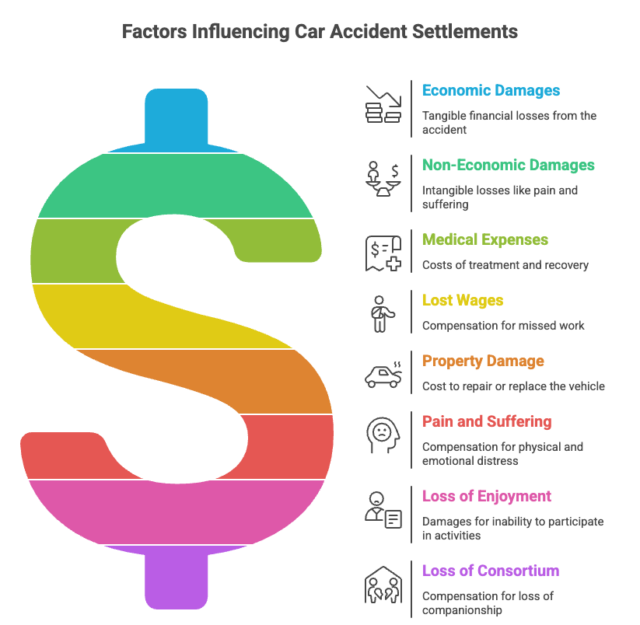
When calculating the average car accident settlement in Florida, attorneys and insurance adjusters evaluate a combination of economic and non-economic damages.
Economic Damages: Calculating Your Financial Losses
Economic damages are the tangible, out-of-pocket costs resulting from the accident. These are relatively straightforward to calculate using bills and receipts.
- Medical Expenses: This includes ambulance rides, emergency room visits, surgeries, hospital stays, prescription medications, physical therapy, and necessary medical equipment.
- Future Medical Care: If your injuries require ongoing treatment or long-term care, experts will estimate these future costs.
- Lost Wages and Earning Capacity: You are entitled to compensation for the time you missed from work while recovering. If your injuries permanently reduce your ability to earn a living, you can claim loss of future earning capacity.
- Property Damage: The cost to repair or replace your vehicle.
Non-Economic Damages: Valuing Pain and Suffering
Non-economic damages compensate you for the intangible, subjective losses that do not have a clear price tag. In Florida, pain and suffering damages can often make up the largest portion of a severe injury settlement.
- Physical Pain and Suffering: Compensation for the physical agony caused by your injuries and the recovery process.
- Emotional Distress: Damages for anxiety, depression, PTSD, and sleep disturbances resulting from the trauma of the crash.
- Loss of Enjoyment of Life: If your injuries prevent you from participating in hobbies, sports, or activities you previously enjoyed.
- Loss of Consortium: Compensation awarded to a spouse for the loss of companionship, affection, and support.
To maximize these damages, it is vital to avoid errors that could undermine your case. Read about the 12 Common Mistakes That Can Ruin Your Car Accident Claim.
The Impact of Pre-Existing Conditions
Insurance companies frequently use pre-existing conditions as a tactic to devalue claims, arguing that your current pain is simply a continuation of an old problem. However, Florida law follows the “Eggshell Plaintiff” doctrine. The at-fault driver is responsible for the actual damage they caused, even if you were more susceptible to injury. The key is proving that the accident aggravated or worsened your pre-existing condition. For a detailed explanation of how this works, especially in rear-end crashes, see our article on How Pre-Existing Back Injuries Affect Settlement Values in Rear End Collision Cases.
How Comparative Negligence Affects Your Settlement
In many accidents, fault is not entirely one-sided. What happens if you were speeding slightly when another driver ran a red light and hit you?
In 2023, Florida transitioned from a pure comparative negligence system to a modified comparative negligence system. This change significantly impacts how much your claim is worth if you share the blame.
Under the new law, you can still recover damages as long as you are not more than 50% at fault for the accident. However, your total compensation will be reduced by your percentage of fault.
- Example: If your damages total $100,000, but a jury determines you were 20% at fault, you will receive $80,000.
- The 51% Rule: If you are found to be 51% or more at fault, you are barred from recovering any damages from the other party.
Because insurance adjusters will actively look for ways to shift blame onto you to reduce their payout, having skilled legal representation is essential to protect your percentage of the settlement.
The Role of Insurance Policy Limits
Perhaps the most frustrating factor in determining the value of a claim is the reality of insurance policy limits. You cannot recover money that does not exist.
If your damages total $250,000, but the at-fault driver only carries $50,000 in Bodily Injury Liability (BIL) coverage, their insurance company will only pay up to that $50,000 limit. While you technically have the right to sue the driver personally for the remaining balance, most individuals do not have the personal assets to satisfy a large judgment.
This is why carrying Uninsured/Underinsured Motorist (UM/UIM) coverage is highly recommended in Florida. If the at-fault driver has insufficient insurance (or no insurance at all), your UM/UIM policy can step in to cover the gap, ensuring you receive the compensation you need.
If you are involved in a crash with a rideshare vehicle, the insurance limits are entirely different and often much higher. Learn more about these complex policies in our guide: Is Uber or Lyft Liable for Accidents in Florida?.
Why You Need a Personal Injury Lawyer to Maximize Your Claim
Determining “how much is my Florida car accident claim worth?” is not a calculation you should attempt alone. Insurance companies employ teams of adjusters and lawyers whose primary goal is to minimize your payout.
An experienced personal injury attorney will: * Thoroughly investigate the crash to prove liability. * Gather comprehensive medical records and consult with experts to accurately calculate your future damages. * Aggressively negotiate with the insurance company to secure a fair settlement. * Take your case to trial if the insurance company refuses to offer what you deserve.
Many victims worry about the expense of legal representation. However, most personal injury firms, including ours, operate on a contingency fee basis, meaning you pay nothing upfront. For a breakdown of how this works, read How Much Does It Cost to Hire a Personal Injury Lawyer?.
Protect Your Claim and Your Future
The value of your car accident claim is directly tied to the actions you take following the crash. From seeking immediate medical attention to preserving evidence and understanding the nuances of Florida’s comparative negligence laws, every step matters. If you are questioning whether your case is viable, our guide Is It Worth Making a Personal Injury Claim? provides a practical framework for evaluating your situation.
Contact us today for a free, no-obligation consultation. We will review your case, answer your questions, and explain your legal options. Learn how we can help you on the road to recovery. Pay nothing unless we win your case.
Call us at 904-770-4953 or visit our website at www.pencheffandfraley.com to schedule your free case consultation.
We’re Here for You 24/7
We are available 24/7 to take your call. If you are unable to travel, we will come to you. The sooner you call, the stronger your case can be. Your path to maximum compensation and justice starts with a single phone call to Pencheff & Fraley.
Author: Pencheff and Fraley Legal Team
Disclaimer: This article is for informational purposes only and does not constitute legal advice. Every case is unique, and you should consult with a qualified attorney about your specific situation.