

Ohio Mansfield comparative fault law can reduce your car accident payout. The reduction may apply when evidence shows that you helped cause the crash or your injuries. Under 1, your own contributory fault does not automatically bar recovery. You may generally recover when your fault is not greater than the combined fault of the other responsible people. The court then reduces compensatory damages in proportion to your fault.
In practical terms, an injured driver who is found 40% at fault may still pursue compensation. Assume the proven compensatory damages are $100,000. A simple statutory illustration would reduce that amount by 40%. The result would be $60,000 before insurance limits, liens, attorney fees, case costs, and other issues. That is an educational calculation. It is not a guaranteed settlement value or final net payout.
Ohio’s rule applies statewide. Mansfield and Richland County do not use a separate comparative-fault percentage. The evidence can change from case to case. So can the people involved, insurance coverage, medical proof, and decision-maker.
How Ohio Mansfield comparative fault law changes a payout
Comparative fault is sometimes called comparative negligence or shared fault. These terms describe a process for assigning responsibility among the people whose conduct contributed to an injury or property loss.
The basic Ohio formula
A simplified educational formula is:
Proven compensatory damages × (1 − your percentage of fault) = illustrative gross damages after the fault reduction
For example, assume a claim proves $80,000 in compensatory damages. If the injured person is assigned 25% of the fault, the simplified calculation is:
$80,000 × 75% = $60,000
The calculation starts with proven damages. It does not start with a hoped-for settlement number. The value can change before the percentage reduction is applied. Common disputes involve medical causation, lost income, future care, pain and suffering, or property damage.
Illustrative fault-to-payout table
The table below uses $100,000 in hypothetical compensatory damages. It shows the arithmetic effect of the claimant’s percentage only.
| Claimant’s assigned fault | Illustrative gross amount after reduction | What the example shows |
| 0% | $100,000 | No comparative-fault reduction in this illustration |
| 10% | $90,000 | A 10% fault finding reduces the example by $10,000 |
| 25% | $75,000 | One-quarter of the hypothetical damages is removed |
| 40% | $60,000 | A 40% finding does not automatically end the claim |
| 50% | $50,000 | Recovery can still be possible at exactly 50%, subject to the statute and facts |
| Greater than 50% | Generally barred under the rule | The statutory eligibility comparison becomes critical |
This table does not account for policy limits or other claimants. It also excludes uninsured or underinsured motorist coverage, causation disputes, liens, subrogation claims, fees, costs, unpaid bills, taxes, and collectability. A negotiated settlement may also differ from a court judgment because both sides assess litigation risk.
What counts as compensatory damages?
Compensatory damages may include economic and noneconomic losses. Economic losses can include reasonable medical expenses, lost wages, reduced earning capacity, rehabilitation, and other documented financial harm. Noneconomic losses can include pain, emotional distress, loss of normal activities, and other legally recognized harms.
The amount must still be proven. Medical records should connect treatment to the crash. Wage documentation should show the loss. Testimony and medical opinions may matter when the injury affects future work or daily life. Property damage follows its own proof issues, such as repair estimates, total-loss valuation, and vehicle ownership.
For more on damages and valuation, see Pencheff & Fraley’s Ohio car accident settlement guide. You can also review the firm’s car accident settlement factors page.
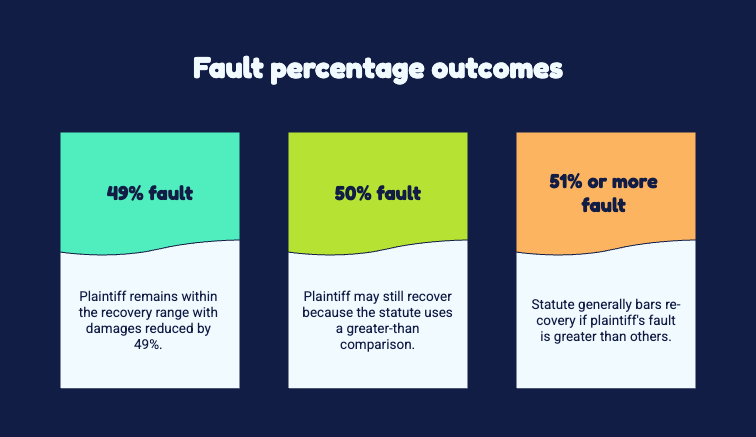
What happens at 49%, 50%, and 51% fault
People often call Ohio’s rule the “51% rule.” That shorthand can confuse readers. The important question is whether the plaintiff’s fault is greater than the combined fault of the other responsible people.
At 49% fault
A 49% finding normally leaves the plaintiff within the recovery range. The compensatory damages are reduced by 49% under the simplified model. A $100,000 example would become $51,000 before the other adjustments described in this article.
At exactly 50% fault
A plaintiff may still recover at exactly 50% because the statute uses a greater-than comparison. The simple $100,000 illustration would become $50,000. The actual case can still turn on proof of fault, causation, damages, coverage, and the parties who can pay.
At 51% or more fault
Section 2315.33 compares the plaintiff’s fault with the combined fault of others. If the plaintiff’s fault is greater, the statute generally bars recovery. In a simple two-driver example, 51% plaintiff fault is greater than the other driver’s 49% fault.
Multi-party cases require more careful analysis. The percentages can include the plaintiff, sued parties, and certain people who are not sued. A percentage assigned to an absent person can affect the comparison and the collection questions. Do not assume that a percentage stated by an adjuster is the final legal result.
How fault is assigned in a Mansfield crash
An insurance adjuster may make an initial fault assessment during claim negotiations. That assessment is not the same as a judge’s finding or a jury’s verdict. The assessment may change after the adjuster receives more information. That may include the crash report, photographs, witness statements, medical records, vehicle evidence, or a demand package.
If a case proceeds to litigation, 2 governs specified findings. Those findings apply when contributory fault is asserted and established. The findings include compensatory damages before the plaintiff’s conduct. They also identify economic loss, noneconomic loss, and each relevant person’s percentage of tortious conduct.
Under 3, the allocation can include the plaintiff and sued parties. It can also include certain people from whom the plaintiff does not seek recovery. The percentages must total 100%. A three-car collision may require more investigation than a simple two-driver crash. The same may be true for a commercial-vehicle claim or road-condition dispute.
Insurer percentage versus court or jury percentage
An insurer may argue that you were speeding or following too closely. It may also allege distraction, impairment, or responsibility for the severity of your injury. The carrier may use that position to reduce an offer or deny some part of the claim.
That position is evidence of the negotiation dispute. It is not automatically the legal answer. The response should address the specific allegation with specific proof. A general denial may be less persuasive than specific proof. Useful proof includes a clear timeline, photographs, witness information, vehicle evidence, and medical records.
Common shared-fault car accident scenarios
The same percentage rule can apply to many types of Mansfield and Richland County crashes. The facts determine whether a particular allegation has merit.
Left turns and intersection crashes
A driver who turns left may face a failure-to-yield allegation. The other driver may still face questions about speed, signal timing, visibility, distraction, or a traffic-control violation. Photos of lane positions, damage locations, sight lines, and traffic signals can help reconstruct what happened.
Rear-end collisions
A rear driver is often accused of following too closely. The lead driver may still face questions about an unsafe stop or sudden lane change. Other issues can include missing brake lights or another action that contributed to the impact. Rear-end fault should be evaluated from the full sequence, not from the vehicle positions alone.
Lane changes and sideswipes
A lane-change case may involve a failure to yield or an unclear turn signal. It may also involve a blind spot or a vehicle already occupying the lane. Dashcam footage, vehicle damage, road markings, and witness accounts may be important.
Speeding for the conditions
A driver may not need to exceed the posted limit to face a speed-related allegation. Rain, darkness, congestion, a work zone, or limited visibility can affect whether the speed was reasonable for the conditions. The analysis should connect the speed to the collision and the claimed injury.
Distracted driving and phone evidence
An allegation of phone use requires reliable proof. Do not guess about another driver’s phone activity. Preserve lawful evidence, provide relevant information to counsel, and avoid accessing another person’s private account or device.
Three-car and chain-reaction crashes
A chain reaction may involve a first impact, a second impact, and later impacts. Each event can raise separate questions about stopping distance, speed, timing, vehicle position, and injury causation. A damaged vehicle may not show which impact caused every symptom.
Pedestrian, bicycle, and motorcycle crashes
A vulnerable road user may be accused of crossing outside a marked area. Other allegations may involve missing lights or an unexpected entry into the roadway. The driver may face separate questions about speed, lookout, yielding, and visibility. Lighting, clothing, roadway design, and surveillance footage can become important.
Why the gross calculation is not your final check
The arithmetic reduction is only one part of a car accident payout. A gross settlement or judgment can be reduced by obligations and practical limits that the percentage table does not show.
Insurance limits and multiple claimants
A liable driver’s policy may have limits. Several injured people may seek payment from the same policy. The available coverage may also involve an employer, a commercial carrier, or another policy that requires separate analysis.
Your own uninsured or underinsured motorist coverage may matter if the at-fault driver has no insurance or insufficient limits. Policy language, notice requirements, offsets, and household coverage issues can affect the analysis. Do not assume that every policy responds in the same way.
Medical liens and subrogation claims
Health insurers, government benefit programs, medical providers, or other payors may assert reimbursement rights. A settlement statement should identify known deductions. Those may include liens, subrogation claims, unpaid bills, fees, and case costs.
Settlement, judgment, and net recovery
A settlement is a negotiated resolution. A judgment is a court-entered result. Neither should be confused with the gross damages figure used in a comparative-fault illustration.
The net recovery is what remains after permitted deductions. Those deductions may include fees, costs, liens, subrogation, and medical obligations. Ask for a written settlement breakdown before signing a release. A release may end claims that you did not intend to waive.
Evidence that can challenge a fault percentage
A strong shared-fault response is organized around the allegation and the proof. Preserve evidence promptly because footage can be overwritten and vehicle conditions can change.
Priority evidence checklist
- Crash-scene images: Photograph vehicle positions, road markings, traffic controls, sight lines, lighting, weather, and visible hazards when it is safe to do so.
- Vehicle evidence: Preserve repair estimates, photographs before repairs, total-loss evaluations, event-data information if available, and parts that may help explain the impact.
- Witness information: Record names and contact details. Write down what each witness actually observed rather than what someone later inferred.
- Official records: Obtain the crash report and preserve citations, 911 information, incident numbers, and related public records.
- Video: Ask about dashcam, doorbell, business, traffic, or nearby surveillance. Request preservation before routine deletion occurs.
- Medical records: Follow the treatment plan and keep records that connect symptoms, treatment, restrictions, and future care to the collision.
- Income records: Keep wage statements, employer verification, missed-work dates, disability notes, and evidence of reduced earning capacity.
- Insurer communications: Save letters, texts, emails, recorded-statement requests, claim numbers, and any written percentage assessment.
- Personal timeline: Note pain, symptoms, appointments, restrictions, and changes in daily activities. Do not exaggerate or minimize what happened.
Do not delete photographs, posts, messages, or location information that may relate to the crash. Do not speculate publicly about fault. Tell your lawyer about unfavorable evidence early so the claim can be evaluated realistically.
For immediate post-crash steps, see Pencheff & Fraley’s Ohio car accident guide.
What to do after an insurer blames you
A percentage allegation can feel final, but it may be an opening position. Take these steps:
- Ask the carrier to state the allegation and its factual basis in writing.
- Do not give a recorded statement or sign a release before understanding the request.
- Preserve the evidence listed above.
- Avoid posting about the crash, injuries, treatment, or settlement online.
- Continue reasonable medical care and follow medical instructions.
- Do not miss an important deadline while negotiating with an insurer.
- Have an attorney review the evidence if the percentage would materially reduce or eliminate your recovery.
A lawyer may investigate the crash and gather records. The lawyer may also identify responsible parties, prepare a demand, address liens, negotiate with insurers, and file suit when appropriate. The right approach depends on the evidence and claim value.
For more information about the firm’s services, visit the Ohio car accident lawyers page.
Choosing a Mansfield personal injury lawyer
When you search for how to choose a personal injury lawyer, focus on fit and process rather than a slogan. A lawyer should be able to explain how the firm handles disputed fault, damages proof, insurance coverage, and settlement decisions.
What to look for in a lawyer
- Experience with Ohio car accidents involving disputed liability.
- A clear explanation of contingency fees, case costs, and potential liens.
- A plan for obtaining video, reports, medical records, and witness evidence.
- Honest answers about strengths, weaknesses, timing, and litigation risk.
- A named lawyer or team responsible for communication.
- Local access for Mansfield, Richland County, and surrounding Ohio communities.
- Trial capability when a fair result cannot be reached through negotiation.
Pencheff & Fraley’s Mansfield personal injury lawyer page provides local office information. Review the firm’s current fee agreement and representation terms before hiring any lawyer.
Best accident lawyer questions to ask
- How would you investigate the percentage of fault the insurer assigned?
- What evidence would you want first in my type of crash?
- How do you evaluate medical bills, lost income, pain, and future care?
- Could another driver, owner, employer, or insurer be involved?
- How do policy limits, liens, fees, and case costs affect my net recovery?
- Who will communicate with me, and how often?
- What facts could hurt the claim, and how would you address them?
- What is the deadline for my claim, and what must happen before it expires?
You can also review Pencheff & Fraley’s personal injury FAQs before a consultation.
Ohio filing deadline and other timing issues
4 generally states that an action for bodily injury or injury to personal property must be brought within two years after the cause of action accrues, subject to statutory exceptions and claim-specific rules. The section states that accrual generally occurs when the injury or loss occurs, but it contains additional provisions for particular situations.
A filing deadline is different from an insurer’s notice requirement. It is also different from a health-insurance reimbursement deadline or an offer’s expiration date. Different claims can also have different rules. Wrongful-death, minor, governmental, product, and uninsured-motorist issues may require separate analysis.
Read Pencheff & Fraley’s Ohio car accident statute-of-limitations guide, then obtain case-specific advice well before the deadline. Waiting can make video, witness, medical, and vehicle evidence harder to secure.
Frequently asked questions
What happens if I am 40% at fault in a Mansfield car accident?
You may still pursue compensation under Ohio’s comparative-fault rule. Your fault must not be greater than the combined fault of the other responsible people. A simple $100,000 damages illustration would be reduced to $60,000 before limits, liens, fees, costs, and other issues. The actual percentage and damages must be proven.
Can I recover if I am exactly 50% at fault in Ohio?
Possibly. Ohio Revised Code § 2315.33 uses a greater-than comparison. In a simple case, exactly 50% plaintiff fault can remain within the recovery range. The result still depends on evidence, causation, damages, other responsible people, and available coverage.
What happens if I am 51% at fault?
The statute generally bars recovery when your fault is greater than the combined fault of the other responsible people. Fault allocation can involve multiple parties and nonparties. Do not rely on a percentage without understanding how it was calculated.
Does an insurance adjuster’s fault percentage decide my case?
No. An adjuster’s percentage is usually part of a claim negotiation. It is not automatically a court finding or jury verdict. You can ask for the factual basis and respond with evidence that addresses the specific allegation.
How is fault divided in a three-car crash?
Ohio can allocate percentages among the plaintiff, sued parties, and certain people who are not sued. Under Ohio Revised Code § 2307.23, the percentages must total 100%. The sequence of impacts, vehicle data, witnesses, photographs, and accident-reconstruction evidence may matter.
What evidence can lower my assigned fault?
Useful evidence may include photographs, dashcam or surveillance video, witnesses, and crash reports. It may also include vehicle damage, roadway measurements, medical records, lawfully obtained phone evidence, and a clear timeline. Evidence should address the actual allegation instead of merely stating that you were not at fault.
Does comparative fault reduce property damage too?
Ohio Revised Code § 2315.33 refers to compensatory damages that directly and proximately result from another person’s tortious conduct. Property damage has its own proof and valuation issues. A lawyer can assess how the rule applies to the injury and property components of your claim.
How do policy limits and medical liens affect my payout?
They can materially reduce the money that remains after a settlement. Policy limits and multiple claimants may limit available insurance. Medical providers, health plans, or government programs may seek reimbursement. Request a written gross-to-net breakdown before signing a release.
Should I accept a settlement if the insurer says I caused the crash?
Do not decide from the percentage alone. Ask what evidence supports it, identify the damages included and excluded, review available coverage, and understand the release. A lawyer can help compare the offer with the risks and costs of further negotiation or litigation.
How long do I have to file an Ohio car accident lawsuit?
Ohio Revised Code § 2305.10 generally provides a two-year period. It applies to bodily-injury and personal-property actions, subject to exceptions and claim-specific issues. Do not wait until the end of the period. Your case may involve a different rule or an earlier notice requirement.
How do I choose a personal injury lawyer in Mansfield?
Look for experience with disputed fault and strong evidence preservation. Also look for a transparent fee agreement, clear communication, and litigation ability. Ask how the lawyer will challenge the percentage, prove damages, evaluate coverage, and explain your net recovery.
What are the best accident lawyer questions to ask at a consultation?
Ask who will handle the case and what evidence is needed. Ask how the firm charges and what facts could hurt the claim. Also ask whether other parties may be responsible, how liens and policy limits matter, and what deadlines apply. Good answers should be specific to your facts.
Talk with a Mansfield car accident lawyer
Shared blame does not automatically end an Ohio car accident claim. But a fault percentage can reduce proven damages. A percentage greater than the combined fault of others can also bar recovery under the statutory rule. The outcome depends on evidence, causation, damages, coverage, timing, and the people who may be responsible.
If an insurer blamed you or offered too little, contact Pencheff & Fraley Injury and Accident Attorneys. The firm can provide consultation information. Bring the crash report, photographs, insurance letters, medical information, wage records, and any video or witness details you have. Do not delay if a filing deadline may apply.
Sources and legal references
[1] Ohio Revised Code § 2315.33 — Contributory fault effect on right to recover
[2] Ohio Revised Code § 2315.34 — Findings of fact by court and jury interrogatories
[3] Ohio Revised Code § 2307.23 — Determining percentage of tortious conduct
[4] Ohio Revised Code § 2305.10 — Bodily injury or injury to personal property
Website disclaimer: This website contains attorney advertising and is intended for informational purposes. It is not formal legal advice and does not create an attorney-client relationship. Prior results do not guarantee a similar outcome. Every claim is different.
This article is intended for general informational purposes only and does not constitute legal advice. Laws change, and the information above may not reflect the most recent legal developments.
Please contact a qualified personal injury attorney to discuss the specific facts of your case.
Author: Pencheff & Fraley Legal Team