

If you are searching for what to do after a car accident Tampa, start with safety. Call 911 when anyone may be hurt or the crash may require a police response. Move to a safe place only when it is safe to do so. Then document the scene, obtain medical care, notify your insurer, and protect your claim before discussing a settlement.
Florida crash rules can be confusing. Official state sources do not currently display identical property-damage thresholds. This guide explains the safest next steps, the Florida issues that may affect your claim, and when a Tampa car accident lawyer may help. Learn more about the firm’s Tampa location and car-accident practice. It is general information, not legal advice for a specific case.
If someone has a serious injury, call 911 now. Do not delay emergency care to collect photos or exchange information.
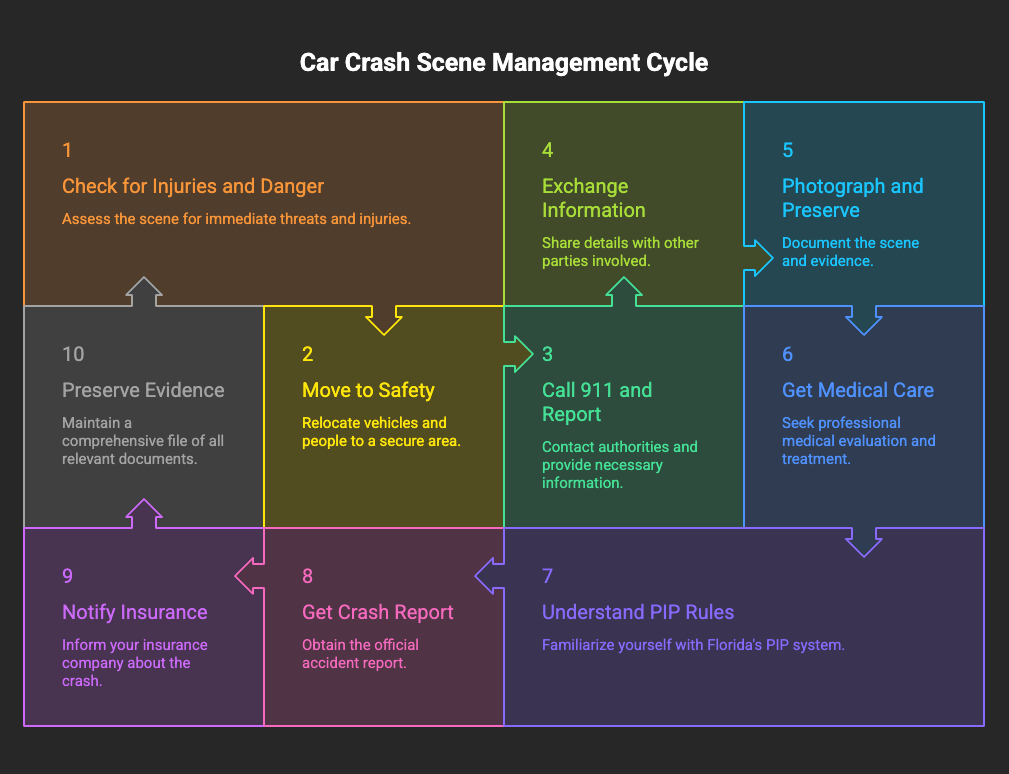
What to Do After a Car Accident Tampa: Quick Checklist
- Check for injuries and immediate dangers.
- Call 911 or the appropriate law-enforcement agency when required or uncertain.
- Move a drivable vehicle out of traffic only when it is safe.
- Exchange driver, vehicle, and insurance information.
- Photograph the vehicles, road, signs, signals, injuries, and debris.
- Identify witnesses and preserve dashcam or phone footage.
- Seek medical evaluation and follow the treatment plan.
- Report the crash to your insurer, but avoid guessing about fault.
- Save every record and be cautious with recorded statements or releases.
- Get legal advice before accepting a settlement if you have an injury, disputed fault, or a coverage problem.
This order matters. Safety comes before evidence. Medical care comes before a quick insurance payment. A settlement release can end claims that you do not yet understand.
What to do at the Tampa crash scene
1. Check for injuries and danger first
Turn off the engine if you can do so safely. Check yourself, passengers, and others for visible injuries. Look for fire, leaking fuel, downed wires, oncoming traffic, or another collision risk.
Call 911 when anyone is injured, unconscious, confused, trapped, or in danger. Tell the dispatcher your location, the number of vehicles, and any known injuries. If a person may have a neck or back injury, do not move them unless an immediate danger makes movement necessary.
Some injuries are not obvious at first. The 1. Seek emergency help for worsening headache, repeated vomiting, weakness, seizures, confusion, slurred speech, or loss of consciousness.
2. Move to safety only when it is safe
If your vehicle can move and no one needs to remain inside for medical reasons, move it out of a travel lane. A shoulder, parking lot, or nearby safe area may reduce the risk of a second crash. Turn on your hazard lights.
Do not stand between vehicles. Do not walk into traffic to take photographs. If your vehicle cannot move, stay in a safe position and wait for responders. A damaged car can be replaced. A second collision can cause life-changing harm.
Florida law addresses moving vehicles after certain crashes. The safest practical rule is to follow the dispatcher’s and responding officer’s instructions. Do not move a vehicle if doing so would create a greater danger or destroy evidence of a serious crash.
3. Call 911 and make a report
Call law enforcement when a person is injured or killed. Call when the other driver leaves, appears impaired, refuses to exchange information, or the crash involves a commercial vehicle. Call when a vehicle must be towed or the damage is significant.
The Florida Highway Safety and Motor Vehicles 2. The current Florida Legislature page for 3. The FLHSMV page still displays a $500 threshold for some reporting guidance.
That difference is important. It means a blog should not present one number as a complete answer. If you are unsure whether a crash must be reported, call 911 or local law enforcement. Keep the incident number, the responding agency, the officer’s name and badge number, and the date of the report.
4. Exchange information without arguing
Share only the information needed to identify the drivers, vehicles, and insurers. Do not argue about fault at the scene. Do not apologize as a way to calm the situation. A polite statement such as “I am glad no one appears seriously hurt” is different from admitting legal responsibility, but keep the conversation limited.
Collect:
- Full name and contact information.
- Driver’s license number, if available.
- License plate, make, model, and color.
- Insurance company and policy information.
- Vehicle owner’s name if different from the driver.
- Names and contact information for independent witnesses.
- The responding agency and report or incident number.
Use your phone to photograph the information when possible. Check that the images are readable before leaving the scene.
5. Photograph and preserve the scene
Take wide, medium, and close photographs. Capture the final vehicle positions, damage, traffic signs, lane markings, signals, skid marks, debris, weather, lighting, construction, and road defects. Photograph visible injuries only if it is safe and appropriate.
Record a short video that shows the scene from a safe location. Do not narrate a theory of fault. Say what you observe. Note the time, direction of travel, intersection, nearby businesses, and any traffic or security cameras.
Preserve dashcam footage immediately. Save the original file and a backup. Do not edit the only copy. Ask nearby businesses or property managers whether they may have relevant video. Security footage may be overwritten quickly, so tell your lawyer about possible sources as soon as possible.
For complex or disputed cases, an attorney may work with an accident-reconstruction professional. Pencheff & Fraley’s existing guide explains how accident reconstruction can help recreate a crash scene.
What to do during the first 14 days
6. Get medical care promptly
A medical evaluation protects your health and creates a record of what happened. The firm also discusses the psychological effects that can follow a car accident. You may have pain, dizziness, headaches, numbness, reduced movement, anxiety, or sleep problems that appear later. Tell the provider that the symptoms followed a car crash.
Follow the provider’s instructions. Keep appointments. Take prescribed medication as directed. Save bills, discharge papers, imaging results, work restrictions, therapy records, and transportation expenses. Tell the provider if symptoms worsen or a new symptom appears.
Do not treat a lack of immediate pain as proof that you are uninjured. The 1. Medical decisions belong to healthcare professionals. A lawyer cannot diagnose an injury.
7. Understand Florida’s 14-day PIP rule
Florida’s Personal Injury Protection, or PIP, system may pay initial medical and disability benefits through your own auto policy. Under 4, initial qualifying services and care must generally occur within 14 days after the crash for medical PIP benefits.
The statute provides 80% of reasonable, medically necessary medical expenses within the applicable PIP limits. It also provides a $10,000 limit for medical and disability benefits and a $5,000 death benefit. The amount and availability of medical benefits can differ depending on whether a provider determines that you had an emergency medical condition.
If there is no emergency medical condition determination, the statute limits medical reimbursement to $2,500. That is one reason the first evaluation matters. Missing the 14-day window can also create a serious coverage problem. If you missed it, seek medical advice and legal advice promptly. Do not assume that a website can determine whether an exception applies to your policy or claim.
PIP is not the same as a full personal-injury settlement. It may not cover all medical expenses, lost income, future care, pain, or other losses. Read Pencheff & Fraley’s Florida car-accident guide for more context on no-fault insurance and injury claims.
What to do with the crash report and insurance claim
8. Get the right crash report
The agency that investigated the crash may be Tampa Police, the Hillsborough County Sheriff’s Office, the Florida Highway Patrol, or another local department. The correct agency depends on where the crash occurred.
For a City of Tampa Police report, use the city’s 9. FLHSMV also explains 10. Keep the report, photographs, witness information, medical records, and insurer correspondence in one folder.
Read the report when it becomes available. If it contains an error, tell your lawyer. Do not assume that an officer’s preliminary conclusion decides civil liability. Evidence from witnesses, video, vehicle damage, medical records, and other sources may also matter.
9. Notify your insurance company carefully
Report the crash under the terms of your policy. Give the date, time, location, vehicles, and basic facts. Ask for the claim number and the adjuster’s contact information. Keep a written log of every call, email, letter, and request.
Be truthful. Do not guess about speed, distance, the other driver’s intentions, or the cause of an injury. Do not minimize symptoms because you hope the claim will be simple. Do not sign a broad release before you understand what it covers.
An insurer may ask for a recorded statement, medical authorization, repair authorization, or settlement release. Each document can have legal or financial consequences. You can ask for time to review it. If you are injured, liability is disputed, or the insurer is pressuring you, speak with a lawyer before signing.
If an insurer makes a low offer, read what to do when an insurance company offers a low settlement. Do not accept a check that may include release language without understanding the effect.
10. Preserve evidence and your daily-life records
Keep a claim file with:
- Crash reports and incident numbers.
- Photos, videos, dashcam files, and witness contacts.
- Medical records, bills, prescriptions, and treatment instructions.
- Pay stubs, employer notes, work restrictions, and missed-work dates.
- Vehicle estimates, towing bills, storage charges, and rental records.
- Insurance letters, texts, emails, recorded-statement requests, and offers.
- A dated symptom and activity journal.
Avoid posting about the crash, your injuries, travel, exercise, or dispute. Do not delete existing posts without legal advice. Review Pencheff & Fraley’s guide to common mistakes that can damage a car-accident claim.
Florida rules that may affect a Tampa injury claim
Florida’s no-fault system does not end every claim
PIP usually handles the first layer of medical and disability benefits. A claim against another driver may involve bodily-injury liability coverage, uninsured or underinsured motorist coverage, property damage, and damages that PIP does not cover.
A lawsuit for pain, suffering, mental anguish, or inconvenience after a motor-vehicle injury may require a qualifying injury under 5. The statute lists significant and permanent loss of an important bodily function, a permanent injury within reasonable medical probability, significant and permanent scarring or disfigurement, or death.
The threshold is fact-specific. A diagnosis, treatment history, prognosis, and medical opinions may matter. Do not assume that the crash severity or the vehicle damage alone answers the question.
Florida’s negligence deadline is generally two years
The current 6. The correct deadline can depend on the crash date, the claim type, the defendant, tolling rules, and exceptions. Wrongful-death claims, government defendants, and special notice rules can raise different issues.
Do not confuse an insurer’s claim deadline with the deadline to file a lawsuit. Do not wait until the deadline is close. A lawyer should review the dates and facts of your case.
Pencheff & Fraley also publishes a guide to the Florida statute of limitations for car accidents. Use it as a starting point, not as a substitute for case-specific advice.
Comparative fault can reduce or bar recovery
Florida’s comparative-fault statute says a claimant’s damages may be reduced by the claimant’s share of fault. Under 7, a party found more than 50% at fault for their own harm may not recover damages in a negligence action covered by the rule.
For example, if total damages were $100,000 and a claimant were found 20% at fault, the damages could be reduced to $80,000. This is only an illustration. Fault percentages depend on evidence and the claims in the case.
Do not make a quick admission because you feel embarrassed or confused. Let the evidence develop. Pencheff & Fraley’s page on what to do after a car accident that was not your fault explains practical ways to protect your account of what happened.
What if the other driver is uninsured, flees, or drives for a rideshare?
Uninsured or underinsured driver
Get the plate number, vehicle description, witness contacts, and any video. Report the crash. Notify your insurer and ask about uninsured or underinsured motorist coverage. The coverage you have depends on your policy, selections, exclusions, and the facts.
Do not assume that PIP is the only available source of recovery. Pencheff & Fraley explains more about car accidents involving uninsured drivers.
Hit-and-run
Call 911. Do not chase the vehicle. Write down the direction of travel, plate characters, make, model, color, and damage. Ask witnesses to remain if they can do so safely. Look for nearby cameras and preserve any footage.
A hit-and-run can create a fast-moving evidence problem. Tell your insurer and a lawyer what happened as soon as possible.
Rideshare or commercial vehicle
Save the app trip screen, driver profile, receipt, messages, and route. For a commercial vehicle, photograph company names, USDOT markings, cargo, and the vehicle number if safe. Multiple insurance policies or responsible parties may be involved.
Do not try to resolve a complex commercial or rideshare claim through a quick phone conversation. The evidence may include app records, employer records, vehicle data, maintenance documents, and multiple policies.
How to choose a personal injury lawyer in Tampa
The best lawyer for one case may not be the best lawyer for another. Look for experience with Florida car accidents, clear communication, a written fee agreement, and a plan for evidence and medical records.
The 8 recommends checking qualifications, asking about experience, understanding fees, identifying who will work on the case, and asking about communication and deadlines. Use that advice during a consultation.
Best accident lawyer questions to ask
Ask each lawyer:
- How often do you handle Florida car-accident cases like mine?
- Who will handle my case day to day?
- What evidence should be preserved now?
- How will you communicate updates and respond to questions?
- How does the contingency-fee agreement work?
- Which case costs might be advanced or deducted from a recovery?
- What are the strengths, weaknesses, and deadline concerns you see?
- Are you prepared to file suit if the insurer will not negotiate fairly?
- What decisions remain mine as the client?
- What should I avoid saying, signing, or posting?
Pencheff & Fraley has an existing guide covering questions to ask before hiring an accident lawyer in Florida. The firm’s Tampa personal-injury lawyers page describes its Tampa office, consultation process, and accident services. You can also review the firm’s personal-injury practice page.
What compensation may include
The losses in a car-accident claim depend on the facts and available coverage. Potential categories may include the following:
| Potential category | Examples of records that may help |
| Medical expenses | Bills, treatment records, prescriptions, imaging, therapy, and future-care opinions |
| Lost income | Pay stubs, employer records, missed-work dates, and work restrictions |
| Reduced earning capacity | Job duties, vocational evidence, and medical limitations |
| Property damage | Repair estimates, total-loss records, towing, storage, and rental expenses |
| Pain and suffering | Medical evidence, symptom records, daily limitations, and prognosis |
| Other losses | Case-specific out-of-pocket costs and documented impacts |
Do not calculate a claim from the vehicle’s repair estimate alone. A serious injury may affect work, relationships, sleep, mobility, and future care. Pencheff & Fraley’s resources explain the hidden costs of car accidents, how much a Florida car-accident claim may be worth, factors that affect a car-accident settlement, and how to prove lost wages after an accident.
Frequently asked questions
What should I do immediately after a car accident in Tampa?
Check for injuries and danger. Call 911 when anyone may be hurt or when the crash may require law-enforcement involvement. Move to safety only when it is safe. Exchange information, document the scene, seek medical care, and notify your insurer. Do not admit fault or sign a release before understanding it.
Do I have to call the police after a minor crash in Tampa?
Florida’s official sources currently show different property-damage thresholds. The Florida Legislature’s 2026 statute page states at least $2,000 in apparent damage, while FLHSMV guidance displays $500 and lists additional situations that require contact. Call law enforcement when anyone is injured, a driver leaves, impairment is suspected, a vehicle needs a tow, a commercial vehicle is involved, or you are unsure.
What is Florida’s 14-day rule after a car accident?
Florida PIP generally requires initial qualifying medical services and care within 14 days of the crash for medical benefits under §627.736. The statute provides 80% of reasonable medical expenses within the applicable limits. Coverage can differ when a provider determines there is or is not an emergency medical condition. Seek care promptly and review the facts with a professional.
What if I feel fine after a Tampa car accident?
You should still monitor yourself and consider a prompt medical evaluation. Some concussion, neck, back, and soft-tissue symptoms can appear later. Seek emergency care for worsening headache, repeated vomiting, confusion, weakness, seizures, or loss of consciousness. Do not use a lack of immediate pain to decide that no medical record is needed.
What if the other driver has no insurance?
Report the crash and gather the plate, vehicle details, witnesses, and video. Notify your insurer and ask whether your policy includes uninsured or underinsured motorist coverage. PIP may address initial benefits, but it may not cover every loss. Coverage depends on the policy and the facts.
Can I recover if I was partly at fault?
Possibly. Florida’s comparative-fault statute can reduce damages by the claimant’s share of fault. A party found more than 50% at fault for their own harm may not recover damages in a covered negligence action. Do not decide fault from a stressful conversation at the scene.
How long do I have to file a Tampa car-accident lawsuit?
Florida’s current statute generally provides two years for an action founded on negligence. Exceptions and other claim types may change the analysis. Insurance-notice deadlines are different. Have a Florida lawyer review the accident date, parties, and claim before assuming a deadline.
How do I choose a Tampa car accident lawyer?
Ask about similar Florida cases, who will handle the case, how the firm communicates, what evidence should be preserved, how fees and costs work, and whether the firm is ready for litigation. Use a written fee agreement. Compare answers instead of relying only on advertising or a settlement promise.
Contact Pencheff & Fraley after a Tampa car accident
If you were injured, if fault is disputed, or if an insurer is pushing a fast settlement, a timely legal review may help you understand your options. Bring the crash report, photographs, medical records, insurance letters, and a short timeline if you have them. Do not delay contacting a lawyer because you do not yet have every document.
You can request a free and confidential consultation through the Pencheff & Fraley contact page. The firm’s Tampa personal-injury page states that it serves Tampa accident victims and offers a free consultation. No website can promise a result. Every claim depends on its evidence, injuries, coverage, deadlines, and applicable law.
References
[1] CDC, Symptoms of Mild TBI and Concussion
[2] Florida Highway Safety and Motor Vehicles, Involved in a Crash?
[3] 2026 Florida Statutes § 316.065, Crashes; Reports
[4] 2026 Florida Statutes § 627.736, Required Personal Injury Protection Benefits
[5] 2026 Florida Statutes § 627.737, Tort Exemption and Injury Threshold
[6] 2026 Florida Statutes § 95.11, Limitations Other Than Recovery of Real Property
[7] 2026 Florida Statutes § 768.81, Comparative Fault
[8] The Florida Bar, How To Find A Lawyer In Florida
[9] City of Tampa, Police Traffic Accident Report Online Request and Payment
[10] Florida Highway Safety and Motor Vehicles, Traffic Crash Reports
Disclaimer: This article provides general information and does not create an attorney-client relationship. Florida law, insurance policies, deadlines, and reporting procedures can change or depend on the facts. Talk with a qualified Florida attorney about your situation.