

Who’s Liable When Your Uber or Lyft Ride Ends in Injury?
A routine ride can become a medical emergency in seconds. Who’s liable when your Uber or Lyft ride ends in injury? The person who caused your injuries may be responsible. That could be your driver, another motorist, or another party. Uber or Lyft’s insurance may apply without making the company itself legally liable.
For injured passengers in Ohio and Florida, two questions matter most: Who caused the harm, and what was the driver’s trip status? State law then determines important coverage and claim rules. This guide explains those differences, the evidence to preserve, and how to protect your options.
Who’s Liable When Your Uber or Lyft Ride Ends in Injury?
Start with fault, not the logo on the app. A rideshare injury claim usually requires proof of careless conduct, a connection to your injuries, and resulting losses. An insurance policy identifies a potential payment source. It does not automatically establish negligence.
Passengers often have claims against one or more responsible parties. However, being a passenger does not guarantee compensation. Investigators still need to establish what happened and which coverage applies.
Your Uber or Lyft driver may be responsible
Your driver may be liable for speeding, distracted driving, unsafe turns, or failing to yield. Impaired driving and unsafe following distances can also support a claim. Medical records and collision evidence help connect that conduct to your injuries.
These claims share many features with other car accident claims in Ohio and Florida. The additional challenge is identifying the rideshare trip phase and the correct insurer.
Another driver may be responsible
A motorist who strikes your rideshare vehicle may bear responsibility. Their liability insurance can become an important recovery source. Your own coverage and any applicable rideshare benefits may also require review.
Do not assume Uber or Lyft’s liability policy pays whenever you are riding. If another driver caused the collision, different coverage may apply. Liability coverage and uninsured motorist coverage serve different purposes.
More than one party may share fault
Both drivers might contribute to a crash. Depending on the evidence, a vehicle defect or negligent maintenance could also matter. A business employing another involved driver may need investigation.
Roadway-related claims can raise special governmental defenses and deadlines. These cases require a different analysis from an ordinary driver claim. Identifying every potentially responsible party early can help preserve the right evidence.
How Uber and Lyft Insurance Depends on Trip Status
Both states require particular insurance during covered rideshare activity. The waiting-period minimums differ from the active-trip minimum. That distinction can affect the coverage available for an injured person’s claim.
Ohio Revised Code § 3942.02 and Florida Statutes § 627.748 establish these liability minimums:
| Driver’s status | Ohio liability requirement | Florida liability requirement |
| App off; no active rideshare service | Ordinary vehicle insurance rules apply | Ordinary vehicle insurance rules apply |
| Logged in and available; no accepted ride | At least $50,000 per injured person; $100,000 per accident; $25,000 property damage | At least $50,000 per injured person; $100,000 per incident; $25,000 property damage |
| Ride accepted; traveling to pickup | At least $1 million combined liability coverage per accident | At least $1 million combined liability coverage |
| Passenger aboard during the accepted ride | At least $1 million combined liability coverage per accident | At least $1 million combined liability coverage |
These are coverage minimums, not promised settlements. The active-trip limit is not a separate $1 million entitlement for each passenger. Several injured people may seek payment from the same policy limit.
An accepted ride matters before pickup
In Ohio, covered TNC services begin when the driver accepts an app-requested ride. They end when the last requesting rider leaves the vehicle. That definition appears in Ohio Revised Code § 3942.01.
Florida’s statute similarly defines a prearranged ride from acceptance through the last rider’s exit. Therefore, traveling to pickup is not simply the waiting period. Trip acceptance records can resolve a major coverage dispute.
Drop-off, cancellation, and app disputes need careful review
An app screenshot does not always reveal the complete timeline. An injury during exit may raise questions about when the rider actually departed. A canceled trip or an off-app payment arrangement may also change the analysis.
Preserve receipts, cancellation notices, messages, and the time of the incident. If the driver used multiple apps, record which platform arranged your ride. Counsel can seek records that your passenger app does not show.
You should not automatically have to obtain a personal-policy denial
Ohio’s statute prohibits requiring the driver’s personal insurer to deny the claim first. Florida’s statute also prohibits making TNC coverage depend on a personal insurer’s initial denial. Both contain provisions addressing inadequate or lapsed driver coverage.
The driver, platform, or permitted combination may supply the required insurance. Which carrier handles your claim still requires confirmation. For a Florida-specific explanation, see Uber and Lyft insurance coverage in Florida.
Can You Sue Uber or Lyft Directly?
A claim under platform-arranged insurance is not the same as a lawsuit against the platform. A driver’s negligence may trigger applicable insurance without establishing corporate negligence. The proper defendants depend on the facts and governing law.
Independent-contractor status can affect responsibility for a driver’s conduct. However, the label alone does not resolve every possible claim. Company conduct, vehicle ownership, statutory duties, and applicable legal protections require separate analysis.
Florida limits liability based only on platform affiliation
Florida Statutes § 627.748(18) protects a TNC from certain affiliation-based liability when statutory conditions are satisfied. Those conditions address company wrongdoing, compliance with statutory obligations, and vehicle ownership or possession as a bailee.
This protection is not a reason to ignore available insurance. The statute expressly preserves the subsection’s insurance requirements and policy limits. It also distinguishes the platform’s protection from other parties’ liability.
For more local context, read whether Uber or Lyft may be liable in Florida. A lawyer should evaluate any claimed statutory exception rather than promise a direct corporate lawsuit.
Ohio claims need their own defendant analysis
Do not import Florida’s statutory protections into an Ohio case. Counsel should examine the driver’s relationship with the platform and the specific conduct alleged. Any direct company-negligence theory needs supporting evidence and a valid legal basis.
For both states, insurance identification should happen alongside fault investigation. Focusing only on suing a large company can distract from a viable driver claim. Focusing only on the driver can overlook other recovery sources.
Who Pays an Injured Passenger’s Medical Bills?
Medical bills may arrive before fault is resolved. Available payment sources can include first-party auto benefits, health insurance, and applicable liability coverage. These sources do not necessarily pay in the same order.
Insurance eligibility depends on the policy and your circumstances. Your residence, household policies, vehicle ownership, and crash location can matter. An out-of-state visitor should not assume that every local rule applies identically.
Florida: PIP eligibility and the 14-day rule
Florida’s personal injury protection, or PIP, can cover qualifying losses without requiring proof of another driver’s fault. The applicable insurer depends on statutory priority rules. Your own policy or an eligible household policy may matter before vehicle-based coverage.
Under Florida Statutes § 627.736, qualifying initial care generally must occur within 14 days for PIP medical benefits. Do not wait for an adjuster’s permission to seek necessary care. Medical needs should guide treatment.
The statute provides an ordinary $10,000 combined medical-and-disability benefit framework. It generally covers 80% of qualifying medical expenses and 60% of qualifying income loss. Emergency-medical-condition findings affect medical reimbursement limits; a no-emergency determination limits medical reimbursement to $2,500.
These figures do not guarantee eligibility or payment of every bill. Deductibles, exclusions, priority rules, and supporting records still matter. Review our broader guide to Florida Uber and Lyft accident laws for additional context.
Ohio: review health coverage, MedPay, and liability claims
Ohio does not use Florida’s mandatory PIP framework for ordinary auto claims. Available medical payments coverage, called MedPay, may help with qualifying bills. Health insurance may also cover treatment, subject to plan terms.
An at-fault party’s liability claim may address recoverable losses. It does not necessarily pay every medical bill as it arrives. Before settlement, ask about reimbursement claims from insurers or benefit plans.
What if the other driver is uninsured?
Uninsured motorist coverage, or UM, addresses certain uninsured-driver situations. Underinsured motorist coverage, or UIM, can address insufficient liability insurance. Neither should be assumed from the existence of an active ride.
Uber’s insurance explanation states that UM/UIM varies by state and is not maintained everywhere. Lyft’s insurance overview also describes first-party coverage as potentially available rather than universally identical. Ask for the policy effective on the crash date.
Your own auto policy may provide coverage even while you ride in someone else’s car. Notice and settlement-consent requirements may apply. Obtain advice before releasing an at-fault driver or insurer.
Three Examples of Passenger Injury Claims
The following examples are hypothetical. They are not Pencheff & Fraley case results or predictions of recovery. Each shows why fault and coverage must be investigated separately.
Example 1: Your driver runs a red light in Westerville
Your Uber driver enters an intersection against a red light. A collision injures you while you are a passenger. The driver may be responsible if the evidence proves negligence and resulting harm.
Because the ride was active, Ohio’s active-service insurance minimum becomes relevant. Traffic footage, witnesses, and trip records can support the investigation. The policy limit does not determine your injury claim’s value.
Example 2: Another driver rear-ends your Lyft in Orlando
Your Lyft stops for traffic, and another motorist hits it from behind. The other driver’s conduct may support a liability claim. Eligible PIP and any applicable UM/UIM coverage need separate review.
The rideshare policy’s third-party liability coverage is not automatically the payer. Our Florida guide explains claims when another driver caused the Uber or Lyft crash. Investigators should still assess whether either driver contributed.
Example 3: You fall while getting out at an unsafe drop-off
Your driver stops in a dangerous location, and you are injured while exiting. A negligent drop-off claim may be possible, depending on the circumstances. The actual exit time and cause of the fall matter.
This is not automatically an ordinary collision claim. Trip status, property conditions, policy language, and competing causes require review. Photos of the exact location can become important evidence.
What Compensation Can an Injured Rideshare Passenger Claim?
Potential damages depend on injury severity, proof, applicable law, and available coverage. A claim may address medical expenses, rehabilitation, lost income, and reduced earning ability. Pain, suffering, and lasting limitations may also be relevant.
Keep records of treatment, time missed from work, and changes in daily activities. A serious injury may require a long-term care assessment. There is no reliable universal settlement amount for an Uber or Lyft passenger injury.
Florida can limit pain-and-suffering claims
Where Florida’s no-fault tort threshold applies, not every injury qualifies for noneconomic damages. Florida Statutes § 627.737 lists qualifying categories. They include specified permanent injuries, significant permanent scarring or disfigurement, and death.
Medical evidence helps determine whether the threshold is met. Coverage and defendants can also affect the analysis. Learn more about what an Uber or Lyft passenger can claim after a Florida crash.
Shared fault can reduce recovery
Passengers often have no role in causing a collision. Nevertheless, insurers may dispute conduct that allegedly contributed to the harm. Do not assume every allegation is legally valid.
Under Ohio Revised Code § 2315.33, claimant fault proportionally reduces compensatory damages. Recovery is barred when that fault exceeds the combined fault of others. Florida Statutes § 768.81 likewise reduces recovery and bars damages above 50% claimant fault in covered negligence actions.
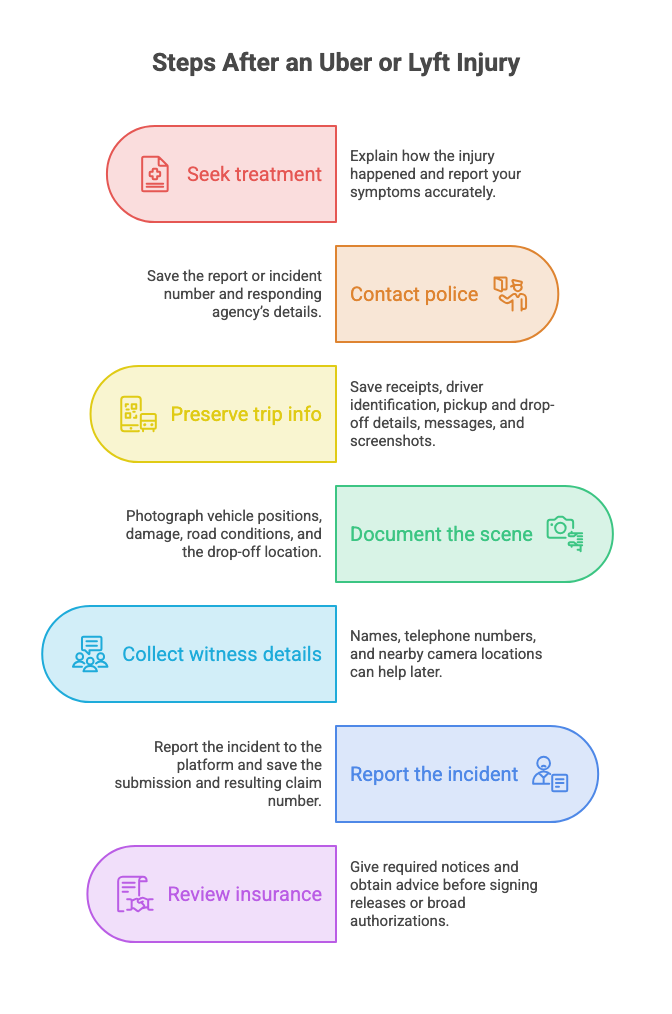
What to Do After an Uber or Lyft Injury
Prioritize safety and medical care. If you are seriously injured or in immediate danger, call 911. Documentation matters, but never put yourself at risk to collect evidence.
- Seek appropriate treatment. Explain how the injury happened and report your symptoms accurately.
- Contact police when appropriate. Save the report or incident number and responding agency’s details.
- Preserve your trip information. Save receipts, driver identification, pickup and drop-off details, messages, and screenshots.
- Document the scene safely. Photograph vehicle positions, damage, road conditions, and the drop-off location.
- Collect witness details. Names, telephone numbers, and nearby camera locations can help later.
- Report the incident to the platform. Save the submission and resulting claim number.
- Review insurance obligations promptly. Give required notices and obtain advice before signing releases or broad authorizations.
Ask for evidence beyond your passenger app
A receipt confirms useful details but may not establish the entire timeline. Driver acceptance records, GPS information, dashcam footage, and app log-on records can matter. Some records require a formal request or litigation process.
Florida’s rideshare statute requires specified log-on and log-off disclosures during a coverage investigation. The disclosure period includes 12 hours before and after the accident. Counsel can assess the request and preserve other relevant evidence.
Avoid preventable claim problems
Do not speculate about fault or exaggerate symptoms. Follow appropriate medical advice and keep organized records. Consider how public posts could be interpreted during an insurance investigation.
Ask for advice before giving a recorded statement to an opposing insurer. Your own policy may impose cooperation duties. An early settlement release can affect claims that have not yet been fully evaluated.
How Long Do You Have to File a Rideshare Injury Lawsuit?
Ohio generally provides two years for bodily injury actions under Ohio Revised Code § 2305.10. Florida generally provides two years for negligence actions under Florida Statutes § 95.11. Specific accrual rules and exceptions require review.
The incident date and claim type matter, particularly for older Florida claims. Minors, wrongful death, public defendants, and insurance-contract disputes can involve different rules. Do not use a general blog deadline as your filing calendar.
Reporting a crash to Uber, Lyft, or an insurer does not itself file a lawsuit. Settlement discussions should not be assumed to extend the deadline. Evidence and contractual notice requirements can require action much sooner.
How to Choose a Personal Injury Lawyer After a Rideshare Injury
Look for a lawyer who can explain both fault and coverage. Ask about experience with app-status evidence, multiple insurers, and passenger claims. Clear communication matters more than a promise of a particular payout.
A suitable lawyer should explain what remains uncertain. That includes the proper defendants, available insurance, medical-bill coordination, and filing deadlines. Read the fee agreement and ask how expenses are handled.
Best Accident Lawyer Questions: Five to Ask
Use these questions during your consultation:
- Who may be legally responsible, and what evidence do we need?
- Which policies could apply during this trip phase?
- How will my medical bills and reimbursement claims be handled?
- What deadlines apply to my specific circumstances?
- Who will manage my case, and how are fees and expenses calculated?
Our guide to questions to ask before hiring an accident lawyer provides additional context. Avoid choosing counsel solely because someone advertises the highest possible insurance limit.
Frequently Asked Questions
Can I make a claim if I was an Uber or Lyft passenger?
Yes, an injured passenger may have a claim against a responsible driver or another party. Compensation depends on fault, injury evidence, applicable law, and insurance coverage. Being a passenger does not guarantee payment.
Does Uber or Lyft automatically pay $1 million after an injury?
No. Ohio and Florida require at least $1 million in liability coverage during covered active rideshare service. That is a policy minimum, not a promised payout or a separate entitlement for each passenger.
What if another driver caused my rideshare accident?
The other driver may be responsible, and their liability insurer may be a recovery source. Eligible PIP, MedPay, health insurance, or UM/UIM may also matter. Rideshare liability insurance does not automatically pay when its driver was not at fault.
Can Uber or Lyft avoid liability because the driver is an independent contractor?
Independent-contractor status can affect corporate liability, but it does not decide every claim. Applicable law and evidence of company conduct still matter. Florida also has statutory protections that require separate review.
What if I do not own a car or have auto insurance?
You may still have a claim against a responsible party. First-party benefits depend on applicable law, household coverage, and vehicle coverage. In Florida, PIP eligibility and insurer priority require individual review.
How soon should I get medical treatment after a Florida rideshare injury?
Seek necessary medical care promptly. Florida generally requires qualifying initial treatment within 14 days for PIP medical benefits. That insurance rule is not a reason to delay emergency care or assume a later injury claim is impossible.
Can I claim compensation without a collision?
Possibly. Sudden braking, an unsafe drop-off, or another negligent act may cause injury without a collision. Assault and other intentional misconduct require a separate legal and coverage analysis.
How long do I have to sue after a rideshare injury?
Ohio bodily injury actions and Florida negligence actions generally have two-year filing periods. Accrual rules, exceptions, incident dates, and claim types can change the deadline. Reporting the incident to a platform does not itself file a lawsuit.
Talk With Pencheff & Fraley About Your Injury
Fault determines who may be responsible. Trip status helps determine which insurance may apply. Ohio and Florida share important rideshare coverage minimums, but their medical-benefit and liability rules are not identical. Your claim deserves an individual assessment.
Pencheff & Fraley provides personal injury representation in Ohio and Florida. The firm’s service areas include Westerville, Ohio and Orlando, Florida. You can request a free consultation to discuss what happened and your potential options.
Call 866-753-0919 in Ohio or 904-562-1371 in Florida. Bring your trip receipt, medical records, insurance correspondence, and any scene photographs. Those materials can help identify the next questions to investigate.
This article provides general information, not legal advice. Laws, insurance terms, and filing deadlines depend on the circumstances. Reading this article or contacting the firm does not by itself establish an attorney-client relationship.
References
The legal and insurance sources below are also linked where relevant in the article.
- Ohio Revised Code § 3942.01: Rideshare definitions
- Ohio Revised Code § 3942.02: Rideshare insurance requirements
- Ohio Revised Code § 2315.33: Comparative fault
- Ohio Revised Code § 2305.10: Bodily injury filing periods
- Florida Statutes § 627.748: Transportation network companies
- Florida Statutes § 627.736: PIP benefits and priority
- Florida Statutes § 627.737: No-fault tort thresholds
- Florida Statutes § 768.81: Comparative fault
- Florida Statutes § 95.11: Lawsuit filing periods
- Uber: Rideshare insurance
- Lyft: Rideshare insurance
