

If you were injured in a crash, this Ohio Car Accident Settlement Guide will help you understand exactly how much your case could be worth in 2026. Dealing with medical bills, missed work, and aggressive insurance adjusters is overwhelming. Knowing the value of your claim — and the Ohio laws that govern it — puts you in a far stronger position to fight for the compensation you deserve.
At Pencheff & Fraley, our car accident lawyer Columbus Ohio team has helped countless Ohio injury victims secure fair settlements. This guide draws on real Ohio case data, state statutes, and the competitive intelligence gathered from analyzing the top-ranking articles on this topic. Read it carefully before you speak to any insurance company.
What Determines Your Ohio Car Accident Settlement Amount?
No two car accident cases are identical, and no single formula produces a settlement figure. Insurance companies and personal injury attorneys both evaluate the same core categories of loss to arrive at a number. Understanding those categories is the first step toward knowing what your case is worth.
Economic Damages: Your Calculable Financial Losses
Economic damages represent every out-of-pocket financial loss you can document with receipts, bills, and employment records. They form the foundation of any Ohio car accident settlement.
Medical expenses are typically the single largest component. Every charge — from the ambulance ride and emergency room visit to surgeries, follow-up appointments, physical therapy, and prescription medications — is compensable. Critically, anticipated future medical costs are also included. If your treating physician projects ongoing rehabilitation or specialist care, those projected costs belong in your demand.
Lost wages cover the income you could not earn while recovering from your injuries. If your injuries have permanently reduced your ability to work or forced you into a lower-paying role, you are also entitled to compensation for loss of future earning capacity. Proving this often requires expert testimony from a vocational rehabilitation specialist or economist.
Property damage covers the repair or fair market replacement value of your vehicle, as well as rental car costs while your car is being repaired.
Non-Economic Damages: The Human Cost of Your Injuries
Non-economic damages compensate you for losses that have no receipt but are no less real. These include:
- Pain and suffering — the physical pain and emotional distress you endure as a direct result of your injuries
- Emotional distress — anxiety, depression, PTSD, and other psychological impacts caused by the crash
- Loss of enjoyment of life — the inability to participate in hobbies, sports, or family activities you previously enjoyed
- Loss of consortium — the impact your injuries have on your relationship with your spouse or partner
- Permanent disfigurement or disability — scarring, amputations, or lasting physical limitations
Non-economic damages are harder to quantify, which is exactly why insurance companies try to minimize them. A skilled attorney uses medical records, expert testimony, and your personal pain journal to build a compelling case for maximum non-economic compensation.
Ohio Laws That Directly Affect Your Settlement
Ohio has several state-specific laws that can significantly increase or decrease the value of your claim. Every Ohio car accident victim needs to understand these rules before accepting any settlement offer.
Ohio Is an At-Fault State
Ohio is an at-fault (also called “tort”) state, not a no-fault state. This means the driver who caused the accident is legally responsible for paying the damages of everyone they injured. You file a claim against the at-fault driver’s liability insurance — not your own — to recover compensation for your injuries.
This is an important distinction. Unlike no-fault states, Ohio law allows you to sue the at-fault driver for the full value of your damages, including pain and suffering, without any threshold requirement.
The 51% Modified Comparative Fault Rule
Ohio follows a modified comparative fault system under Ohio Revised Code § 2315.33. Under this rule, your compensation is reduced by your percentage of fault in causing the accident.
For example, if a jury determines your total damages are $100,000 but finds you were 25% at fault, you recover $75,000. The critical threshold is 51%: if you are found to be 51% or more at fault, you are completely barred from recovering any compensation.
Insurance adjusters are trained to shift blame onto victims to reduce payouts. They may argue you were speeding, distracted, or failed to yield. This is one of the most important reasons to contact a personal injury attorney before speaking to any insurance company.
Ohio’s Cap on Non-Economic Damages
Ohio Revised Code § 2315.18 places a cap on non-economic damages — such as pain and suffering — in most personal injury cases. The cap limits recovery to the greater of $250,000 or three times your economic damages, up to a maximum of $350,000 per plaintiff (or $500,000 per occurrence if multiple plaintiffs are involved).
This cap has a critical exception: catastrophic injuries are exempt. The cap does not apply if you suffer:
- A permanent and substantial physical deformity
- Loss of use of a limb
- Loss of a bodily organ system
- A permanent physical functional injury that prevents you from independently caring for yourself
In catastrophic cases, there is no ceiling on non-economic damages. This is why accurately classifying the severity of your injuries is one of the most important legal questions in any serious Ohio car accident case.
Ohio’s Minimum Insurance Requirements
Under Ohio Revised Code § 4509.51, all Ohio drivers must carry minimum liability insurance of:
- $25,000 for bodily injury per person
- $50,000 for bodily injury per accident
- $25,000 for property damage
If the at-fault driver only carries the state minimum and your damages exceed $25,000, their insurer will rarely pay more than the policy limit. This is why having your own Uninsured/Underinsured Motorist (UM/UIM) coverage is so important. Approximately 17% of Ohio drivers are uninsured, making UM/UIM coverage a critical financial safety net.
The Two-Year Statute of Limitations
Under Ohio Revised Code § 2305.10, you generally have two years from the date of the accident to file a personal injury lawsuit. Missing this deadline will almost certainly result in losing your right to any compensation.
Do not wait until the deadline approaches. Evidence disappears, witnesses’ memories fade, and insurance companies become less willing to negotiate as time passes. Contact an attorney as soon as possible after your crash to preserve your rights. Learn more about the Ohio car accident statute of limitations and what it means for your case.
Ohio Car Accident Settlement Amounts by Injury Type
The severity of your injuries is the single biggest driver of your settlement value. The ranges below are based on reported Ohio case data and assume clear liability. If fault is disputed, your settlement will be discounted by the percentage of fault attributed to you.
| Injury Type | Typical Ohio Settlement Range | Key Notes |
| Whiplash | $8,000 – $28,000 | Most common Ohio injury; damage cap rarely applies at this level |
| Soft Tissue (Sprains, Strains) | $7,500 – $22,000 | Insurers push quick lowball offers before treatment is complete |
| Broken Bones | $30,000 – $140,000 | Surgical fixation cases settle at the high end |
| Herniated Disc (Non-Surgical) | $30,000 – $90,000 | Insurers often argue pre-existing degeneration |
| Herniated Disc (Surgical) | $90,000 – $275,000 | Surgery significantly increases claim value |
| Traumatic Brain Injury (TBI) | $65,000 – $650,000 | Severe TBI preventing independent care is exempt from the cap |
| Internal Organ Injuries | $75,000 – $275,000 | Loss of an organ system qualifies for the uncapped catastrophic category |
| Spinal Cord Injury / Paralysis | $300,000 – $1,500,000+ | Loss of limb use is uncapped; lifetime care costs are enormous |
| Wrongful Death | Varies significantly | Non-economic damages in wrongful death are exempt from the cap |
Source: Analysis of Ohio court records and legal databases, 2025–2026. Ranges assume clear liability.
For context, the national average insurance bodily injury claim payment is approximately $28,278 (Insurance Information Institute, 2024). However, represented Ohio claimants with clear liability and documented injuries commonly settle closer to $48,000, well above the national average. Cases involving severe injuries and strong evidence can far exceed these figures.
How Insurance Companies Calculate — and Undervalue — Your Claim
Understanding how insurance adjusters work is essential for protecting your settlement. Insurers are businesses, and their goal is to pay out as little as possible on every claim.
The Multiplier Method
Insurance companies often start by calculating your economic damages (medical bills, lost wages, property damage) and then apply a multiplier to estimate non-economic damages. For minor injuries, the multiplier may be 1.5x to 2x. For severe injuries, it may be 3x to 5x or higher.
However, this formula frequently undervalues claims. Insurers apply the lowest possible multiplier, dispute the necessity of medical treatment, and argue that your injuries were pre-existing. They also factor in the Ohio damage cap aggressively, even in cases where the catastrophic exception may apply.
Common Insurance Adjuster Tactics
Be aware of these common tactics used to reduce your payout:
- Offering a quick, low settlement before you understand the full extent of your injuries
- Requesting a recorded statement to find inconsistencies they can use against you
- Disputing medical necessity to reduce the value of your medical expense claim
- Attributing injuries to pre-existing conditions rather than the accident
- Monitoring your social media for posts that contradict your injury claims
Never accept the first settlement offer, and never give a recorded statement without consulting an attorney. If an insurance company is offering you a low settlement, learn what to do when an insurance company offers a low settlement.
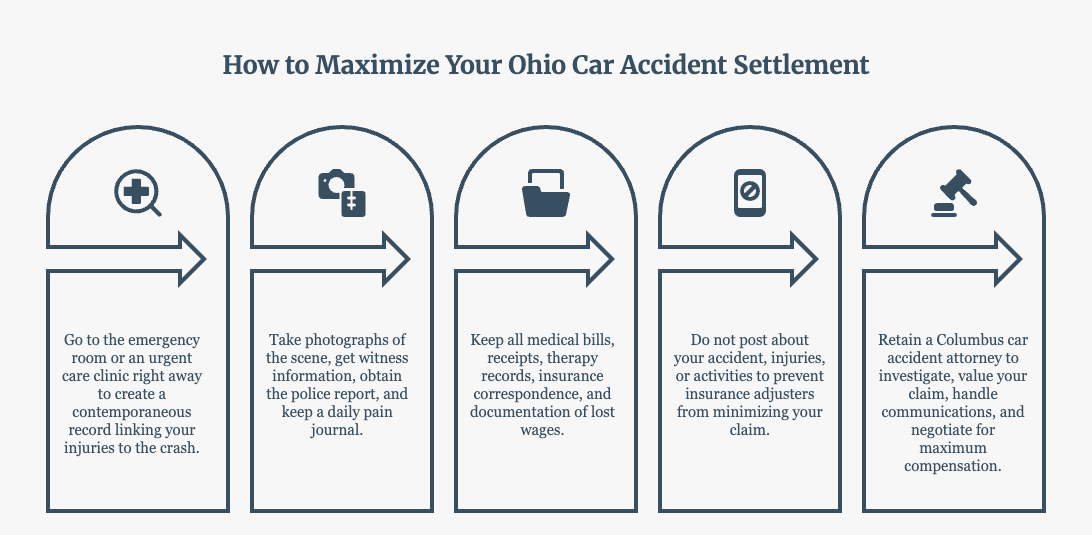
How to Maximize Your Ohio Car Accident Settlement
Taking the right steps immediately after your crash and throughout the claims process can dramatically increase the value of your settlement.
Step 1: Seek Medical Care Immediately
Go to the emergency room or an urgent care clinic right away, even if you feel fine. Adrenaline can mask pain, and some serious injuries — like traumatic brain injuries and internal bleeding — may not produce obvious symptoms immediately.
Prompt medical treatment creates a contemporaneous record linking your injuries to the crash. A gap in treatment gives insurers ammunition to argue that your injuries are not serious or were not caused by the accident.
Step 2: Document the Scene and Your Injuries
If you are physically able, take photographs of the accident scene, vehicle damage, road conditions, and any visible injuries. Get the names and contact information of all witnesses. Obtain a copy of the police report, which will be a key piece of evidence in your claim.
Throughout your recovery, keep a pain journal. Write daily entries describing your pain levels, mobility limitations, emotional struggles, and how your injuries affect your daily life. This documentation is powerful evidence for non-economic damages.
Step 3: Preserve All Evidence and Records
Keep every document related to your accident and injuries. This includes medical bills, pharmacy receipts, physical therapy records, and correspondence with insurance companies. If you miss work, document the hours and your normal pay rate. Gather pay stubs and tax returns to substantiate your lost wages claim.
Learn more about how to prove lost wages after an accident to ensure this critical component of your claim is fully documented.
Step 4: Avoid Social Media
Do not post anything about your accident, injuries, or activities on social media. Insurance adjusters routinely monitor the social media accounts of claimants. A single photo of you at a family event or a post about feeling better can be taken out of context and used to minimize your pain and suffering claim.
For a full explanation of why this matters, read about the 5 reasons not to post on social media after an injury.
Step 5: Hire an Experienced Columbus Car Accident Attorney
This is the single most impactful step you can take. Studies consistently show that accident victims represented by an attorney receive significantly higher settlements than those who negotiate alone. An experienced attorney will:
- Conduct a thorough investigation of the crash
- Identify all potentially liable parties
- Work with medical and economic experts to fully value your claim
- Handle all communications with the insurance company
- Negotiate aggressively for maximum compensation
- File a lawsuit and take your case to trial if necessary
If you are wondering whether it is worth making a personal injury claim, the answer is almost always yes — especially when you have an attorney fighting for you on a contingency fee basis, meaning you pay nothing unless you win.
The Ohio Car Accident Settlement Process: Step by Step
Understanding the settlement process helps you know what to expect and how to avoid costly mistakes.
Phase 1: Reporting the Accident and Seeking Treatment
Report the crash to law enforcement and seek medical attention immediately. Ohio law requires you to report accidents that cause injury or significant property damage. The police report will be a foundational document in your claim.
Phase 2: Opening an Insurance Claim
Notify your own insurance company of the accident, even if you were not at fault. Your attorney will then open a claim with the at-fault driver’s insurance company. The insurer will assign an adjuster to investigate the crash and evaluate your damages.
Phase 3: Medical Treatment and Maximum Medical Improvement (MMI)
Continue all recommended medical treatment until your doctor declares you have reached Maximum Medical Improvement (MMI) — the point at which your condition has stabilized and further significant improvement is unlikely. It is critical not to settle your claim before reaching MMI, as you may not yet know the full extent of your future medical needs.
Phase 4: Demand Letter and Negotiation
Once you have reached MMI, your attorney will compile all evidence and send a demand letter to the insurance company. This letter outlines the facts of the accident, your injuries, your documented damages, and the amount you are seeking.
The insurer will typically respond with a counteroffer lower than your demand. This begins a negotiation process. Your attorney will evaluate each offer and advise you on whether it fairly compensates you for all your losses.
Phase 5: Settlement or Litigation
The majority of Ohio car accident claims settle out of court. If a fair agreement is reached, you will sign a release of liability and receive your settlement payment, typically as a lump sum.
If the insurer refuses to negotiate in good faith, your attorney will file a lawsuit. Filing suit demonstrates that you are serious and often motivates insurers to increase their offer. If the case proceeds to trial, a jury will determine the final award.
Special Situations That Affect Ohio Car Accident Settlements
Accidents Involving Uninsured or Underinsured Drivers
If the at-fault driver has no insurance or insufficient coverage, your own UM/UIM policy becomes your primary source of recovery. Learn about your rights when handling car accidents involving uninsured drivers to understand all available options.
Accidents Involving Multiple Vehicles
Multi-vehicle pileups and chain-reaction crashes create complex liability questions. Multiple parties may share fault, and determining each party’s percentage of responsibility requires a thorough investigation. Read about navigating complex liability in multi-vehicle pileups for more information.
Accidents Involving Pre-Existing Conditions
If you had a pre-existing back injury, degenerative disc disease, or another prior condition, the insurance company will likely argue that your current pain is not caused by the accident. Ohio law protects you under the eggshell plaintiff doctrine: defendants must take victims as they find them. If the crash aggravated or accelerated a pre-existing condition, you are entitled to compensation for that aggravation. Learn how pre-existing back injuries affect settlement values in rear-end collision cases.
Wrongful Death Cases
When a car accident results in a fatality, the victim’s family may pursue a wrongful death claim. Ohio’s wrongful death statute allows surviving family members to recover compensation for funeral expenses, lost financial support, and the loss of companionship. Importantly, non-economic damages in wrongful death cases are exempt from the R.C. 2315.18 cap. Learn about what rights families have after a fatal car accident.
Catastrophic Injuries and Long-Term Disability
Catastrophic injuries — including traumatic brain injuries, spinal cord damage, and amputations — require a fundamentally different legal strategy. Because these injuries are exempt from Ohio’s damage cap, the potential recovery is far greater, but so is the complexity of proving the full extent of your losses. Read more about catastrophic injuries and car accidents and what to expect in these high-stakes cases.
Common Mistakes That Can Hurt Your Ohio Car Accident Settlement
Even well-intentioned actions can inadvertently damage your claim. Avoid these critical errors:
Delaying medical treatment. Waiting days or weeks to see a doctor creates a gap in your medical records that insurers will exploit to argue your injuries are not serious or were not caused by the crash.
Accepting the first settlement offer. The first offer is almost never the best offer. Insurance companies make low initial offers hoping you will accept before understanding the full value of your claim.
Giving a recorded statement. You are not legally required to give a recorded statement to the other driver’s insurance company. Adjusters use these statements to find inconsistencies that can be used against you.
Posting on social media. Even an innocent post can be misinterpreted. A photo of you smiling at a birthday party can be used to argue you are not suffering as much as you claim.
Failing to follow your doctor’s orders. If you skip appointments or ignore medical advice, insurers will argue that your injuries are not as serious as claimed and that you failed to mitigate your damages.
Waiting too long to hire an attorney. Evidence degrades over time. Surveillance footage is overwritten, witnesses move away, and physical evidence disappears. The sooner you hire an attorney, the better your chances of building a strong case.
For a comprehensive list of pitfalls to avoid, read about common mistakes that can ruin your car accident claim.
Why Choose Pencheff & Fraley as Your Ohio Car Accident Lawyers?
Pencheff & Fraley is a dedicated personal injury law firm serving clients throughout Ohio and Florida. Our attorneys have a deep understanding of Ohio’s personal injury laws, damage caps, and insurance company tactics. We have recovered millions of dollars for our clients and are committed to fighting for the maximum compensation you deserve.
We handle all types of car accident cases, including those involving truck accidents, motorcycle accidents, and catastrophic injuries. We work on a contingency fee basis, which means you pay nothing unless we win your case. There are no upfront costs and no hourly fees.
Our case results speak for themselves. We encourage you to read our client testimonials and learn more about our firm overview to understand why so many Ohio injury victims trust us with their most important legal matters.
If you have questions about the personal injury claims process, our personal injury FAQs page is a helpful resource. You can also learn more about how much it costs to hire a personal injury lawyer — the answer may surprise you.
Frequently Asked Questions
How long does it take to settle a car accident claim in Ohio?
The timeline varies depending on the complexity of your case. Simple cases with clear liability and minor injuries may settle within three to six months. Cases involving severe injuries, disputed fault, or litigation can take one to three years. It is important not to rush the process. Settling before you reach Maximum Medical Improvement means you may not know the full extent of your future medical costs, and once you sign a release, you cannot seek additional compensation.
What is the average car accident settlement in Ohio?
There is no single “average” that applies to all cases. Minor injury claims may settle for $10,000 to $30,000, while severe injury cases can result in six- or seven-figure settlements. For represented claimants with clear liability and documented injuries, settlements commonly land near $48,000. The best way to understand the value of your specific case is to consult with an experienced Ohio personal injury attorney.
What if the at-fault driver is uninsured or underinsured in Ohio?
If the at-fault driver lacks sufficient insurance, you can file a claim under your own Uninsured/Underinsured Motorist (UM/UIM) coverage. While UM/UIM coverage is optional in Ohio, it is strongly recommended given that approximately 17% of Ohio drivers are uninsured. Your attorney can help you navigate the UM/UIM claims process and ensure you recover the maximum available compensation.
Will my Ohio car accident settlement be taxed?
Generally, compensation for physical injuries and sickness is not taxable under federal or Ohio law. Portions of your settlement covering medical expenses and pain and suffering are typically tax-free. However, compensation for lost wages is generally subject to income tax because it replaces income that would have been taxed. Punitive damages, if awarded, are also taxable. Consult a tax professional for advice specific to your situation.
Do I need a lawyer to settle my Ohio car accident claim?
You are not legally required to hire an attorney, but doing so significantly increases the likelihood of a fair outcome. Insurance companies employ experienced adjusters and lawyers whose job is to minimize payouts. An attorney levels the playing field, accurately values your claim, handles all negotiations, and is prepared to take your case to court if necessary. Most personal injury attorneys work on contingency, so there is no financial risk to consulting with one.
Conclusion: Get the Ohio Car Accident Settlement You Deserve
Navigating an Ohio car accident settlement is complex. From understanding the modified comparative fault rule and the non-economic damage cap to dealing with insurance adjuster tactics and building a compelling case, the process demands expertise and persistence.
The most important step you can take is to act quickly and get the right legal help. Do not let the insurance company pressure you into accepting less than your case is worth. The team at Pencheff & Fraley is ready to fight for you.
Contact a car accident lawyer Columbus Ohio at Pencheff & Fraley today for a free, no-obligation consultation. We will review the details of your case, explain your legal options, and tell you exactly what we believe your claim is worth. You have nothing to lose and everything to gain.
References
[1] Ohio Revised Code § 2315.33. “Effect of contributory fault on right to recover damages.” https://codes.ohio.gov/ohio-revised-code/section-2315.33
[2] Ohio Revised Code § 2315.18. “Compensatory damages in tort actions.” https://codes.ohio.gov/ohio-revised-code/section-2315.18
[3] Ohio Revised Code § 2305.10. “Bodily injury or injury to personal property.” https://codes.ohio.gov/ohio-revised-code/section-2305.10
[4] Ohio Revised Code § 4509.51. “Requirements for owner’s liability insurance policy.” https://codes.ohio.gov/ohio-revised-code/section-4509.51
[5] Insurance Information Institute. “Facts + Statistics: Auto insurance.” 2024. https://www.iii.org/fact-statistic/facts-statistics-auto-insurance
[6] Ohio Supreme Court. Arbino v. Johnson & Johnson, 2007-Ohio-6948. https://www.supremecourt.ohio.gov