

Knowing what to do after a car accident in Ohio or Florida can mean the difference between a successful personal injury claim and losing your right to compensation entirely. The immediate aftermath of a collision is chaotic, stressful, and overwhelming. However, the actions you take at the scene and in the days following are critical for your physical recovery and financial security.
Whether you are navigating the busy streets of Tampa, FL, the highways near Jacksonville, FL, or the roads around Westerville, OH, the foundational steps remain similar. Yet, the legal landscapes of these two states differ significantly. Florida operates under a no-fault insurance system with strict deadlines, while Ohio follows a traditional fault-based system.
This comprehensive guide provides a detailed car accident checklist for Ohio and Florida drivers. We will walk you through the essential steps to protect your health, document evidence, and safeguard your legal rights.
Essential Car Accident Steps: Immediate Actions at the Scene
The moments immediately following a collision are crucial. Your primary focus must be on safety and fulfilling your legal obligations. Here is what you need to do immediately after a car accident in Ohio or Florida.
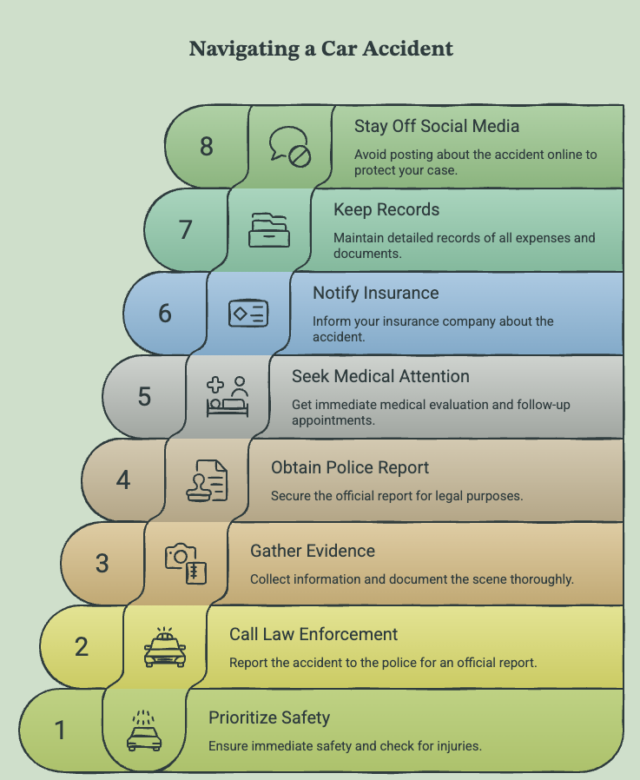
Step 1: Prioritize Safety and Check for Injuries
Your first priority is safety. Stop your vehicle immediately — leaving the scene of an accident can result in severe criminal charges in both Ohio and Florida. Turn on your hazard lights to warn oncoming traffic and prevent secondary collisions.
Check yourself and your passengers for injuries. If anyone is hurt, call 911 immediately to request emergency medical assistance. Do not attempt to move anyone who is severely injured unless there is an immediate threat to their life, such as a vehicle fire. If it is safe to do so, move your vehicle out of the flow of traffic to the shoulder of the road.
Step 2: Call Law Enforcement to the Scene
You must contact the police after any collision. An official police report is a vital piece of evidence for your personal injury claim. In Florida, you are legally required to report any crash resulting in injury, death, or property damage exceeding $500, as outlined by the Florida Department of Highway Safety and Motor Vehicles. In Ohio, you must report accidents involving injury, death, or property damage over $1,000.
When the police arrive, cooperate fully and provide an honest account of the events. Stick to the facts and avoid speculating or guessing. Most importantly, never admit fault or apologize, as these statements can be used against you by insurance companies later.
Step 3: Gather Crucial Evidence and Information
While waiting for law enforcement, begin gathering evidence if you are physically able. This is a critical part of any car accident checklist. Exchange information with the other driver, including names, contact details, driver’s license numbers, license plate numbers, and insurance information.
Use your smartphone to document the scene thoroughly. Take clear photos and videos of the vehicle damage, license plates, skid marks, road conditions, traffic signs, and any visible injuries. Additionally, identify any witnesses and collect their names and phone numbers. Witness statements can provide objective perspectives that strongly support your car accident settlement claim.
What to Photograph at the Scene
Thorough documentation at the scene is one of the most powerful tools in your case. Capture images from multiple angles and distances. Photograph the position of all vehicles before they are moved. Document any debris, skid marks, or road defects that may have contributed to the crash. Capture the surrounding environment, including traffic signals, speed limit signs, and road markings. These photos can later help accident reconstruction experts establish exactly how the crash occurred.
Step 4: Obtain the Official Police Report
Before you leave the scene, ask the responding officer for the report number. You will need this to obtain the full report later. In Florida, you can request your crash report through the Florida Department of Highway Safety and Motor Vehicles. In Ohio, reports are typically available through the investigating law enforcement agency.
Review the report carefully once you receive it. If you find any factual errors, contact the reporting officer to request a correction. Inaccuracies in the police report can complicate your insurance claim and any subsequent litigation.
Navigating the Days Following the Collision
The steps you take in the days after the crash are just as important as your actions at the scene. Protecting your health and building a strong legal foundation should be your main objectives.
Step 5: Seek Immediate Medical Attention
You must seek medical evaluation as soon as possible, even if you feel fine. Adrenaline can mask the pain of serious injuries, such as whiplash, internal bleeding, or a traumatic brain injury. A prompt medical exam ensures you receive necessary treatment and establishes a documented link between the crash and your injuries.
In Florida, this step is legally critical due to the Personal Injury Protection (PIP) 14-day rule. To qualify for your PIP benefits, you must receive initial medical care within 14 days of the accident. Delaying treatment can jeopardize your health and ruin your Florida car accident claim. Do not wait to see if symptoms develop — see a doctor immediately.
Continue All Follow-Up Medical Appointments
Attending every scheduled medical appointment is essential. Insurance companies closely monitor treatment patterns. If you skip appointments or stop treatment prematurely, adjusters will argue that your injuries are not serious. Your medical records are the most powerful documentation available to prove the full extent and lifetime cost of your injuries.
Step 6: Notify Your Insurance Company
Contact your auto insurance provider to report the accident promptly. Provide them with the basic facts of the crash — the date, time, and location. However, be cautious when speaking with insurance adjusters.
Do not provide a recorded statement or discuss the severity of your injuries before consulting a lawyer. Insurance companies are focused on minimizing payouts. If the other driver’s insurance company contacts you, politely decline to speak with them and direct them to your attorney. Handling insurance companies offering low settlements requires legal expertise that most accident victims do not have on their own.
Step 7: Keep Detailed Records of All Expenses
Begin keeping a comprehensive file of all accident-related documents and expenses. This includes medical bills, prescription receipts, physical therapy invoices, vehicle repair estimates, and rental car costs. Also document any time you missed from work due to your injuries. Proving lost wages after an accident requires pay stubs, employer letters, and tax records, so start collecting these early.
Keep a personal injury journal as well. Write daily entries describing your pain levels, physical limitations, and how your injuries are affecting your quality of life. This journal can be powerful evidence of your pain and suffering damages.
Step 8: Stay Off Social Media Platforms
One of the biggest mistakes you can make after an injury is posting about it online. Insurance investigators actively monitor social media accounts to find evidence that contradicts your claims.
Do not post photos of the accident, discuss your injuries, or share updates about your physical activities. Even an innocent photo of you smiling at a family gathering can be twisted to suggest you are not truly injured. There are many reasons why you shouldn’t post on social media after an injury, so it is best to avoid all platforms until your case is fully resolved.
Understanding the Legal Differences: Ohio vs. Florida
While the basic car accident steps apply everywhere, the legal frameworks in Ohio and Florida are vastly different. Understanding these distinctions is crucial for protecting your rights and maximizing your compensation.
Florida’s No-Fault System and PIP Insurance
Florida is a no-fault state. This means that after a collision, you must first turn to your own Personal Injury Protection (PIP) insurance to cover medical bills and lost wages, regardless of who caused the crash. According to the Florida Office of Insurance Regulation, PIP covers 80% of necessary medical expenses and 60% of lost wages, up to your policy limit (typically $10,000).
You can only step outside the no-fault system and file a lawsuit against the at-fault driver if your injuries meet Florida’s “serious injury threshold.” This threshold includes significant and permanent loss of an important bodily function, permanent injury within a reasonable degree of medical probability, significant and permanent scarring or disfigurement, or death.
Ohio’s Traditional Fault-Based System
Ohio operates under a traditional fault-based, or “tort,” system. In Ohio, the driver who caused the accident is financially responsible for the resulting damages. You have three primary options to seek compensation: file a claim with your own insurance, file a third-party claim directly with the at-fault driver’s insurance, or file a personal injury lawsuit against the at-fault driver. Understanding how to start a personal injury claim in Ohio is the first step toward recovering what you are owed.
Ohio also follows a modified comparative negligence rule. You can recover damages as long as you are not more than 50% at fault for the accident. However, your compensation will be reduced by your percentage of fault. If you are found to be 51% or more responsible, you are barred from recovering any damages.
Ohio vs. Florida: Key Legal Differences at a Glance
The table below summarizes the most important legal distinctions between Ohio and Florida for car accident victims.
| Legal Factor | Ohio | Florida |
| Insurance System | Fault-based (Tort) | No-fault (PIP) |
| Minimum Liability Coverage | 25/50/25 | 10/20/10 |
| PIP Required | No | Yes ($10,000 minimum) |
| Medical Care Deadline | No strict deadline | 14 days for PIP eligibility |
| Comparative Fault Rule | Modified (51% bar) | Modified (51% bar, post-HB 837) |
| Statute of Limitations | 2 years | 2 years (post-March 24, 2023) |
| Serious Injury Threshold | Not applicable | Required to sue at-fault driver |
Comparing the Statute of Limitations
The statute of limitations dictates the strict legal deadline for filing a lawsuit. Missing this deadline means you permanently lose your right to sue for compensation.
Ohio: The statute of limitations for car accidents in Ohio is generally two years from the date of the crash for personal injury and property damage claims, under Ohio Revised Code § 2305.10.
Florida: Due to recent legislative changes under HB 837, the Florida statute of limitations for car accidents was reduced from four years to two years. For accidents occurring after March 24, 2023, you generally have two years from the date of the accident to file a negligence lawsuit.
What NOT to Do After a Car Accident in Ohio or Florida
Understanding what to avoid is just as important as knowing the right steps to take. Many accident victims unknowingly damage their own claims by making these common errors.
Do Not Leave the Scene
Leaving the scene of an accident before exchanging information and speaking with police is a criminal offense in both states. In Florida, leaving the scene of an accident involving injury is a felony. In Ohio, it is also a serious criminal charge. Always remain at the scene until law enforcement releases you.
Do Not Admit Fault or Apologize
Even if you believe you may have contributed to the crash, do not say so at the scene. Fault is a complex legal determination that depends on evidence, witness accounts, and applicable traffic laws. Admitting fault or apologizing can be used as a legal admission against you. Review the common mistakes that can ruin your car accident claim to avoid costly errors.
Do Not Sign Anything Without an Attorney
You may be approached by the other driver’s insurance company with a quick settlement offer. Do not sign any release or settlement agreement without first consulting a personal injury attorney. Once you sign a release, you waive your right to pursue any additional compensation, even if your injuries turn out to be far more serious than initially believed.
Do Not Delay Seeking Medical Care
Delaying medical treatment is one of the most damaging things you can do for your case. In Florida, it can disqualify you from PIP benefits. In both states, a gap in medical treatment gives insurance companies ammunition to argue that your injuries were not caused by the accident or are not as serious as you claim.
Why You Need a Car Accident Attorney in Ohio or Florida
Navigating the aftermath of a collision is complex. Hiring an experienced attorney levels the playing field against powerful insurance companies and ensures your rights are fully protected.
Maximizing Your Financial Compensation
Insurance companies employ teams of adjusters and lawyers whose primary goal is to minimize your payout. An experienced attorney understands how to calculate the true value of your claim, including current and future medical expenses, lost earning capacity, and pain and suffering. They will aggressively negotiate to secure the maximum Ohio car accident settlement or Florida car accident claim value you deserve.
Handling Complex Liability Issues
Determining fault is not always straightforward. Cases involving multiple vehicles, commercial trucks, or uninsured drivers require extensive investigation. Your legal team will gather evidence, consult with accident reconstruction experts, and build a compelling case to prove liability and hold all negligent parties accountable.
Navigating the Personal Injury Claims Process
The personal injury claims process in Florida and Ohio involves strict procedural rules, filing deadlines, and complex negotiations. An attorney handles all communications with insurance companies, files all necessary paperwork, and represents your interests at every stage. If a fair settlement cannot be reached, your attorney will be prepared to take your case to trial.
Understanding the Psychological Impact of Your Injuries
Car accidents can cause significant psychological trauma in addition to physical injuries. Conditions such as post-traumatic stress disorder (PTSD), anxiety, and depression are common after serious crashes. The psychological effects of injuries sustained in a car accident are compensable damages that an experienced attorney will ensure are included in your claim.
Frequently Asked Questions
What should I do if the other driver is uninsured?
If you are hit by an uninsured driver, you may need to rely on your own Uninsured/Underinsured Motorist (UM/UIM) coverage. This coverage is optional in both Ohio and Florida, but it is highly recommended. It steps in to cover your damages when the at-fault driver lacks sufficient insurance. An attorney can help you navigate the process of handling car accidents involving uninsured drivers and maximize your recovery.
When should I contact a lawyer after a crash?
You should contact a personal injury lawyer as soon as possible after ensuring your immediate safety and seeking medical care. Early legal intervention prevents you from making critical mistakes, such as giving recorded statements to insurance adjusters. It also allows your attorney to preserve vital evidence before it disappears. There is no cost to consult with our team, and you pay nothing unless we win.
How much does it cost to hire a personal injury lawyer?
Most reputable personal injury firms, including Pencheff and Fraley, operate on a contingency fee basis. This means you pay nothing upfront, and the attorney only collects a fee if they successfully secure a settlement or verdict on your behalf. You can learn more about how much it costs to hire a personal injury lawyer on our website.
What if the accident was partially my fault?
Both Ohio and Florida use a modified comparative negligence system (following Florida’s HB 837 reforms). You can still recover compensation as long as you are not more than 50% responsible for the accident. However, your total recovery will be reduced by your percentage of fault. An attorney can help minimize your assigned fault percentage and maximize your compensation.
What types of compensation can I recover after a car accident?
Accident victims in Ohio and Florida may be entitled to recover economic damages, such as medical expenses, lost wages, and property damage, as well as non-economic damages, including pain and suffering, emotional distress, and loss of enjoyment of life. In cases involving egregious negligence, such as drunk driving accidents, punitive damages may also be available.
Conclusion: Protect Your Rights After a Car Accident in Ohio or Florida
Knowing what to do after a car accident in Ohio or Florida is essential for protecting your physical well-being and financial future. From prioritizing safety at the scene to seeking prompt medical care and understanding the unique laws of your state, every step matters. The differences between Ohio’s fault-based system and Florida’s no-fault PIP framework mean that the specific actions you take can have dramatically different legal consequences depending on where your crash occurred.
Do not face the insurance companies alone. The experienced legal team at Pencheff and Fraley is dedicated to fighting for the rights of accident victims across Ohio and Florida. We have a proven track record of securing millions in settlements for our clients, and we are ready to put that experience to work for you.
If you or a loved one has been injured in a collision, contact us today for a free, no-obligation consultation. Let us handle the legal complexities so you can focus on your recovery.
References
The following authoritative sources were consulted in the preparation of this guide.
- Ohio Department of Public Safety — Crash Reports
- Florida Department of Highway Safety and Motor Vehicles — Involved in a Crash
- Florida Department of Highway Safety and Motor Vehicles — Crash Dashboard
- Florida Office of Insurance Regulation — Personal Injury Protection
- Insurance Information Institute — Auto Insurance Basics
- National Highway Traffic Safety Administration (NHTSA)
- Ohio Revised Code § 2305.10 — Bodily Injury or Injury to Personal Property