
Jacksonville Car Accident Lawyer
A Jacksonville car accident lawyer can investigate a collision, identify available insurance, document your losses, and pursue a claim on your behalf. Pencheff & Fraley Injury and Accident Attorneys offers a free case review for people injured in Jacksonville. The right path depends on the crash, your injuries, and the coverage available.
A collision can interrupt your work, treatment, transportation, and family life. You do not have to sort through every insurance question on your own. Request a free Jacksonville case review to discuss what happened and what representation may involve.
How a Jacksonville car accident lawyer can help
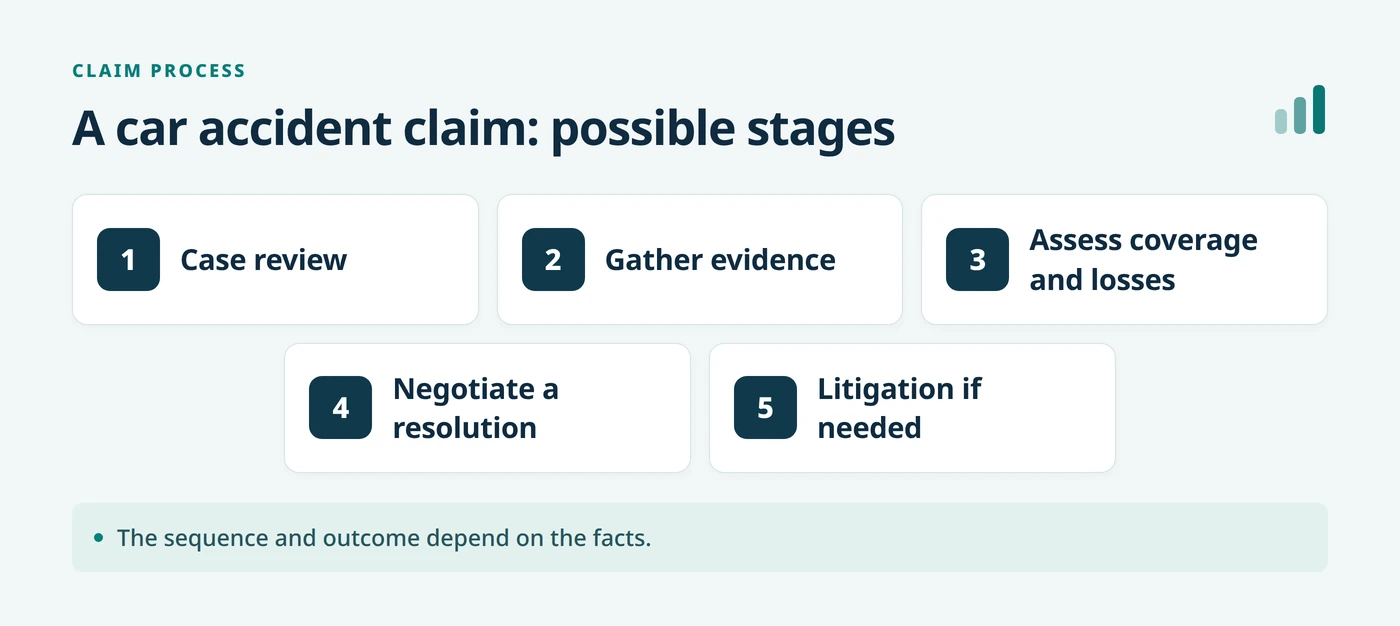
A car accident claim is more than a repair estimate. It may involve several insurers, disputed facts, and injuries that are still changing. A lawyer can assess the situation and explain possible next steps.
Investigating what caused the collision
The legal team can review the available crash report, photographs, vehicle damage, and witness information. It can also look for video or other evidence that may show how the collision occurred. The records available will depend on the crash and how quickly they are preserved.
Identifying insurance and responsible parties
The driver who hit you may not be the only relevant party. An employer, vehicle owner, or another driver may also need to be considered. Coverage can come from more than one policy, depending on the facts and policy terms.
Documenting injuries and financial losses
A claim may involve medical bills, time away from work, and future needs. A lawyer can review the records and identify information needed to describe those losses. Pain and other nonfinancial effects may also matter, subject to Florida law.
Handling negotiations and possible litigation
A lawyer can communicate with insurers, evaluate offers, and discuss whether a proposed resolution fits the evidence. Some cases resolve through negotiation. Others may require a lawsuit or trial. The process and outcome depend on the facts, available coverage, and the parties’ decisions.
Why contact Pencheff & Fraley about a Jacksonville car crash?
The firm represents people with injury claims and lists car accidents among its practice areas. Its Jacksonville office gives local clients a place to connect with the team. The firm also offers free consultations and virtual appointments, according to its Jacksonville office page.
A case review is a chance to describe the collision and ask about the next stage. You can discuss insurance questions, medical bills, and concerns about missed work. The team can explain whether it can assist after reviewing the facts.
- Local contact: Pencheff & Fraley Injury and Accident Attorneys, 1437 San Marco Blvd, Jacksonville, FL 32207.
- Telephone: 904-770-4953.
- Starting point: Request a free case review or schedule a Jacksonville case review.
The firm’s car accident practice page explains its broader work in this area. The Jacksonville office page covers its local injury services more generally.
Types of Jacksonville car accident cases
Different crash situations create different evidence and coverage questions. A case review can help identify which issues matter in yours.
| Collision or situation | Questions a lawyer may examine |
|---|---|
| Rear-end collision | What do vehicle damage, traffic conditions, and available video show about the impact? |
| Intersection or left-turn collision | What do signals, witness accounts, and the vehicles’ paths show? |
| Highway or multi-vehicle crash | How did the sequence of impacts unfold, and which drivers may share responsibility? |
| Hit-and-run or uninsured driver | Can the driver be identified, and is uninsured motorist coverage available under a relevant policy? |
| Rideshare or delivery vehicle | Was the driver working, and which policies may apply at the time of the crash? |
| Commercial or company vehicle | Was the driver acting for an employer, and what records or insurance may be relevant? |
Passengers, drivers, and families of people who died in a collision may face different claim issues. A consultation can identify who may have a claim and the information needed to evaluate it. If a motorcycle was involved, ask the team which insurance rules may apply.
Who may be responsible for a Jacksonville car accident?
Responsibility depends on the evidence, not simply on who received a ticket or whose vehicle has more damage. An investigation may consider each driver’s conduct, the road layout, and the timing of the collision.
Other drivers and shared fault
Possible issues include distraction, failure to yield, following too closely, or unsafe lane changes. A crash report can be useful, but it is not the only evidence. Witnesses, photographs, and vehicle data may help fill gaps or challenge an initial account.
More than one person may share fault. Under Florida’s comparative fault statute, a claimant’s share of fault may reduce damages. In covered negligence cases, a person who is more than 50% at fault for their own harm generally cannot recover. At exactly 50%, that bar does not apply on that basis, though damages may still be reduced. Older accidents, insurance contracts, and different types of claims can raise additional questions about which rules apply.
Employers, vehicle owners, and other parties
A driver may have been working when the crash occurred. Ownership, the driver’s role, and the available records may affect whether another party has responsibility. These issues require a fact-specific review; employment or ownership alone does not establish liability.
A roadway or vehicle condition may also be relevant. Claims involving a public entity or a vehicle defect can raise additional notice, evidence, or legal questions. Those issues should be evaluated promptly because different rules may apply.
Evidence that can support a Jacksonville car accident claim
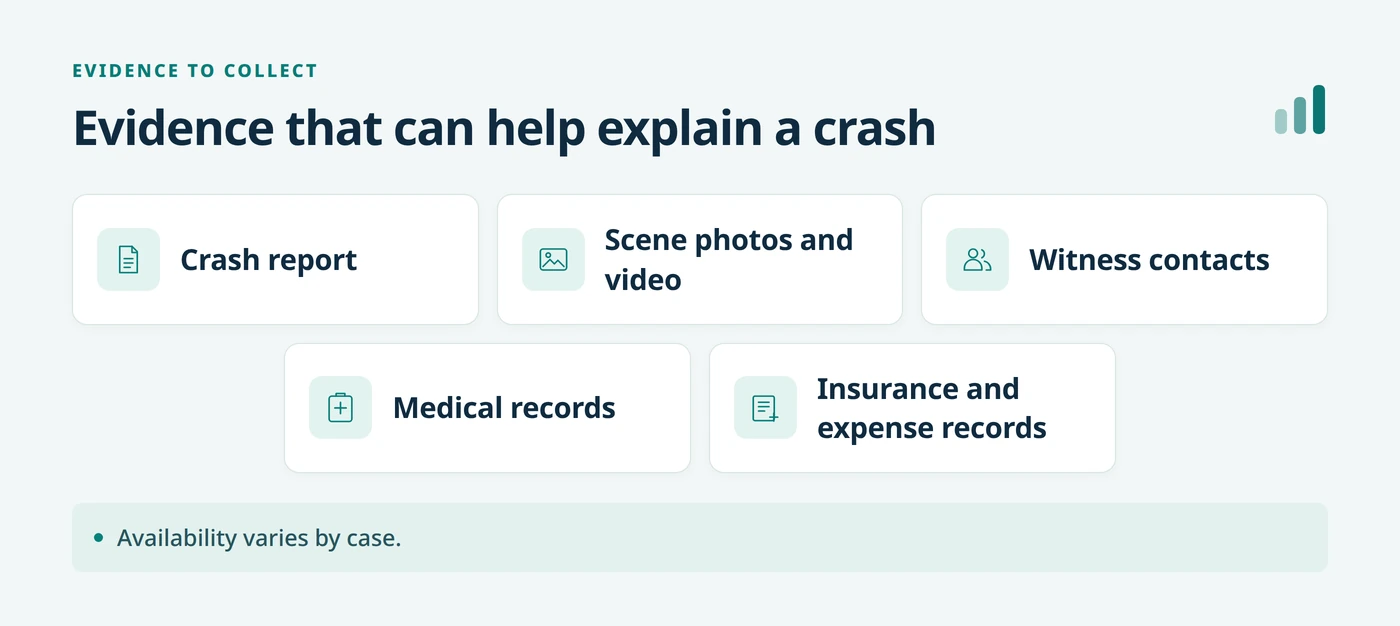
Evidence can help connect the crash to the injuries and losses claimed. The list below is a starting point, not a requirement to have everything before calling.
Crash reports, photos, and witnesses
- Keep the crash report number and the responding agency’s name, if available.
- Save photographs of vehicle damage, the scene, road markings, and visible injuries.
- Keep witness names and contact details if you have them.
- Note nearby cameras, dashcams, or businesses that may have recorded the collision.
- Save communications from insurers and other parties.
A report can contain useful information, but it may omit facts or include errors. Read more about getting a Jacksonville car accident police report. An attorney can discuss how a report fits with other evidence.
For a Jacksonville Sheriff’s Office report, the sheriff’s public records page lists its public counter at 450 Magnolia Street and district locations. The state also offers the Florida Crash Portal. Availability and access requirements vary.
Crash reports containing personal information are confidential for 60 days after the report is filed. Crash parties and their legal representatives are among those who may receive access earlier, subject to the conditions in Florida’s crash-report statute. The applicable identification and other requirements still matter.
Medical, work, and expense records
Medical records can help explain diagnosis, treatment, and the connection between a crash and an injury. Keep billing statements and records of related expenses. Pay records, employer information, and a description of missed work may help document income loss.
Some evidence can disappear or become harder to obtain over time. If you do not have records or photographs, you can still ask for a case review. Explain what you remember and what information you do have.
Florida car accident insurance: how coverage may fit together
Florida insurance claims can involve different sources of payment. The policy language, the people involved, and the injury facts all matter. A case review can identify coverage questions without assuming that a particular policy applies.
Comparing possible sources of coverage
| Possible source | What the review may address |
|---|---|
| Personal injury protection | Eligibility for medical or disability benefits, the care received, and remaining policy benefits. |
| At-fault party’s liability insurance | Evidence of responsibility, covered losses, policy terms, and available limits. |
| Uninsured or underinsured motorist coverage | Whether a relevant policy covers the injured person and the vehicle involved. |
| Property-damage coverage | Damage to the vehicle or other property and the terms of the applicable policy. |
These routes are not interchangeable. More than one may be relevant, and each has its own requirements. An attorney can review the policies and explain how the facts affect the analysis.
Personal injury protection and medical care
Personal injury protection, or PIP, may provide benefits regardless of who caused the crash. Eligibility depends on the person, vehicle, coverage, and statutory rules. Under Florida’s PIP statute, medical benefits generally pay 80% of reasonable expenses for covered, medically necessary services. Medical and disability benefits share a $10,000 limit, subject to the law and policy terms.
For PIP medical benefits, the injured person must receive qualifying initial care within 14 days after the crash. The PIP statute specifies the eligible providers and facilities. That treatment requirement is not the deadline for every PIP benefit or for a negligence lawsuit.
The amount payable for medical services can depend on an emergency medical condition determination. If a qualifying provider determines there was no such condition, reimbursement for the specified services is limited to $2,500. PIP disability benefits can cover 60% of certain lost income, subject to statutory conditions. PIP does not pay for vehicle repairs.
Claims against an at-fault driver
A claim against another driver or other responsible party may involve that party’s liability coverage. A fault-based claim requires evidence of responsibility and damages. The insurer may dispute either issue, so a demand does not necessarily lead to payment.
In covered cases against certain defendants, Florida’s no-fault statute sets an injury threshold for pain, suffering, mental anguish, and inconvenience damages. The listed alternatives include a qualifying permanent injury, significant and permanent scarring or disfigurement, significant and permanent loss of an important bodily function, or death. The threshold does not mean that every type of claim requires a permanent injury. A lawyer can explain whether it applies to your case.
Uninsured and underinsured motorist coverage
Uninsured motorist coverage may be relevant when an at-fault driver has no liability coverage or not enough coverage for the claimed losses. Its availability depends on the policy, the people covered, and the circumstances. Florida’s uninsured motorist statute includes rules for rejecting coverage and for certain underinsured vehicles. An attorney can review the relevant policies and explain possible coverage issues.
Health insurance, liens, and property damage
Health coverage, medical bills, and potential reimbursement claims can affect what happens after a resolution. Property damage is a separate issue from documenting bodily injury. Bring the policies, bills, and insurer letters you have so the team can review how they may interact.
What compensation may be available after a Jacksonville car accident?
A claim may include economic losses and, when the law permits, non-economic losses. Not every category applies to every case. The evidence, available coverage, and applicable law shape what can be pursued.
| Potential loss | Examples of information that may help document it |
|---|---|
| Medical expenses | Treatment records, bills, prescriptions, rehabilitation, and anticipated care information. |
| Lost income | Pay records, work schedules, time missed, and information about future work limitations. |
| Property damage | Repair estimates, vehicle value information, and receipts for related expenses. |
| Other financial losses | Records of accident-related costs and how they connect to the collision. |
| Pain and other non-economic harm | Medical records and information about how the injury affects daily life; legal limits and thresholds may apply. |
Future losses require support rather than a guess. The seriousness of an injury is only one consideration. Responsibility, policy terms, the available evidence, and other legal issues can also affect a claim. See the firm’s discussion of Florida car accident claim value.
How injuries can affect the claim
Some people face fractures, back or neck injuries, head injuries, or other conditions after a crash. Symptoms and recovery differ. The records of diagnosis, treatment, restrictions, and changes over time can be important when evaluating a claim.
A case review is not a medical evaluation. Discuss symptoms and treatment questions with an appropriate medical professional. Tell the legal team about prior conditions as well as new symptoms, so it can understand the complete picture.
Examples of how Jacksonville car accident claims can differ
These examples are hypothetical. They show questions that may arise, not actual results or predictions.
A rear-end crash with ongoing treatment
A driver is hit in traffic and continues treatment after the vehicle is repaired. The property damage records may help explain the impact, but the medical records address different questions. A lawyer can examine the treatment history, missed work, available coverage, and any offer before discussing a possible resolution.
A multi-vehicle collision with disputed fault
Several vehicles collide near a highway interchange, and drivers disagree about the sequence. A report, witness accounts, and available video may tell different parts of the story. The lawyer’s review may focus on each driver’s conduct and on which policies could apply. Responsibility cannot be decided from the number of vehicles alone.
A hit-and-run with limited information
A driver leaves before the injured person can get a name or insurance details. A witness or nearby camera may provide useful information. The injured person’s policy may also need review for applicable uninsured motorist coverage. Coverage depends on the policy and facts; a missing driver does not answer that question by itself.
What happens during a car accident claim?
The path varies. A case may involve several insurers or disputed facts, and a resolution is not assured. These stages can help you understand what a discussion with the firm may cover.
Case review and investigation
The team can start by asking when and where the crash occurred, who was involved, and what treatment you have received. If the firm takes the case, the scope of representation will be addressed in your agreement. The investigation may include seeking records and identifying potential coverage.
Evaluating a demand and negotiating
When there is enough information to evaluate the claim, a lawyer may present a demand to an insurer. The demand can describe liability, injuries, and claimed losses. An insurer may respond with questions, a denial, or an offer. Your lawyer can explain the response and discuss available options.
Settlement, lawsuit, or other resolution
A settlement is an agreement to resolve a claim. Its terms matter, including which claims are released and how any outstanding obligations are handled. If negotiations do not resolve the dispute, a lawsuit may be an option. Filing suit does not mean the case will necessarily go to trial.
Common insurance challenges after a collision
An insurer may ask for a statement, medical authorization, records, or additional details about the crash. The request and the policy involved can matter. A lawyer can explain the request and discuss how to respond based on your situation.
An early offer may arrive before the full effects of an injury are clear. Before agreeing to a release, it can be useful to understand what claims it covers and what expenses may remain. Keep copies of the offer and any documents the insurer asks you to sign.
A denial does not by itself explain every available option. The policy language, stated reason, and supporting records need review. You can bring denial letters and other correspondence to a consultation.
Florida car accident deadlines and time-sensitive issues
Under Florida’s limitations statute, ordinary negligence actions generally have two years to begin a lawsuit. The 2023 change to the negligence period applies to causes of action accruing after March 24, 2023. See the 2023 statute’s applicability notes. An older claim or a claim accruing on that date needs separate review.
The same current limitations statute generally provides two years for a wrongful-death action. Its accrual and exceptions can differ from those of an injury claim. The time to begin a lawsuit is distinct from the PIP medical-treatment requirement.
Different rules may apply to older accidents, different claims, minors, or claims involving a government entity. Insurance policies can also contain reporting and cooperation conditions. A lawyer can evaluate the dates and any exceptions for your circumstances. Do not assume an insurance claim stops a lawsuit deadline from running.
For a closer look, read the firm’s guide to the Florida car accident statute of limitations. A case review can address which deadlines matter in your situation.
Special situations that can change a claim
A passenger is injured
A passenger may have questions about the driver’s policy, another driver’s policy, and the passenger’s own coverage. Responsibility and coverage depend on the crash and the policies. A family or friendship with the driver does not answer every insurance question.
The driver leaves or lacks adequate insurance
In a hit-and-run, identifying the vehicle and preserving available video can be important. An uninsured or underinsured motorist claim may be relevant if applicable coverage exists. Policy conditions and the facts determine the available options.
A rideshare, delivery, or company vehicle is involved
The driver’s work status and the policies in effect can affect the coverage analysis. App records, trip details, employment information, and vehicle ownership may be important. Do not assume that a company is responsible simply because its name appears on a vehicle or an app.
A family member dies in the crash
A fatal collision can raise a wrongful-death claim as well as difficult insurance questions. Under Florida’s wrongful-death law, the personal representative brings the action for the estate and survivors. The facts and applicable deadlines matter. Learn more about Jacksonville wrongful death claims.
Local representation for Jacksonville car accident claims
Jacksonville crashes can happen on neighborhood streets, at busy intersections, or along routes such as I-95, I-10, I-295, and J. Turner Butler Boulevard. The exact location matters when identifying the responding agency, potential witnesses, and available video. The office team can discuss a collision in Jacksonville and the surrounding area.
The firm’s Jacksonville office is at 1437 San Marco Blvd, Jacksonville, FL 32207. Call 904-770-4953 or contact the firm for a free case review. Virtual appointments are also listed on the firm’s Jacksonville office page.
Preparing for a free case review
You can contact the firm even if you do not have a police report or know which insurance applies. Bring or share the information you have, such as:
- The date and location of the crash, and the responding agency if known.
- The other driver’s details and any report or claim numbers.
- Photos, videos, and witness contact information.
- Insurance cards, policy documents, and letters from insurers.
- Medical provider names, bills, and records of missed work.
- Questions about communication, fees, possible expenses, and next steps.
You do not need to know the value of your claim before the conversation. The team can explain what further information may be useful and whether the firm can assist. For more context, see what to do after a car accident that was not your fault.
Questions to ask about representation
Ask who will handle communications, how you can receive updates, and what information the team needs from you. The firm describes its personal injury matters as contingency-fee cases. In that model, the attorney’s fee is generally tied to a recovery. Case costs and expenses are separate from attorney fees, and depending on the written agreement, a client may be responsible for some costs and expenses whether or not there is a recovery. Ask how the proposed agreement treats attorney fees and case expenses. The terms should be set out in your agreement.
Frequently asked questions about Jacksonville car accident claims
How much does a Jacksonville car accident lawyer cost?
Pencheff & Fraley offers a free case review. The firm describes its personal injury matters as contingency-fee cases, where attorney fees are generally tied to a recovery. Case costs are separate from attorney fees and, depending on the written agreement, may be owed whether or not there is a recovery; ask how the proposed agreement treats fees and case costs. A review does not require you to hire the firm.
Who pays for medical bills after a Florida car accident?
The answer depends on the available insurance and the facts. Personal injury protection may pay qualifying benefits, subject to statutory requirements and policy terms. Health coverage and a claim against a responsible party may also be relevant. A case review can help identify the policies and bills to examine.
Does Florida’s no-fault law prevent a pain and suffering claim?
Not necessarily. In covered cases against certain defendants, Florida law requires an injury to meet a specified threshold for pain, suffering, mental anguish, and inconvenience damages. The law lists several qualifying outcomes, and whether it applies depends on the case.
Can I seek compensation if I was partly at fault?
Possibly. Florida’s comparative fault rules can reduce recovery and may bar certain negligence claims when a claimant’s share of fault exceeds the statutory threshold. Exceptions and the law applicable to the case matter. A lawyer can review the evidence and dates rather than relying only on an insurer’s assessment.
Do I need a lawyer if the insurance company made an offer?
You can ask a lawyer to review an offer and any proposed release before deciding. The review can address the documented losses, remaining bills, coverage, and what rights the release would resolve. Whether to accept an offer is a decision based on the facts and the advice you receive.
What if the other driver has no insurance or leaves the scene?
An uninsured motorist policy may be relevant if applicable coverage exists. The driver’s identity, the facts, policy language, and notice requirements can affect the analysis. Share any report, policy information, photographs, or witness details you have during the case review.
How long do I have to bring a car accident lawsuit in Florida?
Ordinary Florida negligence actions generally have two years to begin a lawsuit. The negligence change in 2023 applies to causes of action accruing after March 24, 2023. Other claims, older dates, and exceptions can affect the answer. See Florida’s limitations statute and the 2023 applicability notes. A lawyer can review the dates in your case.
Can a passenger make a car accident claim?
A passenger may have a claim, depending on the facts, the responsible parties, and available insurance. Relevant coverage may include more than one policy. A lawyer can review the collision and policy details to explain possible options.
How much is my Jacksonville car accident claim worth?
There is no fixed value that applies to every claim. The evidence of fault, injury, financial losses, applicable law, and available coverage can all matter. A case review can identify what information is needed to evaluate your particular claim.
How long does a car accident claim take?
There is no single timetable. Treatment, evidence collection, coverage questions, insurer responses, and whether litigation is needed can affect the timing. The legal team can explain the likely stages after learning more about the case.
Can I contact the firm before I have the crash report?
Yes. You can request a case review with the information you have. A report number, the responding agency, and the crash location may help the team identify the report, but you do not need every document before reaching out.
What if I had an injury before the crash?
A prior condition does not answer every question about a later collision. Medical records and treatment history may help explain what changed and whether the crash contributed to your current condition. Discuss both the earlier condition and the new symptoms during the case review.
What if I do not have health insurance?
You can still ask about a case review. Available personal injury protection, other coverage, provider billing, and the facts of the injury may affect how bills are handled. The team can review your coverage information and discuss legal questions; medical providers can address treatment and billing options.
Can I speak with the firm remotely?
The firm’s Jacksonville office page lists virtual appointments. Contact the team or request a Jacksonville case review to discuss available appointment options.
Request a free Jacksonville car accident case review
A crash may leave you with questions about treatment, insurance, and the effect on your work or family. Pencheff & Fraley can listen to your account and discuss whether the firm can help. The first conversation is an opportunity to understand the process, not a promise of a particular outcome.
Request a free Jacksonville case review or contact Pencheff & Fraley. You can also call 904-770-4953.
This article is intended for general informational purposes only and does not constitute legal advice. Laws change, and the information above may not reflect the most recent legal developments. Please contact the Pencheff & Fraley team to discuss the specific facts of your case.
Written by
Pencheff & Fraley Editorial Team
The firm represents injured people in Florida.
Last reviewed: November 11, 2026.
- Record-Setting Verdicts
- No Upfront Fees
- Free Case Reviews
- Personalized Attention
- Maximized Payouts
- 98% Win Rate
- 5 Star Attorneys
- Faster Settlements
- Honest & Transparent
Pencheff & Fraley
Injury and Accident Attorneys
- ✓
- ✓
- ✓
- ✓
- ✓
- ✓
- ✓
- ✓
- ✓
Other Attorneys
- ✕
- ✕
- ✕
- ✕
- ✕
- ✕
- ✕
- ✕
- ✕
OUR LOCATIONS

© 2026 Pencheff & Fraley Injury and Accident Attorneys. All Rights Reserved. Privacy Policy *Client photos are illustrative only.