

A truck crash can leave you injured, disoriented, and unsure what to do next. Knowing what to do after a truck accident in Florida can protect your health, preserve evidence, and help you avoid preventable claim mistakes. Start with safety and emergency care. Then document what you can, protect your records, and get advice before discussing fault or settlement with the trucking company’s insurer.
If you cannot safely move, photograph the scene, or speak with witnesses, do not force yourself. Emergency care comes first. Ask a passenger, witness, or family member to preserve information when possible.
If the crash just happened: the emergency checklist
Call 911 and request law enforcement and medical help. Stay at the scene unless you need emergency treatment or must leave for safety. If you can move without worsening an injury, get away from traffic and other immediate hazards.
Do not admit fault, guess about what happened, sign a release, or accept money at the scene. Give responders accurate facts. Avoid arguing with the truck driver or discussing the crash with bystanders on camera.
When safe, ask for the crash report number. Save the date, time, location, responding agency, and names of officers or paramedics. A commercial motor vehicle crash should be treated as an emergency-reporting event. Florida Highway Safety and Motor Vehicles lists crashes involving commercial motor vehicles among events for which drivers should stay at the scene and call 911. 1
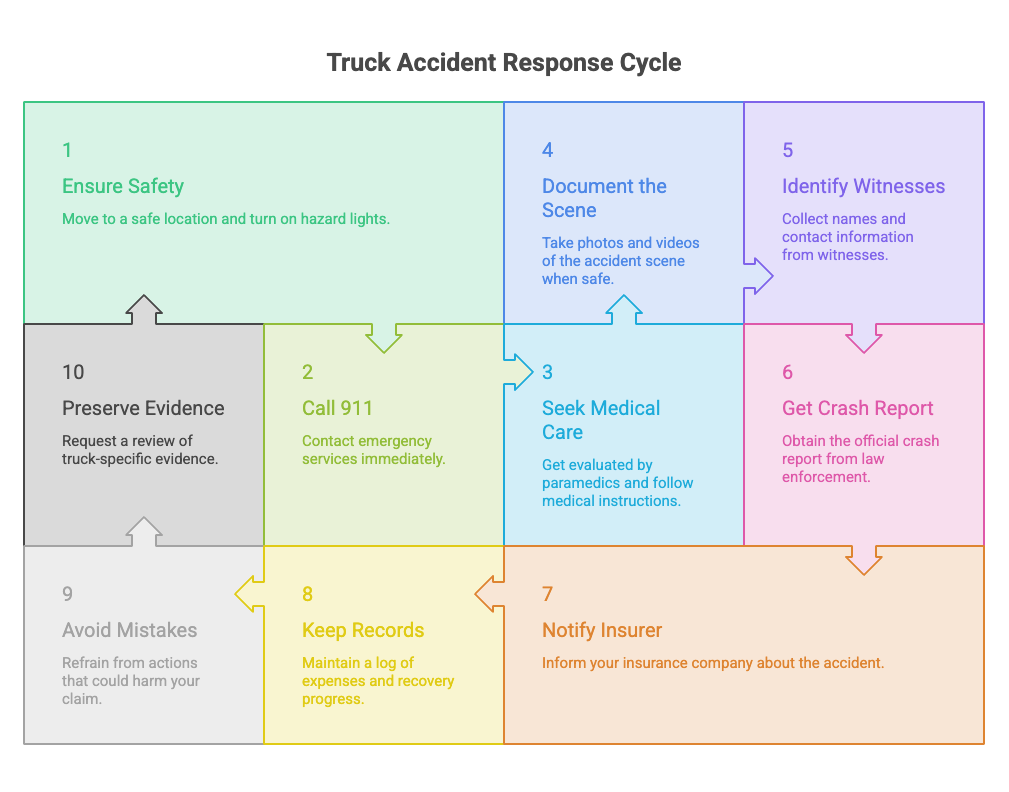
What to Do After a Truck Accident in Florida: the First 60 Minutes
1. Get to safety and call 911
Turn on hazard lights if you can do so safely. Move a vehicle only when remaining in its current position creates a greater danger, or when law enforcement directs you to move it. Do not move an injured person unless necessary to prevent immediate harm or to provide emergency care.
Florida’s current crash-reporting statute requires immediate notice for a crash involving injury, death, or at least $2,000 in apparent vehicle or property damage. The same statute directs notice to local law enforcement, the county sheriff, or the nearest Florida Highway Patrol station, depending on location. Read the current Florida Statutes section 316.065 before relying on a general online checklist. 2
The Florida Highway Safety and Motor Vehicles page also identifies hit-and-run crashes, DUI crashes, tow-away crashes, and commercial motor vehicle crashes as events requiring law-enforcement notification. Its public guidance may not reflect every recent statutory amendment. When sources appear inconsistent, follow the responding agency’s instructions and obtain legal advice.
2. Request medical care and follow medical instructions
Let paramedics evaluate you. Some injuries become more noticeable after adrenaline fades. Follow-up care is also important when symptoms develop later.
Tell the provider about every symptom, even if it seems minor. Describe pain, dizziness, numbness, weakness, headaches, sleep problems, anxiety, and difficulty performing ordinary activities. Do not exaggerate. Do not minimize symptoms to appear fine.
Ask how to schedule follow-up care. Keep each appointment or call the provider if you cannot attend. A treatment gap can create a misleading record, even when the gap has a practical explanation.
3. Document the scene only when it is safe
If you can safely use a phone, capture the scene before vehicles or debris move. Take wide views first. Then take closer images of damage, tire marks, roadway conditions, traffic signs, lane markings, lighting, weather, and visible injuries.
Do not stand in a traffic lane. Do not climb onto a truck or enter a damaged vehicle. Do not handle spilled cargo, leaking fluids, wires, or suspected hazardous materials.
What truck information should you record?
Photograph the truck, trailer, license plate, company name, carrier markings, and any visible USDOT or MC number. Record the driver’s name, employer, contact information, and insurance information if law enforcement or the driver provides it.
Truck identifiers can connect the vehicle to a carrier, broker, owner, or maintenance provider. They can also help a lawyer request records from the correct company. Do not delay medical care to search for every number.
4. Identify witnesses and preserve original files
Ask willing witnesses for names, phone numbers, email addresses, and a short description of what they saw. If a witness has dashcam footage, ask the witness to preserve the original file. Do not edit, crop, filter, or repeatedly resave the only copy.
Keep original photos and videos on the device used to create them. Back them up to a secure location. Preserve the date, time, and location information when available. Do not send the only copy through an app that compresses or strips metadata.
What if I cannot take photos after the crash?
That is common. Ask a passenger, witness, family member, towing company, or lawyer to help preserve evidence. Tell your lawyer exactly why you could not document the scene. A lack of photographs does not decide fault by itself.
The crash report, 911 records, vehicle damage, medical records, witness accounts, traffic-camera footage, and truck-side records may provide other evidence. Your safety and medical care matter more than obtaining a perfect photo set.
First 24 hours: protect your health and your claim
5. Get the crash report information
Ask law enforcement how to obtain the report. Keep the report number, agency name, county, date, and any exchange-of-information sheet. Florida’s official Traffic Crash Reports page says reports may take up to 10 days to become available. It also explains how an eligible person may purchase a report through the Florida Crash Portal. 1
Read the report when it becomes available. Look for incorrect vehicle descriptions, misspelled names, missing witnesses, or incomplete injury information. Do not argue with an officer at the scene. Ask an attorney how a factual error can be addressed.
6. Notify your own insurer carefully
Review your policy and follow its notice requirements. Report the crash honestly. Ask what documents the insurer needs to open a claim and what benefits may apply to vehicle damage, rental transportation, medical bills, or personal injury protection.
Your own insurer is not the same as the trucking company’s insurer. Your policy may require cooperation. The carrier’s adjuster represents the carrier’s financial interests. Before giving a recorded statement to the other side, signing a medical authorization, or accepting a release, seek legal advice.
Florida’s Department of Financial Services automobile-insurance guidance explains common auto coverages and directs consumers to insurance-help resources. Policy language controls. 3
7. Keep a simple recovery and expense log
Create one folder for the crash. Add the crash report, photographs, medical records, bills, prescriptions, insurance letters, emails, text messages, tow receipts, storage invoices, repair estimates, rental records, and receipts.
Record missed work, reduced hours, job duties you could not perform, and out-of-pocket expenses. Keep pay records that show the loss. Ask your employer for written confirmation when appropriate.
Keep a daily symptom and activity log. Note appointments, medication effects, sleep problems, mobility limits, and tasks that require help. Use ordinary language. A consistent record can help your medical team and lawyer understand the crash’s practical impact.
8. Avoid common post-crash mistakes
Do not delete messages, photographs, dashcam files, location data, or social-media posts. Do not post blame, injuries, settlement discussions, or photos that could be taken out of context. Do not exaggerate online, either.
Do not repair or dispose of a damaged vehicle before it is inspected when an inspection is reasonably possible. Ask about storage, preservation, and evidence before authorizing repairs. Do not sign a broad release because an adjuster says it is routine.
Do not stop prescribed treatment without speaking with the provider. If cost, transportation, work, or insurance creates a barrier, tell the provider and ask about options. Do not hide prior injuries. Explain what changed after this crash.
First week: preserve truck-accident evidence
9. Ask for a focused evidence-preservation review
Commercial truck cases can involve records that a crash victim cannot obtain alone. Potential evidence may include the truck’s event-data or engine-control information, electronic logging device records, hours-of-service records, dispatch messages, driver-qualification materials, drug-and-alcohol testing records, inspection and maintenance files, cargo-loading documents, GPS data, dashcam footage, and carrier safety records.
The Federal Motor Carrier Safety Administration explains that an electronic logging device synchronizes with a vehicle engine and records driving time and records-of-duty-status information. 4 An ELD does not necessarily contain every form of speed, braking, or impact data. Different truck systems store different information.
A lawyer may send a written preservation notice to the carrier, owner, broker, maintenance company, shipper, or other party. The notice can identify categories of evidence and request that ordinary deletion or overwriting be suspended. It does not guarantee that evidence exists, will be preserved, or will prove liability.
Why do hours-of-service records matter?
Federal rules for covered property-carrying drivers include an 11-hour driving limit after 10 consecutive hours off duty, a 14-hour on-duty window, and a 30-minute break after eight cumulative hours of driving. The FMCSA hours-of-service summary describes these rules and their exceptions. 5
The rules do not decide every negligence claim. They can identify records worth investigating when fatigue, scheduling, or delivery pressure may be relevant. A lawyer should compare the records with dispatch messages, fuel receipts, GPS data, inspection records, and witness accounts.
Can post-accident testing affect the investigation?
Federal regulation 49 C.F.R. § 382.303 requires post-accident alcohol or controlled-substance testing in specified commercial-motor-vehicle crashes. The triggers include certain fatality, immediate-medical-treatment, and disabling-damage scenarios combined with the regulation’s citation conditions. The rule also states that necessary medical care must not be delayed. Read the current eCFR text before making a case-specific assumption. 6
Medical, property, and income records
Keep treatment connected to your recovery
Attend recommended appointments. Ask questions when a diagnosis, test, referral, or restriction is unclear. Give providers an accurate history and explain how the crash affects work, driving, lifting, sleeping, childcare, and household tasks.
Do not treat an online article as a medical diagnosis. Seek emergency care for symptoms that may signal an urgent condition. Follow the advice of emergency professionals.
Track vehicle damage and property loss
Keep photographs of the vehicle before repairs. Save estimates, invoices, towing records, storage charges, rental-car records, and correspondence about total-loss or diminished-value issues. Make a separate list of personal property damaged in the collision.
Ask your lawyer or insurer when an inspection should occur. A damaged truck or car may hold physical evidence. Repairs can change or eliminate evidence, so document the condition before work begins.
Document lost income and future effects
Keep pay stubs, schedules, tax records, benefit statements, and employer communications. Note missed shifts, reduced duties, unpaid leave, lost business opportunities, and the date you resumed work.
Future medical care and reduced earning capacity may require medical or vocational evidence. Do not promise a specific dollar value in a post-crash conversation. A claim’s value depends on injury proof, causation, fault, coverage, damages, and applicable law.
Who may be responsible for a Florida truck accident?
A truck crash does not automatically make the driver or carrier liable. Responsibility depends on evidence and the legal theory that applies. Potentially relevant parties may include the following:
| Potential party | Questions an investigation may examine |
| Driver | Was the driver distracted, impaired, fatigued, speeding, or violating a safety rule? |
| Carrier or employer | Did the company hire, train, supervise, schedule, or retain the driver negligently? |
| Truck or trailer owner | Who controlled the vehicle, inspections, repairs, and maintenance? |
| Broker or shipper | Did the company select a carrier, create delivery pressure, or provide inaccurate information? |
| Cargo loader | Was cargo loaded, balanced, or secured correctly? |
| Maintenance provider | Were brakes, tires, steering, lights, or other systems inspected and repaired properly? |
| Manufacturer | Did a defective component contribute to the crash or increase the injury? |
| Another motorist or entity | Did another driver, roadway condition, signal, or public or private entity contribute? |
These categories overlap. A contract label does not answer every liability question. The evidence may include the crash report, photographs, ELD and GPS records, driver files, maintenance logs, cargo documents, inspection records, phone data, camera footage, and expert analysis.
For a focused discussion of responsibility, link to who may be liable in a truck accident. For broker-specific issues, use the existing broker-liability resource.
Florida rules that may affect a truck-accident claim
Florida PIP and the 14-day medical-care rule
Florida personal injury protection, or PIP, can provide first-party benefits under an applicable policy. Florida Statutes § 627.736 generally provides a $10,000 limit for medical and disability benefits and a $5,000 death benefit. It also provides 80% of reasonable, medically necessary medical expenses when required initial services and care occur within 14 days of the crash.
Read the current Florida PIP statute 7 and the Florida Bar consumer explanation of automobile insurance 8. Coverage, exclusions, provider qualifications, emergency medical-condition rules, policy limits, and claim facts matter.
The 14-day rule is not a reason to delay emergency treatment. It is a reason to seek appropriate medical evaluation promptly and ask a qualified professional about follow-up care.
Serious-injury thresholds and claims beyond PIP
Florida’s no-fault system does not answer every injury claim. Section 627.737 permits certain tort damages for pain, suffering, mental anguish, and inconvenience when the injury meets statutory conditions. Those conditions include significant and permanent loss of an important bodily function, a permanent injury within reasonable medical probability, significant and permanent scarring or disfigurement, or death.
Read the current Florida Statutes section 627.737 9. Do not assume an injury meets a threshold based on a diagnosis name alone. Medical evidence and the specific facts control.
Comparative fault
Florida’s comparative-fault statute reduces damages in a negligence action according to a claimant’s share of fault. A party found more than 50% at fault for their own harm may not recover damages in an action covered by the statute. The statute has exceptions and does not apply to every type of claim.
See Florida Statutes section 768.81 10. Do not admit fault at the scene or in a recorded statement. A factual explanation is different from a legal conclusion.
Florida filing deadlines
Florida’s current limitations statute generally lists two years for an action founded on negligence and two years for wrongful death. Other claims may have different periods, notice rules, tolling provisions, or exceptions. A government defendant, minor, estate, product claim, or other special fact pattern can change the analysis.
Read Florida Statutes section 95.11 11. Do not wait for the deadline. Evidence, medical records, witness memory, and vehicle condition can change long before a lawsuit is filed.
Insurance and settlement communications
What should I say to the trucking company’s insurer?
Give basic identifying and claim information when appropriate. Avoid speculation about speed, distance, fault, medical prognosis, or whether you are “fine.” Do not guess when you do not know.
Before a recorded statement, broad medical authorization, or release, consult a lawyer. Ask what the document authorizes and whether it limits future claims. An early settlement can end a claim before the full medical and financial impact is known.
Should I accept a quick settlement?
Do not accept a settlement because you feel pressured, because the adjuster says the offer will expire, or because the amount seems helpful today. Once a release is signed, you may lose the ability to seek more money for later-discovered injuries or expenses.
A lawyer can review the offer, coverage, evidence, damages, liens, and future care. No lawyer can guarantee a result or a settlement amount.
What insurance may be involved?
A claim may involve PIP, bodily-injury liability, uninsured or underinsured motorist coverage, medical payments coverage, health insurance, collision coverage, or other policy provisions. The available coverage depends on the vehicles, policies, parties, injury, and facts.
Ask for a complete copy of each relevant policy and declarations page when possible. Do not assume the truck’s size tells you the policy limits. Do not assume the carrier’s first description of the crash is complete.
Special situations after a truck crash
Fatal crashes and wrongful death
If someone died, contact emergency services and a lawyer promptly. Preserve death records, funeral expenses, financial-support information, photographs, messages, and witness details. Wrongful-death rights and eligible survivors depend on Florida law and the facts.
Passengers and children
Each injured person may have a different medical record, insurance path, and legal issue. Keep separate records for each person. A parent or guardian should obtain advice about a child’s claim and any court requirements.
Commercial drivers and work-related crashes
A driver who was working may have employer, workers’ compensation, insurance, and commercial-driver issues in addition to the traffic claim. Report the injury as required by workplace policy and obtain medical care. Do not sign an employment or insurance document without understanding it.
Hit-and-run or unidentified truck
Call 911 and preserve the direction of travel, truck color, trailer markings, cargo description, debris, witnesses, and nearby camera locations. Ask about uninsured-motorist coverage. Do not chase the truck.
Delayed symptoms or inability to document
Seek medical advice when symptoms arise. Explain when they began and what changed. If you could not photograph the scene because of injury, medication, darkness, traffic, or emergency transport, preserve every other record and explain the limitation consistently.
How to choose a Florida truck-accident lawyer
Truck cases can involve multiple parties, federal safety records, severe injuries, and contested insurance coverage. Ask whether the lawyer regularly handles commercial-truck cases, who will investigate the crash, how evidence will be preserved, how communication works, and whether the lawyer is prepared to file suit when appropriate.
Ask how fees and case expenses work. Ask who will be your main contact. Ask whether the firm has experience with ELD, maintenance, cargo, driver-qualification, and carrier records. Ask what the lawyer sees as the first evidence priorities.
For a practical interview list, read 5 Questions to Ask Before Hiring an Accident Lawyer in Ohio or Florida. The firm’s page specifically discusses how to evaluate experience, resources, communication, and trial readiness.
Pencheff & Fraley’s Florida truck-accident lawyers page is the relevant practice-area resource. Its commercial-truck accidents in Florida article is a related topical page. Review those pages for current firm information before publication.
Frequently Asked Questions
What should I do first after a truck accident in Florida?
Call 911, request medical help, and move to safety only when it is safe. Do not admit fault or sign anything. Document the scene only if you can do so without creating another danger.
Should I move my car after a truck crash?
Move it only when leaving it creates a greater danger, when you can do so safely, or when law enforcement directs you. Do not move an injured person unless necessary for immediate safety or emergency care.
Do I have to call 911 after a commercial truck accident?
Treat a commercial motor vehicle crash as a reportable emergency and call 911. Florida’s official crash-report guidance lists commercial motor vehicle crashes among events requiring law-enforcement notification. Current statutory reporting duties also depend on injury, death, and apparent damage.
What if the trucking company’s insurer calls me?
Give basic identifying information when appropriate. Do not guess about fault, prognosis, or the crash. Before a recorded statement, broad medical authorization, or release, seek legal advice.
Should I notify my own insurance company?
Review your policy and follow its notice requirements. Report the crash accurately. Ask what benefits and documents apply. Your own insurer and the trucking company’s insurer may have different interests and duties.
How do I get the Florida crash report?
Ask the responding agency for the report number and agency details. Florida’s Traffic Crash Reports page explains availability, purchase, and self-reporting information. Reports may take up to 10 days to become available.
What if I could not take photos at the scene?
Do not risk your health to obtain photographs. Ask a witness, passenger, family member, towing company, or lawyer to help. Preserve the crash report, medical records, original messages, vehicle evidence, and other available records.
What evidence matters in a Florida truck-accident claim?
Useful evidence may include the crash report, photographs, witness information, dashcam or traffic-camera footage, truck identifiers, medical records, wage records, vehicle records, ELD and GPS data, maintenance files, inspection records, cargo documents, dispatch communications, and driver-qualification records.
How soon should I seek medical care for PIP benefits?
Florida Statutes § 627.736 generally requires initial services and care within 14 days for the statutory PIP medical benefits described there. Seek emergency care immediately when needed. Read the current statute and follow qualified medical advice.
Can I recover if someone says I was partly at fault?
Possibly, but Florida’s comparative-fault statute can reduce damages. A person found more than 50% at fault may be barred from recovery in covered negligence actions. The law and facts must be applied to the specific claim.
How long do I have to file a truck-accident lawsuit in Florida?
Florida’s current statute generally lists two years for negligence actions and wrongful-death actions. Exceptions and different rules may apply. Contact a lawyer promptly instead of relying on a general deadline.
How much is a Florida truck-accident case worth?
There is no reliable standard amount. Value depends on injury severity, medical proof, future care, lost income, property damage, liability, comparative fault, available coverage, liens, and litigation risk.
What does a truck-accident lawyer cost?
Many personal-injury firms use contingency fees, but the percentage, costs, and case expenses depend on the written agreement and case stage. Ask for the fee agreement in plain language before signing.
Can I handle a truck-accident claim without a lawyer?
Some claims can be handled without counsel. Commercial-truck claims may involve multiple parties, federal records, serious injuries, and contested coverage. A consultation can help you understand the evidence and deadlines before you decide.
What should I do if the crash involved a death, child, work injury, or hit-and-run?
Call 911, obtain emergency care, preserve records, and get prompt legal advice. These facts can create different insurance, probate, workers’ compensation, or deadline issues.
Conclusion: act safely and preserve what you can
The most important answer to what to do after a truck accident in Florida is simple: get safe, call 911, obtain medical care, and avoid premature statements or settlements. Then preserve original evidence, protect your records, understand the difference between insurers, and seek advice before important evidence disappears.
If you want a confidential review, contact a Florida truck accident lawyer at Pencheff & Fraley. A consultation can help identify the next evidence and insurance steps. It does not create an attorney-client relationship unless the firm agrees to represent you.
For broader background, read the firm’s Florida personal-injury guide. For catastrophic injuries, use the existing catastrophic truck-accident injuries in Florida resource when relevant to the reader’s circumstances.
References
[1] Florida Highway Safety and Motor Vehicles: Traffic Crash Reports
[2] 2026 Florida Statutes: Section 316.065, Crashes; reports; penalties
[3] Florida Department of Financial Services: Personal Automobile Insurance Overview
[4] FMCSA: Electronic Logging Devices
[5] FMCSA: Summary of Hours-of-Service Regulations
[6] eCFR: 49 CFR § 382.303, Post-accident testing
[7] 2026 Florida Statutes: Section 627.736, Required personal injury protection benefits
[8] The Florida Bar: Consumer Pamphlet—Automobile Insurance
[9] 2026 Florida Statutes: Section 627.737, Tort exemption and limitation on right to damages
[10] 2026 Florida Statutes: Section 768.81, Comparative fault
[11] 2026 Florida Statutes: Section 95.11, Limitations other than for recovery of real property
This article is intended for general informational purposes only and does not constitute legal advice. Laws change, and the information above may not reflect the most recent legal developments. Please contact a qualified personal injury attorney to discuss the specific facts of your case.