

A routine trip to pick up groceries can instantly turn into a painful ordeal. When you slip and fall at a grocery store in Florida, the physical, emotional, and financial consequences can be overwhelming. You may be wondering who is responsible for your medical bills and whether you have a legal claim. Florida premises liability laws are complex, and large supermarket chains fight aggressively to minimize payouts.
Understanding exactly what happens if you slip and fall at a grocery store in Florida is the first step toward protecting your rights. This guide explains the specific legal standards you must meet, the immediate actions you must take, and the compensation you may be entitled to recover. Whether you fell at Publix, Walmart, Winn-Dixie, Aldi, or Target, the legal framework is the same — and so is the urgency to act quickly.
Florida Premises Liability Law: What Grocery Stores Owe You
Under Florida law, business owners owe their customers a legal duty to maintain their premises in a reasonably safe condition. However, the law places a significant burden on the injured person, not the store. This is the most important thing to understand about a Florida grocery store slip and fall lawsuit.
Under Florida Statute § 768.0755, if you slip and fall on a “transitory foreign substance” — such as a spilled drink, a smashed grape, or a puddle from a leaking freezer — you must prove that the grocery store had actual or constructive knowledge of the dangerous condition. You must also prove they should have taken action to remedy it. Simply showing that you fell and were injured is not enough.
Actual Knowledge vs. Constructive Knowledge
Actual knowledge means a store employee directly saw the spill, created the hazard, or was informed about it by another customer before your fall. This is the easier type of knowledge to prove, but it is also less common.
Constructive knowledge is far more frequently litigated. It means the dangerous condition existed for such a length of time that, in the exercise of ordinary care, the store should have discovered and corrected it. Florida law allows you to prove constructive knowledge through circumstantial evidence. For example, if you slip on a puddle of water that has shopping cart tire tracks running through it, those tracks suggest the spill had been there long enough for multiple carts to pass over it.
How Florida’s 2023 Tort Reform Affects Your Claim
In 2023, Florida enacted significant tort reform that directly impacts grocery store slip and fall compensation in Florida. The state shifted to a modified comparative fault system with a 51% bar rule. Under this rule, if a jury determines you are more than 50% at fault for your own fall, you are completely barred from recovering any compensation.
If you are found 30% at fault — perhaps because you were distracted — your total award is reduced by 30%. This change makes gathering strong, immediate evidence absolutely critical. The store’s insurance company will work hard to shift blame onto you, and the new law gives them a powerful tool to do so.
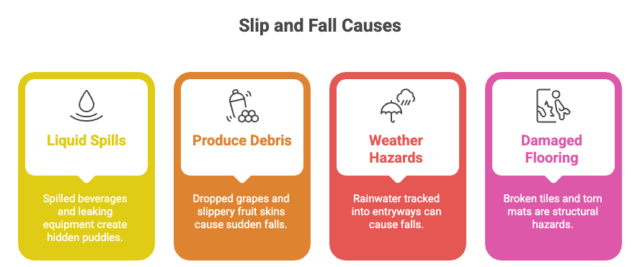
Common Causes of Slip and Fall Accidents in Florida Grocery Stores
Supermarkets are high-traffic environments where hazards can develop quickly. Identifying the specific cause of your fall is essential for establishing the store’s negligence.
Liquid Spills and Leaking Equipment
Spilled beverages in the drink aisle are among the most frequent causes of falls. Leaking refrigeration units and freezer condensation create hidden puddles that are nearly invisible on light-colored tile floors. When employees fail to mop these areas promptly or fail to place warning signs, customers face serious risk.
Produce and Food Debris
The produce section is a well-known hazard zone. Dropped grapes, fallen lettuce leaves, and slippery fruit skins can cause a sudden, violent fall. Store safety protocols typically require frequent sweeping of these areas, and a failure to follow those protocols is strong evidence of negligence.
Weather-Related Entryway Hazards
Florida’s frequent and intense rainstorms mean customers constantly track water into store entryways. If a store fails to provide adequate floor mats, fails to mop the entrance during a storm, or fails to post wet floor signs, they can be held liable for any resulting falls. This is a particularly common cause of injury at stores with large glass entryways.
Damaged Flooring and Poor Lighting
Broken or uneven floor tiles, torn floor mats, and poor lighting in aisles or parking lots are all hazards that a store is responsible for correcting. These are considered “structural” hazards rather than transitory ones, but the same legal principles of premises liability apply.
What to Do Immediately After Slipping and Falling at a Grocery Store
The actions you take in the first few minutes and days after a fall can make or break your case. Supermarket chains have corporate risk management teams and insurers trained to minimize claims. You must be proactive and deliberate.
Step 1: Report the Incident to Store Management
Do not leave the store without reporting your fall to a manager. Request that they complete an official incident report and ask for a copy before you leave. If they refuse to provide a copy, take a photo of it with your phone or write down the manager’s name and the exact time the report was filed. This report creates an official record that the incident occurred.
Step 2: Document the Scene Thoroughly
Use your smartphone to take wide-angle and close-up photos of the exact spot where you fell. Capture the substance you slipped on, any lack of warning signs, nearby cleaning logs, and the surrounding area. Also photograph your shoes and any stains on your clothing. This visual evidence is crucial for proving constructive knowledge.
Step 3: Gather Witness Information
If anyone saw you fall or noticed the spill before you fell, get their names and phone numbers immediately. Independent witness testimony is incredibly powerful evidence when fighting a large grocery store chain. Witnesses who noticed the spill before your fall are especially valuable, as they can help establish how long the hazard existed.
Step 4: Seek Immediate Medical Attention
Your health is the top priority. Go to an emergency room or urgent care clinic right away, even if you believe your injuries are minor. Adrenaline can mask the pain of severe injuries like torn ligaments, herniated discs, or spinal damage. Delaying medical care also gives the insurance company an opportunity to argue that your injuries were caused by something other than the fall.
Step 5: Preserve Evidence of the Surveillance Footage
Grocery stores typically have extensive camera systems covering every aisle and entryway. Critically, most stores overwrite their surveillance footage within 24 to 72 hours. Your attorney can send a formal legal hold letter to the store demanding that this footage be preserved. If the store destroys footage after receiving such a notice, it can be used as evidence of their negligence.
Mistakes to Avoid After a Florida Grocery Store Fall
Knowing what not to do is just as important as knowing the right steps to take. Avoid these common pitfalls that can seriously damage your claim.
Do Not Give a Recorded Statement to the Insurance Company
The store’s insurance adjuster will likely contact you within days of the accident. They may sound sympathetic, but their goal is to get you to say something that minimizes your claim or shifts blame onto you. Never give a recorded statement without first consulting a personal injury attorney.
Do Not Accept an Early Settlement Offer
Stores and their insurers sometimes offer a quick, lowball settlement to close the case before you understand the full extent of your injuries. Once you accept a settlement and sign a release, you permanently forfeit the right to seek additional compensation, even if your injuries turn out to be far more serious than initially apparent.
Avoid Posting on Social Media
Insurance investigators routinely monitor the social media accounts of claimants. A single photo of you standing, walking, or engaging in any physical activity can be used to argue that your injuries are not as severe as you claim. Avoid all social media posts related to your activities, health, or the accident while your case is pending.
Types of Compensation Available After a Grocery Store Slip and Fall
If you successfully prove the store’s negligence, you may be entitled to significant compensation. Florida law allows injured victims to recover two primary categories of damages.
Economic Damages
Economic damages are your calculable, documented financial losses. These include past and future medical bills, emergency room visits, surgery costs, physical therapy, and prescription medications. They also cover lost wages for time missed from work, as well as any loss of future earning capacity if your injuries prevent you from returning to your previous job.
Non-Economic Damages
Non-economic damages compensate you for the intangible but very real impacts of the fall. This category includes physical pain and suffering, emotional distress, mental anguish, and loss of enjoyment of life. Severe falls can result in chronic pain, permanent disability, or disfigurement — all of which dramatically alter a person’s daily life and are compensable under Florida law.
The table below summarizes the types of compensation you may be able to pursue:
| Damage Type | Examples |
| Medical Expenses | ER visits, surgery, physical therapy, medications |
| Lost Wages | Income lost during recovery period |
| Loss of Earning Capacity | Reduced ability to work long-term |
| Pain and Suffering | Physical pain, chronic discomfort |
| Emotional Distress | Anxiety, depression, PTSD from the accident |
| Loss of Enjoyment of Life | Inability to participate in hobbies or activities |
How Grocery Stores Defend Against Slip and Fall Claims
Understanding the defenses that grocery stores and their insurers commonly use will help you and your attorney prepare a stronger case.
The “Open and Obvious” Defense
Stores often argue that the hazard was “open and obvious” — meaning a reasonable person should have seen and avoided it. For example, they may claim that a wet floor sign was clearly visible or that the spill was in plain sight. Under Florida’s modified comparative fault rules, this argument can reduce or eliminate your recovery.
The “No Notice” Defense
This is the most common defense in Florida premises liability grocery store cases. The store will claim they had no actual or constructive knowledge of the hazard. They will argue the spill occurred moments before your fall and that employees had no reasonable opportunity to discover and clean it. This is why photographic evidence, witness statements, and surveillance footage are so critical.
Blaming the Victim
Insurance adjusters are trained to find any reason to argue you were partially at fault. They may claim you were not watching where you were walking, that you were wearing inappropriate footwear, or that you were distracted by your phone. Under the 2023 comparative fault changes, even a finding of 51% fault against you will eliminate your entire recovery.
Why You Need a Florida Personal Injury Attorney
Going up against a massive corporate entity like Publix or Walmart is not something you should do alone. These companies have vast resources, dedicated legal teams, and experienced insurance adjusters whose sole job is to minimize payouts.
An experienced Florida slip and fall attorney understands the nuances of Florida Statute § 768.0755. They know how to secure surveillance footage before it is overwritten, subpoena store cleaning logs, and retain expert witnesses who can testify about the store’s failure to follow safety standards. They will handle all communication with the insurance company and fight for the maximum compensation you deserve.
Before deciding to pursue a claim, many people wonder whether it is worth making a personal injury claim and what the cost to hire a personal injury lawyer will be. At Pencheff & Fraley, we work on a contingency fee basis — you pay nothing unless we win your case.
Time is also a critical factor. Florida’s statute of limitations gives you only two years from the date of the accident to file a lawsuit. Missing this deadline means permanently losing your right to compensation. You can learn more about why understanding the statute of limitations is crucial for your injury claim. If your injuries are particularly severe, you may also need to explore whether your case qualifies as a catastrophic personal injury claim.
Pencheff & Fraley serves clients throughout Florida, including Jacksonville, Orlando, and Tampa. If you or a loved one has been injured in a grocery store slip and fall, contact us today for a free, no-obligation consultation. You can also review our personal injury practice area and our case results to see how we have helped clients like you recover the compensation they deserve.
Contact Pencheff & Fraley today for a free consultation. Do not wait — evidence disappears, and the clock on your claim is already running.
FAQ
How much is the average grocery store slip and fall settlement in Florida?
There is no single average because every case is unique. Settlements can range from $15,000 for minor soft tissue injuries to over $1 million for catastrophic injuries. The amount depends on the severity of your injuries, your total medical bills, lost wages, and how clearly the store’s negligence can be established. A recent jury verdict awarded nearly $3.97 million to a woman who slipped at a Publix in Kissimmee, demonstrating that significant recoveries are possible with strong evidence and skilled legal representation. [1]
How long do I have to sue a grocery store for a slip and fall in Florida?
Due to Florida’s 2023 tort reform legislation, the statute of limitations for negligence claims — including slip and fall cases — is now two years from the date of the accident. [2] If you miss this deadline, you will permanently lose your right to seek any compensation, regardless of how strong your case may be.
Can I still get compensation if there was a wet floor sign?
Yes, but it is more difficult. The presence of a wet floor sign does not automatically absolve the store of liability. You may still recover compensation if you can prove the sign was not clearly visible, was placed in the wrong location, or that the hazard was unavoidable despite the warning. The store will likely use the comparative negligence defense, arguing you should have seen the sign. An attorney can help you counter this argument.
Do I need to go to the doctor if I feel fine after falling?
Yes, absolutely. You should always seek a medical evaluation after any fall, even if you feel fine in the immediate aftermath. Adrenaline and shock can mask the pain of serious injuries. Many conditions — including concussions, herniated discs, and soft tissue damage — do not produce obvious symptoms for hours or even days. A prompt medical record also serves as critical evidence directly linking your injuries to the accident.
What if I cannot afford a lawyer for my slip and fall case?
You do not need money upfront to hire a personal injury attorney. Most reputable firms, including Pencheff & Fraley, operate on a contingency fee basis. This means the firm covers all upfront investigation and litigation costs, and you only pay a percentage of your recovery if your case is successful. If you do not win, you owe nothing. There is no financial barrier to getting experienced legal help.
Contact us today for a free, no-obligation consultation. We will review your case, answer your questions, and explain your legal options. Learn how we can help you on the road to recovery. Pay nothing unless we win your case.
Call us at 904-770-4953 or visit our website at www.pencheffandfraley.com to schedule your free case consultation.
We’re Here for You 24/7
We are available 24/7 to take your call. If you are unable to travel, we will come to you. The sooner you call, the stronger your case can be. Your path to maximum compensation and justice starts with a single phone call to Pencheff & Fraley.
Author: Pencheff and Fraley Legal Team
Disclaimer: This article is for informational purposes only and does not constitute legal advice. Every case is unique, and you should consult with a qualified attorney about your specific situation.