
You were simply a passenger, riding to your destination, when another driver’s negligence turned your trip into a nightmare. If another driver caused your Uber or Lyft accident, you are not alone — and you are not without options. Rideshare accident claims involving a third-party driver are among the most legally complex personal injury cases, involving multiple insurance policies, competing liability claims, and corporate legal teams designed to minimize what you receive.
At Pencheff & Fraley, our personal injury attorneys understand the unique challenges these cases present. This guide will explain exactly what happens when another driver is at fault in a rideshare crash, who is responsible for your compensation, and what steps you must take to protect your rights.
Why Rideshare Accidents Involving Third-Party Drivers Are Uniquely Complex
A standard two-car accident involves two drivers and two insurance companies. A rideshare accident involving a third-party driver adds several more layers: your rideshare driver, the rideshare company (Uber or Lyft), the company’s commercial insurer, the at-fault driver, and the at-fault driver’s personal insurer. Each of these parties has a financial interest in paying as little as possible.
Rideshare services have grown dramatically in the United States. According to research from the University of Chicago and Rice University, rideshare services are associated with a 3% increase in traffic-related fatalities annually, equating to approximately 987 additional deaths per year. A University of Illinois Chicago study found that one in three rideshare drivers has been involved in a crash while working. With millions of rides completed every day, the odds of being involved in a rideshare accident are not negligible.
When another driver causes a crash involving your Uber or Lyft, the situation can feel overwhelming. However, as our guide on sorting through rideshare insurance coverage complications explains, the law provides you with clear rights and multiple avenues for compensation — provided you act quickly and strategically.
Who Is Liable When Another Driver Causes a Rideshare Accident?
Liability in a rideshare accident involving a third-party driver does not rest on a single party. Instead, it is distributed across multiple potential defendants, each with their own insurance coverage. For a broader overview of this topic, see our article on who’s liable when your Uber or Lyft ride ends in injury.
The At-Fault Third-Party Driver
The driver who caused the accident bears primary liability for your injuries. Under standard negligence principles, a driver who acts recklessly, runs a red light, drives while distracted, or otherwise violates their duty of care is legally responsible for the harm they cause. You have the right to file a personal injury claim against their auto insurance policy for:
- Medical expenses (past and future)
- Lost wages and diminished earning capacity
- Pain and suffering
- Emotional distress
- Property damage
The challenge is that many drivers carry only the minimum liability insurance required by state law. In Ohio, for example, the minimum is $25,000 per person and $50,000 per accident for bodily injury — amounts that can be exhausted quickly in a serious crash involving hospitalization, surgery, or long-term rehabilitation. To understand the hidden costs of car accidents that victims often overlook, our dedicated article provides a thorough breakdown.
Uber and Lyft’s Commercial Insurance Policies
This is where rideshare accidents differ fundamentally from standard car accidents. Both Uber and Lyft maintain substantial commercial insurance policies that are designed to protect passengers even when a third-party driver is at fault. This coverage is not optional — it is a legal requirement in most states and a core part of the rideshare business model.
The coverage available to you as a passenger depends on the “period” of the trip at the time of the accident:
| Trip Period | Driver Status | Coverage Available |
| Period 0 | App is off | Driver’s personal insurance only; no rideshare coverage |
| Period 1 | App is on, waiting for a ride request | Limited third-party liability: $50,000/person, $100,000/accident, $25,000 property damage |
| Period 2 | En route to pick up a passenger | Full commercial coverage: $1 million third-party liability + UM/UIM |
| Period 3 | Passenger in the vehicle | Full commercial coverage: $1 million third-party liability + UM/UIM |
Sources: Uber Insurance for Rideshare Drivers and Lyft Insurance Coverage
As a passenger, you will almost always be in Period 2 or Period 3 at the time of the accident, meaning you are covered by the full $1 million commercial liability policy. This is a critical protection that sets rideshare passengers apart from ordinary car accident victims. For Florida residents, our comprehensive guide on Uber & Lyft insurance coverage in Florida provides a detailed breakdown of how state law governs these policies.
Uninsured and Underinsured Motorist (UM/UIM) Coverage
One of the most important — and most overlooked — protections available to rideshare passengers is Uninsured/Underinsured Motorist (UM/UIM) coverage. Both Uber and Lyft include UM/UIM coverage as part of their commercial policies during Periods 2 and 3.
This coverage applies in two critical scenarios:
- The at-fault driver has no insurance (uninsured motorist): If the driver who caused the crash was driving without insurance, or fled the scene in a hit-and-run, Uber or Lyft’s UM coverage will step in to compensate you.
- The at-fault driver’s insurance is insufficient (underinsured motorist): If the at-fault driver’s policy limits are too low to cover the full extent of your damages, the rideshare company’s UIM coverage can make up the difference, up to the policy limits.
This layered protection is one of the most significant advantages of being a rideshare passenger compared to being a passenger in a private vehicle.
What Damages Can You Recover?
When another driver causes your Uber or Lyft accident, you may be entitled to recover a wide range of damages. The goal of a personal injury claim is to make you “whole” — to restore you, as much as money can, to the position you were in before the accident. For Florida passengers, our guide on Uber & Lyft accident settlements in Florida provides detailed settlement ranges by injury severity.
Economic Damages
Economic damages are the quantifiable financial losses you have suffered as a direct result of the accident. These include:
- Medical expenses: Emergency room visits, hospitalization, surgery, prescription medications, physical therapy, chiropractic care, and any future medical treatment related to your injuries.
- Lost wages: Income you lost because you were unable to work during your recovery.
- Diminished earning capacity: If your injuries have permanently affected your ability to work or earn at the same level as before, you can recover compensation for this long-term financial loss.
- Property damage: Compensation for any personal property damaged in the crash, such as a laptop, phone, or other belongings.
In cases involving severe or permanent injuries, the damages can be substantial. Our article on what is a catastrophic personal injury claim explains how these higher-value cases are evaluated and pursued.
Non-Economic Damages
Non-economic damages compensate you for the intangible, subjective losses that are harder to quantify but no less real:
- Pain and suffering: The physical pain and discomfort you have experienced and will continue to experience as a result of your injuries.
- Emotional distress: Anxiety, depression, post-traumatic stress disorder (PTSD), and other psychological impacts of the accident.
- Loss of enjoyment of life: If your injuries have prevented you from participating in hobbies, activities, or other aspects of life you previously enjoyed.
- Loss of consortium: Compensation for the impact your injuries have had on your relationship with your spouse or family.
Your First Steps After a Rideshare Accident Caused by Another Driver
The moments following a car accident are chaotic and stressful, but the actions you take can significantly impact your health and any future legal claims. If you are involved in an Uber or Lyft accident caused by another driver, prioritize the following steps. For a complete walkthrough applicable to any car accident scenario, see our guide on what to do after a car accident that’s not your fault.
1. Ensure Safety and Call 911
Your immediate priority is the well-being of yourself and others involved. If you are able, move to a safe location away from traffic. Call 911 to report the accident and request emergency medical assistance, even if you believe your injuries are minor. Some serious injuries — including traumatic brain injuries, internal bleeding, and soft tissue damage — may not present symptoms for hours or even days. The police report generated by the responding officer will serve as a critical piece of evidence in your claim.
2. Gather Evidence at the Scene
If you are physically able, document the scene of the accident thoroughly. Take photographs and videos of all vehicles involved, their positions, any visible damage, road conditions, traffic signals, and the surrounding area. Collect the names, contact information, and insurance details of all drivers involved, including your rideshare driver and the at-fault third-party driver. Note the names and contact information of any witnesses.
3. Screenshot Your Rideshare Trip Information
Before closing the Uber or Lyft app, take a screenshot of your trip details. This information — including the driver’s name, vehicle information, trip start time, and route — will be important for establishing that you were an active passenger at the time of the accident and for accessing the rideshare company’s insurance coverage.
4. Seek Medical Attention Promptly
Get a thorough medical evaluation as soon as possible after the accident. This not only ensures you receive the necessary treatment for your injuries but also creates a medical record that will be vital for your insurance claim and any potential personal injury lawsuit. Delaying medical treatment can give insurance companies grounds to argue that your injuries were not serious or were not caused by the accident. It is also worth considering getting a second opinion after a personal injury to ensure your injuries are fully documented and understood.
5. Report the Accident to the Rideshare Company
Use the Uber or Lyft app to report the accident. Both companies have in-app reporting features. This creates an official record with the company and is a necessary step to access their insurance coverage. The company will then initiate their own internal investigation.
6. Do Not Speak to Insurance Adjusters Without Legal Counsel
You will likely be contacted by insurance adjusters from multiple companies — the at-fault driver’s insurer, the rideshare company’s insurer, and possibly your own insurer. It is in your best interest to refrain from giving any recorded statements or accepting any settlement offers until you have spoken with an experienced personal injury attorney. Our article on fighting insurance low-ball payout offers explains the specific tactics adjusters use and how to counter them.
7. Contact a Rideshare Accident Attorney
The sooner you consult with an experienced personal injury attorney, the better. Evidence can be lost quickly, witnesses’ memories fade, and the statute of limitations clock is already running. An attorney will take immediate steps to preserve evidence, identify all liable parties, and protect your rights.
The Claims Process: Step by Step
Understanding the claims process will help you navigate the aftermath of a rideshare accident with greater confidence.
Step 1 — Investigation: Your attorney will conduct a thorough investigation, gathering police reports, medical records, rideshare app data, GPS logs, dashcam footage, traffic camera recordings, and witness statements.
Step 2 — Demand letter: Once your injuries have stabilized and the full extent of your damages is known, your attorney will send a demand letter to the at-fault driver’s insurance company, outlining your injuries, damages, and the compensation you are seeking.
Step 3 — Negotiation: The insurance company will respond with a settlement offer. Your attorney will negotiate on your behalf to reach a fair settlement that fully compensates you for all your losses.
Step 4 — Filing with Uber/Lyft’s insurer (if necessary): If the at-fault driver’s insurance is insufficient to cover your damages, your attorney will file a claim under Uber or Lyft’s commercial policy, including UM/UIM coverage if applicable.
Step 5 — Litigation (if necessary): If a satisfactory settlement cannot be reached through negotiation, your attorney will file a personal injury lawsuit and pursue your case in court.
Common Challenges in Third-Party Rideshare Accident Claims
While the law provides strong protections for rideshare passengers, insurance companies do not simply hand over fair compensation. Here are some of the most common challenges you may face:
Disputed liability: The at-fault driver’s insurance company may argue that your rideshare driver was partially or fully responsible for the accident. This is a common tactic to shift liability and reduce the at-fault driver’s exposure.
Lowball settlement offers: Insurance adjusters are trained to minimize payouts. They may offer a quick settlement that seems reasonable but fails to account for future medical expenses, long-term lost wages, or the full extent of your pain and suffering. Our article on fighting insurance low-ball payout offers provides practical strategies for pushing back against these tactics.
Delayed claims processing: Rideshare accident claims often involve multiple insurance companies, each conducting their own investigation. This can lead to significant delays in receiving compensation.
Disputes over trip status: In rare cases, an insurance company may dispute whether the rideshare driver was actively on a trip at the time of the accident, which affects which coverage period applies. App data and GPS logs can be used to resolve these disputes.
Comparative fault arguments: In Ohio, the law follows a modified comparative fault rule. This means that if you are found to be partially at fault for the accident, your compensation may be reduced proportionally. Insurance companies may attempt to assign some degree of fault to you in order to reduce their payout.
Time pressure: Ohio’s statute of limitations for car accidents is generally two years from the date of the accident. Missing this deadline permanently bars you from recovering any compensation. Our article on why understanding the statute of limitations is crucial for your injury claim explains why acting promptly is so important.
An experienced rideshare accident attorney will anticipate these challenges and develop a strategy to overcome them.
How an Attorney Builds Your Case
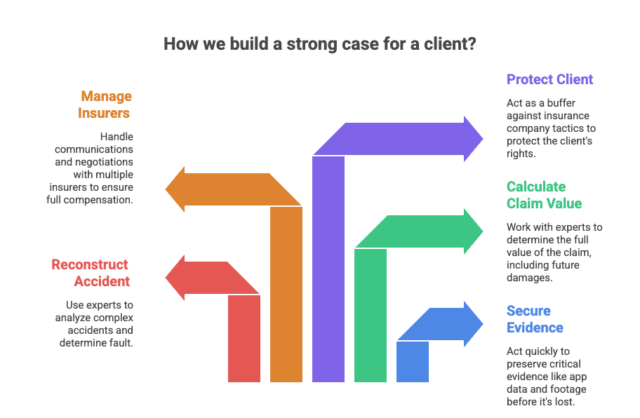
A skilled personal injury attorney does far more than file paperwork. Here is how the team at Pencheff & Fraley builds a strong case on your behalf:
Securing critical evidence: Rideshare app data, GPS logs, dashcam footage, traffic camera recordings, and police reports are all vital pieces of evidence. Some of this evidence — particularly surveillance footage — can be lost or overwritten within days. Your attorney will act quickly to preserve it.
Reconstructing the accident: In complex multi-vehicle accidents, an accident reconstruction expert may be retained to analyze the physical evidence and provide a definitive account of how the crash occurred and who was at fault. This is especially important in cases involving t-bone accidents at intersections or other high-impact collision types common in urban rideshare environments.
Calculating the full value of your claim: Many accident victims underestimate the value of their claim by focusing only on immediate medical bills. Your attorney will work with medical experts and economists to calculate the full present and future value of your damages, including future medical care, lost earning capacity, and non-economic losses. Cases involving a traumatic brain injury require particular care, as these injuries often have delayed and long-lasting consequences that must be fully documented.
Dealing with multiple insurers: Your attorney will manage all communications and negotiations with the at-fault driver’s insurer, Uber or Lyft’s commercial insurer, and any other relevant parties, ensuring that no potential source of compensation is overlooked.
Protecting you from insurance company tactics: Insurance adjusters are skilled at obtaining statements and information that can be used to minimize or deny your claim. Your attorney will serve as a buffer between you and the insurance companies, protecting your rights at every stage of the process.
Frequently Asked Questions
Can I sue Uber or Lyft directly if another driver caused the accident?
In most cases, you will not need to sue Uber or Lyft directly. Their commercial insurance policy is designed to provide compensation to passengers without requiring a lawsuit against the company itself. However, if there are circumstances suggesting that Uber or Lyft’s own negligence contributed to the accident — for example, by knowingly retaining a driver with a dangerous history — a direct claim against the company may be possible. An experienced attorney can evaluate whether such a claim is warranted in your case.
What if the at-fault driver fled the scene (hit-and-run)?
If the driver who caused the accident fled the scene, Uber and Lyft’s uninsured motorist coverage will apply. This coverage is specifically designed for situations where the at-fault driver cannot be identified or does not have insurance. It is critical to report the hit-and-run to the police immediately and to document everything you can about the other vehicle, including its color, make, model, and any partial license plate information.
How long do I have to file a claim in Ohio?
The statute of limitations for car accidents in Ohio is generally two years from the date of the accident. However, it is always best to consult with an attorney as soon as possible after the accident, as evidence can be lost and witnesses’ memories can fade over time. Our article on time limits that could cost you your injury claim explains the key deadlines you need to know.
Will my own auto insurance cover me as a rideshare passenger?
In some cases, your personal auto insurance policy may provide additional coverage, such as medical payments (MedPay) coverage, even when you are a passenger in someone else’s vehicle. However, the primary sources of compensation in a rideshare accident are the at-fault driver’s insurance and the rideshare company’s commercial policy. Your attorney will identify all available sources of coverage to maximize your recovery.
What if both the rideshare driver and the other driver share fault?
Ohio’s modified comparative fault rule means that multiple parties can share responsibility for an accident. If both the rideshare driver and the third-party driver contributed to the crash, you may have claims against both drivers and potentially both insurance policies. As a passenger, you are generally not considered at fault, which means your ability to recover compensation is not typically reduced by the comparative fault of the drivers. For more on how fault is determined in multi-vehicle crashes, see our article on who’s liable when your Uber or Lyft ride ends in injury.
Do I need an attorney for a rideshare accident claim?
While you are not legally required to have an attorney, it is strongly advisable. Rideshare accident claims are significantly more complex than standard car accident claims, involving multiple insurance policies, corporate legal teams, and sophisticated claims adjusters. Studies consistently show that accident victims who are represented by an attorney recover significantly more compensation than those who handle their claims alone. You can review our personal injury FAQs for answers to other common questions about the claims process.
I was injured as a passenger in Florida — does anything change?
Yes. Florida has specific rideshare insurance laws under Florida Statute 627.748, and the state’s no-fault PIP system means you must seek medical treatment within 14 days of the accident to preserve your right to PIP benefits. Our dedicated guide on what to do if you’re injured as an Uber or Lyft passenger in Florida walks through every step of the process under Florida law.
Why Choose Pencheff & Fraley?
At Pencheff & Fraley, we are dedicated to fighting for the rights of accident victims throughout Ohio and Florida. Our personal injury attorneys have extensive experience handling complex rideshare accident cases, and we understand the tactics that insurance companies use to minimize your claim. We work on a contingency fee basis, which means you pay nothing unless we win your case.
We serve clients across multiple locations, including Westerville, OH, Mansfield, OH, Jacksonville, FL, Tampa, FL, and Orlando, FL.
We provide:
- Free, no-obligation consultations to review your case and explain your options
- Aggressive representation against insurance companies and corporate legal teams
- Personalized attention to every client, ensuring your case receives the focus it deserves
- A proven track record of securing maximum compensation for our clients — see our case results
Take Action Today — Your Rights Have a Time Limit
If another driver caused your Uber or Lyft accident, the clock is already ticking. Evidence is being lost, witnesses’ memories are fading, and insurance companies are building their defense. The sooner you contact an experienced personal injury attorney, the stronger your case will be.
Contact Pencheff & Fraley today for your free consultation. Call us or fill out our online contact form, and one of our experienced rideshare accident attorneys will be in touch promptly. You deserve full and fair compensation — let us fight to get it for you.