

If you are asking, “what is the process for changing personal injury lawyers?” you are not alone. Research shows that 40–50% of personal injury clients consider switching attorneys at some point during their case. Feeling frustrated, ignored, or pressured by your current lawyer is a serious problem — and you have every right to seek better representation.
The good news is that changing your personal injury lawyer is entirely legal, more common than most people realize, and far simpler than it sounds. This step-by-step guide walks you through the entire process, from recognizing the warning signs to finding a new attorney, handling fees, and protecting your case.
Do You Have the Right to Change Your Personal Injury Lawyer?
Yes — absolutely. Under the American legal system, you have the fundamental right to choose and change your legal representation at any time. This right is protected by the American Bar Association’s Model Rules of Professional Conduct, which establish that the attorney-client relationship is built on trust, communication, and loyalty to the client’s best interests.
You do not need your current attorney’s permission to make a change. You do not need to provide a reason. Whether you are unhappy with their communication, their strategy, or simply your gut feeling, the decision is entirely yours to make.
The only situation in which it is generally too late to switch attorneys is after you have signed a final settlement agreement. Before that point, the law is on your side.
10 Warning Signs You Need to Change Your Personal Injury Attorney
Knowing when to act is just as important as knowing how. Here are the most common red flags that signal it is time to find new legal representation.
Poor Communication and Unresponsiveness
Your attorney should respond to your calls and emails within a reasonable timeframe — typically 24 to 48 hours. If your lawyer is consistently unreachable, fails to provide case updates, or you can only ever speak to a paralegal, your case may not be receiving the attention it deserves. According to a survey cited by the American Bar Association, communication failures are the number one complaint clients have about their attorneys.
Pressure to Accept a Low Settlement
One of the most serious red flags is an attorney who pushes you to accept a settlement offer you are uncomfortable with. A good lawyer advocates for your maximum compensation, not a quick payout. If your attorney seems more interested in closing the case fast than in fighting for your rights, it is time to reconsider your representation. Understanding what factors determine your car accident settlement can help you recognize when an offer falls short.
Lack of Personal Injury Experience
Personal injury law is a specialized field. A general practice attorney may lack the specific expertise needed to handle complex cases, such as catastrophic personal injury claims or truck accident litigation. Ensure your lawyer has a proven track record in cases like yours.
Missed Deadlines
Missing a filing deadline or the statute of limitations can be catastrophic for your case. In Ohio, for example, you generally have two years from the date of injury to file a personal injury lawsuit. In Florida, the deadline is also two years. If your attorney has missed important dates or seems disorganized, act quickly.
No Clear Case Strategy
Your lawyer should be able to explain their legal strategy in plain language. If their plan seems vague, inconsistent, or they are unable to answer your questions about the direction of your case, that is a serious concern.
Ethical Violations
Dishonesty, misrepresentation, or mishandling of your funds are grounds for immediate termination. If you suspect your attorney has acted unethically, you have the right to report them to your state’s bar association — the Ohio State Bar Association or the Florida Bar.
Disbarment, Illness, or Death of Your Attorney
Sometimes the need to switch is not about performance at all. If your attorney is disbarred, becomes seriously ill, or passes away, a new lawyer can take over your claim and continue fighting for you.
Personality Conflicts or Lack of Respect
You do not have to tolerate an attorney who is condescending, dismissive, or who treats you as just another case number. You deserve an advocate who listens to you and treats you with dignity.
Stalled Case Progress
If your case has been sitting idle for months with no clear explanation, your attorney may be overwhelmed or simply not prioritizing your claim. This is especially damaging in cases involving common mistakes that can ruin your car accident claim.
Gut Feeling Something Is Wrong
Sometimes your instincts are your best guide. If you have a persistent sense of unease about your representation, it is worth exploring your options. Getting a second opinion after a personal injury costs nothing and can provide valuable clarity.
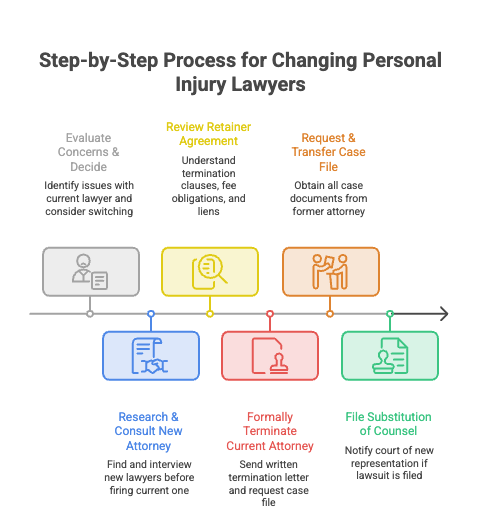
What Is the Step-by-Step Process for Changing Personal Injury Lawyers?
The process of switching personal injury lawyers follows a clear sequence of steps. Understanding each one will help you make the transition as smoothly as possible.
Step 1: Evaluate Your Concerns and Decide to Switch
Before taking action, clearly identify what is not working with your current attorney. Is it a lack of communication? A disagreement over strategy? Understanding the source of your dissatisfaction will help you articulate your needs when interviewing new lawyers.
It is also worth attempting to resolve the issue directly with your current attorney first. A candid conversation about your concerns may be all that is needed. If the problems persist, however, do not hesitate to move forward.
Step 2: Research and Consult With a New Attorney First
Never fire your current lawyer before you have a new one lined up. This is the most important rule of switching attorneys. Leaving yourself without legal representation — even briefly — can result in missed deadlines, lost evidence, or other serious consequences for your case.
Take advantage of free consultations offered by most personal injury firms. During these meetings, ask the following questions:
- What is your experience handling cases like mine?
- What is your strategy for my specific situation?
- How do you communicate with clients, and how often?
- Are you prepared to take my case to trial if necessary?
- How will you handle the transition from my previous attorney?
Look for a firm with a strong track record in personal injury cases, clear communication policies, and genuine commitment to your outcome. Reviewing case results and client testimonials is an excellent way to evaluate a firm’s capabilities.
Step 3: Review Your Current Retainer Agreement
Before formally terminating your relationship with your current lawyer, carefully read the fee agreement or retainer contract you signed. Pay particular attention to:
- Termination clauses: Some agreements outline specific procedures for ending the relationship.
- Fee obligations: Understand what, if anything, you may owe your former attorney for work already completed.
- Lien provisions: Your former attorney may have a lien on your case, meaning they have a right to be paid from any future settlement.
Your new attorney can help you review and interpret these terms before you take any action.
Step 4: Formally Terminate Your Current Attorney
Once you have secured new representation, you must formally end the relationship with your current lawyer. This should be done in writing. A termination letter should:
- Clearly state that you are ending the attorney-client relationship.
- Request that all work on your file cease immediately.
- Ask for the return of your complete case file.
- Be sent via certified mail to create a record of receipt.
Your new attorney will often handle this step on your behalf, which can make the process feel much less confrontational and stressful.
Step 5: Request and Transfer Your Case File
You have an absolute legal right to your entire case file. This includes all evidence gathered, medical records, correspondence with insurance companies, expert reports, and any legal filings. Your former attorney is legally obligated to transfer this file to you or your new attorney promptly.
If your former attorney is uncooperative or refuses to transfer the file, your new lawyer can take formal steps to compel the transfer. In rare cases, a court order may be necessary. An attorney generally cannot withhold your file solely because of a fee dispute, especially if doing so harms your case.
Step 6: File a Substitution of Counsel (If a Lawsuit Has Been Filed)
If your personal injury case has already progressed to a formal lawsuit, the court must be officially notified of the change in representation. This involves two formal documents:
- Motion to Withdraw: Filed by your former attorney to formally remove themselves from the case record.
- Notice of Appearance / Substitution of Counsel: Filed by your new attorney to formally enter the case.
Both documents typically require signatures from you, your former attorney, and approval from the presiding judge. This process is routine, and judges generally approve these requests unless the timing would cause significant prejudice to the opposing party.
How Are Attorney Fees Handled When You Switch Lawyers?
The question of fees is one of the most common concerns for clients considering a switch. The key point to understand is this: you will not pay two separate attorney fees.
Understanding Contingency Fees
Most personal injury cases are handled on a contingency fee basis. This means your attorney is paid a percentage of the final settlement or verdict — typically between 33% and 40% — and you pay nothing upfront. If you do not win, your attorney does not get paid. You can learn more about how much it costs to hire a personal injury lawyer on the Pencheff and Fraley website.
When you switch lawyers, the total contingency fee percentage you agreed to in your original contract generally stays the same. The fee is simply divided between your former and new attorneys based on the work each contributed to your case.
The Doctrine of Quantum Meruit
In cases where the two attorneys cannot agree on how to split the fee, the legal doctrine of quantum meruit applies. This Latin term means “as much as deserved.” It allows a court to determine fair compensation for each attorney based on the reasonable value of the services they provided.
This protects you from being overcharged while ensuring both attorneys are fairly compensated. The American Bar Association provides guidance on fee-splitting between lawyers to ensure clients are protected throughout this process.
| Scenario | Who Pays | How It Works |
| Case settled after switch | No extra cost to client | Single fee split between old and new attorney |
| Fee dispute between attorneys | No extra cost to client | Court applies quantum meruit to determine fair split |
| Case not won | No cost to client | No contingency fee is owed by anyone |
How Long Does the Process of Switching Lawyers Take?
The timeline for switching personal injury attorneys varies depending on the complexity of your case and the stage it is in. Here is a general overview:
- Immediately: Your new attorney files a Notice of Appearance or Substitution of Counsel with the court (if a lawsuit is active).
- Within 1–2 weeks: Your former attorney is legally required to transfer your complete case file.
- Within 2–4 weeks: Your new attorney reviews all evidence, medical records, and prior negotiations to get fully up to speed.
In most situations, the entire transition takes between two and four weeks. While there may be a brief period of adjustment, a skilled and experienced attorney will work to minimize any delays and keep your case on track.
Changing Lawyers at Different Stages of Your Case
The process for switching attorneys differs slightly depending on where you are in the legal process.
Before a Claim Is Filed
This is the easiest time to switch. No court involvement is required. Your new attorney simply contacts your former lawyer, requests the case file, and takes over your representation. The transition is typically seamless and has the least impact on your case timeline.
During Settlement Negotiations
Switching during negotiations is also relatively straightforward. Your new attorney will review any existing settlement offers and advise you on whether to accept, reject, or counter. A fresh perspective at this stage can often lead to a significantly better outcome, particularly if you feel your current attorney has been pushing you toward an inadequate offer.
After a Lawsuit Has Been Filed
Once a formal lawsuit is on record, the court must be notified via a Substitution of Counsel. This is a routine legal procedure. Your new attorney will handle the paperwork, and the judge will typically approve the change without issue, provided the request is not made on the eve of trial.
Close to a Trial Date
Switching attorneys very close to a scheduled trial date is the most complex scenario. A judge may deny the request if they believe it is being done to delay the proceedings. However, if there is a genuine and compelling reason for the change, the court will generally accommodate it. Acting quickly is always the best approach.
Types of Personal Injury Cases Where Switching Lawyers Is Common
Clients switch attorneys across all types of personal injury cases. Here are some of the most common situations where a change in representation makes a significant difference.
Car Accidents: If you were injured in a collision and feel your attorney is not fighting for full compensation, a new lawyer with specific car accident experience can make a significant difference. Knowing what to do after a car accident is the first step toward protecting your rights.
Truck Accidents: These cases involve complex federal regulations and multiple liable parties. If your current attorney lacks experience in commercial vehicle litigation, consider switching to a firm that specializes in truck accident cases. Understanding who is liable in a truck accident is critical to building a strong case.
Motorcycle Accidents: Motorcycle accident claims often involve bias against riders. You need an attorney who understands how to handle motorcycle accident claims and can counter these prejudices effectively.
Slip and Fall Cases: Premises liability claims require specific knowledge of property owner negligence standards. If your lawyer is not building a strong case around proving liability in slip and fall incidents, it may be time to switch.
Catastrophic Injuries: Cases involving severe or permanent injuries demand an attorney with the resources and experience to handle high-value claims. Learn more about catastrophic personal injury claims and what they require.
Rideshare Accidents: Cases involving Uber or Lyft accidents are particularly complex, involving multiple layers of insurance coverage. If your attorney is not navigating these complexities effectively, consider a firm experienced in rideshare accident claims.
What to Look for in Your New Personal Injury Attorney
Choosing the right replacement attorney is just as important as deciding to switch. Here are the key qualities to prioritize.
Specialization in Personal Injury Law. Avoid general practice attorneys. Choose a firm that focuses exclusively or primarily on personal injury cases and has demonstrated expertise in your specific type of claim.
Proven Results. Review the firm’s case results to see their history of settlements and verdicts. A strong track record speaks louder than any advertisement.
Trial Experience. Most personal injury cases settle out of court, but your attorney must be willing and able to take your case to trial if the insurance company refuses to offer fair compensation. Ask directly whether they have courtroom experience.
Transparent Communication. Ask about their communication policy. How often will they update you? Who will be your primary point of contact? A good attorney will give you direct, honest answers.
Client-Centered Values. Read client testimonials and online reviews. Look for consistent themes of responsiveness, compassion, and dedication to achieving the best possible outcome.
Free Consultation. Any reputable personal injury firm will offer a free, no-obligation consultation. Use this opportunity to assess whether the attorney is the right fit for you and your case.
Is It Worth Switching Personal Injury Lawyers?
For many clients, switching attorneys is one of the best decisions they make during their case. A new attorney brings fresh eyes, renewed energy, and potentially a stronger strategy. Legal professionals consistently report that clients who switch to a more experienced or communicative attorney often achieve better outcomes.
That said, switching is not without some short-term disruption. There will be a period of transition as your new attorney reviews your file and gets up to speed. The key is to act decisively and not delay. The sooner you make the change, the less impact it will have on your case timeline.
If you are unsure whether switching is the right move, consider getting a second opinion on your personal injury case before making a final decision. Many attorneys will review your case for free and give you an honest, no-pressure assessment.
Frequently Asked Questions
Can I change personal injury lawyers at any time?
Yes. You have the right to change your personal injury lawyer at almost any point in your case, for any reason. The only exception is after you have signed a final settlement agreement. Before that point, the decision is entirely yours to make.
Will switching personal injury lawyers hurt my case?
Switching lawyers does not inherently hurt your case. In fact, it often improves outcomes. There may be a brief delay as your new attorney reviews your file, but a skilled lawyer will work quickly to minimize any disruption and build on the work already completed.
Do I have to pay my old lawyer if I switch?
You will not pay two separate attorney fees. If your case is on a contingency basis, the single fee is split between your former and new attorneys based on the work each contributed. This split is handled between the attorneys — not by you — and is resolved at the conclusion of your case.
How long does it take to switch personal injury lawyers?
The transition typically takes two to four weeks. If a lawsuit is already filed, your new attorney will immediately file the necessary court documents. Your former attorney must transfer your case file within one to two weeks, after which your new attorney will review everything and get fully up to speed.
Can I switch lawyers if my case is close to trial?
It is possible, but more complex. A judge may deny the request if they believe it will cause unnecessary delay. However, if there is a genuine reason for the change, courts generally accommodate it. Acting quickly is essential — the sooner you make the switch, the better.
What if my former attorney refuses to give me my case file?
Your former attorney is legally obligated to transfer your case file. If they refuse, your new attorney can send a formal demand letter or seek a court order. You may also file a complaint with your state’s bar association if your former lawyer is violating their professional obligations.
Is it too late to switch lawyers before settlement?
No. Switching before a settlement is finalized is not only possible but is often the ideal time to make a change. A new attorney can review any existing settlement offers and advise you on whether they reflect the true value of your claim.
Conclusion: Take Control of Your Case Today
Understanding what the process is for changing personal injury lawyers gives you the power to make informed decisions about your own future. You should never feel trapped with an attorney who is not fighting for your best interests. Your case — and your recovery — are too important.
The process is straightforward: find a new attorney first, review your agreement, send a written termination notice, transfer your file, and notify the court if necessary. Fees are handled between the attorneys, and you will not be charged double.
At Pencheff and Fraley LPA, we believe every client deserves aggressive, compassionate, and transparent representation. If you are unhappy with your current attorney and want to explore your options, we are here to help. We serve clients throughout Ohio and Florida, and we will handle the entire transition process for you.
Contact us today for a free, no-obligation consultation. We will review your case, answer your questions, and explain your legal options. Learn how we can help you on the road to recovery. Pay nothing unless we win your case.
Call us at 904-770-4953 or visit our website at www.pencheffandfraley.com to schedule your free case consultation.
We’re Here for You 24/7
We are available 24/7 to take your call. If you are unable to travel, we will come to you. The sooner you call, the stronger your case can be. Your path to maximum compensation and justice starts with a single phone call to Pencheff & Fraley.
Author: Pencheff and Fraley Legal Team
Disclaimer: This article is for informational purposes only and does not constitute legal advice. Every case is unique, and you should consult with a qualified attorney about your specific situation.