

The Dangers of Tanker Truck Accidents
The dangers of tanker truck accidents extend beyond the first collision. A damaged tanker can release fuel, spread toxic fumes, or block traffic after rolling over. People in nearby vehicles may suffer injuries even without hitting the truck. The cargo can turn one crash into a much larger emergency.
For injured people in Ohio and Florida, recovery can involve medical care, disputed insurance claims, and several potentially responsible companies. Understanding the hazards helps explain why these cases require careful investigation. It also shows why safety and medical treatment must come before gathering evidence.
If a tanker crash just happened: put safety first
Call 911 and report any visible fire, leak, smoke, or vapor. Keep away from the tanker and spilled material. Move away from immediate danger only when you can do so safely. Follow evacuation or shelter-in-place instructions from emergency responders.
Do not approach the truck to read a placard or photograph a leak. Avoid smoke and vapor, and do not attempt a cleanup. There is no single safe distance for every cargo. Responders assess the substance, wind, terrain, fire conditions, and amount released.
The 2024 Emergency Response Guidebook warns trained responders against rushing into hazardous-material incidents. Its precautions include staying clear of spills, fumes, and smoke. For the public, the practical lesson is simple: keep away and let trained crews manage the hazard.
Why tanker truck crashes are different
Tanker trucks transport liquids, gases, and some dry bulk materials. Their cargo may include gasoline, diesel, propane, industrial chemicals, milk, or water. The load determines whether a crash creates fire, toxic exposure, contamination, or primarily collision hazards.
Not every tanker carries hazardous material. However, a food-grade or water tanker can still cause a devastating collision. Its size, elevated load, and changing cargo movement can affect handling. A spill may also create a roadway hazard without being toxic.
The Federal Motor Carrier Safety Administration’s rollover guidance identifies four important factors: vehicle design, load effects, highway conditions, and driver behavior. A sound investigation considers all four. It should not assume that a rollover proves speeding or that good weather makes a tanker safe.
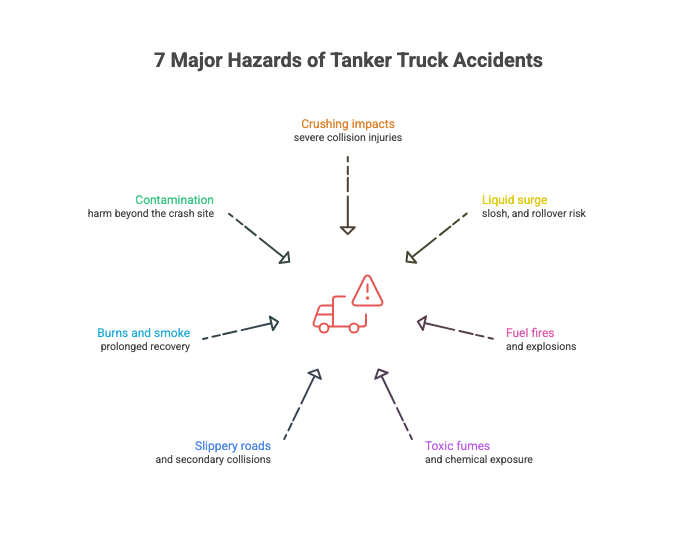
The Dangers of Tanker Truck Accidents: 7 Major Hazards
1. Crushing impacts and severe collision injuries
A tanker collision can crush a smaller vehicle or push it into other traffic. Occupants may suffer brain injuries, spinal injuries, fractures, or internal injuries. Some crashes also involve underride, where part of a smaller vehicle moves beneath the truck or trailer.
A tanker does not need to catch fire to cause catastrophic harm. The first impact alone may leave someone unable to work or live independently. Medical records and vehicle inspections help explain the injury mechanism and resulting losses.
2. Liquid surge, slosh, and rollover risk
Liquid inside a tank keeps moving when the truck changes speed or direction. Forward-and-backward movement is commonly called surge. Sideways movement is often called slosh. These forces can affect vehicle stability, especially during abrupt steering or braking.
A partially filled tank can leave room for cargo movement. Internal baffles may reduce some movement, but tank designs differ. Neither an empty tank nor a particular fill level guarantees safety. The cargo, compartment layout, vehicle condition, and maneuver all matter.
FMCSA’s cargo-tank rollover fact sheet reports that 63% of studied rollover crashes involved partial loads. The statistics come from a 2007 study, not a current annual crash count. That historical finding supports investigating loading records rather than guessing from the truck’s appearance.
3. Fuel fires and explosions
Gasoline or other flammable cargo can escape after a tank, valve, or fitting is damaged. Released material may ignite when it reaches an ignition source. Flames can spread beyond the truck and involve nearby vehicles or property.
Pressurized cargo introduces additional hazards. A heated pressure tank may rupture violently, but not every fuel fire follows that pattern. The Emergency Response Guidebook distinguishes fire and explosion hazards by substance. Identifying the actual cargo is essential to understanding what happened.
4. Toxic fumes and chemical exposure
A chemical release may harm people who never collided with the tanker. Depending on the substance, exposure can affect the eyes, skin, or breathing. Smoke from a fire can create additional inhalation hazards. A visible cloud is not a reliable measure of danger.
Tell medical providers if you were near a tanker spill, smoke, or vapor. Describe your location and symptoms accurately. Let responders identify the cargo; do not return to the scene to investigate. Exposure records can later help doctors and legal investigators assess possible causation.
5. Slippery roads and secondary collisions
Leaked fuel, oil, or other liquid can reduce traction. Drivers approaching the scene may brake suddenly or swerve around debris. A second crash can occur after the tanker has already stopped moving.
This creates an important investigation question: which event caused each injury? A person may experience an initial impact and a later collision. Video, witness accounts, and vehicle damage can help reconstruct the sequence. Final vehicle positions alone may not tell the whole story.
6. Burns, smoke injuries, and prolonged recovery
Tanker fires can cause thermal burns, while certain cargo can cause chemical burns. Severe injuries may require surgery, rehabilitation, or long-term assistance. Scarring and restricted movement can affect work and daily activities. The consequences may continue after visible wounds improve.
Treatment needs depend on the injury and medical findings. Do not assume that a burn’s appearance shows its full severity. Follow emergency and treating professionals’ instructions. A claim should consider medically supported future needs, not just the first hospital bill.
7. Contamination and harm beyond the crash site
A spill can affect nearby soil, drainage systems, buildings, or water. Residents and businesses may face evacuation, restricted access, or property damage. Cleanup can continue after the roadway reopens. Those impacts do not automatically establish an individual injury claim.
A person seeking compensation still needs evidence of legally recoverable harm. Property loss, exposure, and bodily injury can involve different proof and legal rules. Keep official notices, expense records, and medical information. Do not collect spill samples or enter a restricted area yourself.
What causes tanker truck accidents?
Driver decisions and carrier practices
Investigators may examine distraction, fatigue, impairment, unsafe speed, following distance, or abrupt lane changes. They may also review scheduling pressure and driver training. Experience alone does not eliminate rollover risk. A safety review should connect any suspected mistake to the actual crash.
FMCSA’s rollover-prevention material says over 78% of cargo-tank rollovers involve driver error. This is a training statistic about rollovers, not all tanker accidents. It does not prove that the driver caused any particular crash.
Loading, equipment, and roadway conditions
Other questions involve load distribution, tank configuration, brakes, tires, steering, and valve condition. A damaged component may have caused the crash or failed during impact. Inspection is needed to distinguish those possibilities. Road geometry and shoulder conditions can also matter.
Required qualifications depend on the vehicle and cargo. FMCSA’s CDL endorsement guidance identifies tank, hazardous-material, and combined endorsements. Its hazmat compliance guidance also addresses specialized training. An endorsement alone may not satisfy every material-specific training duty.
What to do after a tanker truck accident
Get medical care and explain possible exposure
Accept emergency evaluation and seek appropriate follow-up care. Tell providers about pain, breathing problems, dizziness, or possible chemical contact. Explain what you actually observed. Do not guess the substance or minimize symptoms because you escaped the initial impact.
Keep treatment instructions, discharge papers, prescriptions, and appointment records. Document barriers that prevent recommended care, such as transportation or cost. Discuss those barriers with your provider. For broader steps, read our Florida truck-accident checklist.
Preserve what you already have safely
Save original photographs, dashcam files, messages, and witness contact details. Keep the crash-report number and responding agency’s name. If available, record the carrier name and truck identifiers from a safe position. Do not delay treatment or cross a safety perimeter for better photographs.
Back up files without deleting the originals. Save towing invoices, repair estimates, wage records, and insurance correspondence. Ask about inspection before authorizing disposal or repairs when reasonably possible. Your lawyer can coordinate preservation without asking you to investigate dangerous cargo.
Handle insurance communications carefully
Notify your own insurer as your policy requires and provide truthful information. Your insurer’s cooperation requirements differ from the opposing insurer’s requests. Do not speculate about fault, speed, or future recovery. Obtain advice before signing a release or giving the other side a recorded statement.
An early payment may come with language ending additional claims. Understand what the offer covers and what rights the release affects. Future treatment, lost earnings, and reimbursement obligations may not yet be clear. A quick offer is not necessarily a complete evaluation.
Who may be liable for a tanker truck accident?
The driver, carrier, and vehicle owner
A negligent driver may be responsible when their conduct causes harm. A carrier may face responsibility for employee conduct or its own negligent practices. Hiring, training, supervision, scheduling, and maintenance can become relevant. Ownership and leasing arrangements may also require investigation.
A company’s name on the trailer does not resolve every responsibility question. Investigators examine contracts, operating authority, control, and actual conduct. Multiple parties may share fault, but involvement alone does not establish liability. Our guide explains more about who may be liable in a truck accident.
Cargo handlers, repair companies, and manufacturers
A loader or shipper may become relevant if loading practices or cargo information contributed to the harm. A repair company may face questions about defective work. A manufacturer may be investigated when a defective tank or component caused or worsened injuries. Each theory requires supporting evidence.
A freight broker’s potential liability raises additional legal questions. Do not assume arranging transportation automatically creates responsibility for a crash. Applicable law and the company’s conduct must be examined. A careful claim identifies supported defendants rather than naming every company in the shipping chain.
Evidence that matters in tanker accident claims
Cargo identity and loading records
Shipping papers, load tickets, compartment records, and safety data sheets can identify what the truck carried. They may also show cargo quantity and hazard information. These records help distinguish a handling problem from a chemical-release issue. Families should request help obtaining them, not search the damaged truck.
For example, a suspected surge-related rollover calls for more than a photograph of an overturned tank. Investigators may compare fill levels, tank design, loading procedures, and steering evidence. That is an investigation example, not a finding about your crash. The records must support the theory.
Vehicle data and company records
Useful records may include maintenance files, inspections, dispatch messages, driver qualifications, and camera footage. Electronic logging devices primarily document duty-status information. They are not interchangeable with every engine-control or event-data system. Available speed, braking, or impact data depends on the equipment.
Under 49 C.F.R. § 395.8(k), covered carriers must retain duty-status records and required supporting documents for at least six months. That minimum is not a safe waiting period. Video or other data may disappear sooner, and litigation-related preservation duties can require longer retention.
Emergency-response and exposure records
Fire reports, hazmat reports, 911 records, and evacuation notices can help establish the incident’s timeline. Medical records may explain when symptoms began and what providers observed. Cargo identification helps connect those records to the suspected substance. Neither proximity nor a diagnosis alone resolves every causation question.
A lawyer may send focused preservation notices and arrange appropriate inspections. A notice does not guarantee that records exist or prove fault. Prompt action can help prevent avoidable loss of evidence. It also allows investigation to begin while memories and physical conditions remain fresh.
Compensation after a tanker truck crash
Medical costs, income loss, and lasting injuries
Depending on the claim and applicable law, compensation may include medical expenses, rehabilitation, and medically supported future care. Lost wages and reduced earning capacity may also matter. Other potentially recoverable harm includes pain, emotional distress, scarring, and property damage. These categories require proof and remain subject to legal limits.
There is no reliable standard settlement for every tanker accident. Injury severity, causation, fault, coverage, and available defendants all affect the case. Fees, costs, liens, and reimbursement claims can affect net recovery. Our personal injury services address the broader claims process.
Fatal crashes and family losses
A fatal tanker crash may support a wrongful-death claim. The proper claimant, eligible losses, and procedure depend on state law. Funeral expenses and lost support may be relevant, but entitlement is not identical for every relative. Families should obtain advice about estate and claim requirements promptly.
Punitive damages are not automatic because a tanker carried dangerous cargo. They involve separate legal standards and supporting evidence. A lawyer should distinguish possible compensation from a promised outcome. The focus remains on the facts, recognized losses, and applicable law.
Ohio and Florida legal rules to understand
Ohio tanker accident deadlines and shared fault
Ohio Revised Code § 2305.10 generally gives two years for ordinary bodily-injury claims after accrual. Accrual usually occurs when the injury happens. Exceptions and different claim types can change the analysis. Do not assume that insurance negotiations pause the deadline.
Under Ohio Revised Code § 2315.33, your fault must not exceed the combined fault of others. Compensatory damages are reduced proportionately. An insurer’s initial percentage is not automatically the final legal determination. Our Mansfield comparative-fault guide explains the rule in more detail.
Chemical-exposure claims need a separate deadline review
Section 2305.10 contains a specific accrual rule for certain hazardous or toxic chemical exposure injuries. Medical knowledge and reasonable diligence can affect that analysis. An exposure claim should not be treated automatically like an ordinary impact injury. Ask a lawyer to assess the facts promptly.
Florida tanker accident deadlines and shared fault
The current Florida limitations statute, § 95.11, generally provides two years for negligence actions. Older claims and other legal theories may follow different rules. Exceptions, notice requirements, and accrual questions can matter. Have the actual deadline assessed instead of relying on a general summary.
Under Florida Statutes § 768.81, applicable negligence claims are barred when the claimant is more than 50% at fault. At lower percentages, damages can be reduced proportionately. The statute contains exceptions and applicability limits. Evidence is essential when an insurer tries to shift blame.
Florida PIP and serious-injury requirements
For eligible people, Florida personal injury protection may help with initial medical and disability expenses. Section 627.736 requires qualifying initial services and care within 14 days for the described medical benefits. Limits and medical-condition requirements also apply. Seek emergency care immediately rather than waiting for an insurance deadline.
Certain motor-vehicle claims for pain and suffering also involve Florida’s serious-injury threshold under § 627.737. Permanent injury or significant permanent scarring may be relevant. Whether the provision applies depends on the vehicles, coverage, and claim. A tanker crash does not automatically satisfy or eliminate that requirement.
A documented case: the Indianapolis propane-tanker rollover
The NTSB’s Indianapolis investigation shows how tanker hazards can combine. On October 22, 2009, a propane tanker rolled over on an interstate connection ramp. It carried 9,001 gallons of liquefied petroleum gas. The crash was followed by a fire.
The truck driver and a nearby Volvo driver suffered serious injuries. Three passenger-vehicle occupants suffered minor injuries from the fire. The NTSB identified excessive, rapid evasive steering as the probable cause. Contributing factors included the truck’s high center of gravity and shoulder conditions.
This is a historical public investigation, not a Pencheff & Fraley case result. It demonstrates why investigators examine steering, vehicle stability, roadway geometry, and cargo hazards together. The NTSB did not quantify the actual contribution of liquid slosh in that crash. The example should not be treated as proof of another driver’s fault.
How to choose a personal injury lawyer after a tanker crash
Look for relevant commercial-truck experience and a clear investigation plan. Ask whether the team can evaluate cargo records, vehicle systems, and exposure evidence. Confirm who will handle the case and how communication works. Discuss strengths and weaknesses rather than accepting a promised settlement.
Review the lawyer’s qualifications and the written fee agreement. Our firm overview introduces Pencheff & Fraley’s team. Our personal injury fee resources explain questions to raise about costs. Attorney fees and case expenses are different, so ask about both.
Best accident lawyer questions to ask at a consultation
There is no single best lawyer for every accident. Useful questions focus on fit, investigation, and accountability. Bring the records you have, but do not delay contacting counsel because your file is incomplete. Ask these questions before signing a representation agreement:
- Have you handled tanker crashes, hazardous cargo, or comparable commercial-truck cases?
- What evidence should be preserved first, and who will request it?
- Which experts might help evaluate loading, crash dynamics, exposure, or future care?
- Who will handle my case and provide updates?
- How do attorney fees, expenses, and reimbursement obligations affect my net recovery?
- What facts could weaken the claim, and which deadlines apply?
- Are you prepared to litigate if a reasonable resolution cannot be reached?
For more guidance, read our questions to ask before hiring an accident lawyer in Ohio or Florida. Use the answers to compare experience and approach. Avoid choosing a lawyer solely from a slogan or an unsupported claim of being “the best.”
Frequently Asked Questions
Why are tanker truck accidents so dangerous?
Tanker crashes combine collision forces with risks from the load. Liquid movement can affect stability, while damaged tanks may release flammable or toxic cargo. Spills can also cause secondary crashes. The actual hazards depend on the cargo, tank design, and crash conditions.
Can an empty tanker truck still be dangerous?
Yes. An empty tanker remains a large vehicle that can cause serious collision injuries. Some tanks may contain hazardous residue or vapor after unloading. Do not assume an apparently empty tank is safe to approach after a crash.
Can I have a claim without hitting the tanker?
Possibly. A tanker spill or fire may injure nearby drivers, passengers, residents, or bystanders without direct vehicle contact. A claim still requires evidence of legally recoverable harm and responsibility. Exposure and causation should be assessed using medical and incident records.
Who can be responsible for a tanker truck accident?
Potentially responsible parties may include the driver, carrier, vehicle owner, cargo handler, maintenance provider, or manufacturer. A broker may raise additional legal questions. Liability depends on each party’s conduct, causation, and applicable law. Participation in the shipment alone does not establish fault.
How long do I have to file a tanker accident lawsuit?
Ordinary Ohio bodily-injury claims generally have a two-year period after accrual. Florida negligence actions generally have a two-year period under current law. Exceptions, older claims, and other claim types can change those rules. Have a lawyer evaluate the actual deadline promptly.
Can I recover if I was partly at fault?
Possibly. Ohio generally allows recovery when your fault does not exceed the combined fault of others. Florida bars recovery above 50% fault in applicable negligence actions. Damages may be reduced proportionately, and exceptions or claim-specific rules can matter.
What should I do if the tanker is leaking or burning?
Call 911, keep away from the tanker, and avoid spills, smoke, and vapor. Move away from immediate danger only when you can do so safely. Follow responders’ evacuation or shelter instructions. Do not approach for photographs, identify the cargo yourself, or attempt cleanup.
How much does a tanker accident lawyer cost?
Pencheff & Fraley offers free consultations and no upfront attorney fees. The firm states that attorney fees are owed only if compensation is recovered. Ask for the written fee agreement and an explanation of case expenses. Do not assume attorney fees and expenses follow identical rules.
Talk with Pencheff & Fraley about your tanker accident
Tanker accidents can involve crushing injuries, unstable loads, fire, exposure, and secondary collisions. Recovery may require ongoing care and a detailed investigation. You do not need to identify every responsible company before asking for help. Start with your safety, treatment, and the information already available.
Pencheff & Fraley Injury and Accident Attorneys serves injured people across Ohio and Florida. Contact the firm for a free tanker-accident case evaluation. Call 866-753-0919 for Ohio or 904-562-1371 for Florida. The firm charges no upfront attorney fees and no attorney fee unless compensation is recovered.
Our truck accident lawyers serving Ohio and Florida can discuss the next steps for your situation. Bring your crash-report details, medical information, and insurance correspondence if available. Ask about evidence preservation, deadlines, and representation terms. No outcome or settlement amount can be guaranteed.
This article provides general information, not legal or medical advice. Reading it or contacting the firm does not by itself create an attorney-client relationship. Laws, coverage, and claim requirements depend on the facts. Prior results do not guarantee a similar outcome.
