
If you were injured in an Uber or Lyft accident in Florida, one of the first questions you need to answer is: how long do I have to file a rideshare accident claim in Florida? The answer matters enormously. Miss the legal deadline and you could lose your right to any compensation, no matter how serious your injuries or how clear the other party’s fault.
The short answer is two years from the date of the accident for most personal injury claims. But the full picture is more nuanced. Florida Uber and Lyft accident laws changed significantly in 2023, and several exceptions can either shorten or extend your deadline depending on the specific facts of your case. This guide breaks down everything you need to know so you can protect your rights and act before it is too late.
Florida’s 2-Year Statute of Limitations for Rideshare Accidents
The statute of limitations is the legal deadline by which you must file a lawsuit. In Florida, the statute of limitations for car accidents — including those arising from Uber and Lyft accidents — is two years from the date of the accident.
This two-year rule is the direct result of House Bill 837, signed into law in March 2023. Before this change, Florida gave injury victims four years to file. The legislature cut that window in half, effective March 24, 2023. If your accident occurred on or after that date, you have two years. If your accident happened before March 24, 2023, the old four-year deadline may still apply to your case.
Important: The statute of limitations is not a suggestion. Florida courts strictly enforce this deadline. If you file your lawsuit even one day after the deadline expires, the court will almost certainly dismiss your case and you will be permanently barred from recovering compensation.
Rideshare Accident Claim Deadlines at a Glance
The table below summarizes the key filing deadlines for different types of claims arising from a Florida rideshare accident.
| Type of Claim | Deadline | When the Clock Starts |
| Personal injury (accident on/after March 24, 2023) | 2 years | Date of the accident |
| Personal injury (accident before March 24, 2023) | 4 years | Date of the accident |
| Wrongful death | 2 years | Date of the victim’s death |
| Property damage | 4 years | Date of the accident |
| Claim against a government entity | 3 years (with pre-suit notice required) | Date of the accident |
Note: These are general guidelines. The specific facts of your case may affect which deadline applies. Always consult a qualified Florida personal injury attorney to confirm the time limits that could cost you your injury claim.
Why Did Florida Shorten the Deadline?
Florida’s legislature passed HB 837 as part of a broader tort reform effort. Proponents argued that the previous four-year window encouraged delayed litigation, made it harder for defendants to gather evidence, and contributed to higher insurance premiums across the state. The reform aligned Florida more closely with the majority of U.S. states, which use a two-year statute of limitations for personal injury claims.
For accident victims, however, the practical effect is significant. You now have half the time to investigate your accident, treat your injuries, consult an attorney, and decide whether to pursue a lawsuit. This makes it more important than ever to seek legal advice as soon as possible after a rideshare accident.
Exceptions That Can Change Your Deadline
While the two-year rule applies to most Florida rideshare accident claims, several important exceptions can toll (pause) or otherwise modify the deadline, as outlined in Florida Statutes § 95.051.
Injured Victims Who Are Minors
If the person injured in the rideshare accident is under 18 years old at the time of the crash, the statute of limitations is typically tolled until the minor turns 18. The two-year clock generally does not begin to run until the minor’s 18th birthday. This means a child injured at age 10 would generally have until age 20 to file a personal injury lawsuit.
The Discovery Rule
In rare circumstances, Florida’s “discovery rule” may apply. Under this doctrine, the statute of limitations does not begin to run until the injured party knew — or reasonably should have known — about their injury and its connection to the accident. This exception is most commonly seen in medical malpractice cases involving latent injuries, but it can occasionally apply to accident cases where injuries were not immediately apparent.
Fraudulent Concealment
If the defendant actively concealed information that prevented you from discovering your claim, a court may toll the statute of limitations for the period during which the concealment occurred. This is a narrow exception that requires clear evidence of intentional deception.
Claims Against Government Entities
If your rideshare accident involved a government vehicle or a government employee, different rules apply. You must file a formal written notice of claim with the appropriate government agency within three years of the accident, and additional procedural requirements must be met before you can file a lawsuit. Missing these pre-suit notice requirements can be just as fatal to your claim as missing the statute of limitations itself.
Mental Incapacity
If the injured person was legally incapacitated at the time of the accident, the statute of limitations may be tolled until the incapacity is removed.
Why You Should Not Wait Until the Deadline
Even though you technically have two years to file, waiting is a serious mistake. Here is why understanding the statute of limitations is crucial for your injury claim:
Evidence disappears fast. Surveillance camera footage from intersections, businesses, and dashcams is typically overwritten within days or weeks. Skid marks fade. Witnesses move away or forget details. The sooner your attorney begins investigating, the better your chances of preserving the evidence that proves your case.
Medical documentation is stronger when timely. Insurance companies routinely argue that gaps in medical treatment mean your injuries were not serious or were not caused by the accident. Seeking treatment immediately and consistently creates a clear medical record that links your injuries to the crash.
Insurance companies use delay against you. Uber, Lyft, and their insurers have experienced claims teams whose job is to minimize payouts. The longer you wait to hire an attorney, the more time they have to build a defense, locate evidence that favors them, and pressure you into a low settlement.
Florida’s modified comparative negligence rule. Under HB 837, Florida now uses a modified comparative negligence standard. If you are found to be more than 50% at fault for the accident, you cannot recover any compensation. Acting quickly allows your attorney to investigate and counter any attempt by the defense to shift blame onto you.
Understanding Florida’s No-Fault Insurance System and Rideshare Accidents
Florida is a no-fault insurance state, which adds a layer of complexity to rideshare accident claims. Under Florida’s no-fault system, your own Personal Injury Protection (PIP) insurance pays for your initial medical expenses and a portion of your lost wages, regardless of who caused the accident.
Florida law requires all registered vehicle owners to carry at least $10,000 in PIP coverage. PIP typically covers 80% of reasonable and necessary medical expenses and 60% of lost wages, up to $10,000 in combined benefits.
However, to access PIP benefits, you must seek medical treatment within 14 days of the accident. If you wait longer than 14 days, you may forfeit your right to PIP benefits entirely. Additionally, if a healthcare provider does not diagnose an Emergency Medical Condition (EMC), your medical benefits may be capped at $2,500.
PIP coverage alone is rarely sufficient to cover the full cost of a serious rideshare accident. Once your PIP benefits are exhausted, you may need to pursue a claim against the at-fault party’s insurance — which is where the statute of limitations and the rideshare company’s insurance coverage become critical.
Uber and Lyft Insurance Coverage in Florida: What You Need to Know
Florida law requires Uber, Lyft, and other Transportation Network Companies (TNCs) to carry specific levels of insurance coverage depending on the driver’s status at the time of the accident. Understanding the details of Uber and Lyft insurance coverage in Florida is essential for knowing who pays your claim.
| Driver’s App Status | Coverage Available |
| App is OFF (driver not working) | Driver’s personal auto insurance only; no Uber/Lyft coverage |
| App is ON, waiting for a ride request | $50,000 per person / $100,000 per accident for bodily injury; $25,000 for property damage |
| En route to pick up a passenger | $1,000,000 in primary third-party liability coverage |
| Passenger is in the vehicle | $1,000,000 in primary third-party liability coverage |
The $1 million coverage that applies when a passenger is in the vehicle or the driver is en route to a pickup is one of the most significant protections available to rideshare accident victims. However, navigating these coverage tiers and getting the rideshare company’s insurer to pay fairly is rarely straightforward, which is why it’s important to understand how to handle these rideshare insurance coverage complications.
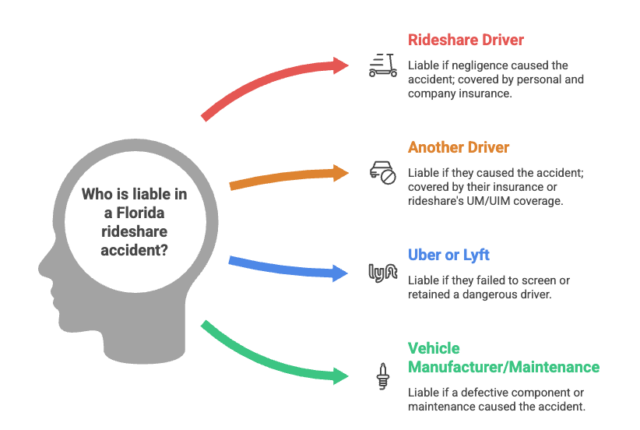
Who Can Be Held Liable in a Florida Rideshare Accident?
Determining liability in a rideshare accident is more complex than in a standard car accident. Multiple parties may share responsibility.
The Rideshare Driver. If the Uber or Lyft driver caused the accident through negligence — speeding, distracted driving, running a red light — they are the primary at-fault party. Their personal insurance (and, depending on app status, the rideshare company’s policy) may cover your damages.
Another Driver. If a third-party driver caused the accident, that driver’s insurance is typically the primary source of compensation. In this scenario, Uber or Lyft’s uninsured/underinsured motorist coverage may also apply if the at-fault driver has insufficient insurance.
Uber or Lyft Directly. While rideshare companies classify their drivers as independent contractors to limit their direct liability, there are circumstances in which you can question whether Uber or Lyft is liable for accidents in Florida. This can occur if the company failed to properly screen a driver with a known history of dangerous driving, or if it retained a driver after receiving complaints about unsafe behavior.
Vehicle Manufacturers or Maintenance Providers. If a defective vehicle component or improper maintenance contributed to the accident, the manufacturer or maintenance provider may also bear liability.
Common Injuries in Florida Rideshare Accidents
According to data from the Florida Department of Highway Safety and Motor Vehicles, nearly 10,000 crashes in Florida involved rideshare drivers in a recent reporting period, with approximately 30% resulting in injuries serious enough to require hospitalization. Common injuries include:
- Traumatic brain injuries (TBI) — ranging from concussions to severe brain damage
- Spinal cord injuries — which can result in partial or complete paralysis
- Broken bones — particularly in the arms, legs, ribs, and pelvis
- Whiplash and soft tissue injuries — often causing chronic pain and limited mobility
- Internal injuries — including organ damage and internal bleeding
- Lacerations and scarring — from broken glass, metal, or airbag deployment
Many of these injuries have long-term or permanent consequences that require ongoing medical treatment, rehabilitation, and lifestyle adjustments. A comprehensive personal injury claim must account for not only your current medical bills but also your future medical needs, lost earning capacity, and the full impact on your quality of life.
What Compensation Can You Recover After a Florida Rideshare Accident?
If you file a successful rideshare accident claim in Florida, you may be entitled to recover the following types of compensation, which are key components of Uber and Lyft accident settlements in Florida.
Economic Damages (tangible financial losses) include all past and future medical expenses, lost wages and income, loss of future earning capacity, property damage, and out-of-pocket expenses related to the accident.
Non-Economic Damages (intangible personal losses) include pain and suffering, emotional distress and mental anguish, loss of enjoyment of life, permanent scarring or disfigurement, and loss of consortium for spouses.
Punitive Damages are available in rare cases involving particularly egregious conduct — such as a rideshare driver who was intoxicated or a rideshare company that knowingly retained a dangerous driver. Punitive damages are designed to punish the wrongdoer and deter similar conduct in the future.
Steps to Take After a Florida Rideshare Accident
Knowing what to do after a car accident in Florida can make a significant difference in the outcome of your claim.
Step 1: Call 911. Report the accident to law enforcement and request medical assistance. An official police report is a critical piece of evidence.
Step 2: Seek Medical Attention Immediately. Even if you feel fine, see a doctor as soon as possible. Some serious injuries — including concussions and internal bleeding — may not produce obvious symptoms right away. Delaying treatment can also give insurance companies grounds to argue your injuries were not caused by the accident. Remember: you must seek treatment within 14 days to preserve your PIP benefits.
Step 3: Document the Scene. If you are physically able, take photographs and videos of the vehicles, the accident scene, road conditions, traffic signs, and any visible injuries. Screenshot the trip details in the Uber or Lyft app, including the driver’s name, vehicle information, and the route.
Step 4: Collect Witness Information. Get the names and contact information of any witnesses. Their accounts can be invaluable in establishing what happened.
Step 5: Report the Accident to the Rideshare Company. Use the Uber or Lyft app to report the accident. However, do not provide a detailed recorded statement to the rideshare company’s insurance adjuster without first consulting an attorney.
Step 6: Contact a Florida Rideshare Accident Attorney. The sooner you speak with an experienced attorney, the better. An attorney can preserve evidence, identify all liable parties, handle communications with insurers, and ensure you start a personal injury claim in Florida correctly and on time.
Mistakes That Can Hurt Your Florida Rideshare Accident Claim
Avoiding these common mistakes in personal injury claims can protect the value of your claim.
- Giving a recorded statement to the insurance company. You are not required to give a recorded statement to the at-fault party’s insurer. These statements are often used to find inconsistencies or admissions that can be used against you.
- Accepting a quick settlement offer. The first settlement offer is almost always far below the true value of your claim. Accepting it means you forfeit your right to seek additional compensation, even if your injuries turn out to be more serious than initially thought.
- Delaying or stopping medical treatment. Gaps in treatment give insurers ammunition to argue your injuries were not serious or were not caused by the accident.
- Posting about the accident on social media. Insurance companies and defense attorneys routinely monitor social media. Even an innocent post can be taken out of context and used to undermine your claim.
- Waiting too long to hire an attorney. The two-year statute of limitations may seem like a long time, but evidence disappears quickly. Contacting an attorney early maximizes your chances of a successful outcome.
Frequently Asked Questions About Florida Rideshare Accident Claims
How long do I have to file a rideshare accident claim in Florida?
For accidents occurring on or after March 24, 2023, you have two years from the date of the accident to file a personal injury lawsuit. For accidents before that date, the previous four-year deadline may apply. Wrongful death claims must be filed within two years of the date of death.
Does the 2-year deadline apply to both Uber and Lyft accidents?
Yes. The two-year statute of limitations applies equally to accidents involving Uber, Lyft, and any other rideshare or Transportation Network Company operating in Florida.
What happens if I miss the filing deadline?
If you fail to file your lawsuit before the statute of limitations expires, the court will almost certainly dismiss your case. You will permanently lose your right to seek compensation through the courts, regardless of how strong your case may be.
Can I still file a claim if I was partially at fault for the accident?
Yes, but your recovery will be reduced. Under Florida’s modified comparative negligence rule (enacted as part of HB 837), you can recover compensation as long as you are 50% or less at fault for the accident. Your total damages will be reduced by your percentage of fault. If you are found to be more than 50% at fault, you cannot recover anything.
Does the deadline apply if I was a passenger in the rideshare vehicle?
Yes. Whether you were a passenger in the Uber or Lyft, a driver of another vehicle, a pedestrian, or a bicyclist, the same two-year statute of limitations applies to your personal injury claim.
What if the rideshare driver was uninsured or underinsured?
If the at-fault driver does not have sufficient insurance to cover your damages, you may be able to make a claim under Uber or Lyft’s uninsured/underinsured motorist (UM/UIM) coverage, or under your own UM/UIM policy if you have one.
Do I need an attorney to file a rideshare accident claim in Florida?
You are not legally required to have an attorney, but it is strongly advisable. Rideshare accident claims involve multiple insurance policies, complex liability questions, and aggressive insurance companies. An experienced attorney can significantly increase the likelihood of a fair settlement and ensure your claim is filed correctly and on time.
How much does it cost to hire a rideshare accident attorney in Florida?
Most Florida personal injury attorneys, including Pencheff & Fraley, handle rideshare accident cases on a contingency fee basis. This means you pay no attorney’s fees unless and until your attorney recovers compensation for you. There is no upfront cost to get legal help.
Why Choose Pencheff & Fraley for Your Florida Rideshare Accident Claim?
At Pencheff & Fraley, we understand how overwhelming the aftermath of a rideshare accident can be. You are dealing with injuries, medical bills, lost income, and an insurance system that is designed to minimize your payout. Our experienced Florida personal injury attorneys are here to level the playing field.
We have a proven track record of recovering significant compensation for rideshare accident victims throughout Florida. Our team will:
- Conduct a thorough investigation of your accident
- Identify all liable parties and applicable insurance policies
- Handle all communications with Uber, Lyft, and their insurers
- Fight aggressively for the full compensation you deserve
- Keep you informed every step of the way
Contact us today for a free, no-obligation consultation. We will review your case, answer your questions, and explain your legal options. Learn how we can help you on the road to recovery. Pay nothing unless we win your case.
Call us at 904-770-4953 or visit our website at www.pencheffandfraley.com to schedule your free case consultation.
We’re Here for You 24/7
We are available 24/7 to take your call. If you are unable to travel, we will come to you. The sooner you call, the stronger your case can be. Your path to maximum compensation and justice starts with a single phone call to Pencheff & Fraley.
Author: Pencheff and Fraley Legal Team
Disclaimer: This article is for informational purposes only and does not constitute legal advice. Every case is unique, and you should consult with a qualified attorney about your specific situation.